
- Music
- 10 Dec 25
Huartan: "We are pagan Ireland, and despite your best efforts, we are still here"








Winners of Hot Press’ inaugural Amhrán na Laoch Irish Language Song Contest in 2024, Huartan have finally unveiled their debut album, which showcases their massive tradtronic sound in all its glory.
Huartan have had a good week. As well as dropping their self-titled debut album, the trio were crowned BBC Introducing NI Artist of the Year – or, as the band themselves refer to it, the ‘Occupied 6 Music Prize’.
That nickname tells you where the Irish-language, pagan-influeneced trio’s politics sit. They were one of several Irish/folk-leaning acts to take home awards on the night.
“It’s no surprise to us that the place these things have continued to be oppressed the most is also where we are starting to see a return swing of the pendulum,” says Stíofán Ó Luachráin, the man in charge of the electronic side of the band’s innovative production, which blends with the sean nós-rooted voices and trad musicianship of Catriona Gribben and Miadhachlughain (Múlú) O’Donnell to create their signature ‘tradtronic’ sound.
After a conversation in the Hawthorn Bar in Belfast, where the members played trad music, the idea of combining electronic and traditional music felt natural.
“They’re both forms of dance music,” Stíofán observes. “Trad music would have once been played for people to dance to. So I always felt there was space there for the two of them to come together.”
The band’s formation itself was shaped in part by misfortune, when Stíofán had his music equipment robbed from his car one evening. Among the thieves’ haul were hard drives containing projects he had been working on.
“That was pretty devastating, but in a weird way, I don’t know if we would be here on this project either if that hadn’t happened,” he reveals. “I decided if I’m gonna be working on music, I’m gonna stop just saving on my laptop because what was that all for? So we decided to start trying to put stuff out as soon as we could.”
Huartan’s look is as distinctive as their sound. You might already recognise their playful reimagination of a mythical, pre-Christian Ireland, complete with ram skull masks, a focus on “síogaí” (fairies) and the natural world. Even the name reaches back into history, with Huartan being an ancient Ogham word meaning the tool associated with the hawthorn tree.
“I guess what we’re trying to do with the aesthetic is reach back to a pre-colonised Ireland,” Stíofán says. “We’re not saying that was some utopia we want to return to, but there are definitely lessons we can learn from those kinds of cultures, particularly in terms of our relationship to nature. To us, it feels like a project of decolonisation.”
They channel the idea of decolonisation in everything they do, including their performance of ancient songs. One of the standout tracks on their album is ‘Caoineadh Eoin Burcach’, which Catriona uncovered while researching for her master’s degree. The song was nearly extinct, despite the gripping story behind it.
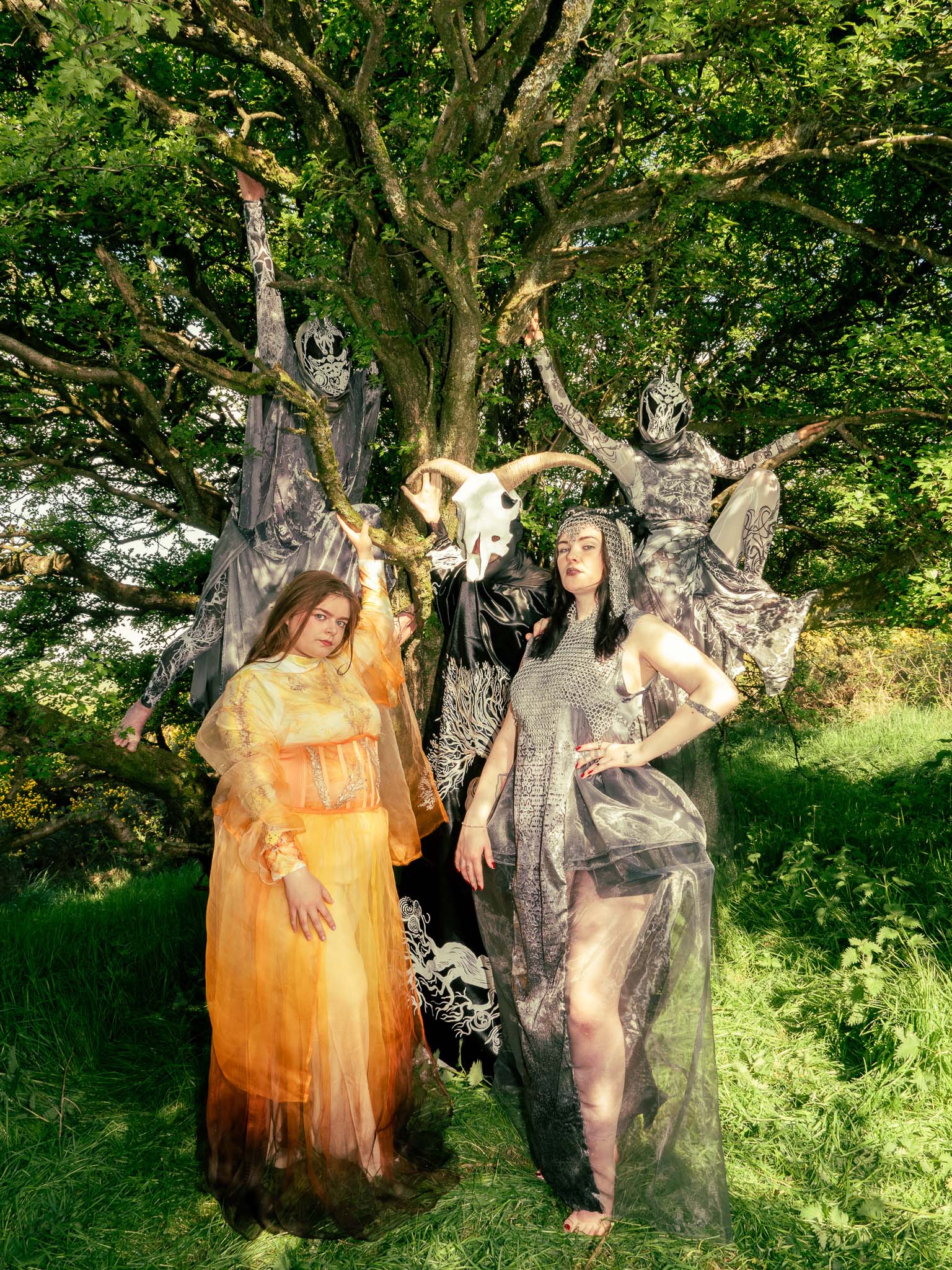 Huartan by Méabh Ní Dhoibhlin.
“It was a pagan belief that poverty-stricken families would get wealth from swapping their tenth child. So the tenth child was of some sort of special, paranormal nature,” she explains. “You would give the goddess of the forest your tenth child, which this family in Ranafast apparently did and became very rich.
“Eoin Burcach was one of the slaves on their farm. He went out to the forest one day and came across this girl, who was afraid of him. And he goes back the next day with bread to win her over. He then brings her clothes and builds her a house and they fall in love.
“He brings the girl back to his master and they realise it’s their daughter and they try to get rid of him by drowning him. Anyway, that’s the whole heavy story before the song, which then starts with the girl saying, ‘How could you kill Eoin Burchach?’”
For Múlú, it reinforces the importance of keeping traditions alive.
“It’s an oral tradition, it’s handed down from generation to generation and if somebody stops doing that one day, then all the music will just cease to exist,” she says. “So it is the duty of traditional musicians and singers to keep the tunes alive.”
Decolonisation manifests in more explicit, raised-fist ways on the record too. ‘Dorn San Aer’ features a searing gaeilge manifesto.
“The tune was written against the backdrop of the first Lá Dearg (Irish language march),” Stíofán explains. “I think there’s around 20,000 people who came out in the streets of Belfast in opposition to the cuts the DUP brought against the language. So it was an inspiring moment for me.
“The first time we performed it in the Cultúrlann, we wanted to use the track to just let people know what we stand for in terms of the politics of the band. The statement is: ‘We are pagan Ireland, and despite your best efforts, we are still here.’ It’s a declaration of war, I guess, against capitalism and systems, rather than individual people.”
Discussions of decolonisation inevitably steer towards Palestine.
“We obviously have been performing mostly in the context of the genocide,” Stíofán begins. “So we use our platform, any time we’ve got a microphone in our hands, to try to steer people towards engaging in solidarity. Any act of decolonisation anywhere is almost a pro-Palestinian act.
“Whilst we should be concerned and campaigning for Palestine, especially when a genocide is ongoing, we also have to recognise that we are still a colonised people. In the North, we’re still a British colony, but in the south as well, there’s a third wave of colonisation by American corporations.
“There’s an American/Canadian company called Dalradian, and the most insulting thing about that is that it’s the name of an ancient Ulster kingdom. They’ve called themselves that, and they’re actually mining for gold in the Sperrins, and it’s going to destroy nature. That to me represents the ongoing colonisation – the extraction of resources that are going to go into foreign pockets at the expense of the land.”
Reaching back to a time before flags and borders means Huartan can celebrate Irish culture on their own terms. Do they see their embrace of pre-Christian Ireland as a means of transcending sectarian divisions that have marked recent history?
“The sectarian issue that exists in the North, it’s a very sad thing,” he says. “We recently did an interview with a guy from a inionist background, and he expressed a feeling that they weren’t able to participate in the Irish language revival, which is a very sad thing, because obviously that isn’t true.
“In terms of the history of the language, it only exists in its form today because of the efforts of Presbyterians down the years. There were then active campaigns to separate working class unionists from the language, music and tradition.
“We’re anti-sectarian, in terms of our politics and what we want to achieve here. I guess we are trying to develop a sense of pride in culture that can be shared and connected with other people.”
“We’re looking at the island of Ireland being a land that you can work with,” adds Caitriona. “The pagan thing connects people to the nature and history that’s in Ireland.”
• Huartan is out now.
RELATED


- Music
- 25 Sep 26
Alex Warren announces shows in Belfast and Dublin

- Music
- 15 Sep 26
Lambrini Girls announce new album and Dublin and Belfast shows
RELATED


- Music
- 01 Sep 26
Dock Street Jazz Club celebrates one year anniversary


- Music
- 17 Aug 26
KNEECAP announce 3Arena show this December

- Music
- 17 Aug 26