
- Opinion
- 06 Jun 26
Séamas O’Reilly: "An awful lot of Northern Irish people have that – there’s an element of not wanting to cause a fuss, or act like it’s a big deal"








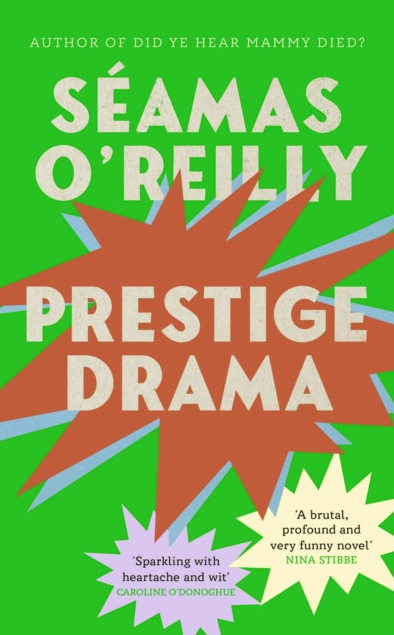
Séamas O’Reilly discusses his brilliant debut novel Prestige Drama, the changing face of social media and interviewing legendary satirist Chris Morris.
Having enjoyed huge acclaim for his moving memoir Did Ye Hear Mammy Died?, Derry writer Séamas O’Reilly is back with his debut novel, Prestige Drama. Mixing the author’s trademark comedic flair with powerful moments of high emotion and tension, the book centres around the making of a US-backed series about the Troubles.
When star Monica Logue goes missing, the production is plunged into all kinds of difficulty. The book features a memorable ensemble cast, including neurotic script-writer Diarmuid, aspiring actors hoping for a part in the series, newspaper editors covering the mystery and plenty more.
Before the story even commences, Prestige Drama features one of the funniest openings of a book I’ve read in ages, with O’Reilly quoting graffiti he once spotted on a Derry bus depot as an epigraph: ‘Remember Barry Sands’. More broadly, given the satirical strain that runs through the novel, I wonder if it was partially inspired by American screen depictions of Ireland?
“It’s definitely part of it,” nods O’Reilly from his London home. “The main things I was trying to examine were memory and grief. It’s also a portrait of people trying to remember something accurately, but also struggling with the idea of the stories we tell ourselves. That could be creating a very worthy and inert, Bafta-winning drama about something that’s really happened. Or it could be a really shlocky, terrible adaptation that gets all the facts wrong.
“But it could also be something where, to help yourself get to sleep at night, you tell a story about what’s happened. That can be from a very political point of view, or it can be from the point of view of just ignoring it. Every time I thought about leaving something in or out, I always came back to, ‘Does it have something to say about memory?’”
O’Reilly teases out the idea further.
“I was definitely driven by the fact that, my whole writing life, I could write about the Troubles and growing up in Derry if I was asked,” he continues. “But if I brought it up too much, it was like, ‘Oh, this again’. It echoed what it was like for me, as an 18-year-old coming down to Dublin, and just noticing that people knew so little about what had gone on in Northern Ireland.
“Also, there was a dismissiveness about it. People were pre-programmed to be sick of hearing about something which, to my mind, was never talked about.”
How much did the Troubles factor in your upbringing?
“I go back and forth on this,” O’Reilly considers. “Because the fact of it is, I had it much easier than even my older siblings, or my Dad. My dad didn’t get the right to vote til he was 30 – my granddad was 60, and he never owned his own house either. So I obviously take all of my whinging with gigantic pinches of salt. For years, that was the way I thought about things.
“My childhood memories are happy and carefree, but there are literally bombs going off. Every single morning my dad listened to BBC Radio Foyle, where you’d just hear a ticker-tape of deaths listed, with the religion of the person afterwards. It was like, ‘Two Catholics were shot, and another man believed to be a Protestant…’ It was a weird score-card thing. For me, that was like the shipping forecast, it was just part of the fabric.”
O’Reilly notes the layered nature of his own story.
“In my teenage years, there was the peace process,” he reflects. “But my three oldest siblings had already been to university by that time, so they’ve never lived in Northern Ireland in peace time. Whenever I’d talk to people from other places, I’d say, ‘I didn’t grow up on the barricades’, so to speak. In the way I approached my childhood, I was always informed by that.
“Even when I wrote my memoir, I went into it like, I don’t want this to seem like I’m stealing valour (laughs). But the crazy thing is when you start investigating this stuff, you realise all the things you didn’t count. For the first 12 years of my life, we went through a checkpoint every single morning. In 1988, when I was three, a bomb went off about 10 or 15 metres from our front door.”
TWITTER THREAD
There was more…
“We lived way out in the sticks, but we were right on the border with Donegal,” says Séamas. “The nearest building to us was this small, pre-fab customs house for the British army. The IRA blew it up, and it deposited an entire wall of the customs house – with the sink attached – in our garden. My mum died just before I turned six, and one of my main surviving memories is being on a bus, and having soldiers take us off because of a bomb scare.
“Compared to the people I grew up around, those are tiny little appetisers,” he adds. “So I suppose I did always underplay it. I think an awful lot of Northern Irish people have that same thing, where there’s an element of not wanting to cause a fuss, or act like it’s a big deal. But then it maybe simmers in us that, perhaps as a consequence, people don’t want to talk about it, or apportion blame – or look into how completely insane it was.”
O’Reilly first came to wide prominence in 2018, when in response to a Twitter thread about people’s worst work experiences, he hilariously recalled the time when, after taking ketamine, he had to serve drinks to President Mary McAleese. His story quickly went viral, and was even recently made into an animated short – starring Chris O’Dowd and Aisling Bea – that’s set to show at New York’s Tribeca Film Festival.
Obviously, Twitter – now X – is a very different platform these days, and I wonder what the author has made of its strange and ugly metamorphosis.
“It’s a good question,” says Seamas. “I owe pretty much everything to that one Twitter thread, really. I think two things. Twitter was extraordinarily fun, I loved it to death and thought it was amazing. Even at the time, in that thread, there’s a reference to it being a Nazi-riddled microblogging platform – that’s in 2018. But it was just a really good space to see funny things.
“I’d say for half a decade at least, it was extremely good for breaking news, disaster and emergency stuff, and you’d have interactions between the world’s most famous people and these absolute shit-posters. And if anyone was weird or racist, I’d just block them, it was fine.
“It was a garden that weeded itself. Obviously, at a certain point, this became much more of the task of being on there.”
Naturally, that marked a shift for the author.
“I haven’t posted anything there for well over a year, because it was dispiriting and depressing,” he says. “Part of it was sort of muscle memory, because it was such a big part of how I digested the rest of the internet. Once the algorithm and ads came in, it was already dead. It probably was by 2018, it just hadn’t been pronounced dead yet. It limped on, and then what Musk has turned it into is just this horror-show.”
UNIQUE IMPACT
I end on a more personal note. I’ve actually known O’Reilly for 20 years, back when he was a student at Trinity College. We first became friends through a shared fandom of legendary satirist Chris Morris, who famously fronted two of the greatest and most groundbreaking comedy shows of the ’90s, The Day Today and Brass Eye.
I wonder what O’Reilly makes of Morris as a cultural figure these days.
“I interviewed Chris Morris last year,” he replies, a notable feat in itself, given Morris’s famously elusive nature. “First person to talk to him in seven years, I believe. I was writing a piece about the broadcasting ban [instigated by Margaret Thatcher to deprive Sinn Fein of publicity], and I may or may not have come up with the idea, basically, because I wanted to speak to Chris Morris. There was the famous Day Today helium sketch, where Steve Coogan plays a fictional Sinn Fein president called Rory O’Connor.
“Someone I know who knew Chris, said, ‘He might talk to you, here’s his email.’ So I emailed him and he was like, ‘I don’t know if I could help you very much, but I’ve got five minutes.’ Forty-five minutes later I was still talking to him about satire and all sorts of stuff.”
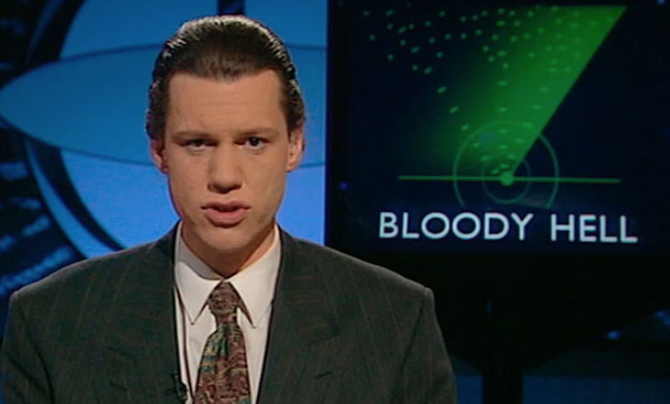
Chris Morris on The Day Today
He elaborates further on Morris’s unique impact.
“I think it’s because of the marriage of what I call smart-stupid,” O’Reilly continues. “I love stupidity and big, broad laughs. But you very quickly realise that, having to do that at the same time as making any sort of a point – or even for it to just work on a structural level – is impossible. Then you go back and watch The Day Today and Brass Eye, and you just marvel. It seems like they did it completely effortlessly.
“I know it was probably more effortful than that, but I also think the brains of those people – Chris Morris, Armando Iannucci and the others – just worked in that mode. They created that style and I think everyone else is still trying to catch up.”
• Prestige Drama is out now.


