
- Opinion
- 04 May 26
Jan Carson: "I want to write with a degree of hope... There’s a lot of potential in the North"








Belfast-based author Jan Carson discusses her brilliant new novel Few And Far Between, which uses the ongoing ecological crisis at Lough Neagh as a metaphor for the issues haunting Northern Ireland.
What landmark do you associate with Northern Ireland? Most will say the Giant’s Causeway. Others might point to the Mourne mountains, or even the peace walls in Belfast, as a concrete reminder of the region’s fraught history.
Few would mention Lough Neagh. For Jan Carson, that’s the point.
“We’ve a number of areas of outstanding beauty in the North and they’re celebrated,” the author says. “Lough Neagh isn’t. That’s an interesting metaphor in regards to the whole of the North, because we’re often a very dismissive kind of people. We have some really great assets, but we tend to not notice them.”
Lough Neagh has been all over the news lately, though not for any reason worth booking a train ticket. The largest lake in Ireland and the UK is choking under a bloom of toxic blue-green algae, causing an ecological disaster.
“A lot of what has been proposed to fix it is not dealing with the cause, it’s dealing with the symptoms,” Carson says. “That’s a really interesting idea for Northern Ireland. A lot of our legislation post-’98 has not been getting to the bedrock of a divided society. Our school system is still segregated, the peace walls are still up. Until you deal with the cause of the division, it’s just sticking band-aids on the surface.”
Lough Neagh is also the setting for Carson’s fourth novel, Few And Far Between, which depicts an archipelago (or Ark, as it’s referred to in the book) on the lake. It sounds like science fiction, but the idea was inspired by UUP MP Terence O’Neill’s plans in 1958 to drain Neagh and make the North’s seventh county.
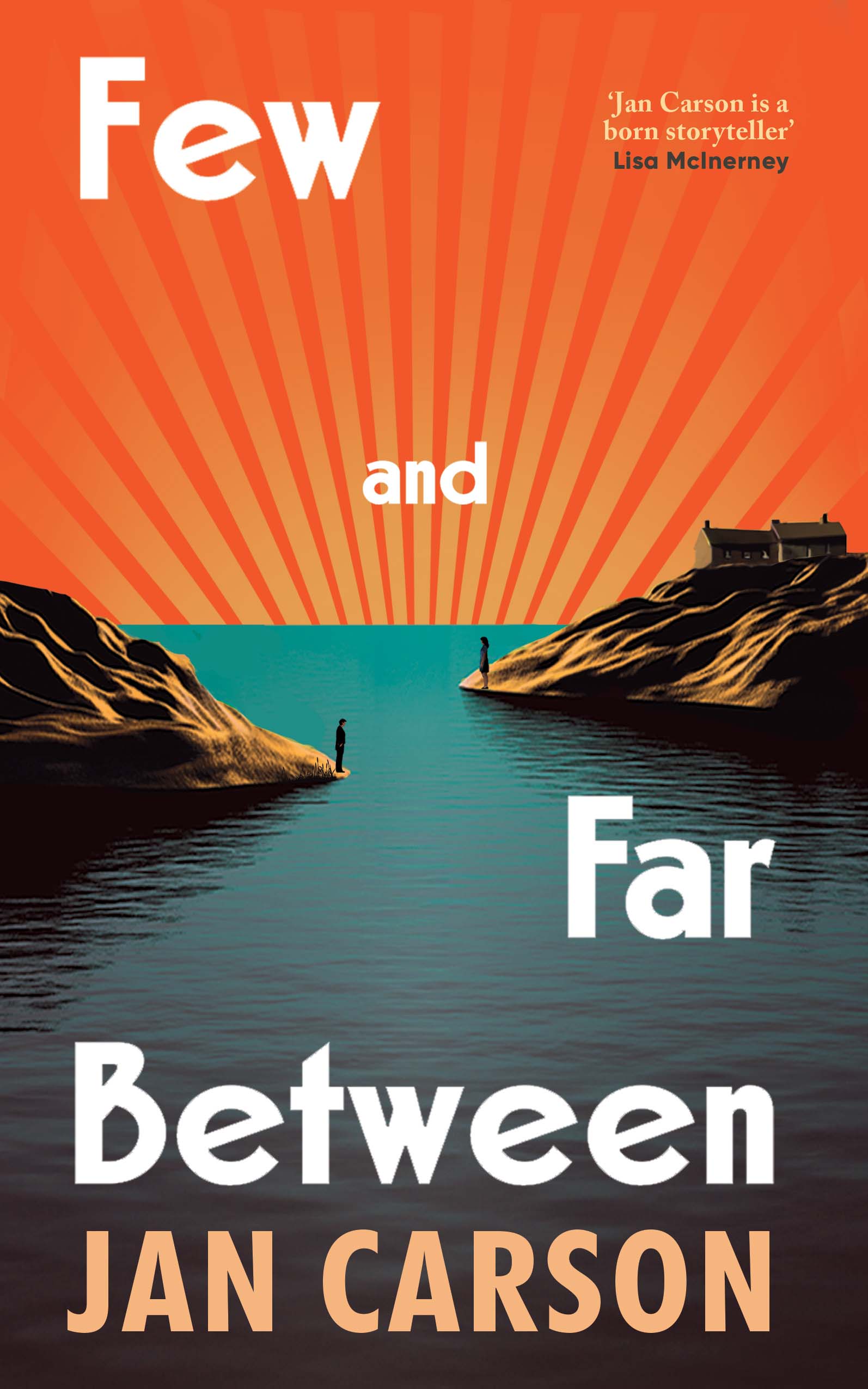
The book’s scattered islands are home to a small community, who face eviction as the government plans to flood the lake in an effort to combat the algae. Once hailed as a secular oasis during the Troubles, being cut off from the rest of the world has left islanders detached from modernity over time.
A little world set apart, the Ark reveals itself as a microcosm of Northern Ireland.
“I grew up in the ’80s in a space that was incredibly inward-looking,” Carson says of her Protestant Evangelical upbringing in Antrim. “There was very little going out and there was very little coming in, so we were convinced the way we did life was the only way to do life. Within that environment, ideas of masculinity are very difficult to challenge, and so are ideas of what the family unit should look like.
“These kinds of repercussions, they are subsidiary of the conflict. I’m blessed that I didn’t lose any family members to the Troubles. But I grew up in a segregated school system in a divided town. I grew up with a culture of fear and division, and to me those are subsidiary issues of the Troubles.”
A group of islands called the ‘Far Side’ imbue these issues with haunting symbolism. There’s an island populated by forgotten, zombie-like figures called the ‘Almost Deads’; as well as another island where people go to kill themselves.
“The Far Side islands exist as different metaphors in my head for issues within Northern Irish culture,” Carson says. “I sometimes think we are stuck in this kind of Bardo. There was a degree of progression that happened with the Good Friday Agreement, but it hasn’t quite gone far enough. Yes, it’s better than what we had before – but it’s still kind of a halfway house limbo we’re in.
“Being in the North now, it’s quite an isolating experience. Post-Brexit we feel very much on the edge of Europe, and there is sometimes a marked lack of interest from the British government.”
SYMPTOMS OF TRAUMA
One of the book’s most striking lines is a statistic: “More people have now died by suicide in Northern Ireland post-Good Friday than during the entire duration of the Troubles.”
“There are so many studies that show that symptoms of trauma are physically exhibited in the bodies of children who didn’t experience the trauma first-hand,” says Carson. “We’re seeing young people take their own lives who didn’t witness the violence. They’re growing up as products of a society where integration hasn’t quite kicked in and funding cuts have taken away provision for services.
“There’s another island full of women who have fallen into a comatose state because of what they’ve witnessed. That’s a real syndrome, it’s been recorded in kids in countries where they’ve come out of a conflict. It’s like they’ve been able to keep going when the violence and terror is an everyday thing, and as soon as they get a chance to relax, their bodies shut down.
“There’s more peace walls in Belfast now than in 1998. Enough work hasn’t been done to make Catholic and Protestant areas feel they would be safe if things integrated. So a lot more work has to be done.”
Like its predecessors, Few And Far Between uses a magic realist lens to explore life in the North. Carson grew up Protestant, but says she identifies as Irish rather than British – so how has writing about the North shaped the way she sees herself, and the place she came from?
“It’s made me more sympathetic,” she says. “I left the North when I was 25, because of the claustrophobia of it and the frustration with some of the things we’ve talked about. I moved to Portland, Oregon for four years. It was great because it introduced me to people who were radically different to the folks I’d grown up with.
“I encountered lots of things that initially made me uncomfortable and then challenged some of my thinking. When I came back to Northern Ireland, I had almost exclusively been writing stories set in the US. I struggled with the first six months. I hated being back, I was very negative about it. Someone said, ‘I think if you write about Northern Ireland, it might help.’
“It was difficult at first, but when you pay the close attention that you need to pay to a place to write about it well, you start to see beautiful things about it. You also start to see the cracks. And when you see those cracks, you have two choices: you can either use it against people, because that’s where they’re weakest, so you can use it to lord it over them; or you can use it to kind of go in and try to hold people together.”
Credit: Polly Garnett
And it matters, in a cynical world, to write with a degree of hope.
“I don’t want to be the kind of person who goes in and exposes the fault line, and mocks it and satirises it, and removes myself from it,” Carson says. “I want to be what I would call a ‘critical friend’. I’m going to write about the stuff that’s difficult and broken, but I want to put myself in the mix.
“I also want to write with a degree of hope. Not offering a Hallmark rainbow solution to everything, but there’s a lot of potential in the North and I’m still really hopeful about it. The thing that gives me most hope is the same as what’s in this book: it’s people, and their tenacity, kindness and sense of community. I wanted to leave readers with that rather than ‘it’s all a disaster.’
“I had a wonderful afternoon where I met with a fantastic chap who’s farming sustainably on the banks of Lough Neagh. I thought he was going to give me utter doom and gloom about the algae, and he was so hopeful. He talked about the goodwill among the farmers and how an ecosystem is a really delicate thing. He can already see aspects of the Lough Neagh ecosystem balancing itself to cope with these new circumstances.
“So I came away from that thinking: it’s still an ecological crisis and we need long-term thinking about the causes rather than the symptoms. But it’s also not as hopeless as I thought it was.”
• Few And Far Between is out now.


