
- Music
- 25 Nov 26
U2’s The Edge: "The darkness thrives in that kind of silence. Right now, people need to speak up."


Punk energy, 21st century gospel, radical joy, feminine power and flamenco-inspired fireworks combine to glorious effect on Carnaval De Luz, the new U2 album which proves that rock ‘n’ roll life begins at 50! “We were looking for music that no one had ever heard from U2 before,” an excited Edge tells Hot Press.
They could easily have leaned in to the nostalgia side of U250 but no, Bono, Edge, Adam and Larry are celebrating their half-century with the release this month of Carnaval De Luz, studio album no. 16, which finds them reapplying yet again for the job of best band in the world. That they’ll have to battle Fontaines D.C. for the crown makes it all the more enticing!
Having already given us the Days Of Ash and Easter Lily EPs in February and April, it means that 25 new U2 songs have gone out into an expectant world this year. That makes it the single most productive year ever for U2 – including 1988, when Rattle & Hum was released.
Just as exciting is the announcement of a 2027 world tour which confirms that Larry has fully recovered from his career-threatening back surgery and is ready to give it hell on stage again.
The excitement in the U2 camp was palpable last month when Hot Press got to spend quality time with the band as they returned to their Mount Temple Comprehensive School birthplace, and then dashed back into town for another top secret gig on the Bewley’s balcony, which brought Grafton Street to an awestruck standstill.
Whatever U2 are on at the moment – we’ll presume it’s adrenaline and dopamine – is definitely working.
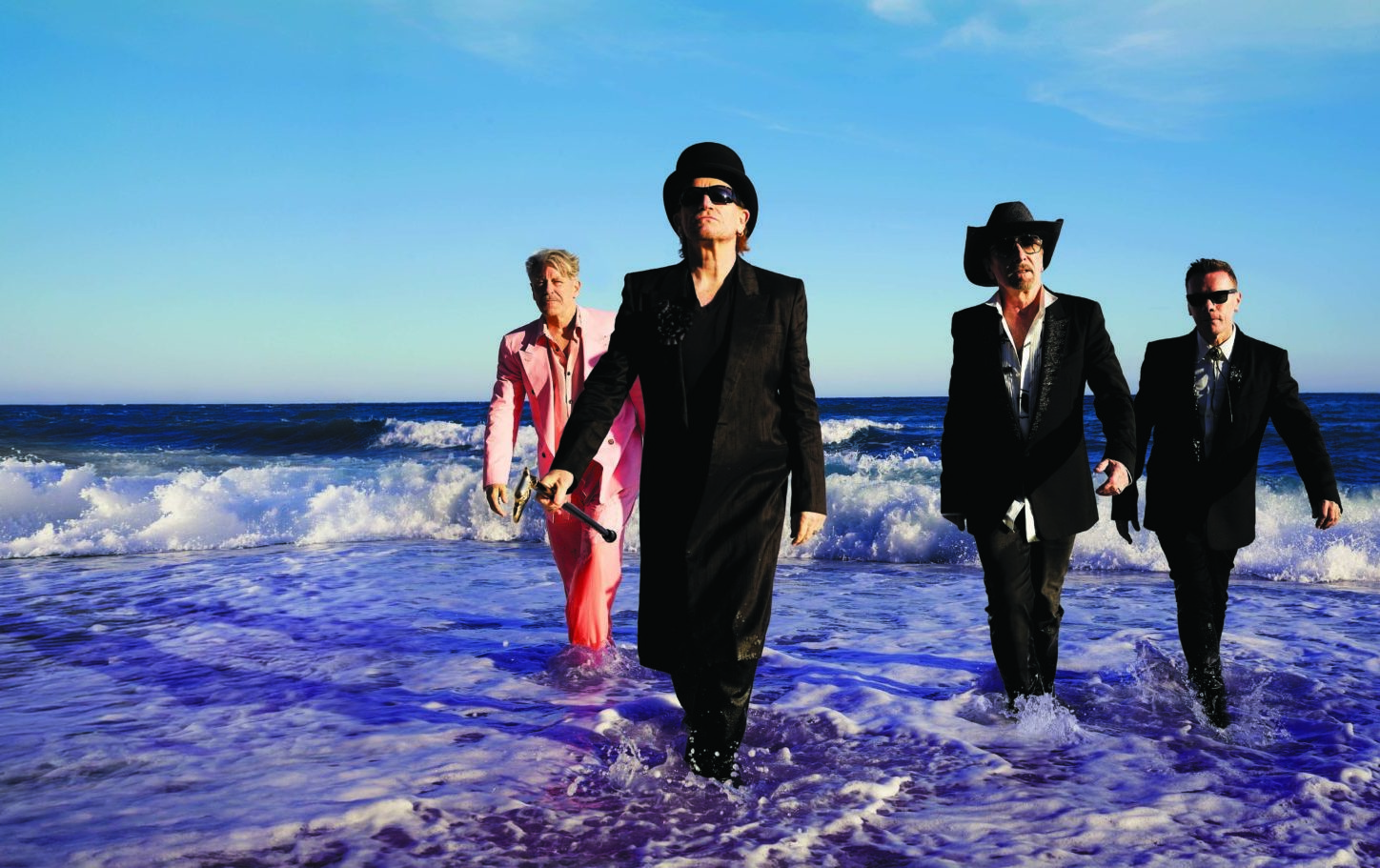
Credit: Viviane Sassen
While Carnaval De Luz nods proudly at the past, there’s also a strong desire to break new ground with the record.
“That was the thing that we were holding onto as we were making the album; two ideas which seem in some ways contradictory,” The Edge tells Hot Press. “One is that we wanted to make music that only U2 could make, so stuff that really spoke about who we were and why we were a unique collaborative proposition. But also, we were looking for music that no one had ever heard from U2 before. So it’s the two things we’re trying to hold in tension.
“It’s certainly the beginning of a new chapter,” he says, suggesting that the band members won’t be hanging up their rock ‘n’ roll boots any time soon.
“That’s what we’re really excited about,” The Edge adds.
The beating heart of the album is the opening ‘Go (Carnaval De Luz)’, which U2 teased out with the help of an old friend.
“In the lead-up to getting formally together to start the album, we went into a phase of songwriting and experimenting and worked with a lot of different people,” The Edge resumes. “One of the sessions was with Brian Eno, and we weren’t necessarily working on stuff for a U2 album. We were just seeing where the music took us, so it was fun. And one of the tracks that came out of that was this really odd piece, which ultimately became ‘Go’.”
In that classic U2 jigsaw songwriting style, it came together in pieces.
REALLY RAW
“It started out really raw, but with all of the spirit of the final track,” the guitar maestro reflects. “Then, as the album started to come into focus, it just presented itself as the opening. We were putting words and lyrics and melodic parts into the track, and it became this kind of throwdown manifesto for us: ‘This is a moment to look for something new. The old ideas are played out. Let’s get on with inventing something that no one has heard before.’
“It’s like, whatever you thought you were going to hear from the next U2 album, you were not expecting this. I think ‘Go’ is definitely music people have never heard from U2 before.”
‘Superficiality’ also follows in the proud tradition of U2 songs that start out as one thing – and then morph into something completely different once everybody starts pitching in with ideas.
“This was based on a demo I worked up and brought to everyone,” Edge explains. “I was super excited about it: sort of U2 does Motown, early Jackson 5. It had a real rhythmic, almost funk-like quality. I was excited about that quality, but I think Jacknife Lee and Larry felt, ‘Well, let’s do what we do.’ So they brought it back to more of a CBGB’s direction. And what was smart about that was that it really supported Bono’s melody.”
This is where the collaborative nature of what the band do comes to the fore. Nothing is finished until they’re all happy that it’s finished.
“It’s a great example of where I have a piece of music that I’m excited about, but it’s actually what the others do with it that ends up being the magic,” The Edge acknowledges. And there’s another aspect to it that was striking during the recent 50th anniversary shows.
“Bono’s voice is amazing,” The Edge observes, with a grin, “and if anything, it’s better than it’s ever been. ‘You and me are breaking news / Because the news can’t break us.’ It’s back to this idea of radical joy. I’m sure a lot of people have had dark times in recent years because of the unrelenting negative information we’re taking in, and it’s understandable. We’re not designed for this. It’s this combination of clickbait and the fact that what drives clickbait is our negative bias. It’s just this unending litany. So, it’s like, can you hold onto positivity and joy in the face of all of this? And I think it’s not just a good idea… it’s essential.”
HAUNTING VIDEO
The collective manner in which U2 work, with everyone leaving their fingerprints on the finished song, is evident again on ‘The Greatest Show On Earth’ – which is accompanied by a powerful, haunting video.
“This took a while and a few rewrites,” Edge admits. “It started out as one of the songs we were working on with Brian Eno, and when we got the band on it, we were like, ‘Wow, this is really getting very exciting.’ But, still, to get it to the place where it is was hard. We knew what we wanted it to be… it didn’t come easy, but I love it.”
As ever, The Edge is analytical about why he feels so positively about a song that could become the new ‘Where The Streets Have No Name’ in their live set.
“I think we made all the right decisions as we went along,” he says. “There were a couple of different lyrical directions that we explored, and a lot of new sections were written and whatever. But it’s funny, that was one where we had it in our minds what we wanted, and we just were relentless and got there in the end.
“Lyrically, it could be read as just a straightforward love song, or as a song bemoaning the end of western civilisation, or the end of a certain sort of movement in organised religion. I think what we’re dealing with right now, particularly in America, is fundamentalist religion in all sorts of guises. Which is so antithetical to the idea of spiritual reflection.”
Joining that distinguished list of U2 collaborators is Dutch DJ and producer Martin Garrix – with fascinating results.
21ST CENTURY GOSPEL
“‘Glorify’ was a tune that initially Bono and Martin started, and then I got involved, and then we thought it could make a good U2 song, so we brought it to the guys and we worked it up,” Edge resumes. “It’s a kind of 21st century gospel song, and Bono sings it so beautifully. It’s perfect for his voice. There’s going to be, I think, another version at some point. Martin might even have it in mind, possibly for his album.”
It received an early live outing in the band’s acclaimed Las Vegas residency.
“It was one of the earliest songs that we finished, so we actually teased it in the Sphere shows. We’d walk off stage to a version of ‘Glorify’. I think it’s going to be a big song in our lives.”
Politically, U2 have sharpened their claws again with Bono making global headlines last month when he compared the Israeli Minister of National Security, Itamar Ben-Gvir, to Himmler.
“There are people in Gaza who are not worthy of life,” Ben-Givr – a man who has made a misssion out of genocide – had declared. “They shouldn’t live. They’re not even people.”
“There’s a guy, a minister in the government, and he’s not being locked up,” an appalled Bono told Rolling Stone. “So many of the people that have expanded my mind, changed my consciousness, made me laugh, broken my heart with their songs, lifted my spirits, are Jewish. And this guy’s putting their religion in the shade. It’s just outrageous.”
Bono had previously expressed that outrage on ‘The Tears Of Things’, one of the Days Of Ash stand-outs, which views human brutality, historical atrocities and religious violence through the horrified eyes of Michaelangelo.
It’s a subject he returns to again with vigour on Carnaval De Luz’s ‘If The World Is At War We Better Not Be’.
“Bono really led the charge on that one,” Edge notes. “He had this lyric in his head, and so Jacknife, with a little help from me, put the track together for the vocal. There’s a book that I’ve been holding onto a lot, from years ago, called People Of The Lie by psychiatrist M. Scott Peck, and it’s referenced in ‘American Obituary’. It’s an attempt to try and put some sort of clinical definition on the idea of evil. Because it does exist. We’re seeing it right now. We’re seeing it in the world, and not just in individuals. It infects institutions, it infects nations, and it is a spirit – but it is also a kind of psychological malaise, and in this song, Bono is calling it out.
“It’s a pivotal piece on the album. Right now is one of those times where we really have to pull together. It’s kind of a looking forward/looking back moment, being our 50th anniversary, and remembering the early days of Mount Temple.”
ORIGIN STORY
Which, of course, is so central to the U2 origin story.
“Obviously high school is pivotal on so many levels,” The Edge says, “but for us it’s the high school where we met the people that were going to have such an important part in our lives.
“For Bono, it’s even more so because he met Ali there as well. So, as 16-year-olds, even in our wildest dreams, we couldn’t have imagined where this was all going to take us. But it was all there.”
Subscribing to Leonard Cohen’s credo that “There is a crack in everything, that’s how the light gets in”, U2 offer up some divine hope on the wonderfully exuberant ‘Street Of Dreams’.
“To us it’s emblematic of the theme of the album,” Edge proffers. “Even though lyrically it starts off with a cry for help – ‘God hear me shout / Lend your ear to my prayer’ – the song itself is very joyful. I think the album takes account of where we are right now in this moment in history, in geopolitics, but doesn’t surrender to the negativity and the despair. It reaches for joy, not as a distraction, but as a reaction, an act of defiance, almost.
“The essence of ‘Street of Dreams’ is that it’s literally answering the question: ‘If you look this dark spirit in the face, are you still able to choose joy? And if you do, is it defiant?’ That’s what we’re trying to get across in this song.”
It’s a pivotal track in more ways than one. Because if it hadn’t clicked – if the mood had turned sour – then we might not have a new U2 album to listen to at all.
VERY EVOCATIVE
“‘Street Of Dreams’ was one of the first tracks that we cut together,” The Edge recalls. “So it was really exciting to be in the room with everyone and playing some new music for the first time in a few years. I think ‘calle de los sueños’ was the first Spanish phrase that we put into a song on the album, and to us it’s more than decoration. The Spanish language has a power that is very evocative. To us, it’s liberation theology, it’s revolution, it’s freedom of a certain type.”
In one of the best two-for-one deals you’re likely to get this year, ‘Street Of Dreams’ also gave birth to ‘Midnight Sunshine’.
“It often happens with U2,” Edge laughs. “We call it ‘cell division’, where you’ll start with a song like ‘Lady With The Spinning Head’ on Achtung Baby, which ended up as a B-side, but it split into ‘Ultraviolet (Light My Way)’, ‘The Fly’ and ‘Zoo Station’. We ended up, from this one song, getting these three other songs.
“So, ‘Midnight Sunshine’ developed from some vocal ideas for ‘Street Of Dreams’, and then we kind of pushed it more into an early Talking Heads flavour. It’s so uplifting.”
As ever with U2’s music, there is no one source. They tend to be fans of the rock ‘n’ roll smorgasbord.
“Maybe the Velvets might have been part of the inspiration,” The Edge adds. “I think of ‘Sunday Morning’, some of their melodic ideas. They were not afraid of naïve melodies, not afraid to be very accessible. I think it’s a good thing for us. It’s always worked for us when we just unashamedly go for a beautiful melody.”
The longest gestation period of any of the Carnaval De Luz tracks is the nine years it’s taken U2 to nail ‘Silencio’.
“It’s an outtake from Songs Of Experience,” Edge reveals. “There was a demo of it, but as a very different idea. I dug it out and said, ‘I think we need something like this.’ So, we started working with the riff, and it came together very quickly.
“The theme is different forms of silence, because that’s what we’re dealing with at the moment. There’s a good silence – the silence of nature, of contemplation. But then there’s the bad silence of, ‘You better shut your mouth because if you say anything, you’re gonna be in trouble.’ That’s the silence where ‘the devil rock and rolls’. The darkness thrives in that kind of silence. Right now, people need to speak up.
“It was a lot of fun to record,” he continues, “and the punk energy is great. Sometimes you might spend a lot of time on a track, and you’re very proud of where it got to, but this was one that seemed to just kind of fall out of the sky.”
Demonstrating that U2 still have their finger on the popular culture pulse is ‘The Mirror Maker (Rosalía)’, a tribute to Rosalía Vila Tobella that’s almost as hot-blooded as the Spanish singer herself.
“Rosalía is just so incredible, bringing as she does so many different new forms into contemporary music, which I always think is when it gets really interesting and enriched,” Edge enthuses. “She’s bringing flamenco, she’s bringing opera, she’s bringing in all these other disciplines.”
POWER OF IMAGINATION
Along with Rosalía, the track also doffs its cap to some of Edge’s six-string heroes of yore.
“In the spirit of, ‘Let’s put the guitar in the spotlight again’, this song went through various iterations. It was always a kind of major guitar song, but we ended up going with the acoustic guitar for the beginning, because it felt like we needed to build, and if we started at ‘10’, there was nowhere to go.”
There’s an unashamed ‘60s flavour to this one too.
“Y’know, I love Pete Townshend, I love simple chord figures on guitar. I think The Kinks did it so brilliantly as well. This was a nod in that sort of direction of songwriting, but using the guitar like its own orchestra, with dynamic shifts and stabbing chord entries.
“It’s this idea of creative power and the power of imagination, and we do need to think about things in a different way,” Edge passionately adds. “We have got to the end of something. I really think people feel that, and I do myself, but that doesn’t mean it’s a moment for despair. It’s actually a moment to be awake to new things, to be awake to where this could go.
“So, the mirror is this portal. Can we move through that mirror to the other side?”
That is, of course, the 60 million dollar question. Or in the era of the tech oligarchs, perhaps we need to change that to 60 billion dollars.
The amps also get turned up on ‘La Reina’ – it translates as ‘The Queen’ and just happens to be the Ballon d’Or Féminin 2026 winner Alexia Putellas’ nickname – which is almost a companion piece to ‘The Mirror Maker (Rosalía)’.
“The clarion call of guitar was definitely one of the things that I was excited about for this record,” Edge says, “and ‘La Reina’ had that quality as a piece of music, it’s a great tune. It also has the stomp beat which we’ve never played with before.
“Actually, the journey to get to that final version was quite a roundabout one because my very first guitar riff – the thing that actually got the song going – it turned out that it wasn’t good enough. So, towards the end of the process, I was like, ‘OK, I’ve got to actually reimagine this piece of music. There’s a song there, but is there a riff there?’ Normally it’s the other way around with us. We have the music nailed down, then we’re sort of looking for the song.
GREAT PROCESS
“There’s a lot of music on this record which I would have started, and then brought to the band, and not really known necessarily where that was going to go. It could have meant it never got looked at or it could have meant that it became something completely different, or y’know, stayed fairly close to the idea I came in with. So, it’s a great process, but you definitely have to learn to kind of take your hands off the steering wheel. To put a lot of trust in your bandmates and allow the inspiration to guide you, and the music to kind of tell you, ‘OK, that was cool. That had something, but this is really interesting’.
“Anyway, it all came together so fast in the end. This celebration of the Queen of the Carnaval seemed like an obvious place to go. The great aspect of the ritual is that it’s a woman who’s taken, most often, from a regular working family. It’s not somebody who’s got status necessarily in society. They’re elevated to this symbolic role, so that was inspiring to us. It’s not a new theme for U2. ‘Mysterious Ways’ speaks of it. It’s feminine power.”
With the 50th anniversary of Larry sticking the notice on the school noticeboard having just passed, you have to hand it to U2: they’ve stayed married to one another for a total of 150 years (or something like that). If you’re wondering how they have managed to survive for all that time without any major implosions, ‘Can’t Stop Us’ provides some of the answers.
“Within the band, even though our circumstances have changed so much, the relationships have survived,” Edge ventures. “We got to know each other before we could play. I knew Bono before he could sing and watched him become a singer, as he watched me become a guitarist. So, that’s rare, to fully understand each other’s strengths and weaknesses, and accept them both.
“Friendship is not a warm, fuzzy type of thing for us. It’s tough and it’s real. We know that together we are so much more potent than we would be as individuals, and that sense of cooperation and reliance on each other is an important thing to be able to showcase.”
So what about the song?
“This is another one that started out from those early Eno improvisations, but grew completely into this real essential U2 track. But you’ll hear Eno’s keyboards throughout, which is a great texture to have in a U2 song. We were doing quite a lot of harmony singing, and that led us then to using vocoders, and other ways to create that wall of sound of voices. It was a new road to go down for us. I mean, we’ve always done harmonies, but not really in a kind of block-harmony way, like the Beach Boys. It was fun. I think we’ll do more of it.”
So, we’ve U2’s Pet Sounds to look forward to! Carnaval De Luz ends on a bittersweet high with ‘Torn’, which – in one of her last studio performances – features Dolly Parton, who was initially resistant to U2’s overtures.
ICONIC CHARACTER
“We knew we wanted to try and do something with Dolly, and myself and Bono had written a bunch of songs for another project with Ed Sheeran and Johnny McDaid from Snow Patrol,” Edge concludes with a smile. “But she wasn’t biting. She said that she thought some of them were a bit ‘too Irish’ for her. So she sent us something that she’d started, and we adapted it and changed it. Bono and Johnny went off and got a finished lyric together. We sent it back and she loved it, and she agreed to sing on it. And boy, did she deliver a vocal. It’s an astonishing bit of singing on that track.
“Dolly was one of those iconic characters not just in American culture, but in global culture. We’ve had the good fortune to be able to work with a lot of iconic singers in the past, and we just thought, this is a moment. Let’s grab this chance.
“Danny Lanois played beautiful pedal steel on top of it. We have Brian, so it’s lovely to have Danny represented on the album as well.”
They have, of course, done that country and western thing before. The Edge smiles…
“‘Torn’ is reminiscent of the end of Zooropa,” he says, “where Johnny Cash sings ‘The Wanderer’. A kind of unusual twist at the end of the record.”
• Carnaval de Luz is out now.
RELATED


- Music
- 16 Nov 26
Becoming U2: "There was a story here that needed to be told"

- Music
- 13 Nov 26
Album Review: U2, Carnaval de Luz
RELATED

- Music
- 28 Oct 26
U2 announce special London concert for BBC


- Opinion
- 11 Oct 26
U2 at 50: "What a long, strange trip it’s been. For all of us..."


- Opinion
- 30 Sep 26