
- Opinion
- 11 Oct 26
U2 at 50: "What a long, strange trip it’s been. For all of us..."








There was huge joy to be savoured as Adam, Bono, Larry and The Edge celebrated the 50th Anniversary of the formation of the band that would become U2 in Dublin, with two free gigs. To have a ringside view was an enormous privilege. But even while the carnival – for the carnaval – reigned in the world’s greatest music city in the world, it was impossible to get the appalling carnage elsewhere out of our collective heads.
“I will sing, sing a new song,” the crowd sings, and then. “How long to sing this song? How long to sing this song?”
It is a familiar moment of departure. The crowd is sounding almost rapturous. “How long to sing this song?” The drummer is on his own now – and then he stops. The crowd continues. “How long to sing this song?”
I look up and down Grafton Street, in the heart of Dublin city. On the balcony above the entrance to Bewley’s Cafe, the four musicians have already made their exit. There is a sense of quiet joy. We have just witnessed something very special. Without any advance warning, the once and future biggest band in the world have just played what amounted to a festival set of their greatest hits to an adoring Dublin audience of Christ knows how many thousands.
Some people are beginning to shuffle for the exits. Others are standing their ground, still soaking it all in. On a rooftop across the street, fifteen minutes previously, up to ten revellers had danced and cheered, on occasion getting perilously close to the edge. “Imagine if one of them fell,” I said to the Brazilian woman beside me. She shook her head with a horrified grimace. It wasn’t very hard to imagine at all. But the untoward had not happened, and now we knew that it wouldn’t.
There had been people in the windows of one of the taller buildings, men and women who gyrated and moved together, gloriously oblivious to the fact that they could be clearly seen from below. The silhouettes had faded to nothing since, their moment in the upside down spotlight over. The street was still crowded, as citizens tried to move in both directions at once. But space was gradually opening up. I reconnected with my compadre, who had battled to a better vantage point to get some images on his mobile phone.
He led me up South Anne Street to Dolce Sicily, where he bought a couple of cakes. It was the end of a long day and time, he reasoned, for a small self-indulgence. Food was needed. But most of all sleep...
PERIOD OF IMMENSE CHANGE
The morning before the night after. First there was a coin to be launched by the Central Bank. “That’s their gig not ours,” one of the U2 insiders had explained the previous day. Only an official photographer would be allowed. Larry Mullen and Paul McGuinness did the honours for the band, in the Little Museum of Dublin. This was a day for solidarity. But it was also a measure of just how far the band had travelled together.
Anniversaries have a way of creeping up on you, slowly – and then suddenly. It was fifty years exactly since the first get-together of the musicians that would become Feedback, then The Hype and finally U2. I’ve been doing a lot of thinking about all of that recently, editing and hammering into shape the origin tale of the book Becoming U2, by Brian O’Connell.
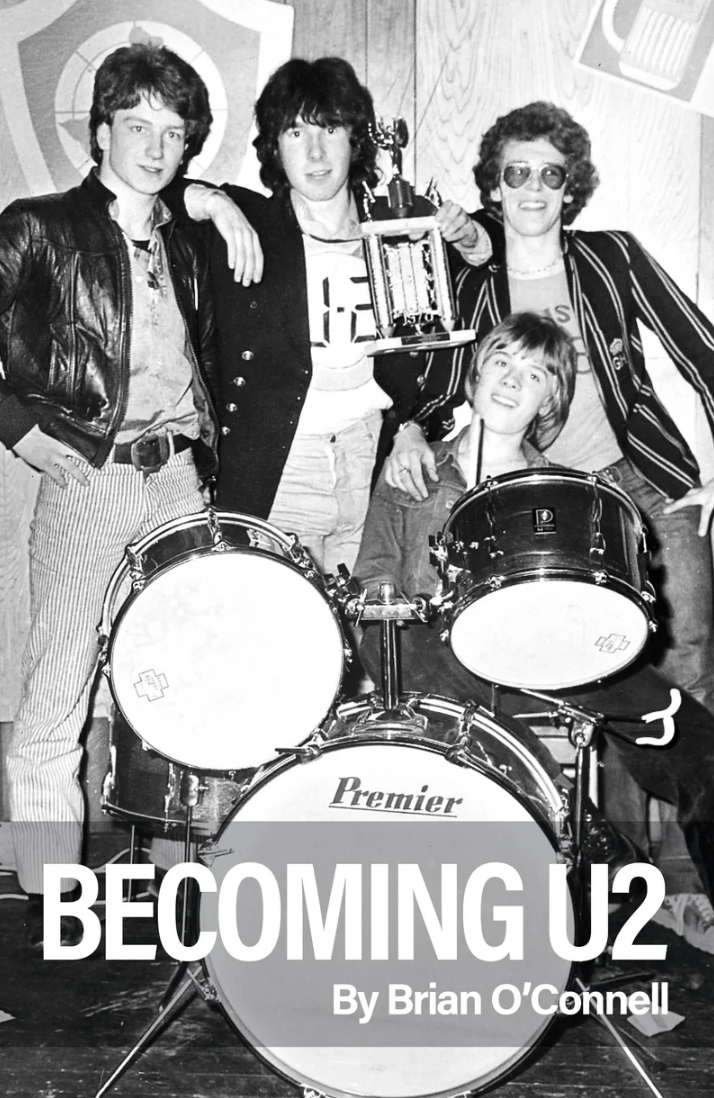
It is a fantastic yarn that focusses on the Pop Group ’78 competition, which Adam, Bono, Larry and The Edge won, as part of Limerick Civic Week. That was all of 18 months after the first gathering in Artane, and yet the boys in the band were still happy to grin widely and admit that they couldn’t really play at that stage.
And yet they won, stealing the show – and the prize money – from under the noses of numerous far more professional and musically proficient outfits.
How had it come to this, that guys who could render a complicated Steely Dan song note-perfect had been outdone by a bunch of punk upstarts who weren’t even half punky enough for real punk rockers? It was an outrage! That’s what it was – or so they say, in all sorts of different ways, in the book...
What was the mood like on the night? And what did the defeated musicians themselves feel, all of 48 years later, now that the usurpers had shown that, well, maybe they did have something going for them after all? What about the organisers? Would they feel vindicated – or just a lot less embarrassed? And what had the band’s relationship with Limerick been like in the long years afterwards? Could it be true that they had played Munster’s second city just once since the Big Win – and that the gig turned into a bit of a disaster?
All of this is teased out brilliantly in Becoming U2, which is very funny as well as immensely informative and full of unique insights. But the book also delves into the build-up, highlighting the forward steps that the four lads had been enthusiastically making, and painting a vivid picture of the wider cultural and musical scene in Ireland at the beginning of a period of immense change.
There isn’t, of course, even the slightest chance that anyone who convened informally at that first rehearsal could have had any inkling that four among their multitude would end up with their legend adorning a €2 coin five decades later. But here we are. There is a coin and it tinkles.
JUMPING AND POGOING
From The Little Museum, it was but a short stroll to where a couple of buses were parked, awaiting the arrival of a school of media operatives – fine men and women one and all! – who were scheduled to go to… a school. The buses took the airport road, before cutting East, along Collins Avenue. A short ride back towards town on the Malahide Road and the crowds jostling on the roadside signalled that we had arrived.
There were enough Gardaí in attendance to handle a minor insurrection. They weren’t needed. The bus people showed their wrist-bands and were ushered in and told to follow the man with his arm in the air.
It was like being back at school – which it was, of course, for the outfit that would soon clang out the intro to whatever was to be the chosen opening salvo. I took a call, pre-arranged, from BBC Radio 4, as the band went through their final pre-gig rituals in an area that was doubling as back-stage. Even mere minutes in advance of the off, sworn to secrecy, I couldn’t say that we were in the yard of Mount Temple Comprehensive school – where just over 50 years ago, Larry Mullen had pinned a message on the school noticeboard looking for musicians to form a band – as the first sounds of real music began to float on the afternoon breeze from the make-shift stage at the far end of the playground.
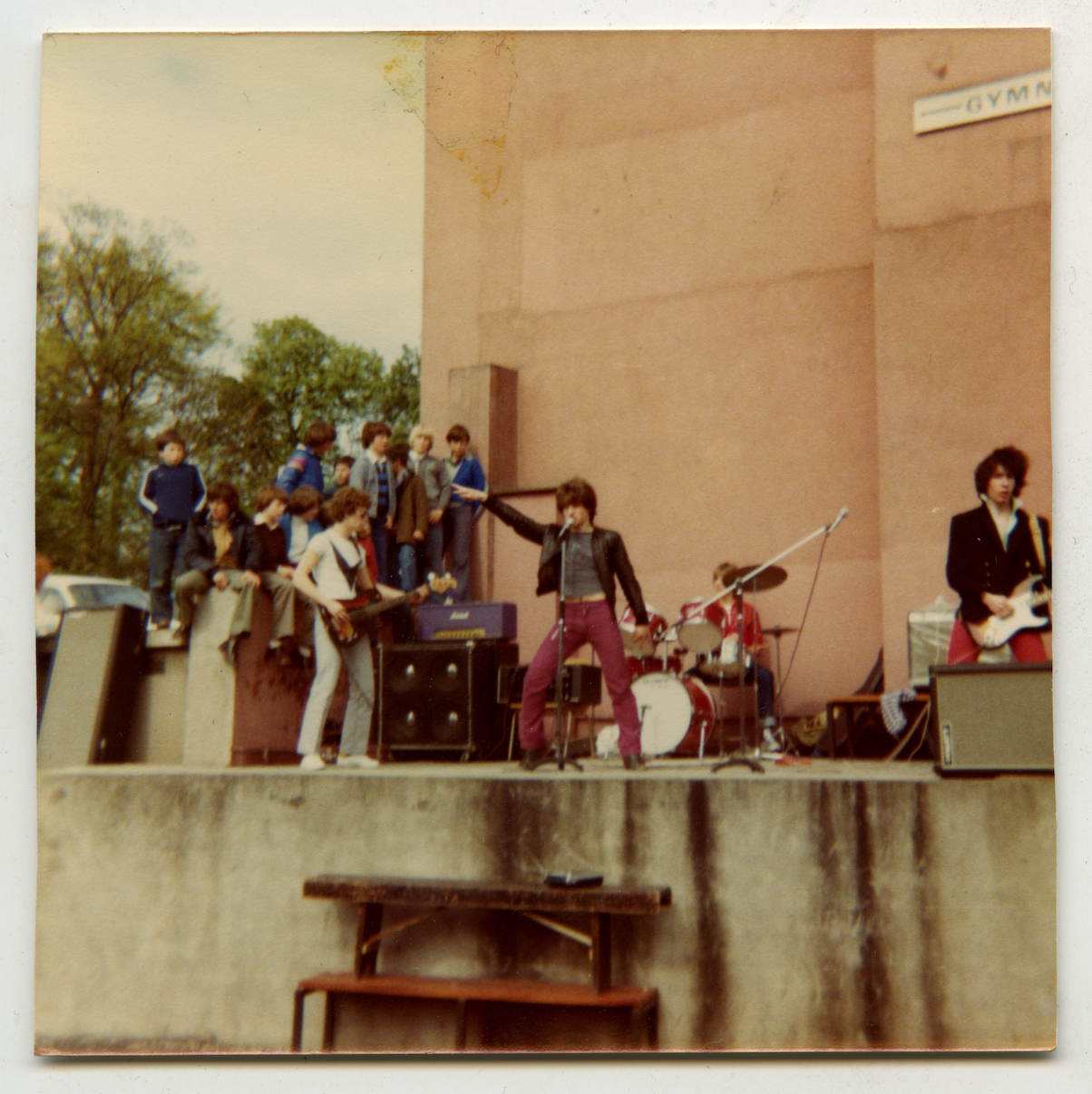
U2 in 1977 - Performing at Mount Temple - Credit: U2
All around me, faces familiar from a few dozen media outlets grinned. Phones were held aloft to capture snatches of the music. And what an opening it was, a blistering ‘I Will Follow’ – from U2’s debut album Boy – setting the tone. That was followed by ‘Vertigo’ and the gorgeous ‘Beautiful Day’ (which veered briefly into Elbow’s ‘One Day Like This’), before they rekindled long-ago emotions that had swept us off our feet then, and did again, with ‘Out Of Control’. It was the lead track on their debut EP, U2 Three and here – remarkably – it got the biggest response of all from the 1,000-or-so students getting a welcome Friday afternoon breather from their studies, with the gang of 2026 jumping and pogoing to beat the band. Well, in a manner of speaking.
History lesson over, it was into ‘Silencio’, the band’s latest single from their upcoming album Carnaval de Luz, given its live debut on this historic day. Finally they played ‘One’, with a mini-orchestra of 32 string instrumentalists (one from every county on the island of Ireland) from Music Generation – a programme for schools that was inspired, and has been generously funded, by the band, making both instruments and lessons in music available free to thousands of children all over the country. An encore of ‘With Or Without You’ came with a palpable sense of relief on the side. Everything had gone smoothly. It was a special occasion. The kids had risen to it. So had the band.
Friends and familiar faces from down all the days stopped, hugged, grinned and exchanged reassuring words. That was something, wasn’t it? And it was only right and proper. The boys had honoured the place of not so much their birth as their marriage. And here they were 50 years later, still not looking for a divorce! Take a bow, Adam, Bono, Larry, The Edge. Take a second bow. Annd a third and a fourth.
EMOTIONAL IMPACT
In a packed McGonagle’s – it had been thus renamed for the day – the Universal Music crew had some videos to show. For many in the audience, it was their first introduction to tracks from Carnaval de Luz and – after Universal Ireland CEO Mark Crossingham kicked things off – some of the visiting honchos from the UK and the US offered scene-setting introductions to the four chosen video-ready tracks. It was an intriguing ‘first look’, with the Dolly Parton duet ‘Torn’ emerging as an early front-runner for the “biggest track on the record” title. And then it was off to Grafton Street for a different kind of shindig, involving the odd, unintentional dig in the shins, as everyone battled for the best spot in the make-believe house.
If Mount Temple had been special, this was different class. The sound was better for a start, however they managed that in a narrow street and from a tiny balcony. But it was also as if they had found their sea legs, launching into ‘I Will Follow’ to a wild expression of collective recognition and driving on with another epic version of ‘Out Of Control’.
Whoever shaped the set got it exactly right. I hadn’t expected ‘I Still Haven’t Found What I’m Looking For’, and I was reminded of the wonderful sense of openness and adventure – but also doubt – expressed in the song. The Dublin-ness of it all was highlighted by a singalong rendition of ‘Molly Malone’ before the slow-quick-slow triumvirate of ‘With Or Without You’, ’Silencio’ and the divine ‘All I Want Is You’.
Bono spoke lovingly then of the great, lately departed Irish bard, Glen Hansard and The Edge stepped up to deliver a fine version of ‘Falling Slowly’. If ever U2 are looking for a new singer, well, they have their man already.
The dancing in the windows – and occasionally heart-stopping antics on the roofs – began again for ‘Beautiful Day’, after its immediately evocative, plucked guitar intro. And even wilder shapes were thrown for ‘Vertigo’, which really is an outstanding slice of gloriously unapologetic rock ’n’ roll.
When it was done the boys on the balcony made to escape, but they were never going to get away that easily. There were calls for ‘One More Tune’ and they duly obliged, reverting to the early days with the long-standing tropes fashioned around ‘40’ from the War album. I thought back to the fevered, celebratory gig the band did in Phoenix Park racecourse in 1983 and the extraordinary emotional impact of the crowd singing this same refrain for maybe five minutes after the band had headed backstage.
All those gigs. All those years. 50 of them now. And I recalled the old nugget with a grin of my own: what a long, strange trip it’s been. For all of us...
335 BULLET HOLES
Meanwhile there is a different world still happening to us out there.
I was wondering recently: how much has the utterly immoral Israeli campaign of genocide in Gaza cost, including the complete destruction of houses, hospitals, schools, businesses and infrastructure there, and the poisoning of the land so that crops cannot be grown?
What, then, also about the lives lost, the people left without an arm or a leg, the relentless trauma heaped on two million people over a sustained three-year period? What amount of money might make recompense for that massive ongoing act of grotesque, wholly unjustified, deliberately punitive, murderous violence against the people of Palestine?
Every day, new evidence emerges of the outrageous scale of Israeli depravity. Eyal Weizmann is an Israeli-born British architect, who is Jewish. The Professor of Spatial and Visual Cultures at Goldsmiths, University of London, he is a Doctor of Forensic Architecture, and the pre-eminent expert in what is a new field of scientific analysis. He knows what he is talking about.
He has just published a book about Gaza. It is titled Undergrounding: The Architecture of Genocide.
His Jewishness opely declared, Weizmann is absolutely clear that Israel has embarked on a campaign of genocide, which extends to the complete destruction of the entire strip, in a way that will leaves no trace of what had been there before. He talks about Israel using bombs that are specifically designed to destroy what is below the surface – and then on the surface they use bulldozers to do the rest.
The aim, he explains, is not just the destruction of the city. They are also destroying the traces of the destruction. And the result is the complete desertification of this small, but vitally historic country.
He quotes Avraham Zarbiv, a rabbinical Israeli court judge turned enthusiastic bulldozer merchant, who boasts that Palestinians “will be returning to nowhere… if they return, they will not know where their home is. All they will find is sand.”
The book is an utterly shocking and absolutely irrefutable account of a genocide that has in fact been going on since the 1940s, but has now accelerated to previously unimaginable levels.
It is the minute detail that reveals Israeli countless lies for what they are. Forensic Architecture examined the size and angles of 335 bullet holes in the car in which five year-old Hind Rajab – the subject of Macklemore’s ‘Hind’s Hall’ – and six other members of her family were brutally shot dead. Hind Rajab was alone for three hours in the car, surrounded by dead bodies before she too was shot, along with the two paramedics who had come to take her from the car.

Hind Rajab
FA calculated, from audio of the time between the bullets being fired, and from their impact, that the tank from which Hind Rajab was shot was close enough for the crew to know they were shooting a child.
Similarly incontrovertible evidence is provided on the massacre, carried out by the Israeli army in Rafah, in March 2025, of 15 aid workers, who were in separate ambulances and a fire brigade, all clearly marked.
“I was a Jewish person in Palestine,” Eyal Weizmann says – deliberately using the name to include the post-1948 state of Israel – and “it is my emotional and my professional duty to work for the liberation of this place.”
DAY OF RECKONING
The United Nations, the European Union and the World Bank have together estimated that it will require $71.4 billion over a 10 year period to cover what’s necessary for relief, debris clearance, reconstruction and ongoing economic losses. That figure does not include anything for redress, compensation or punishment for flagrant crimes of grossly excessive ongoing, multi-pronged sadistic violence.
What, also, about the ongoing theft of land in the West Bank, and the impact that is having on an entire community? The stolen water? The murders? What about the businesses shut, some of them permanently? So far this year, 76 Palestinians – including 18 children – have been killed in the West Bank by the Israeli murder machine (aka the IDF) or by violent settlers. 3,800 Palestinians, almost half of them children, have been directly displaced as a result of settler violence, demolitions and evictions. Many of these attacks have been overseen and supported by the Israeli army. 355 children are currently being held in ‘administrative detention’ – which basically equates to being held hostage – by Israel, in appalling conditions where mistreatment and abuse are widespread.
“We need to end this evil system imposed on us,” Riyad Mansour, Permanent Observer of the State of Palestine told the UN recently. “Through the theft of our financial resources to the attack against our institutions, Israel is seeking the collapse of the Palestinian Authority in the hope that this would precipitate the transfer of Palestinians outside of Palestine.” Throughout the Occupied Palestinian Territory, annexation is under way, he pointed out. Palestinians are now confined to 30 per cent of the Gaza Strip, 40 per cent of the West Bank and 13 per cent of East Jerusalem.
But Palestine is just the start of it.
Whole areas of Lebanon have been destroyed. Land has been stolen there too. A million people have been displaced, forced to flee, leaving their entire earthly belongings behind them. Hundreds of people have been butchered. This campaign is also ongoing. Would five billion cover it? That’s not much more than double the cost of building a children’s hospital in Ireland. Make it $10 billion.
And then there is Iran. In a vast country, home to 80 million people, it is hard to know where to start. Already, estimates of the military cost to the US alone had reached $43.6 billion by the middle of September. But the real figure is probably far more accurately reflected in the supplemental funding package of $70 billion demanded by the Defence Secretary Pete Hegseth for the war this year, and the $454 billion he wants added for the budget in 2027, which will bring military spending to almost $1.5 trillion.
I know, the monstrous, criminal waste of it beggars belief.
Throw in the $17.5 billion spent by Israel in the first 40 days of the war – a figure which has likely doubled almost six months later – and we’re surely up to a minimum of $70 billion spent by the attackers alone to date.
In addition, there has been massive damage inflicted on and in Iran. Given the scale and volume of the munitions used by the US and Israel against the regime in Tehran, it is hard to imagine that the damage is less than that caused in Gaza, though the latter is clearly far more concentrated. Let’s be conservative and say $50 billion. But Iran – in response, it has to be said, to all-out attacks by Israel and the United States – has inflicted its own level of carnage on the Gulf States as well as on Israel and other targets, including numerous ships.
It is hard to begin to estimate the cost of this, not least because it is something that no one in Donald Trump’s confederacy of dunces really wants to acknowledge. But a figure of $10 billion can’t be too far off the mark.
Between the two wars of choice, embarked on by the US and Israel – who have successfully dictated the terms to Trump’s clowns – we’re talking in the region of €200 billion. And that’s before there is any consideration of the wider economic impact. In fact, current estimates produced by experts in Harvard University indicate that the Iran war is costing US taxpayers $2 billion a day – and that the cost will escalate to at least $1 trillion. But if could be a lot more. George W. Bush’s war in Iraq cost a whopping $5 trillion.
Add to that the amount that ordinary citizens are paying in increased prices for just about everything and the size of the bill becomes too vast to contemplate. All because Benjamin Netanyahu wanted to avoid jail.
For now, that is enough to contemplate. I will say no more, except that a day of reckoning should eventually come. And someone will have to pay the bill...


