
- Music
- 16 Jul 26
Jimmy MacCarthy: "I'm not in the business of defaming anybody at this stage. But over 40 years… That's a long time to stay quiet, isn't it?"








After a decade out of the spotlight, Jimmy MacCarthy is back – with a run of sold-out shows in October, and plans to re-release two of his classic ‘90s albums. During a visit to Hot Press, the revered songwriter reflects on an extraordinary journey through life and music, and reveals the stories behind some of Ireland’s most beloved songs, including ‘Ride On’ and ‘No Frontiers’.
“Am I 30 minutes early, or 30 years late?”
Jimmy MacCarthy poses that philosophical question, with an energy both impish and meditative, in the doorway of the Hot Press offices. The 73-year-old songwriter is, in fact, 30 minutes early for our interview – but he’s right on the second count too. After more than half-a-century immersed in Irish music, and over three decades on from the release of his debut album, The Song of the Singing Horseman, he is here to finally tell his own story, on his own terms.
It’s been a long time coming for fans too. Few songwriters, you could argue, have embedded themselves so indelibly into Irish life, while remaining so enigmatic, as Jimmy MacCarthy.
His compositions have shaped the Irish songbook – soundtracking childhoods, relationships, weddings, funerals, and taking on the status of quasi-national anthems. They’ve not only been brought to the world stage by legends and superstars like Christy Moore, Mary Black, Mary Coughlan, The Corrs and Westlife, but have also helped power those artists’ international careers – and continue to be heard in local pubs and stadiums alike, belted out by the likes of Coldplay and Paolo Nutini. Whether performed on The Late Late Show or MTV Unplugged, Grafton Street or Croke Park, the impact remains just as powerful.
To this day, ‘Ride On’ remains Christy Moore’s most-streamed track, with around 20 million listens on Spotify alone. Mary Black has clocked up just shy of that figure on the same streaming service, across ‘No Frontiers’, ‘Bright Blue Rose’ and ‘Katie’ – all penned by MacCarthy.
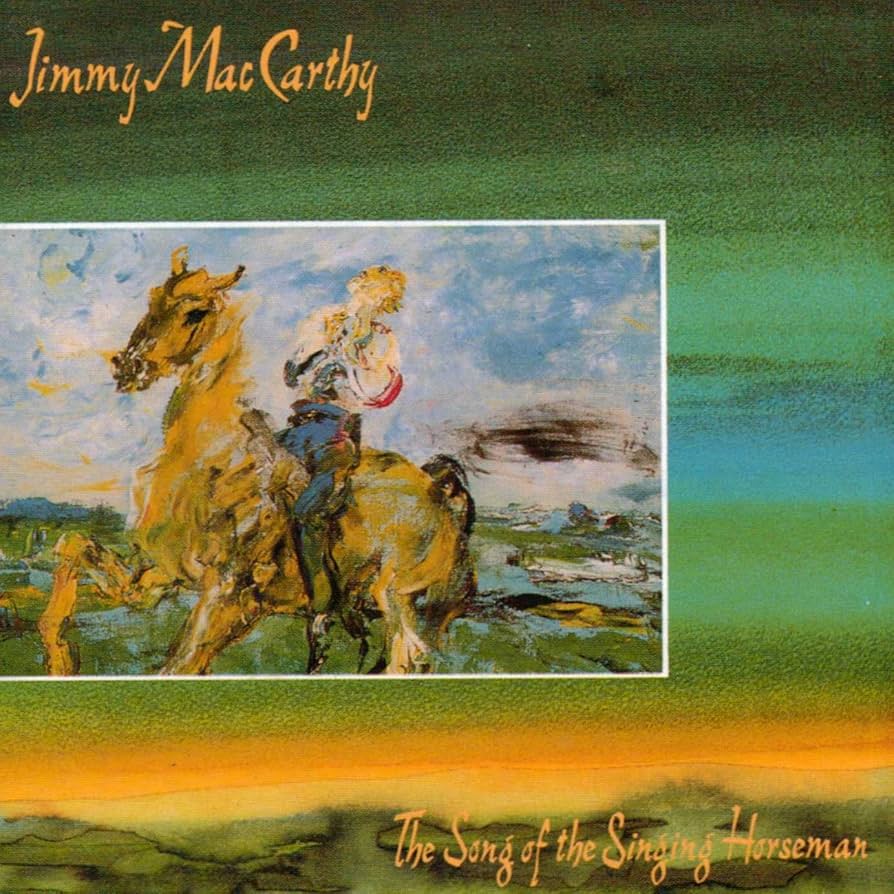
Many of those songs he has also recorded himself, across his albums The Song of the Singing Horseman (1991), The Dreamer (1994), The Moment (2002), and Hey-Ho Believe (2010).
But until now, the Cork-reared songwriter has, for the most part, revealed very little about the remarkable stories and experiences behind those classic compositions.
“I’m not in the business of defaming anybody at this stage,” he tells me at one point in our conversation. “But over 40 years… That’s a long time to stay quiet, isn’t it?”
There have been many reasons Jimmy has avoided clear-cut explanations of his songs over the years, and has maintained a somewhat inscrutable persona.
“A lot of it’s my own fault,” he remarks. “I’ve stayed very hidden. I’m very shy in many ways.”
Jimmy, who has been sober for 43 years, has been open about his mental health struggles in the past, including his experiences with anxiety and depression. At the time of our interview, he hasn’t performed onstage in a decade. He tells me that he “withdrew from the music world, and from the world in general” – instead focusing his time on renovating period homes in Co. Kilkenny and Co. Wicklow.
There are aspects of his personal life – and his unique struggles – about which he cannot speak, as events take their circuitous route towards a kind of completion. But now, after several years spent in what he carefully describes as “catatonia”, he has emerged with a fresh creative drive and vision.
“I’ve never been so happy in my life,” he reflects. “I work out five times a week. I’m as fit as a fiddle. I’m singing better than I ever sang, and I’m engaged in the music that I, to an extent, left behind, 10 years ago. And I’m writing good. I’m really flying. I couldn’t be better spiritually, mentally, psychologically – in every way.”
This rejuvenated state has also led him back to live performances. After getting into the swing of things again with an intimate four-night residency at The White Horse in Ballincollig, Co. Cork, he’s now gearing up for a run of sold-out shows in both the National Concert Hall and Cork Opera House in October.
This autumn will also see him re-release The Song of the Singing Horseman – with additional plans in place to unveil a reworked version of The Dreamer in 2027.
Sitting down now, he reflects on a life and career that didn’t always follow a straight line – yet still managed to spawn some of the most treasured songs in the history of this country.
To this day, he remains a firm believer in one of his father’s classic phrases: “There’s no such thing as chance, Jim, but order unknown…”
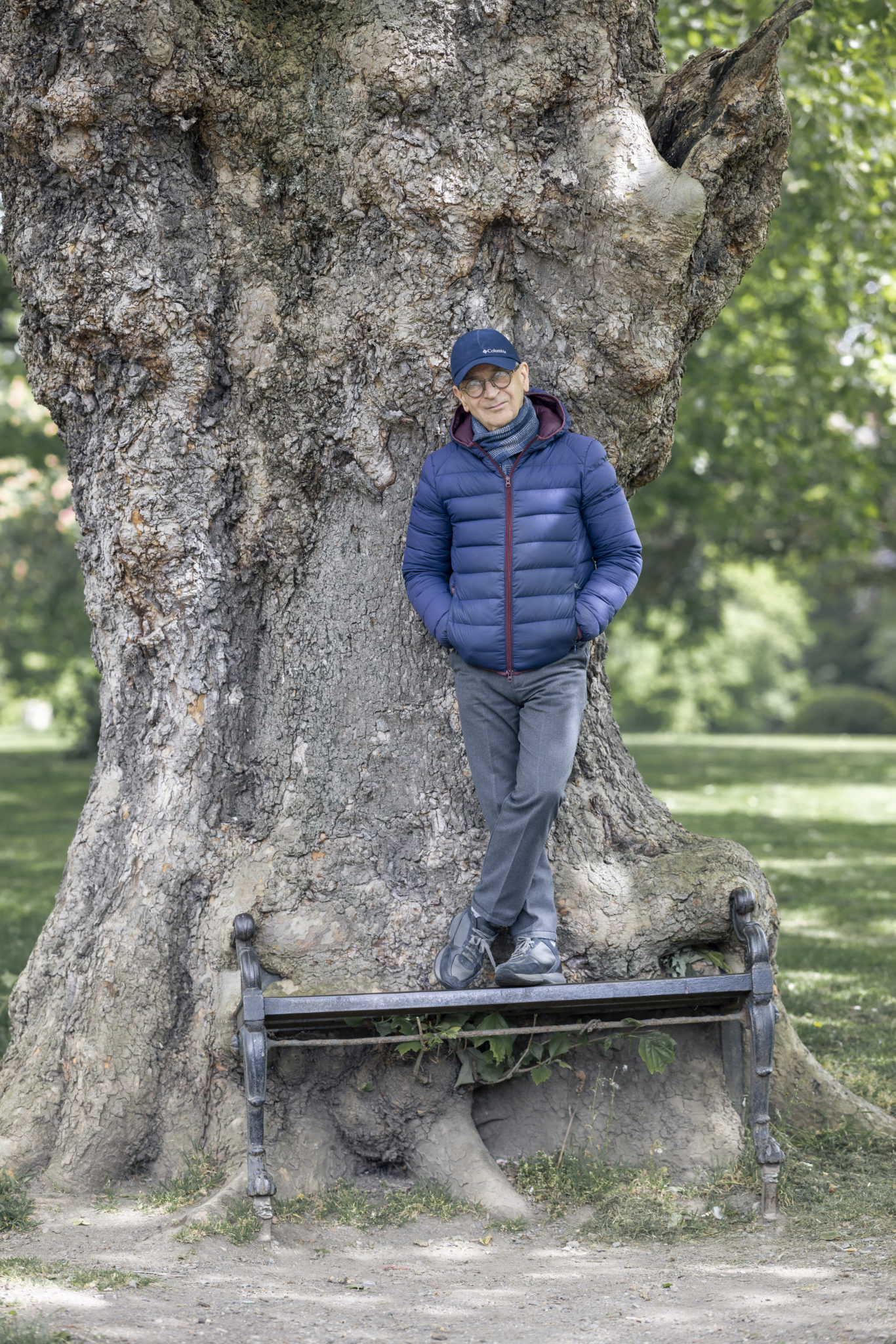
Credit: Cat Gundry-Beck
Did you enjoy growing up in Cork?
JM: I loved my childhood. When I was a child, my father bought me the smallest pony in Ireland – he went to the zoo to get it – because he was worried I’d get hurt. I played at being a cowboy, at being in the army jumping team. Where we grew up is all houses now, but when I was a child, it was all country.
You’ve said your father had great turns of phrase – clearly you didn’t lick it off the road.
He used to say things like, ‘Little things make perfection, and perfection is no little thing.’ He was an unusual man, my father. A very hands-on, can-do kind of person.
Once, he brought a JCB onto the bit of land out the front of our house, and dug a big hole. We didn’t know what was going on. But the night before Christmas, he pulled up the venetian blinds and said, ‘Happy Christmas, lads. We have a swimming pool!’ By that summer, we were swimming every day.
What about your mother?
The art, I got from my mother. She was a very creative person – a gifted amateur painter, and potter. She was a great inspiration to me. Art was a big thing in our house. My mother had all the books of all the great artists strewn all around the house, and I was always drawn to that.
If you ever come out of Cork Airport, there’s a big eight-and-a-half foot bronze statue of [legendary hurler] Christy Ring – and my brother, Seán MacCarthy, is the sculptor.
When did you discover your love of music?
We used to be driven some mornings to school in a Daimler Jaguar. Other mornings, we would be driven in the back of a Transit van – so you never got above your station, really! But the Daimler Jaguar had a state-of-the-art radio.
I remember one day we were late for school. It was five past nine, the news was over, and they played a song that was just released that day – which was ‘Penny Lane’ by The Beatles. I turned up the volume. And then the piccolo trumpet came in, and I thought, ‘Mother of God, I’ve just gone to heaven.’ I got my first guitar when I was about nine. I learned to sing songs like ‘The Streets of Laredo’ and ‘Liverpool Lou’ – all three chords.
But when The Beatles happened, my world exploded.
Does listening to music still have that kind of impact on you?
Bob Dylan, Leonard Cohen and Randy Newman – they’re my top three, with a little bit of Tom Waits thrown in. [Cohen’s] ‘Alexandra Leaving’, from Ten New Songs, has recently become my most favourite song. I looked back into it again, and it overwhelmed me for three days. That lost love – it just went into my soul so deeply.
I still love ‘Penny Lane’ and ‘The Long and Winding Road’ and lots of the early McCartney stuff. I hated everything from Wings on – I really, really couldn’t bear it. Because I loved The Beatles so much.
What about contemporary Irish songwriters?
Dermot Kennedy has some very interesting lyrics. “Once we were giants” – that’s a great angle. It’s right up my alley, in fact.
And Bono… Even though I don’t think that it addressed the Gaza problem, in terms of calling the Israelis out, ‘The Tears of Things’ [from 2026’s Days of Ash EP] is, in my book, the best piece of lyric-writing he ever did. The metaphor is too gentle for the subject, but apart from that, it’s a beautiful bit of writing.
Were you gigging much in your own teenage days?
Me and my brother Dan had a garage band. Our first gig was at the Legion of Mary down on Grand Parade. Half a crown, and tea and cakes, was our pay.
Me and Dan used to go around Cork, going to things. I remember Rory Gallagher came back from playing the Cream tour, and on a Sunday afternoon, he played in a place called The Shambles. It was the first burger joint in Cork – I’ve never tasted anything like those burgers since. And on a tiny little stage there, the original Taste played. And the volume… I couldn’t hear for three days afterwards. The excitement of Rory Gallagher playing was an extraordinary thing.
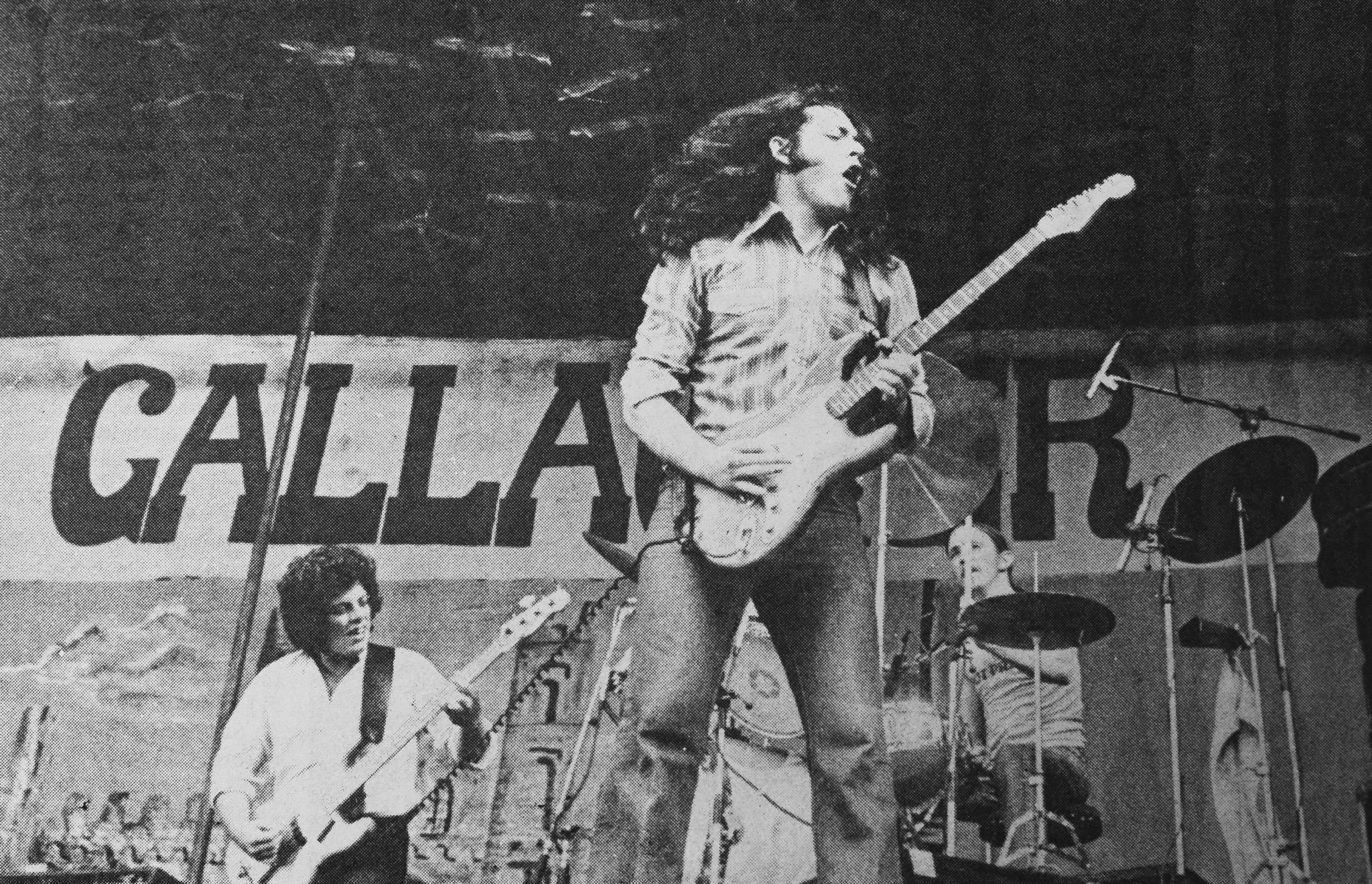
Rory Gallagher at Macroom, 1977
Horses were also a big part of your life from an early age.
When I was 16 years of age, I went to Vincent O’Brien’s racing stables, the best in the world at the time. My father had spoiled me, and I paid no attention to what I was told to do in school. But when I went into racing stables, it was like joining the army. I became disciplined, and it was the best thing that ever happened to me.
But I had a very bad accident. A filly reared up and fell back on me, and kept rolling over my leg, and crushed it several times. I was in traction for about five or six months. When I got back on the horse again, I decided, ‘Well, I can ride and I’m still light. I’m going to go to Newmarket [in Suffolk, England] and get a job there.’ So I went to a small racing stable in Newmarket, and I rode a few races on the flat.
What brought you back to Ireland?
By the time I got into my stride, my dad got sick. Maybe I wanted to come back anyway. I enjoyed England and I enjoyed Newmarket. But it was the time of the Troubles, and there were guys picking on me, because the bombings had started. They wanted to fight me down behind the paddocks. It hung on me a little bit: ‘You’re Irish, so you’re IRA.’ It was not easy.
So when my dad got sick, I came back and worked for him in his transport business.
But my mother and myself couldn’t cope with running the business – we didn’t know how. So we closed the business, and had to sell the family home. My mother and my six younger brothers – I’m the second oldest of 12 – moved down to a rented farmhouse.
My father wasn’t good for a long time. I remember the first time he came out of hospital, to see where we had rented, he said, ‘Jesus, Jim. We’ll all freeze in here!’ And he was right!
But they fixed the place up. They struggled, but I learned that they were more than I thought they were – because they were the same, and better, than they were when they had everything. And after eight massive coronaries, my father gave us another 26 years.
Did you reconnect with music during that time back home?
I had two options. One was to ride horses for peanuts, and the other was to play in bars, for £5 for a night – which was good money in those days. I started to write songs after about a year and so, and more and more that developed into a thing.
You opened up for some big names in those early days.
The first people I opened up for were Planxty, when they had just happened. I was in a duo called Huntermac – Owen Hunter O’Brien and Jimmy MacCarthy, very original!
A guy called Bomber was our manager, and he was a chancer. One day he said, ‘I've got a gig for you. It's out the window of a boutique down in Academy Street.’ I said, ‘I'm not playing in the window of a boutique!’ So, a week later he came back: ‘I have two big gigs for you – opening for Planxty in the Savoy, Limerick, and the Savoy, Cork.’ We thought that was fantastic – how did he do that?
But we arrived in Limerick, only to see a poster: ‘Support Act: Barry Moore’. We went in and Barry was there, saying, ‘What are you doing here? I’m the opening act!’ And then Christy Moore walked by. He said, ‘Let them play half the gig with Barry, and pay them.’ And that was the same for Limerick and Cork, even though we were never booked. Bomber was completely chancing his arm!
I also opened for Horslips many times. The Flying Burrito Brothers. Budgie, who were a heavy metal band, in the RDS. Chris Rea. And the McGarrigle Sisters, who were fantastic.
Your first serious band was Southpaw, with Declan Sinnott.
Declan was a huge influence on me. He knew all about Americana, and he loved Robbie Robertson and The Band. We did some gigs as a duo together, and then we formed Southpaw. We made a couple of nice recordings that were played on the radio, and we were on TV a couple of times. In those days, if you made a bit of noise, you could get seen.
By the time Southpaw ended, I had just written ‘Ride On’ – and I knew it was a landmark.
Tell us about ‘Ride On’.
I used to go to anti-nuclear meetings, and in 1979, the band and I played in Carnsore Point, on the site of the proposed nuclear station. I met a girl. She was a Trinity graduate, and she was very bright. We got on like a house on fire, and we became an item.
Later on, she told me that she was a member of an organisation that was Marxist-Leninist. They were a collection of university graduates, and a large smattering of highly politicised working-class people. They were all very bright, and very idealistic. But that Red Brigades idea I had a problem with.
The IRA, and offshoots of that, were born out of partition, and we all understood that. You’d have to be stupid not to. But imported models like the Red Brigades [an Italian militant group] we did not need.
I had prescience, with regard to this. I was having strange dreams – and I wrote ‘Ride On’. And when ‘81 came, what I had feared about this organisation became a reality, with the shooting in Trinity College.
[On March 24 of that year, British businessman Geoffrey Armstrong was shot in the legs while delivering a guest lecture in Trinity. The three masked gunmen reportedly told the lecture theatre: ‘This is a protest on behalf of the H-Block prisoners.’]
Once this shooting had happened – I knew she wasn’t personally involved in anything extreme, but she was part of this organisation. So I parted – and therefore ‘I could never go with you, no matter how I wanted to.’
What were the next steps after Southpaw?
I was making demos with [producer and engineer] Philip Begley, as the Jimmy MacCarthy Band, and I took the demos to Seamus O’Neill from Mulligan Records. And he put me in the studio to make a single.
But it was the time of the Stardust fire, and there were things in the song that echoed that: running, fire, glass, steel. So he said, ‘We won’t do that. What about the demo you made of ‘Miles of Eyes’?’
And it was a turntable hit. It was played for three years on all the local stations. It was my calling card for a while.
I actually wrote ‘Miles of Eyes’ in London. There was a heatwave – I mean, unbearable. I was living in a squat down on Old Brompton Road. It had these high walls, with several blocks inside in it – it was actually for people with rare tropical diseases during the time of the empire. And we opened it as a squat.
Do you have good memories of that time?
It was very exciting, but we were under pressure. There was a crowd then called the National Front. They were fascist, right-wing thugs, and they used to beat people up. They broke into our squat and wrote things on my wall – which was in an old double-room of a hospital, with a mattress on the floor.
I wrote ‘Miles of Eyes’ sitting on that mattress. I imagined going back to a more natural place and time – sitting under an ash tree somewhere in West Cork, with the sound of lapping water, and a cool breeze blowing. Because, Jesus – the heat inside in that building was unbelievable.
Was ‘Missing You’ – a song about the alcoholism and homelessness experienced by many Irish emigrants in London – inspired by what you saw over there?
I witnessed ‘Missing You’ while living in a squat down on Arlington Road [in Camden]. You’d see the casualties. You’d recognise them 20 paces away – you’d recognise they were Irish, and that they were drunk. They came over to earn big money, and with big money came big drinking. And with big drinking eventually came destitution. I saw them everywhere, and I found it heartbreaking. Not being able to go home – that was a huge part of it.
You’ve been open about your own struggles with alcoholism in the past.
I’m nearly 43 years sober now. My father was in the fellowship before me, and he became exemplary when he went on a programme. As I did myself. But it was wild drinking when I was younger. It was a different world, when I was in my 20s. It was much more rock and roll in the early days!
Songs like ‘Bright Blue Rose’ – which you would’ve written shortly after becoming sober – also reflect a deeply spiritual side.
I stayed schtum about ‘Bright Blue Rose’, because when I wrote it, you couldn’t mention the word ‘Jesus’ without people jumping on top of you.
But when I wrote of Jesus, I didn’t write of him as a deity – which I never believed he was. I believe he was the son of a carpenter and Mary. But he was a profound and beautiful individual, who was a mystic and a philosopher, and gave something to the world that lasted 2,000 years – and with it, gave salvation, of a type, to billions and billions of people.
The song is about the excesses of our earthly existence, leading on to a more spiritual way. There are characters in the song. There’s a desolate and desperate young man ‘on the banks of an urban morning’ – that’s me. I had just given up the drink, and the stuff that ran with that. But the core of the song is alchemy – the ability to turn base metal metal to gold, or turn a base life to a precious one. And I think it’s my best melody.
Have the melodies always come naturally to you?
They say songwriting is my work, but melody has never been work. It’s just easy. I stand in front of a lyric with a guitar or by a piano, and I put the first melody down – and the first melody that I heard will be the last one you’ll hear on a record. But I have a fascination with the elasticity of language – and what you can say in so many different ways. That has been my obsession.
You’ve said that you scrapped the first album you recorded – a pop record – while living in Switzerland.
I threw it in the bin. Not that it wasn’t good. But it was plastic, and I wanted a better foundation. If I started with a plastic foundation, I would have a plastic career.
My writing had become more resonant. I started working with De Danann, and I toured America with them. And I was listening to Christy a bit – and I realised there was something more real there.
Was it your time in Switzerland that inspired ‘No Frontiers’?
I used to walk over the border on foot from Basel into Saint-Louis. I was coming back one day over the border, and the Swiss guard said, ‘Where are your papers?’ And I looked up and there was a sign that said: ‘Frontiers’. And as I walked on, I thought, ‘No Frontiers.’ I thought of my mother, and then I thought of my father.
On March 25, 1962, the Sunday Independent did an article on my mother called ‘Cork’s Flying Housewife’. My mother was taken up at an air show in Ballincollig for two shillings and sixpence – you flew over Cork for six or seven minutes, and you were dropped down to the ground again. And she got the aviation bug. She was 10 hours short of becoming the first licensed woman pilot in Ireland. But she became pregnant with my younger twin brothers, and it became dangerous. My grandfather forbade her from flying. As she said herself: ‘My wings were clipped.’
‘And if life is the wild wind that blows way on high/ then your heart is Amelia, dying to fly’ – that’s referring to Amelia Earhart.
The second verse refers to my father in his drinking days. He was a bit of a terror, but he loved to sing. He would head to the piano player with a glass of whiskey in one hand, and sing ‘Red Sails In The Sunset’. So the piano player is ‘the man with his fingers on the ivory gates’. When I went to see him in intensive care, after he had the eight massive coronaries, he said, ‘Do you know, we are all addressed to ourselves.’
He told me he had an experience: ‘I could see myself on the table in the operating room. I was euphoric. I was in a big white light, and I didn’t really want to come back.’
So – ‘We stack all the deadmen in self-addressed crates’ – that’s coffins, and it’s also barroom slang, for sticking bottles into crates.
When I was in Switzerland, Basel was a big jazz centre, and I met a lot of Black South African musicians. We were talking about apartheid all the time. Nelson Mandela was still imprisoned, so he featured in my mind, when I wrote the last verse: ‘And your spirit’s a slave to man’s whips and man’s jails/ Where you thirst and you hunger for justice and right...’
After your scrapped pop record, you released your debut album, The Song of the Singing Horseman, in ‘91, via Mulligan Records.
I decided that I was going to make a fully organic album. No click track, no synthesiser, no electric instruments.
All of the influences that I had been around went into The Singing Horseman – the folk music, the rock music, the orchestral arrangements, the jazz structures.
You had Steve Cooney playing wonderful nylon-string guitar, and Nollaig Casey making these amazing, radical string arrangements. We also had Bill Whelan, who did four magnificent classical arrangements. He also played piano on the record – so did Liam Ó Maonlaí. Kevin Conneff from The Chieftains was there too. Working with these people, I knew instantly that I was after landing in the hands of God.
But the problem was that the budget was exhausted. At the end of it, there were two songs that still had guide vocals that needed to be replaced – and they were probably the two best songs on the album: ‘No Frontiers’ and ‘Bright Blue Rose’. It was uncomfortable, but I had to live with that, for a long time.
Until now – with the re-release of The Song of the Singing Horseman lined up for this autumn...
Six weeks ago, with very inexpensive software, I re-sung both of those song, for the-re-release of the album.
The Singing Horseman is a great record. I’m not saying that from a boastful point of view – but I’m 73, and I’m looking back. It has magnificent people playing with me, that maybe I didn’t deserve, but I got anyway. And they’ll all be with me, for the main part, at the gigs.
What’s the plan from there?
The Dreamer [originally released in 1994 via Sony] is going to come out, I hope, as The Dreamer Awakens, in 2027. Philip Begley is working with me to re-sing and re-play the songs for that.
I don’t always make the right decisions – certainly with regard to The Dreamer album – which I’m fixing now. It was a great disappointment to me that I let it down myself. They’re possibly the best songs I’ve ever written, and Fiachra Trench’s arrangements are just wonderful.
What about revisiting The Moment and Hey-Ho Believe?
I recorded a couple of good songs [for The Moment], like ‘The Contender, ‘Still In Love’, and ‘Love Don’t Fail Me’. But as a production… My studio in Wicklow wasn’t big enough to have bass and drums in at the same time, so it’s done the modern way, which I do not like.
I made Hey-Ho Believe with Dónal Lunny. It’s very good, but I need to get my hands on some new software that diminishes the reverb on the vocal.
So I’m going to fix everything I recorded before I die – and that’s my final statement!
The re-release of The Song of the Singing Horseman is out this autumn, with The Dreamer Awakens set to follow in 2027.
Jimmy MacCarthy plays the Cork Opera House (October 1 & 20) and the National Concert Hall, Dublin (October 14 & 22).
RELATED

- Opinion
- 05 Oct 26
KNEECAP show support for Garvaghy Road community

- Music
- 04 Aug 26
All Together Now: The Final Wrap-Up

RELATED

- Music
- 14 Jul 26
Paul Charles and Paul Fenn Announce Closure of Asgard Agency


- Music
- 07 May 26

