
- Music
- 02 Nov 26
Dónal Lunny RIP: His funeral In Newbridge was a stately and loving farewell to an Irish legend


The Irish music community came together to say a final goodbye to Dónal Lunny on a gorgeous autumnal Hallowe'en day in Co. Kildare. At once both sad and dignified, the occasion will be remembered forever by anyone who was there.
There was a huge turnout for the funeral of the legendary Irish musician Dónal Lunny, held on Saturday in Newbridge, Co. Kildare.
It is an ancient Irish belief that Hallowe’en is the time when the gap – or the veil – between the living and the dead is at its thinnest. Later on, otherworldly-seeming creatures would roam across cities, towns and villages all over Ireland in a celebration of our pagan past – but for now, it was a gorgeous autumnal day, suggesting that the planets had aligned specially for the moment. The sun shone. There was almost no wind. The foliage seemed to retain a deep, green lushness.
It felt appropriate to what the day held in store that we were seeing Ireland at its most beautiful, as if nature itself were offering its summation of the work that the man we were mourning had created.
Dónal Lunny. A great leader in Irish music. Gone now. Hard to believe it still, as we locked the car just short of our destination and looked towards a spire just around the corner.
Photographers were lined up along the wall at the edge of the grounds of St. Conleth’s Church, their zoom lenses uncovered. You have to be hardened to do this gig, placing yourself on the ground, at the scene, on occasions like this. You do it hail, rain or storm. Very tough at times. But today, it was a doddle as the sun shone brightly from a luminous blue sky. There’d be no raindrops on the lenses to worry about.
The church – a large, expensively finished space harking back to a time when the Roman Catholic Church was the dominant force in Irish society – was full, well in advance of the start of the ceremony. People shuffled up to make space for the last surge of mourners who followed in, after the wicker coffin had been taken from the hearse and navigated up the aisle. It was impossible to escape the prevailing sense of sadness that hung in the air. There was sorrow etched on people’s faces and, already, there were tears.
We talk about funerals in Ireland as being a celebration of someone’s life, and of course that is part of the ritual we go through. But there is also the harsh reality that this is a point of departure – and that, for many of us, all the old certainties we have relied on are forever changed. And where an artist of the calibre and eminence of Dónal Lunny is concerned, they are forever changed in a big, as yet unfathomable way. As Sharon Shannon – herself one of Ireland’s greatest trad maestros – put it, “His loss is immeasurable."
NO GOING BACK
Being in a church, there was a quiet, understated formality to the proceedings, with Fr. Ruairí Ó Domhnaill and Fr. Paul Ward setting the tone. The great benchmarks in a career that was studded by far too many highs to enumerate from the altar were signposted.
Listening, it felt almost impossible to believe that Dónal Lunny began gigging with The Rakes of Kildare, formed with his brother Frank and a man by the name of Christy Moore, in 1966. That’s all of 60 years ago! Take a deep breath.
Sixty fucking years.
He first hit the headlines with Emmet Spiceland as far back as 1967, the handsome three-piece folk group subsequently scoring a No.1 hit in Ireland with ‘Mary From Dungloe’ early in 1968. They also had a Top 10 single with the traditional Irish-language song ‘Báidín Fheidhlimi’, released on the Gael Linn label, later that same year.
Sixty years at the forefront of Irish music. It is an extraordinary legacy.
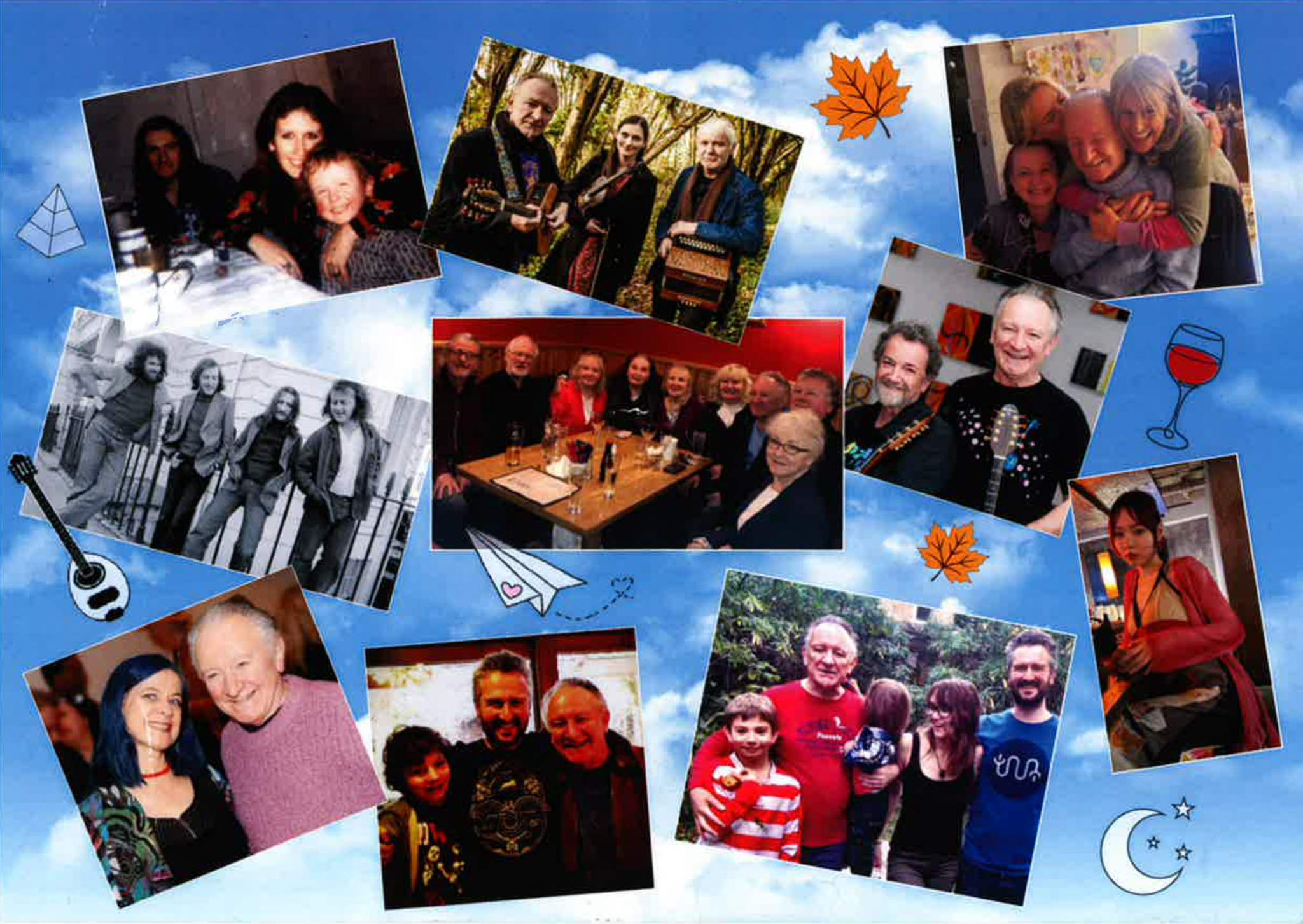
And that’s before you consider just how important and influential each of the many adventures on which Dónal embarked proved to be. He played on Christy Moore’s second album Prosperous, along with Andy Irvine, uileann piper Liam Óg O’Flynn, and a gaggle of other musos – which turned out to be the start of something very special. In 1972, the four troubadours re-united as Planxty, and immediately had Top 10 hits. Their approach to Irish music was ground-breaking, combining songs and tunes in a style that married the work of the best-known ballad groups with the more refined sensibility of the music of Sean Ó Riada. It was as if a threshold had been crossed, and there would be no going back.
Dónal moved on then to form The Bothy Band in 1974, and they became leading standard-bearers of instrumental Irish folk music, combining virtuoso musicianship with a raw, elemental style that captured the innate exuberance of traditional music as a live force. This was a street-level expression of Irishness, as against the polished drawing room version perfected by The Chieftains.
Then came Moving Hearts, the highly politicised band that merged folk, rock, trad and jazz into an almighty uproar at the start of the 1980s. They were one of a kind, combining outrageous musicianship with great songs that – from the opening track on their debut album, Jim Page’s ‘Hiroshima, Nagasaki, Russian Roulette’ onwards – offered a gutsy howl of protest against the machinations of a power-grabbing establishment that cared nothing for the lives of ordinary men, women and children.
Christy Moore, Mick Hanley and Flo McSweeney featured as singers through different phases of the group's development. But there was a consistent message, as they moved towards the instrumental-only showcase of The Storm in 1985. “Let the music keep our spirits high,” Jackson Browne wrote in ‘Before the Deluge’. Moving Hearts made that song their own and delivered the kind of live performances which suggested that this is what they were born to do.
HEART OF THE ACTION
While these Lunny-inspired headline artists were enormously influential, there was a whole other dimension to Dónal’s burgeoning influence. In 1975, he formed the Mulligan label, which recorded and released some of the most innovative albums of the era, with Dónal playing on some and producing others, including Pumpkinhead’s much-loved eponymous debut released in 1975.
He worked as a producer on a number of Christy Moore solo albums, including the legendary Ride On, released in 1984. He recorded with Clannad, Elvis Costello, Kate Bush, Mary Black, Shaun Davey, Paul Brady, Sinéad O’Connor, Baba Mall, Frank Harte and Jimmy MacCarthy – just to scratch the surface of a magpie career as an arranger, producer and session musician that was wildly varied and rich in every respect.
Dónal was the musical director and producer of the music for Philip King’s influential documentary, Bringing It All Back Home, which explored the connections between Irish and American music and inspired a growing sense of mutual recognition – and respect for the Irish tradition – on both sides of the Atlantic. He wrote the music for the highly-rated Eat The Peach, one of the 1980s Irish movies that heralded the emergence of a modern film industry here. Along the way, he was elected to Aosdána, in recognition of the distinguished body of work of genuine originality he had already created.
He produced the internationally acclaimed album Common Ground, featuring Kate Bush, Sinéad O'Connor, Bono and Elvis Costello, for EMI Records. And he worked with numerous other musicians and players on different projects, including his own more recent excursions Coolfin, Mozaik and LAPD – and in a trio with Zoe Conway and Máirtín O’Connor, with whom he played Electric Picnic as recently as this year.
He was, it turned out, still at the heart of the action, all of 60 years since he struck his first chord onstage with The Rakes of Kildare.
A MAGIC RIVER
Elements of all of this were alluded to as the funeral ceremony progressed. His abiding love of nature was reflected too, in what his children Oisín Lunny and Cora Venus Lunny had to say. “We were all very lucky to be loved by this beautiful man,” Cora Venus, herself a superb musician, said – and she spoke about the way Dónal could mimic bird sounds. “He would echo the call of the curlew so perfectly,” she remembered, “that you didn’t know if it was him or the curlew.”
"Thank you dad for bringing music to the children of Palestine,” she added, referring to the Gaza Solidarity concerts Dónal was involved in, "and for always being honest and caring, and sharing your love with us and bringing joy to so many of us, in so many ways. A lot of you know him as Dónal off the telly, but he was even better at home. What an amazing man. Thank you so much, Dad.”
Oisín – also an acclaimed musician and writer – recalled him as a fantastically playful father. “He was always great craic,” he said. "Music was his life so, during school holidays, I got to go out and travel around Ireland with him and his wonderful musical families, so I have memories of bouncing round single lane roads in rural Ireland in a transit van and hearing absolutely thunderously good music every evening – it was such a privilege.”
And he described working with Dónal on his own music. "I remember frequently being overcome with the feeling of bursting with pride. Not only was he a great friend and father, he was absolutely the best possible person to work with. He brought things together in a way that was so elegant, and seemingly effortless, it just translated into pure joy.”
Dónal’s partner Úna O’Boyle – in a note read for her by Cora Venus – recalled some of Dónal’s final words. “We are two surfboards on a magic river,” he had said. It was a metaphor that resonated for Úna in a wider sense. “Everyone here has been on a magic river with Dónal,” she offered, “and the magic river will continue to flow.”
The beauty of it is that this really is true. It is one of the great gifts offered by art, and by music in particular: even after our spirits have departed, the songs and the sounds and the influences carry on, in the lives and repertoires and imaginations of those that follow. You might like Ulysses, or even love it, but you can’t sing it. Whereas, you can sing ‘Follow Me Up To Carlow’. We all can.
A LIFETIME MAKING MUSIC
There was, of course, music throughout the ceremony, curated by Dónal’s long-standing musical compadre Paddy Glackin – from the ‘March of the High Kings of Tara’ that soundtracked the entrance through to ‘The Green Groves of Éireann’ as the family and friends followed the coffin along the aisle towards the exit. His brother Manus Lunny was an authoritative presence throughout. The familiar voices of Maighread and Tríona Ní Dhomhnaill were heard early; and later, Andy Irvine and Paul Brady’s ‘West Coast of Clare’ was followed by Christy Moore’s dulcet timbre rising to the high beams on ‘John O’ Dreams’.
But there was an appropriately stately feel to the playing of the entire ensemble, with the pipes of Mick O’Brien on ‘Johnnie Seoige’ scaling marvellous heights and Zoe Conway recalling one of the great Irish socialist heroes with the Moving Hearts tune, ‘Peadar O’Donnell’.
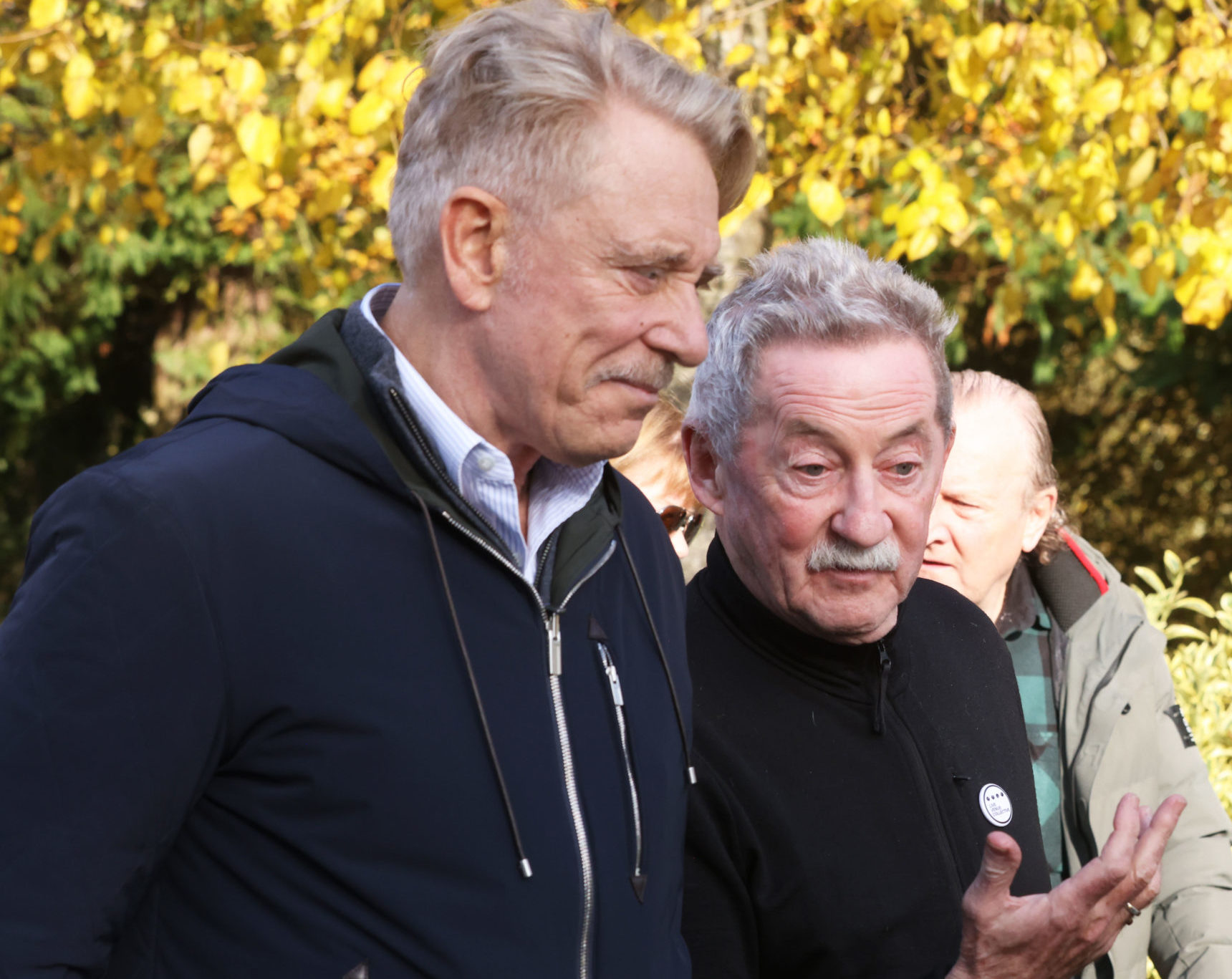
Adam Clayton of U2 with Phillip King, after the funeral mass at St Conleth’s Parish Church in Newbridge, Co. Kildare. Photograph: Eamonn Farrell / © RollingNews.ie
People filed out, shook hands, hugged and spoke. Dónal’s brothers and sisters were there in force. So were many musicians and admirers from within the music industry and without, who paid private tribute in that familiar Irish way, queueing up to talk to individual members of the family. Mary Black with her husband Joe O’Reilly. Adam Clayton of U2. Oisín Leech. Philip King of Scullion and Other Voices. Leagues O’Toole. Gary Monroe of Monroe’s in Galway. Julian Vignoles, formerly of RTÉ. Fachtna O Ceallaigh. Everywhere we turned, there were familiar faces, some with the ravages of the years showing more clearly than others. But for none of us is there any escaping the inexorable march of time and where it ultimately leads for one and all. The thought was impossible to shake as we walked within yards of the Liffey, towards the cemetery, remembering that there had been heartbreak along the road too, when Dónal's youngest child, Shane – his son with Sinead O’Connor – died tragically, at the age of 17, in 2022.
The final words spoken at the graveside, the musicians clustered again. Sharon Shannon took a tune. Zoe Conway did the same. Mairéad Ní Mhaonaigh of Altan and Paddy Glackin played the fiddle. Manus Lunny carried the rhythm. Michael McGoldrick, Nollaig Casey, John McCartan, John Whelan and Paul McGrattan added their musical graces to a sound that wafted gently over the graveyard like a genie escaping from the bottle. Irish music. An endlessly beautiful thing even on a uniquely sad occasion.
Liam Ó Maonlaí stepped forward to sing marvellously as gaeilge. And when the final notes had been played, people like Eleanor McEvoy, Paul Brady and Mary Elliot, Mundy, Madeleine Seiler, John Munnis, Chris Meehan and George Gill gathered to the side, before beginning the long march back to base. It was a gathering of the clan, and that, in itself, felt good even if the mood was sombre. There would be food and conversation afterwards. Memories shared. Sympathies expressed. The music lingering in our hearts.
“Let the music keep our spirits high…"
Images of Dónal were never far from our thoughts as we spooled through the back-story of a man who loved the life he led because he loved the thing that shaped its every twist and turn.
“It’s only when I look back at my career that I see the road I have travelled,” Dónal said when he was presented with the Lifetime Achievement Award at the RTÉ Folk Awards in 2025, “and the wonderful friends I have made through this community. Getting this award means so much to me – the recognition of a lifetime making music.”
Ní fheichimíd a leithéid arís. We’ll never see his like again.
Dónal Lunny is survived by his family, including his children Oisin, Cora Venus, and Sora Chan, his loving partner Una O’Boyle – and by the Irish music community to whom he gave so much.
THE FUNERAL MUSIC
Curated by Paddy Glackin
- Entrance, “March of the High Kings of Tara”
- Maighread and Tríona Ní Dhomhnaill “A Íosa”
- Manus Lunny, “October”
- Neil Martin, “Sean O Duibhir A’ Ghleanna”
- Mick O Brien, “Johnie Seoige”
- Zoe Conway, “Peadar O’ Donnell”
- Andy Irvin and Paul Brady, “West Coast of Clare”
- Christy Moore “John O’ Dreams”
- Graham Henderson “The Parting Glass”
- Exit, “The Green Groves of Erin”
THE MUSICIANS
The performers during the ceremony in the church were:
Mick O’Brien, pipes
Zoe Conway, fiddle
Mairtín O’Connor, accordion
Graham Henderson, Keys
Eoin O’Neill, bass
Noel Eccles, percussion
Neil Martin, cello
Manus Lunny, bouzouki and guitar
with:
Maighread and Tríona Ní Dhomhnaill
Andy Irvine, Paul Brady
Christy Moore
Sharon Shannon


