
- Opinion
- 19 Aug 26
Cuba on the brink: "Many artists have emigrated, as has the audience that consumes quality art, and this has fragmented scenes that were once very strong"








Drug use, mental health difficulties and emigration have all spiralled out of control as the US fuel blockade on Cuba bites. It’s also having a devastating impact on the country’s once thriving arts scene, as Liam Cunningham reports.
When Cuban-born, Brooklyn-based music producer Garo returned to Havana in February, he noticed something unusual.
The artist was attending Cuba’s International Jazz Festival. The event has been held in Havana since 1979, attracting hundreds of thousands to the capital at its peak. But this time, Garo noticed the city was markedly quiet.
“You felt it, that society is crumbling,” says Garo. “Cuban musicians always giving it their all, but very empty, very precarious. It’s always a double feeling for me because you have all this, and then you see the Cuban musicians killing it.
“But Cuba feels like an empty star. The emigration has been tremendous. We used to have like 12 or 13 million people but now we are down to eight.”
The Jazz festival was once bustling with major bands and international tourists, but now, it too feels the effects of mass migration and economic turbulence. These days, music in Cuba is produced against a backbeat of the humanitarian crisis.
US fuel blockades have decimated what was already a brittle economy. Emigration is rife, tourism has collapsed, child mortality has doubled and rubbish is piling up in Cuba’s capital Havana, as decades-old garbage trucks break down or run out of fuel.
Due to the fuel shortages, the Cuban government ended the school year two weeks early and scrapped college entrance exams - the latest blow to the once globally-renowned education system.
“So many of the artists who are Cuban who have careers and some kind of success, don’t live in Cuba anymore,” says Judy Cantor-Navas, a journalist and author who extensively covers Cuban music on her Substack, Cuba On Record.
“They leave because they want to have a career, because it’s much easier to tour and build something if you’re living in Madrid, New York, Miami, Paris than if you’re living in Cuba.”
Cuba’s economic crisis stretches back to the fall of the USSR in 1991. The union provided Cuba with favorable trade agreements, money, and military support. At its peak, the relations accounted for 35% of Cuba’s GDP and 85% of its trade.
USSR fell, this support ended, kicking off a decade of recession known as The Special Period, during which Cuba’s economy receded by 35% before marginally recovering at the turn of the millennium.
The 2000s brought tourism, remittances and Venezuelan oil, but the economic model was nonetheless fragile. Since Covid, much of that recovery has been undone. Reuters reported in 2025 that Cuba’s economy had declined for five consecutive years, with a 10% fall since 2019.
Creativity Amidst The Collapse
In June, the Fábrica de Arte Cubano (FAC), a premier interdisciplinary arts venue and nightclub in Havana, announced it would temporarily close due to severe limitations caused by the energy crisis.
Founded in 2014 by hip-hop and afro-rock musician X Alfonso, the FAC is a multi-disciplinary labyrinth where nearly every form of human artistic expression coexists under one roof.
“For many young artists, FAC represents a first real opportunity to present their work to a broad and diverse audience,” says Alfonso. “More than an exhibition platform, it functions as a creative ecosystem where collaborations, projects, and professional careers can emerge.
“FAC’s temporary—and I repeat, temporary—closure is due to the complete uncertainty surrounding the availability of electricity needed for its stable operation; the emigration of professionals; the lack of transportation for audiences, artists, and staff; and above all, the limited guarantee that we can carry out our work professionally, with the quality and rigor we have demonstrated since FAC began 12 years ago.”
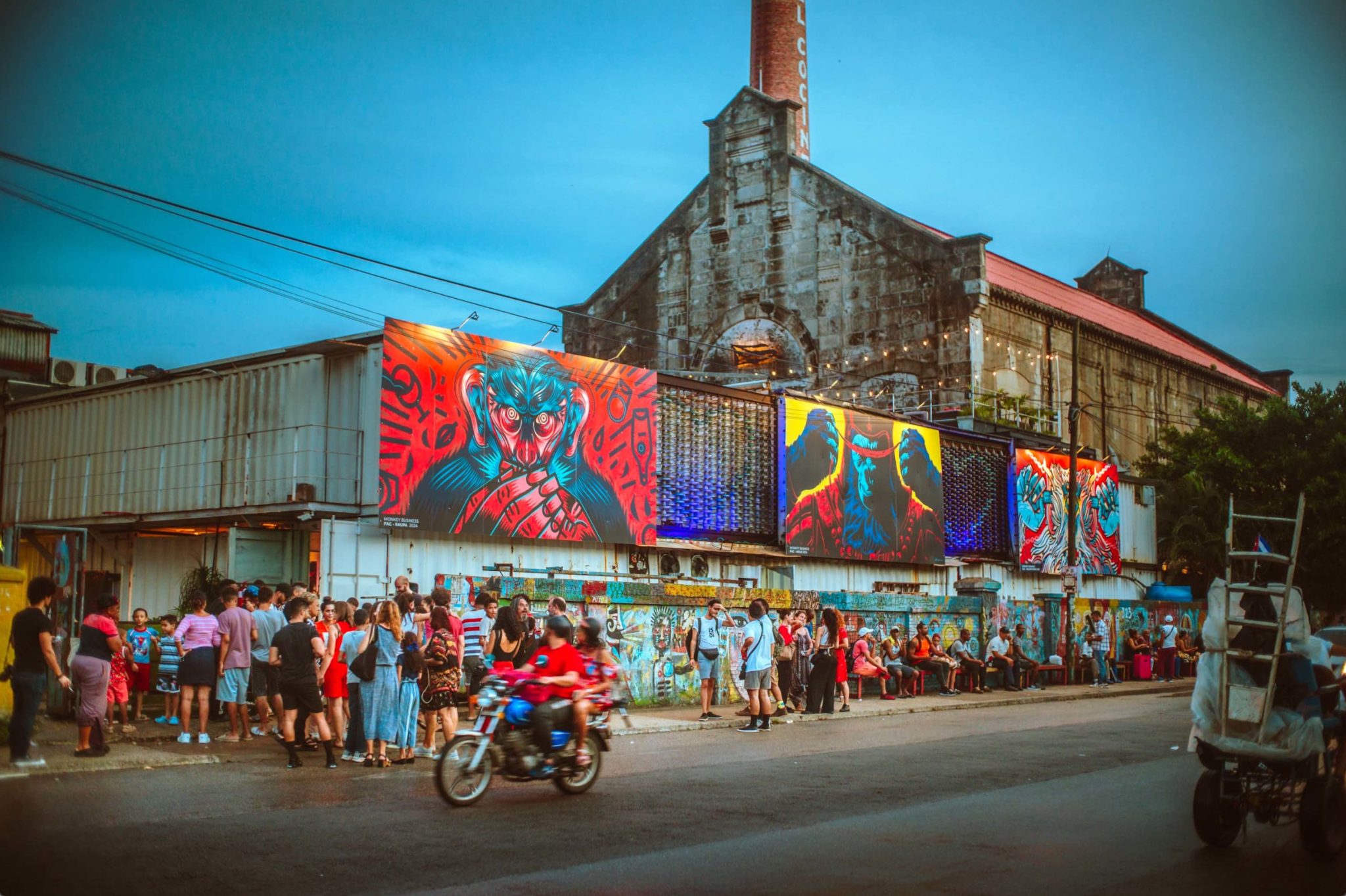
Fábrica de Arte Cubano
Cubans have been forced to adapt. They are migrating to smaller, privately owned clubs and outdoor public plazas that do not depend on the heavy air-conditioning.
“Despite all the difficulties, Cuban musicians continue to compose and record however they can, and search for new ways to express themselves,” says musician X Alfonso.“There is an enormous capacity for reinvention, along with a younger generation that has many things to say—bringing fresh, high-quality proposals and exceptional talent.”
However, the music industry cannot survive on creativity alone. Musicians need food to eat and energy to heat their homes, recording spaces, promoters, bookers, sound engineers and an audience that can afford to buy their music and attend their concerts. For many Cubans this is simply not a reality. There is an abundance of creativity in Cuba, but the grassroots venues that foster this creativity, and keep it in the country are dwindling.
“What is struggling to survive are the cultural spaces, alternative venues, and small institutions created by artists that sustained cultural life for years,” Alfonso explains. “It is becoming increasingly difficult to produce, rehearse, record, and present projects with any stability. Many artists have emigrated, as has the audience that consumes quality art, and this has fragmented scenes that were once very strong.”
An Escape Route
Thus, artists have looked outward. Since Cuba introduced nationwide mobile internet access in 2018, emerging artists began building audiences online. Many have been extremely successful, garnering millions of views and providing a pathway out of the country. One genre in particular that has embraced social media is Reparto, a style that blends modern reggaeton beats and hip-hop with traditional Afro-Cuban rhythms like timba, rumba, and the signature Cuban clave.
“If you see the numbers of Reparto groups on YouTube, it’s crazy,” Garo says. “Any song has 3 million views. Crazy. Like kids that nobody outside that world knows.
“But you look, some artists, they have a lot of songs with millions and millions of views. Some you have never heard about. A lot of them. It’s their own ecosystem. So there’s always been a way to escape. That’s how I got to the States. I got to Berkeley College of Music through music. From hip hop, most of all. It has always been an escape route for us.”
View this post on Instagram
Music aside, the destitution is causing issues with drug addiction. Lower-income youth are turning to addictive substances to cope with chronic stress and harsh environments.
“Drug use in Cuba is as old as it is anywhere else in the world,” Alfonso says. “What is happening now is that cheaper substances, such as ‘El Químico’ (chemical), are available, and there are constant reports on social media about the harm they are causing, especially among younger people.”
El Químico is a cheap, highly addictive cannabinoid that is being widely consumed by the Cuban youth. The drug contains a mix of substances, including carbamazepine, benzodiazepines, formaldehyde, animal anesthetics, fentanyl, and phenobarbital, dissolved in oregano or applied to paper. Garo has also seen the problems that the drug is causing.
“They’re saying ‘El Químico is fucking us up,” Garo says, recalling a conversation he had with a young man in Cuba. “‘This fucking El Químico is killing us. El Químico is taking our young ones away.
“‘We are fucked up in general. We have a problem that’s deeper than El Químico. This is not a functioning society that is being fucked up by El Químico’. This is a fucked up society that also has that drug problem. It’s very cheap and it’s all over, we see videos all the time.”
Many young Cubans are sick of drugs and violence destroying their communities. One form of respite they have found is religion, and they are using social media to portray this message.
“There’s videos coming from the perspective of people from the hood that turn to God,” Garo explains. “And now they have a channel, and they want to turn kids to God, so they have a church that helps them. They talk from a ghetto point of view, not from a point of view of Christ, the wise saviour, from completely ghetto. ‘We have the tools, come to our community. We’re gonna help you’”.
Local musician Danay Suárez went viral for her pivot to creating music deeply rooted in religious and spiritual themes. Her song ‘Dejando al Mundo ’, which has amassed millions of views on YouTube, directly addresses her spiritual awakening and leaving secular paths behind.
Another Cuban act who Garo admires, Ayamey Smith, follows a similar trajectory with her music. Her songs contain strong Christian themes while and anti-drug messaging.
“She’s saying all positive things, like, ‘I’m this shit, ‘cause I don’t drink’,” Garo says. “‘And I’m the shit ‘cause I don’t do it, El Químico’. And she’s talking about all the things that we should aspire into, but in a voice that is very authentic. She’s not preaching on anybody. She’s talking about her experience.”
Even with the respite that music offers, it is evident that the greatest opportunity it provides is a pathway out. Even if the destination for most of these expatriates is the United States, X Alfonso believes that Cubans and Irish people display a lot of similarities.
“I have always felt that Cuba and Ireland have more in common than might seem at first glance,” Alfonso says. “They are two islands with a very strong cultural identity, an immense tradition of music, poetry, and storytelling.
“They are also countries shaped by emigration, where memory and nostalgia hold an important place in many people’s lives. Cubans dance through our pain, while the Irish turn theirs into songs. Perhaps that is why I believe we would get along so well.”
RELATED

- Lifestyle & Sports
- 21 Sep 26


