
- Opinion
- 06 Nov 26
Drought and data centres: "AI’s devouring mouth doubles every day"


Ahead of Saturday's protest, as part of the Europe-wide Day of Action on Data Centres, Gerry McGovern finds that "AI’s devouring mouth doubles every day" – and "it wants more and more and more water..."
“There was an old woman and she lived in the woods
Aweela, weela walya
There was an old woman and she lived in the woods
Down by the River Saile…”
Was there ever a song that better summarised Western Civilisation’s hatred of women and nature? An old, useless woman. Worse, she was branded a child killer. Everything the modern state abhors. Women have long been the baby factories of the state. A baby-killing old woman was a nightmare for capitalism.
In modern Europe, older women – particularly financially independent ones – had long been feared and hated by the male elites. They became prime targets for the witch burnings. With their child-bearing years behind them, their independence, their herbal and ancient medical knowledge – often freely shared among the community – they undermined capitalism and male supremacy.
This old women lived in the woods; a fearsome hag in a fearsome place. Some of us might now think well of forests. To the emerging state, though, they represented wild nature, and that had to be tamed. This Dublin woman lived down by the River Saile. What river is that?, many Dubliners might ask. ‘Saile’ probably comes from the Irish word “salach” for dirty. A dirty old woman, in the dirty old woods, down by a dirty old river – probably dancing naked at night with other witches!
The Saile is the River Poddle. Once upon a time – and it wasn’t that long ago – she was the key source of fresh water for Dubliners. She became dirty and abused as Dublin prospered, because for civilisation to prosper, nature – or some part of it – must perish. Instead of honouring her for the great life-giving service she had given, she was stripped of her name, her dignity, and shoved down and buried underground.
When they built the water-guzzling Amazon data centre in Tallaght, they treated her like engineers treat rivers and water. As a material resource. Without even naming her, she was labelled a culvert, an engineering term of nothingness and no history and no respect, as they buried here again to get her out of the way.
Her story isn’t over, though. “Water always wins,” as Erica Gies put it. Water remembers. “Water in plain sight,” Judith Schwartz wrote about this apparently invisible water. Dubliners have lost sight of water. It wasn’t always this way. The once Indigenous Irish respected water.
Now, Irish civilisation has turned the once lovely Poddle into a dirty drain that slumps through filthy railings into the River Liffey. Water will find its way. Time will tell. That Amazon data centre, when its cement and silicon are ruined, the Poddle will reappear from underneath the cracks in the concrete. As this devouring civilisation lurches forward in moral drought, drunk on AI invincibility, it will learn hard lessons from nature and from water.
DROUGHT AND WATER BANKRUPTCY
In 2026, the world entered an era of “global water bankruptcy”, the UN has warned.
Not many people know where the water we use actually comes from. The blithe assumption is that water goes up in evaporation and comes down in rain, to be gathered in reservoirs and rivers and put to human use. It is especially easy, in a country like Ireland with a lot of rain, a moderate climate and summers that are generally mild, that the whole thing is self-replenishing.
Here's the reality: since the 1970s, we have pumped so much groundwater that we are drying out the continents. We have altered the earth’s tilt and global warming is slowing the earth’s rotation. Meanwhile freshwater is running scarce and scared almost everywhere.
Into this already deepening crisis comes the voracious mouth of AI. In 2020, it hardly existed. By 2030, it will demand as much water per annum as 1.3 billion people, according to another UN report.
Already, the severe shortage of water is a major issue in much of Africa, the middle east, central Asia and, increasingly, the Mediterranean and south Europe.
Meanwhile, in drought-stricken USA, data centres consumed about 77 billion litres of water directly in 2023. (Indirect water use can be up to 20-times greater.) By 2028, this grotesque level of water consumption could rise to more than 300 billion litres per annum. In the US West, years of drought have made the local lakes shrink dramatically, as the area now experiences one of the greatest data centre booms.
In South Korea, there is also both drought and a data centre boom, with annual water shortages of up to 40 billion litres predicted by 2030.
In Spain, Tu Nube Seca Mi Río is an organisation opposing data centre growth. Its name means: “Your cloud is drying my river.” They had a similar slogan in Uruguay. “No es sequia, es saqueo!” – “It’s not drought, it’s pillage!” Uruguay – the land of rivers – thought they had so much water they wrote it as a human right into their constitution. And yet, Uruguayans would soon face drought and be forced to drink salty-tasting tap water as the big plans for data centres were rolled out.
In Chile, a country facing worsening drought, people were asking, “With Google as my neighbour, will there still be water?”
Querétaro, in the North West of Mexico, has been suffering the worst drought in 100 years, while at the same time becoming a mega data centre hub. Brazil, which not so long ago was known as the “Saudi Arabia of Water” has faced increasing droughts in the 2020s. Despite this, the Brazilian government is hungry for the thirsty data centres.
Even in Switzerland, long considered the “water castle” of Europe, freshwater is becoming scarcer, as they roll out the data centres in great secrecy, while the ice caps melt. By 2036, "water-related spend across Europe’s data centre sector is projected to reach €6.8 billion,” according to Water Online. Despite the massive spend, Europe is in no way prepared for the surging water demand precipitated by AI. The UK’s data centre water plans have been described as “fatally flawed.”
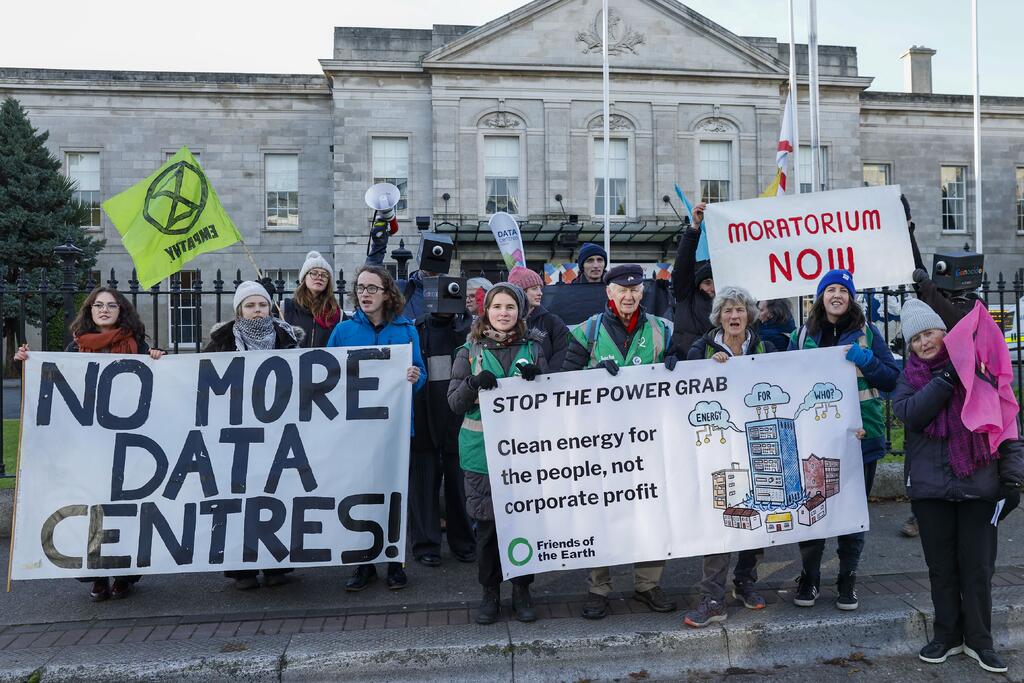
Photo: friendsoftheearth.ie
And in rainy old Ireland – the home of the data centres – we are hoping that real drought will never visit us, like it has visited Uruguay, Brazil and Switzerland. As usual, we are unprepared. “Does Irish Water even know how much water data centres are using?”, Dublin Inquirer asks. Good question. I spent a month inquiring from Irish Water. I received long, bland, friendly – and what felt like AI-generated – replies. Again and again, I was told that they were actively looking into my request. Of course, they’re short-staffed and low on funds. And they have to save every euro they can so that they can give their CEO and eye-popping €118,000 raise so as to make him one of the highest paid executives in Ireland.
Meanwhile, I waited and waited for a reply. But from experience, I know that – when it comes to environmental information – the Irish government are world-leading masters of deception and obfuscation. ‘Protect industry at all costs’ is the Irish motto. And indeed, when Uisce Éireann did finally give me some figures, it was like receiving a PR release from the Irish Data Centre Adoration Association. Irish data centres only use a teensy weensy “6.5 million litres per day” and that’s at peak times, I was informed.
WHY DATA NEEDS WATER
Let’s talk about some of the things that we are not told.
Data gets hot. It needs to be cooled. If you look at the back of some fridge-freezers, you will see pipes running back and forth. A typical computer server rack is about the size of a fridge-freezer. The servers in this rack can be surrounded by an intricate layer of pipes, weaving back and forth, through which water flows in what is often called a “closed-loop” system.
As the servers hum and get hot, their heat is transferred through these pipes and into the water. When the water reaches a certain temperature, it is moved along out of the server room and into what is called a “cooling tower”. There, the pipes are sprayed with other water to cool them down. So there are generally two sets of water systems involved, one that is in the pipes that surround the servers (closed loop), and one that is in the cooling tower.
As the water from the cooling tower is sprayed on the pipes, much of it evaporates. This is what is called “evaporative cooling”. Evaporative cooling systems love deserts, as long as they have access to lots of dirt-cheap public water.
“That’s why there are so many data centres in Arizona,” data centre expert, Steven Gonzalez, told me. “It’s almost like the goldrush. It’s a water-rush. All these companies are clustering to get this cheap water. But it’s doomed. We see how communities are struggling to pay their water bills, while data centre and other industries are getting water at a much cheaper rate.”
Evaporative cooling in a desert. Doesn’t sound ethical or moral, does it? “I think they should be jailed for doing that,” Nicolas Dubé, from Hewlett-Packard Enterprise, stated.
The way an ordinary person, or a farmer, uses water is different to the way a data centre uses it, researcher Shaolei Ren explained to Reece Rogers for Wired. “When we get the water from the utility, and then we discharge the water back to the sewage immediately, we are just withdrawing water – we’re not consuming it. A data centre takes the water from this utility, and they evaporate the water into the sky, into the atmosphere, where it may not return to the earth’s surface until a year later.”
If you think data centre direct water use is criminal, wait until you hear about their indirect water use. That’s the water consumed in such things as manufacturing the semiconductors for the servers, supplying all that electricity, etc. “The discrepancy between reported and actual water consumption is staggering,” Tech Central stated. In 2024, Meta reported that it’s “indirect consumption amounted to 19 billion gallons, overshadowing direct consumption by a ratio of 20 to one.”
I have often been asked why data centres are so intent on using public water. The answer is simple: it’s cheaper and cleaner. In fact, Big Tech gets super-discounted rates on its water use, which is one reason it goes to such an extent to hide its water use from public view. Things have been so cosy for Big Tech, for so long, that water has been an afterthought. For years, most data centres got water so cheap, they didn’t even bother metering it, let alone managing it.
There is “no business justification” for managing water, data centre managers said. Perhaps. But there is much more than business to consider…
TOXIC WATER
Here’s something else they haven’t told you.
Wastewater from data centres is highly toxic. Treat water with lots of chemicals, add biocides to prevent mould, algal or bacterial growth. Add phosphates to reduce corrosion. Place this water in closed loop pipes. Heat it. Keep circulating it. As the water continuously rubs against the pipes, micro-quantities of heavy metals (zinc, copper, lead), forever chemicals, and other goodies, peel off. Chemical resistant organisms can thrive in such warm, re-circulating water.
In the USA, and in much of the rest of the world, the majority of data centres are now targeting rural areas because that’s where they can get cheap land, cheap electricity, cheap water and cheap politicians. In the USA, "nearly 90% of all existing data centres are in urban areas, but 67% of planned facilities are slated for rural communities and 39% are planned in counties without an existing data centre."

Anti-data centre sentiment in rural Kansas neighbourhood. Photo: Catboy69
According to a 2026 report by the University of California Environmental Law Journal, “There is a clear lack of transparency in data centre cooling water discharge practices.” Rural communities are particularly unprepared for toxic data centre water. They simply don’t have the testing equipment or staff. Add to this the super-secrecy of Big Tech and derisory government regulations, and you’ve got a recipe for nasty surprises – including “mysterious, unusual white colonies of bacteria.” In Wyoming, the Cheyenne Board of Public Utilities has stopped accepting industrial wastewater from Meta, Luke James wrote for Tom’s Hardware in July 2026. The deadly Cupriavidus gilardii, a metal-resistant bacterium, had been found.
It’s not simply in the pipes that strange toxicity builds up. As the water evaporates in the cooling towers, it leaves behind a nasty concentrated waste, known as “blow down”, made up of minerals, metals and salt. This blow down is often dumped into sewers or local rivers. Historically, evaporative cooling systems have been known as a source of Legionnaires’ disease. To avoid such infectious risks, chlorine and bromine-based chemicals and disinfectants are added.
Bromine is highly toxic for living systems, targeting the nervous system and brain. Data centre pollutants have been found to include “total dissolved solids, chlorine, metals like copper and nickel, biocides, corrosion inhibitors, and pH-altering chemicals.”
Even when the data centres “clean” the water, it remains dangerous to nature. “Clean” water will have been washed with chemicals and stripped of life-supporting nutrients and biomatter. Even in small quantities, such ‘ultra clean’ water poses problems for aquatic ecosystems.
But, hey, Big Tech have a solution! When it comes to Big Tech, however, the ‘innovative solution’ is nearly always worse – from an environmental point of view – than the problem it seeks to address. Stung by the bad publicity – and the increasing oversight required due to its abusive water use – Big Tech now claims that it has a new ‘liquid cooling solution’ that requires much less water.
“While liquid cooling systems may reduce – but not eliminate – data centre water use, they often rely on dangerous per- and polyfluoroalkyl substances (PFAS), which are highly toxic, lab-made chemicals that persist in the environment and harm many systems of the human body,” US Food & Water Watch reports. “Data centres are poised to increase the use of these “forever chemicals” just as some other industries are phasing them out.”
It is hard to overstate the harm that forever chemicals do. They are among the most toxic, long-lasting and dangerous chemical materials ever developed. “Small leaks in these cooling systems are common, according to the industry itself,” Food & Water Watch adds. “And the prolonged exposure to these PFAS fluids leads to the degradation of the computer system’s parts, which contaminates the fluid, and then necessitates disposal. These fluids are likely incinerated, meaning the PFAS are released into the air or remain in the ash that is then sent to landfills.”
How can Big Tech get away with all this?
In many countries, data centres are not even legally obliged to report what chemicals they are using. Big Tech simply owns the government. The government does what it’s told, and thus Big Tech can hoover up every bit of data it wants on us, while we have practically no data on it.
A TOWN CALLED THE DALLES
In a town called The Dalles in Oregon, USA, local people were worried that Google’s water use was soaring. As is so often the case, the city officials, who had given Google millions in tax breaks, had no intention of letting anyone know how much of the precious liquid Google was using. It was up to a regional paper, The Oregonian, to try and find out. The case came to court. City officials were ordered by Google to argue that Google’s use of scarce public water was a “trade secret”. After more than a year of proceedings, city officials were forced to tell their own citizens how much public water Google was taking.
“But most troubling in the affair,” Binoy Kampmark wrote for Scoop, “leaving aside the lamentable conduct of public officials, was the willingness of a private company to bankroll a state entity in preventing access to public records.”
Actually, it was even worse than that, as Erin Kissane, a respected technology writer, informed me. “Rather than The Oregonian suing for access, the city of The Dalles actually sued the Oregonian in a ‘reverse public records lawsuit’ to prevent the paper from disclosing the data, despite their county district attorney having already ruled that the information should be disclosed. Google funded the suit until the press got too bad and then pulled out, so the city settled.”
It isn’t over, though. When it comes to the greed of Big Tech, it never is. AI’s devouring mouth doubles every day. It wants more and more and more water. The Dalles city officials now say they need to take over a local forest that has lots of water on it. For the good of the community, the officials say. Nothing to do with Google’s insatiable thirst, they say.
In another story of watery “trade secrets”, David Wren, writing for The Post and Courier in Dorchester County, USA, warned that the amount of public water Google was demanding “is a closely guarded ‘trade secret’.” Like in so many other places, imperial Google had imposed a gag order on Dorchester city officials, warning them that they must not tell the public anything about the Google project, particularly how much public water Google was slurping.
Again, dragged kicking and screaming, Google was finally forced to disclose. “After fighting its disclosure for more than a year, Dorchester County has agreed to publicise the amount of water used at a data centre Google is building, reversing its previous stance that the information is a closely guarded trade secret that shouldn’t be shared with the public,” Wren would write. A victory of sorts for the community? Except that the community would also learn in the disclosure that Google demanded from Dorchester that in case of any natural emergency, its data centre would have priority on the water. Like everywhere else, Big Tech demands that AI must drink first, and let the people die of thirst.
AI SUPERCHARGES WATER DEMAND
With AI, this digital thirst is surging for many reasons. Firstly, AI explodes the quantity of data. Generally speaking, the more data being stored, the more heat. Secondly – and more importantly – AI is much more processing intense. The more processing, the hotter the data gets. One alternative to water in combatting this surging heat is to use air conditioning. However, because local governments sell water to data centres at such discounted rates, it can be many times cheaper for Big Tech to choose water as a cooling agent rather than air conditioning.
AI servers are an order of magnitude more powerful – and thus hotter – than traditional servers. Water is much more efficient at removing heat than air conditioning, so it is often the only practical solution for managing the intense heat thrown off by these monstrous AI server racks.
Big Tech loves to hide behind averages when it comes to water use. All water use is local. On the hottest days of the year, when the local community needs water the most, the AI data centre will also have a massive spike in demand.
What about Big Tech innovation? Surely, we all know that half of the solutions to half of the problems we now face haven’t even been invented yet? Along rides Nvidia to the rescue, the company that totally dominates the AI server marketplace. A Nvidia executive was heard to say that the water problem was “largely solved” because the geniuses at Nvidia have developed servers that can run “hotter than a hot tub”! That’s a good thing, right? So, during accelerating global warming – or should that be ‘global boiling’ – we’ll have millions of ‘hotter than hot tub’ servers running all over the world pumping heat into an already overheated atmosphere. Genius!
In data centres, Big Tech have invented giganteum natural gas ovens (natural gas is their favourite go-to fuel) to fry what’s left of the atmosphere is super quick time.
And here’s another innovation from Nvidia. They’re boasting that they’re going to use so much more copper in their server infrastructure, claiming that more copper would reduce energy costs. That’s to forget that everything is connected. We cannot focus on one metric alone. For years, Big Tech boasted about its tremendous energy efficiency – but that was because it was using so much water to cool the servers, instead of electrically driven air conditioning. Using more copper – or using PFAS forever chemicals – is another great energy ‘efficiency’ story. Copper mining is among the most environmentally devastating mining activities of all. Because of the greed for copper coming from Nivida, from the fake renewable energy industry, and from capitalism in general, more copper will need to be mined in the next twenty years than in the previous 10,000.
And if you’re not sick to your teeth of innovation and efficiency, how about those AI data centre super ovens plonked in our already super-heated oceans. Or, if you’re not buying that, how about we sell you AI data centres in space!
Yes, AI data centres are really like giant ovens superheating an already superheated atmosphere, land and oceans. Studies have found that in a community with a data centre, “it would raise local daytime temperatures by five degrees Fahrenheit and a staggering 28 degrees at night.”
The bottomless criminality of it all is staggering. As our planet burns, Big Tech unleashes a multitude of AI arsonists, for nothing more than greed and the vain egos of the tech bros.
DOWN BY THE RIVER SAILE
“Our toilets won’t fill because of the Amazon, across the road,” one resident, living down by the Poddle river and close to the Amazon data centres in Tallaght, told researcher Laure De Tymowski. There would be no access to the Poddle’s once-fresh water for this resident and the local community. Buried underground and labelled as a culvert, the Poddle has been forced to make way for progress.
When it comes down to a choice between a poor person drinking, and AI drinking, the data comes first. “When Hurricane Maria and Hurricane Irma devastated Puerto Rico, the data centres on the island did not go hungry for power or thirsty for water,” researcher Steven Gonzalez, whose family are from the Puerto Rico, told me. The data drank its fill, even as the citizens went without access to fresh water for months.

Illustration: Elna Korhonen
In Nigeria, they had to “buy water to cook”, Felix Adebayo explained. Meanwhile, close by, at least ten data centres drank their fill. It’s not right. You know it. I know it. And increasingly, the world is waking up to it.
Meanwhile, among politicians and economists, the Growth Death Cult continues to exert its dominance, its control. Anything for growth. For the god of GDP.
Land change is the climate change that nobody wants to talk about. We are draining the water from the continents.
Do you think that if the Amazon data centre in Tallaght uses fake renewable energy, then everything is all right? Do you really think that if we ‘electrify everything’ then we’ll be living in some brexity sunny uplands?
Here’s the twisted truth. We’re running out of freshwater because too much is used –and because vastly too much is wasted – running AI servers to pump out fake news and cheap entertainment. Running a capitalist economy of planned obsolescence. It’s not a production problem we have. It’s a overconsumption societal moral crisis.
If AI demands the water of 1.3 billion people in 2030, how much water will it demand by 2040? We cannot simply accept the annihilation of life on this planet in order to make a few greedy – and as the past decade has illustrated very clearly – genuinely evil tech bros even richer and more powerful. We must slow them down. And the very best way to do that is for us to radically slow down. Stop using slop AI. Stop producing so much data. Delete as much of your old data as you can. Stop buying new technology.
Respect the materials of life, like your Indigenous Irish ancestors did. We must remember and respect the rivers that give us life. Water gives us life.
So go back to basics. Respect to water. Honour the Poddle. Honour her past. The Indigenous people say we must look seven generations back and seven generations forward in order to be good ancestors. It is never too late to stand for something, to believe in something more than easy convenience.
To try, at least, to be a good ancestor.
This Saturday, November 7, protesters are set to gather at the Garden of Remembrance in Dublin at 12pm, before marching to the Dáil – as part of the Europe-wide Day of Action on Data Centres.
You can sign up for the march on Friends of the Earth's website here.
View this post on Instagram


