
- Music
- 24 Jul 26
Charli xcx's Music, Fashion, Film is not a continuation of Brat, but a counterweight








Will pop eat itself? It just might. As Music, Fashion, Film is unleashed, we look inside Charli xcx’s magnificently curious dominion – and discover a world of private rooms, cultural ghosts, fan decoding and Pop elitism, in which the album is only the beginning of the spectacle. So how do you follow Brat?
The phrase “Pop will eat itself” was coined by music journalist David Quantick in the mid-1980s. It captured the moment when Pop seemed to be running out of innocence and was beginning to feed openly on its own carcass.
By the 1990s, that idea had evolved to become a creative method: sampling, remix culture, hip-hop collage, Britpop flashback, magazine nostalgia and the cut-and-paste aesthetics of alternative culture all suggested that Pop was no longer moving incrementally forward. It was raiding the archive, chewing through signs, slogans, old records and past styles, and then presenting the result as the future. Which in a way it was.
The 2000s accelerated this process. If you’ll forgive the promiscuous citation of genres, Bloghouse, MySpace, electroclash, Ed Banger, nu-rave and indie sleaze created a culture of constant cross-contamination, where songs became remixes, bands became brands, DJs became tastemakers – and so on. In the 2010s, record label PC Music – with a certain A. G. Cook at the fore – made that collapse explicit with what was dubbed hyperpop. In a zone dominated by the internet, artificiality was no longer something to hide; it became the thrill. The vocal could be plastic, the hook cartoonish, the emotion both sincere and a parody at once.
By the 2020s, the archive had exploded completely. TikTok fragments, Tumblr nostalgia, Y2K revivalism, stan-account warfare, luxury-fashion theatre, underground club codes, influencer intimacy, political meme-making and celebrity self-mythology all moved through the same weirdly mashed-up feed.
In the French philosopher Jean Baudrillard’s account of modern culture, the image is no longer merely a representation of reality; it begins to supersede it. We are on the road to AI. To misquote Fun Boy Three, the avatars have taken over the asylum.
So, where does that leave our quarry, the enigmatic artist on the move that we know as Charli xcx?
Flipping The Focus
For now, let’s just say that Charli truly belongs in this super-modern lineage. She does not mourn the cannibalism. She weaponises it. Her Pop is synthetic and hyper-aware. Around her, the song remains central, of course, but it is no longer a thing unto itself. The signs attached to it – colour, typography, styling, meme, rumour, attitude, pose – can move faster than the music, reproduce more easily, and sometimes become the thing people remember first.
Thus, on the eve of her seventh album Music, Fashion, Film, Charli xcx seems less like a pop star preparing to release an album than the curator of a multi-dimensional cultural happening.
Her last stand-alone album Brat became a global phenomenon: how can you possibly follow that? The new record is preceded by three singles; it has a cover featuring John Cale, Marc Jacobs and Martin Scorsese; and a title that reads like a diagram of twenty-first century celebrity.
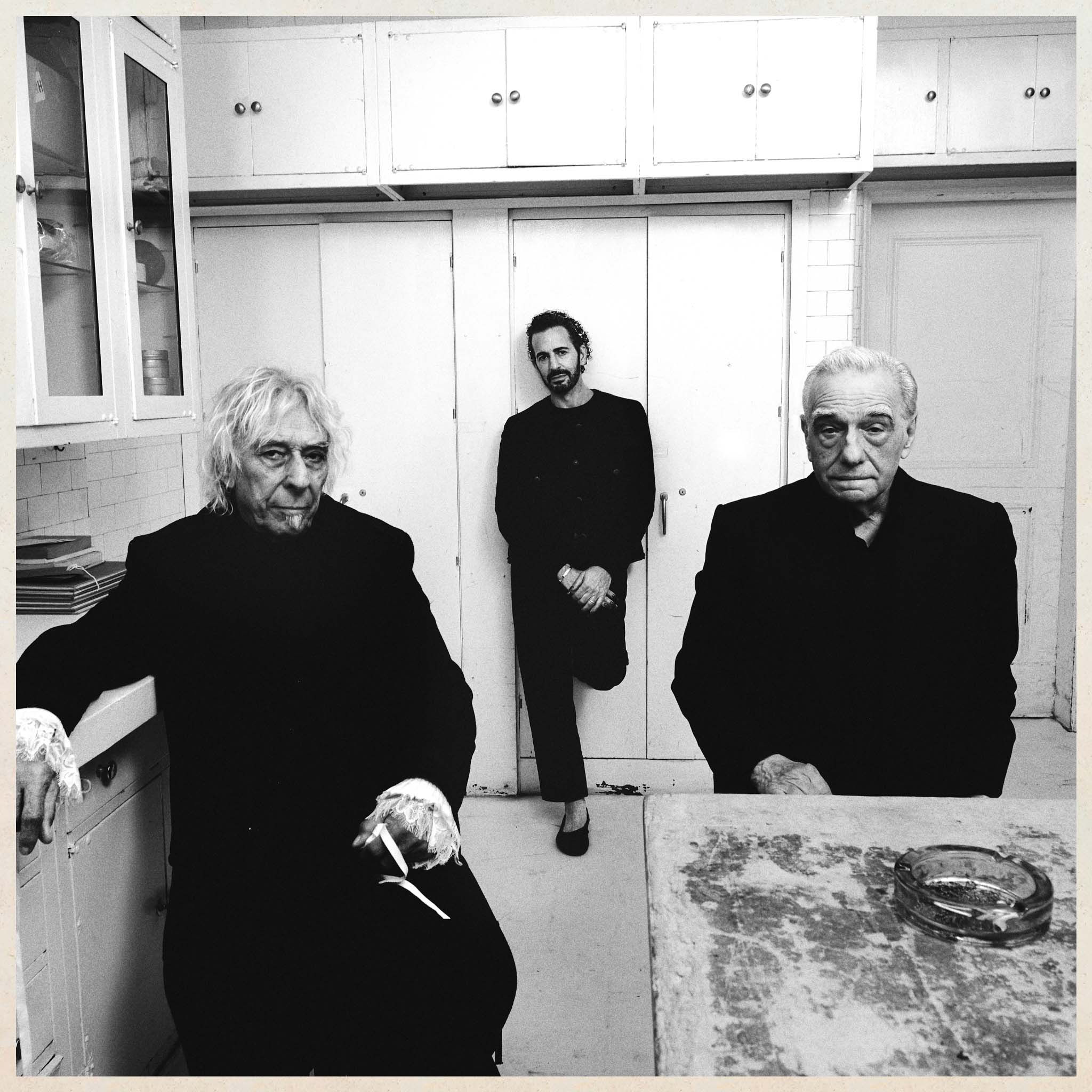
Credit: Aidan Zamiri
Charli is no longer just writing about the pressures of being seen: the envy, desire, judgment, misunderstanding and social performance that run through Brat. Rather, she is flipping the focus, turning the lens back on the machine that produces those sensations in the first place.
The songs are coming, but the world around them is already in motion. Fans have begun decoding the clues, the cover has become its own cultural argument, and Charli herself seems as interested in talking about Madonna, David Cronenberg, Jean Rollin and Robert Altman as she is in discussing her own music.
This is not evasion exactly. It is Charli shifting attention from the album as a sealed object and moving it to the ceaseless machine that surrounds it. Or is it? We shall see.
The Route to Brat
Born on 2 August 1992, the woman we know as Charli xcx emerged from the unruly back-rooms of the internet. As a teenager, Charlotte Emma Aitchison posted demos to MySpace, took her MSN handle as a stage name, and was soon being booked to perform at East London warehouse parties. On occasion, her parents hovered nearby, parental chaperones amidst nocturnal possibility.
The wider world first encountered her through other people’s work. She featured on Icona Pop’s 2012 UK No.1 hit ‘I Love It’ and Iggy Azalea’s ‘Fancy’ - before the hit electropop anthem ‘Boom Clap’ briefly made her seem like a conventional pop prospect. Instead, however, she slipped sideways, into the world of SOPHIE, A. G. Cook, PC Music and the thrilling plastic wreckage of future-pop.
Her major label debut was True Romance in 2013. As the visuals on the albums became more risqué, through Charli (2019) and How I’m Feeling Now (2020), sales actually dropped. Sucker, released in 2014, was the biggest of her first five releases (mixtape included), reaching No.15 in the UK and No.28 in the US.
With her sixth album Crash (2022), Charli made a bold move for Pop’s centre stage. For an artist long adored for refusing the obvious it was a dazzling act of self-reinvention. Crash became her breakthrough album, reaching No.1 in the UK, Ireland and Australia and No.7 in the US.
And then came Brat, which peaked at No.2 in Canada and No.3 in the US, as well as hitting that triple No.1 again – going on to become a zeitgeist-defining record.
That Mad Brat Summer
Where Crash gleamed with the bright surfaces of professional Pop, Brat returned to the heady underground as a site of friction, replete with serrated synths, acid squelch, metallic percussion and cavernous bass. With George Daniel, A. G. Cook, Easyfun, Hudson Mohawke and Gesaffelstein among the co-conspirators, Charli folded her own dance-music history into the record: an Aphex Twin fascination, Bloghouse adolescence, PC Music extremity, a lifelong belief that trash, handled correctly, can fuel a sublime sound.
Her early bedroom demos were lo-fi, minimalist, club tracks that possessed humour with high and low themes interlaced. It took her a while to find her tribe, before she met SOPHIE, Hannah Diamond and A.G. Cook – people who understood her. She made ‘Vroom Vroom’ with that trio, a schizoid song of sugary chorus and hard verse production. To hear it now is to hear Brat in embryo.
Brat arrived in a lurid green glare, stripped of glamour and yet instantly iconic for its crude typography, hard club minimalism and confessional lyrics.
Brat slipped into politics, quite literally, when Charli’s tweet – “kamala IS brat” – detonated across the 2024 U.S. election cycle and the Harris campaign briefly absorbed its visual language. Suddenly, Charli was no longer simply releasing music; she was watching her private grammar become public property. Brands, politicians, fans, fashion people, critics and opportunists all rushed the room. Brat proved that Pop could still create a moment, even as the culture now devours moments almost as soon as they appear.
Music, Fashion, Film.
Charli has described her records as part of an ongoing argument with herself - each album answering, correcting or resisting the one before it.
By that logic, Music, Fashion, Film is not a continuation of Brat, but a counterweight. If Brat was blunt, conversational and born of the internet’s nervous system, the new record seems to be something more deliberate: an attempt to examine her changed life, and the strange aftershock of becoming one of the biggest stars on the planet.
There is, at the time of writing, no interview, no advance album stream, no sanctioned tour through the machinery. To date we have three singles: ‘Rock Music’, ‘SS26’ and ‘Wink Wink’. Oh, and one of the year’s most arresting album sleeves: a stark black-and-white photograph of Cale, Jacobs and Scorsese in a bare kitchen, three black-clad cultural titans gathered around an ashtray and a bruised table.
Easter egg culture is Pop’s new detective fiction. Charli xcx’s audience has been trained to read her work as a system of clues. A video can point backwards to an old era, a costume can become evidence, and a joke can harden into mythology.
Sure, the music is the centre, but never the whole object. Meaning is not delivered cleanly from artist to audience; it ricochets between platforms, eras, collaborators and fandom until the “album” becomes less a fixed object than a live network of signals.
Speaking recently on Bella Freud’s interview series Fashion Neurosis, she described a creative process governed less by grand design than by instinct, accident and momentum – a way of working in which the wrong turn or the unplanned collision can become the thing that unlocks the work.
Why Cale, Jacobs, Scorsese?
What is the sleeve all about? John Cale, Marc Jacobs and Martin Scorsese are obviously totemic representations of Music, Fashion and Film. So what is Charli telling us? Why choose those three? And where is Charli herself?
In the wake of Brat, Charli floated the idea of making what she called a “Lou Reed record.” On the Fashion Neurosis Podcast, she spoke about collaborating with Velvet Underground’s John Cale on ‘House’, a song on the soundtrack of Emerald Fennell’s Wuthering Heights released earlier this year. And about the Todd Haynes documentary The Velvet Underground, in which Cale said that he wanted his string arrangements to sound both elegant and brutal.
That was why she reached out to him. Elegant and brutal.
Charli does not claim an encyclopaedic knowledge of music. She simply digs The Velvet Underground – and by extension Andy Warhol and The Factory scene and its wild assortment of otherworldly characters, Jackie Curtis, Candy Darling and Bridget Polk among them, along with their splendidly alluring hangouts, places like Max’s Kansas City and Studio 54.
As a young, isolated artist, Charli craved the sense of camaraderie and collaboration that seemed to exist in that Warholian movement.
As a fashion designer, Marc Jacobs has repeatedly drawn on that Warhol, Edie Sedgwick, downtown Manhattan world that Lou Reed helped define. As it happens, Jacobs was also the first designer who chose Charli to do a campaign. But the singer is fascinated by what happens when artists do not stand alone but cross-contaminate.
Martin Scorsese first encountered Lou Reed while finishing Raging Bull in Los Angeles and invited him to watch the Final Cut – a telling gesture from one New York obsessive to another. Over the years, their acquaintance deepened. But their real affinity was imaginative. Scorsese recognised in Lou a fellow cartographer of the Big Apple’s lower frequencies. Lou wrote songs like overheard scenes. Scorsese made films that often seemed to move with the nervous rhythm of a Lou Reed lyric.
Set against that background, Charli’s connection with Scorsese feels less like celebrity networking than a kind of conceptual theatre: a young pop auteur inviting one of cinema’s great image-makers into her own frame. For a moment, the director becomes the directed, absorbed into Charli’s system of signs, references and cultural power plays.
The image was shot in New York at the end of April by Charli’s regular collaborator Aidan Zamiri, who is also the director of The Moment – the mockumentary in which she stars as herself, and which satirises the whole Brat phenomenon.
There is a sense, inevitably, that Charli brought the three men together simply because, after Brat, she could. Charli has admitted she found it hard to believe that she had managed to assemble Cale, Jacobs and Scorsese in the one room and pull off an image so absurdly simple, so loaded, so perfectly strange – and so right for the record.
Destination Unknown
Speaking recently on Nikki at Night, Charli acknowledged another consequence of Brat. There is a strange split between the long-serving Angels – the fans who came up through the mixtapes, PC Music, Pop 2 and the years when she was Pop’s best-kept secret – and the newer Brats, who arrived when the green square swallowed the summer of 2024.
Charli had initially resisted the usual pop-star business of christening her followers. But she changed course after seeing an image that placed her face on a Charlie’s Angels poster. In 2014, she wrote, with typical informality - “if u want to… you can be my Angels.” What might have been a throwaway line stuck. In 2017, she released Number 1 Angel, a mixtape that was the perfect bridge between Sucker (2014) and Charli (2019).
Music, Fashion, Film seems almost designed to test both the loyalists and the newbies. It is unlikely, one hazards, to generate the ardour or excitement of Brat. But that’s okay. Charli xcx doesn’t need that particular fix again.
As ever, she is on her way somewhere else. Just don’t try to tell her where the destination is. She’ll know it when she gets there. And so, I suspect, will we.
RELATED

- Music
- 23 Oct 26
Album Review: Jazzy, Peace & Patience

- Music
- 22 Oct 26
Sister Ghost announces live album and Japan tour

RELATED

- Music
- 21 Oct 26
CHVRCHES announce new album All the King’s Men and Dublin show

- Music
- 21 Oct 26
Warpaint announce new live album Artifact

- Music
- 20 Oct 26
Fontaines D.C. on course for second No.1 album in the UK

- Music
- 19 Oct 26
Album Review: Ash, 1977 (30th Anniversary Edition)

- Music
- 16 Oct 26
Album Review: Brian Kennedy, How Can I Keep From Singing

- Music
- 16 Oct 26