
- Opinion
- 22 Aug 26
Tyre, South Lebanon: "We don't want to lose our houses, our lovers, our music"








In Tyre, the South Lebanese city of ancient myths and artistic talent, Chloe Craft meets two locals to speak about their everyday experience under Israeli attack, the caretaker of Carthage, and the Led Zeppelin of Lebanon.
In Tyre, South Lebanon, it is often difficult to tell whether historical ruins are crumbling because they are ancient or because they have recently been bombed by Israel. The answer is usually “both”.
Tyre (also referred to as Sour in Arabic) is one of the world’s oldest continuously inhabited cities, with archaeological excavations dating the city’s founding to around 2750 BC. The ancients believed the city was built by the gods. In their myths, it was the birthplace of two legendary namesakes: the Phoenician princess Europa, who gave her name to the modern continent, and the Carthaginian queen Dido, who gave her name to the British-Irish pop star.
On July 22, 2026, the entirety of Tyre was inscribed on the UNESCO List of World Heritage in Danger due to the city sustaining damage from Israeli strikes. While Tyre has been a UNESCO World Heritage Site since 1984, this latest designation raised it to the same critical threat level applied to olive farming regions in Palestine, national parks in South Sudan, and historic churches in Ukraine.
In early July, I visited the main archeological site in the eastern part of the city. I followed a pathway that led between intricate tiled mosaics, beside rows of Corinthian columns, over ancient baths, all the way to the breathtakingly picturesque oceanfront. It was a humid 37º day, spent mostly walking between urban bomb sites, and my visit to the ruins was unplanned.
On my way back towards the exit, I asked to speak with one of the three gentlemen working at the site, and one kindly agreed to sit for an interview. He introduced himself as Dr. Ali Badawi and, to my surprise and appreciation, told me that he happened to be the regional director at the Lebanese Ministry of Culture for the country’s South Governorate.
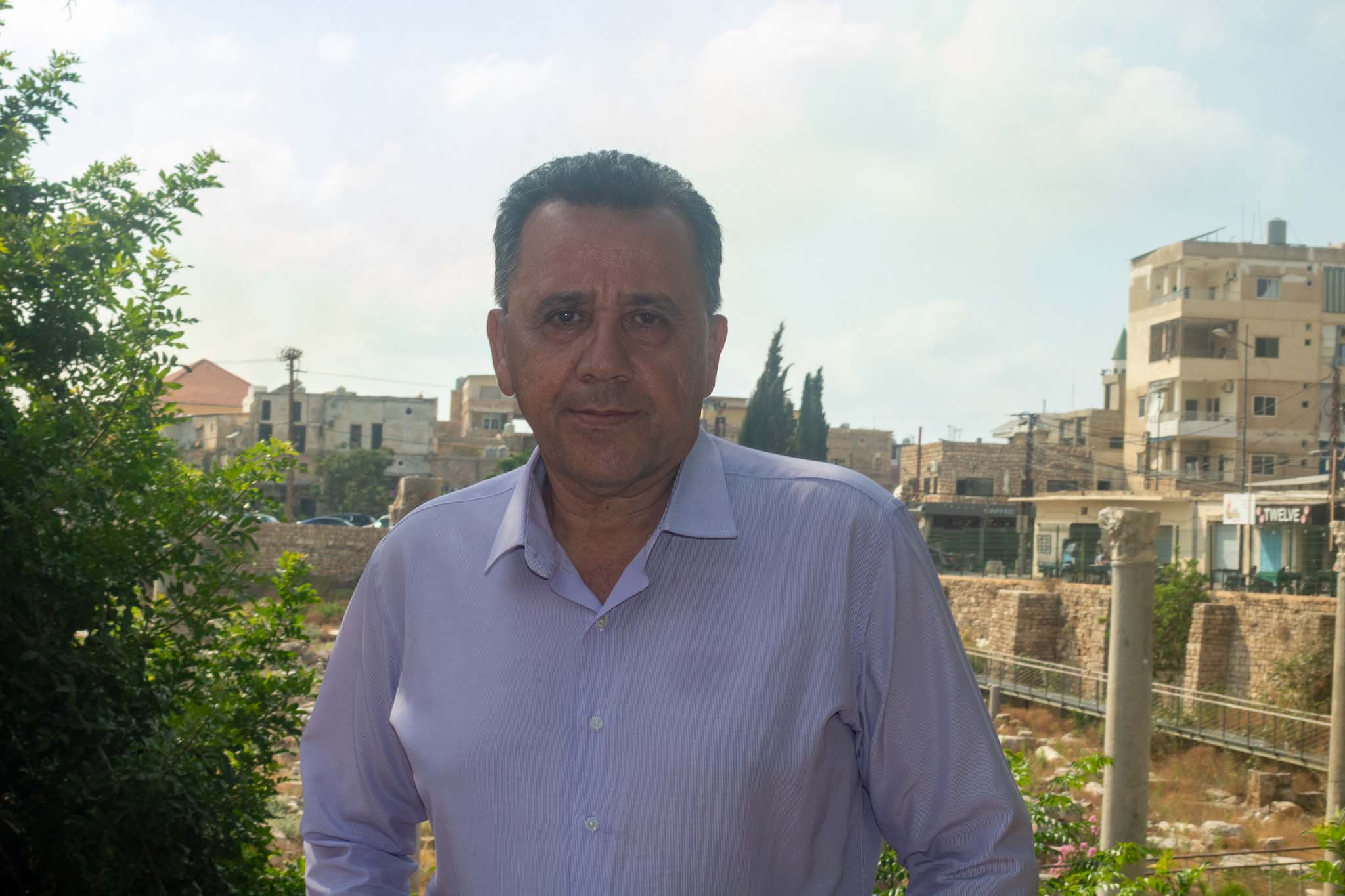
Dr Ali Badawi
I dealt out thank-you cigarettes to Badawi and his colleagues, reluctantly accepted my fourth espresso of the day, and took a seat beside him under the shade of vibrantly blooming oleander bushes overlooking the ruins to begin our interview.
“The heritage of Tyre is its identity,” said Badawi. “So everything – what we call archaeological sites sometimes, historical towns, the harbour – all of these are parts of the identity of Tyre and the people of Tyre themselves. And also, because it is a World Heritage Site, everything here is part of the international heritage that we all have.”
He explained that the Lebanese people had understood the critical risk posed to the city– especially the archeological site where we sat – since the 1920s, when colonial French troops took over parts of Tyre and later bombarded locals in the city. The city underwent attack after attack: it was occupied by French Nazi collaborators and later liberated by Indian and Australian troops in World War II.
It took in thousands of Palestinian refugees following the Nakba and underwent Israeli shelling in the process. Subsequently, it was the site of many firefights during the first and second Lebanese civil wars, and was afflicted by Israeli attacks and the Israeli invasion of Lebanon continuing to the modern day.
Arguing its long history of suffering violence, Lebanon successfully designated 73 cultural sites, including Tyre, under the 1954 Hague Convention for the Protection of Cultural Property in the Event of Armed Conflict, which mandates the protection of cultural heritage during times of military conflict. It demands all parties involved in a conflict coordinate not to use or allow anyone else to use a historical site for military reasons.
Tyre’s inscription under the Hague Convention was represented by several signs posted around the historical site, bearing the emblem of enhanced protection: a black and white hourglass shape with a red border. I asked Badawi what the effects of protections mandated under the Hague and UNESCO looked like on the ground, pointing to a sign nearby. He looked out at the crumbling columns and sighed before answering.
“Does any of it really, fully protect these sites?” he said. “No, it doesn’t mean full protection. Definitely not in the case of Tyre. It’s possible that you didn’t actually see what happened as a result of attacks here. For example, you see the colonnade here? Some of the columns fell, or the capital [top of the column] fell from the column onto the floor.
“There were also some big metal elements that, as a result of the bombings, exploded and destroyed some of this site. Many other protected places [in Lebanon] have been completely demolished. So the international protections that are available might not always be helpful, but I think it is our duty to try.”
HISTORICAL SITES
Nearby residential buildings and civilian infrastructure were also hit, and we could see the wreckage from where we sat. Badawi said he wasn’t surprised that historical sites were attacked – “We know the people that we are dealing with here,” he said – and explained that there were emergency protocols in place to protect artifact collections, which were mostly successful. But when it came to entire archeological sites like in Tyre, there was no saving everything; only “trying our best to minimise the effect” of severe damage.
“When the most recent attacks started, everything we knew could be done was done,” he says. “But we knew at the same time that it may not work. This is war, and it is really a tough war. We have to think about what could happen here. We look to Gaza: the demolishing and the genocide. That total destruction of culture and property could happen in Lebanon. But we all do our best every day.”
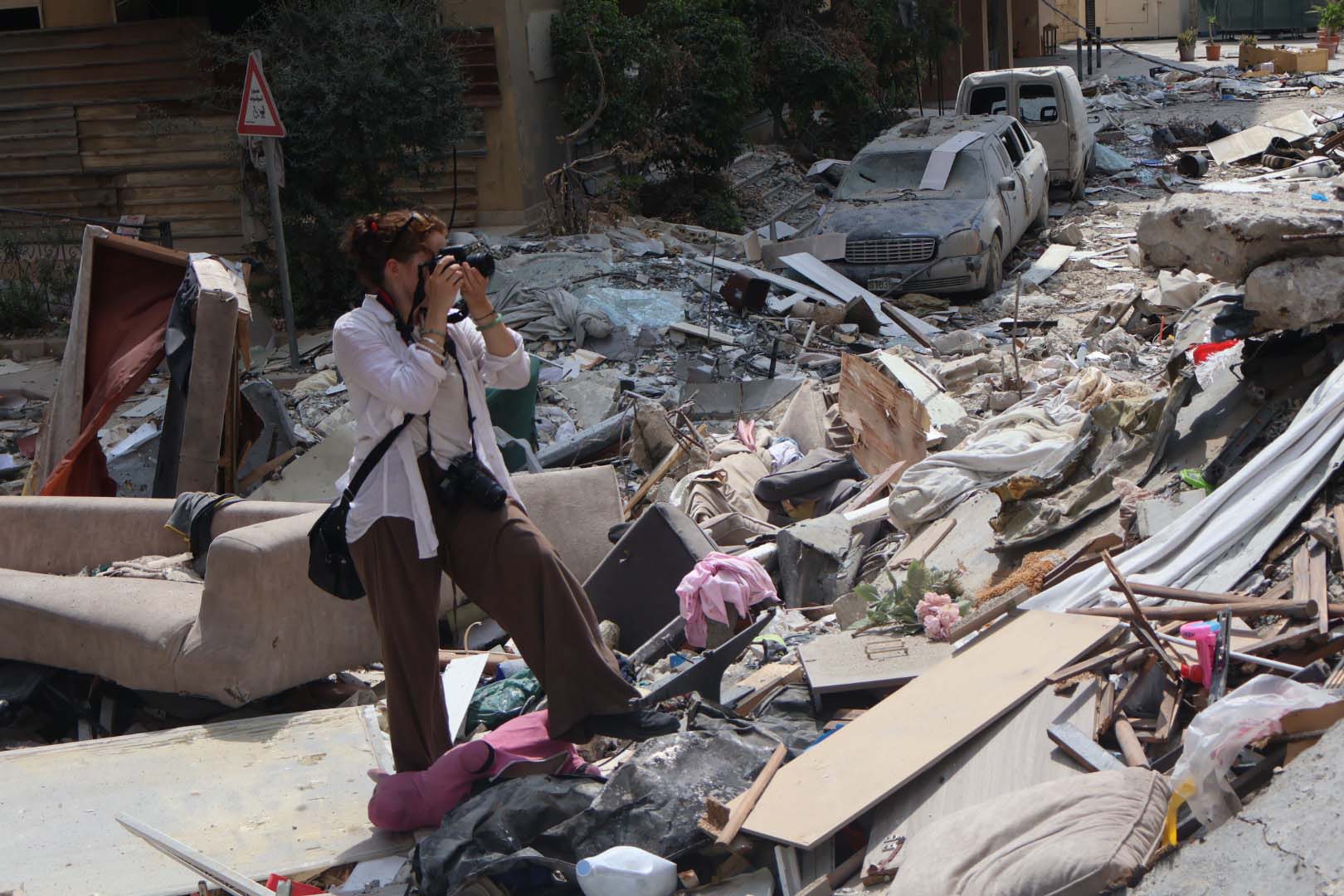
Chloe Craft in Tyre
When asked what message he had for the international community in terms of preserving sites like Tyre, he shrugged. I pressed, asking if he believed more diplomatic pressure was needed to achieve more concrete protection, and he ashed his cigarette with a huff.
“I will tell you frankly, I think we have put too much into pushing for these international protections, despite what is happening to the sites even now, to call it diplomatic pressure,” he says. “Our Ministry of Culture has been doing so many things and making so many calls with ambassadors and high-level nationals. We believe they could help us to minimise damage to our heritage sites, so maybe we can call that diplomatic pressure. But we are still so worried.
“UNESCO and many other entities all over the world have published statements saying they are also worried about this history here. So we are depending on diplomatic pressure. We just hope the international community would remember us more and that diplomacy will help us be independent in the future.”
Badawi paused, then added, “Actually, this is not about us. It’s not about the Lebanese government. I mean, this city could belong to any state, but that’s not even the point. It is a human history at this site. This is my heritage. This is your heritage.”
I thanked him profusely, and on my way out, he pointed to what I first thought was some kind of discarded pile of burnt scrap metal. “That is my car,” he said with a laugh. “After it was bombed, I needed somewhere to keep it. I thought I would just park it here. And then they bombed here.”
From the historic site by the sea, I walked along one of the main coastal streets, passing a sprawling refugee camp on my way. Tents were draped with layers of woven fabrics, thick plastic sheets, and UN-branded tarps. In a dense forested area between streets, a fire had started.
Children were gathering by the roadside to watch. I watched with them for a few moments, before making my way through the winding streets of the old city to meet musician and music teacher Zeina Ibrahim at her home. Ibrahim welcomed me, a translator, and a local guide into her home, insisting we each take a bottle of soda and make ourselves comfortable.
LOVE OF MUSIC
It was clear from the moment we entered how much she loved her hometown. From a tiny figurine of the columns from the heritage site on her desk, to the locally made ocean-themed decor, to the traditional ceramics and textiles of the region in every corner. She sat in a chair by the window, and the translator and I sat side-by-side on a couch next to her. I started by asking how she first became interested in music. She smiled from ear to ear as she answered.
“When I was little with my mother, if we were shopping somewhere in a souk, I would stare at the instruments inside the shops, fascinated,” Ibrahim explained. “And then during ceremonies when music was played, I would listen carefully to each instrument being played apart from the others, so that I could distinguish between instruments. I wanted to learn them all. Because of this, I say that I was a musician from my early childhood.”
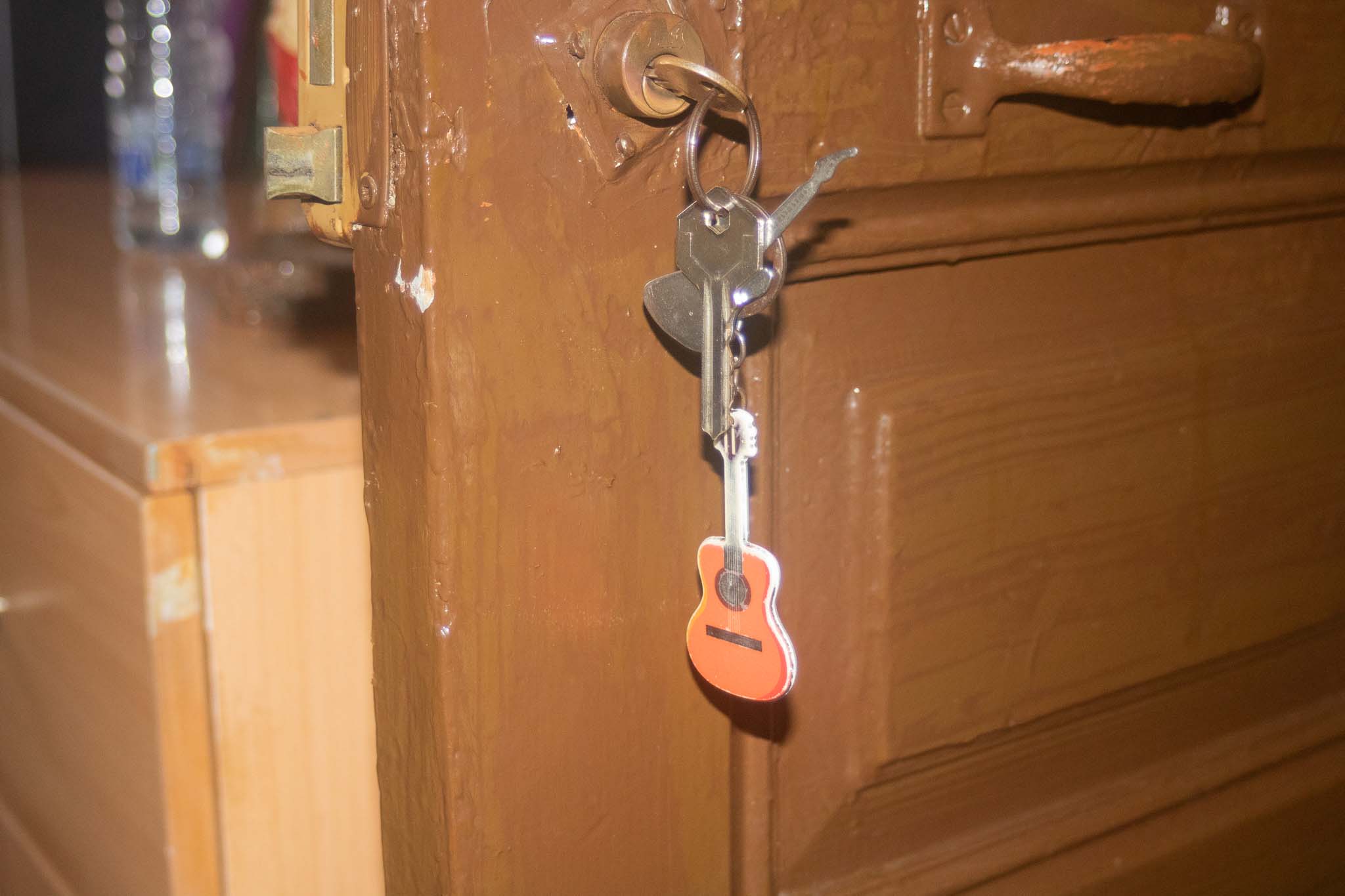
Zeina's keychain
She said that she likes all different types of music, but she loved music from Tyre above all others. She named old Arabic singers like Umm Kulthum and newer ones like Majida El Roumi, but said her current interest was in Western classical music. She paused to hum an old Arabic song, swaying with a content smile, and repeated that the best music for her to listen to and play was any music that comes from Tyre. I asked her what the music meant for her.
“Music, for me, is a message for people unlike anything else. It is a mix between beauty, emotion and culture. So through music, I can send a message to human beings and give people emotions to feel.”
THEATRE GROUP
She explained that she is an active member of a theatre and music group in Tyre, which often invites her to play more modern music. While she owns many instruments, practising often on her acoustic guitar and oud, she hadn’t owned an electric guitar. Inspired to try her best to be more involved in her theatre group, she bought one earlier this year. As she spoke, her smile faded.
“After I bought the guitar, the war began,” she said. “From four months ago when it [the 2026 Iran War] began until now, I didn’t play it. The flame turned off. It was only in recent days that I began to play it again. What I am sure of now is that music cannot be taken away from the culture, and I will not play silly music.”
As much of Tyre went north towards Beirut to escape Israeli bombings, and Ibrahim spent most of the time at home with her mother, occasionally leaving as strikes hit near her home, she pivoted to teaching music online. But due to restrictions on the internet in Lebanon, including a ban on many websites and online services with ties to Israel, she has struggled to find a way to create a website and receive payment for teaching.
In the meantime, she continued to post videos in Arabic, English and Spanish on her YouTube channel, @zeinaibrahim1. She showed me an older video of her playing a cover of the Pirates Of The Caribbean theme tune, and the translator remarks, “She’s like the Led Zeppelin of Tyre.” I laughed, but asked her to elaborate on her comment about no longer playing silly music.
“Music is a peace language,” she says. “The message of the music before the war is totally different than after the war began. Before the war, you can play something to give happiness to the people, just happiness. But during the war, since the war affected us so much and hurt us inside, music has a different purpose. We make music talking about nationality, talking about countries. We make music as something to offer to martyred souls. We are sad so our music must be sad.”
I asked her what she meant; surely, music with more joyful themes might lift people’s spirits. She shook her head.
“Even if I travel outside Lebanon, even to Europe, the sadness is built in inside me. Since I am from South Lebanon and my roots are here, I cannot just play something very happy, because the music I play is a part of myself as the player. What is inside me will always be mirrored somehow in the pieces I perform here, or inside a theatre or on a stage.”
Recalling her love for music from her hometown, I asked her to tell me about the songs of Tyre and what makes them special. She told me that “all songs about Tyre touch their soul,” but named a few that affect her more than others. In particular, she mentioned a song by Julia Boutros titled “Ghabat Shams El-Haq” or in English, ‘The Sun Of Justice Has Set’.
“The song basically says, I can sacrifice the south for everything, and I am willing to sacrifice everything for the south,” she said.
When asked about her hopes for the future, Zeina began to cry as she spoke.
“In the situation we have now, we are hopeless,” she said. “We cannot have any hope unless the governments write a real peace agreement and the Israeli army pulls back to their borders and stops striking our country. But before that happens, we cannot talk about hope.”

Zeina Ibrahim
It will take years to rebuild Tyre, she said, if it ever could be rebuilt. But first there must be a peace agreement, and until then, she said she will not see “any light of hope”.
“All we want is to be safe and secure and live in peace,” said Zeina. “We don’t want to get evacuated again, to lose our houses, to lose our lovers, to lose our music.”
DRONE STRIKE
As we reached the end of our interview, Ibrahim paused to glance at her phone. In a WhatsApp channel for Lebanese news, there was a new message with a video of a mushroom cloud over a village.
“They just hit Nabatieh,” she announced.
I later learned that the drone strike in Nabatieh, a city just a few miles northeast of Tyre with a similar wealth of historical sites, killed four people. The Israeli military claimed a car had approached occupied territory and was deemed a threat. The strike, according to Lebanese media, killed a schoolteacher and her mother, alongside a woman working as a foreign domestic worker and a Syrian man. The four people were reportedly returning after visiting their home in Nabatieh when their car was hit with a guided missile.
At the time, it was the deadliest Israeli attack since the announcement of a ceasefire in Lebanon in June, according to the BBC. There have been several more attacks on Tyre since then. Through it all, Badawi has continued to keep a watchful eye over the ancient ruins of world heritage, and Ibrahim has continued to play music heavy with grief and insistent on existence. At the time of writing, a final peace agreement has yet to be reached.
RELATED

- Opinion
- 02 Oct 26
Watch: The Mary Wallopers perform live on Garvaghy Road

- Opinion
- 30 Sep 26
Filmmakers defend NAZA documentary amid threats from Israeli government

- Opinion
- 30 Sep 26
Bono likens Israeli minister to Hitler's right-hand man
RELATED


- Lifestyle & Sports
- 21 Sep 26
Student Special: "Saving money does not have to mean surviving exclusively on instant noodles and blind optimism"

- Opinion
- 20 Sep 26
Dylan Moran: "Time is literally all we have. It’s all we are"


- Opinion
- 17 Sep 26
