
- Opinion
- 19 May 26
An Garda Síochána: "There's no other job like it"








The organisation is evolving and becoming more sophisticated by the day, but – at heart – its mission remains the same: putting in the hard yards to make Ireland a better, safer place.
“There’s no other job like it,” Garda Tara Brady says, with a grin. “Only guards can know what it is really like, doing what is a very varied, often challenging but ultimately genuinely fulfilling job.”
Tara has been a member of An Garda Síochána since 2005. Even twenty-one years into her career, she still talks about it as a vocation. She knew it was what she wanted to do since she was a kid, and her passion for it remains undiminished.
But hers is just one back-story among many. It isn’t as if joining the guards has to have been a lifelong dream. Garda Manus Murphy got there by a completely different route, and he is no less passionate about the role.
“I used to work in retail in Dublin city centre,” he explains. “I had a customer who was a guard. We got talking about the job and he had mentioned that he thought I’d be a good fit for the role. He told me that it was something I should consider if I was thinking of studying further or making a career change.”
The seed was planted, but it took a stint abroad to give it the space to grow.
Manus and his partner spent a year and a half in Australia just before COVID, where his interest in Brazilian Jiu-Jitsu introduced him to a network of Australian police officers. They gave him a first-hand view of what the job was really like for them. It struck a chord.
When the couple came home, Manus decided to go for it. He spoke to serving Gardaí, completed a certificate in policing and applied to a Garda Trainee recruitment competition, the country’s only Garda training centre, where recruits live on-site Monday to Friday across a nine-month, three-phase training programme.
“It’s kind of like going to boarding school for being a guard,” Manus laughs. “You roll in with a big group of Trainees, and get to meet people from all over the country and, increasingly, all over the world. People joining the Gardaí have such a variety of backgrounds.”
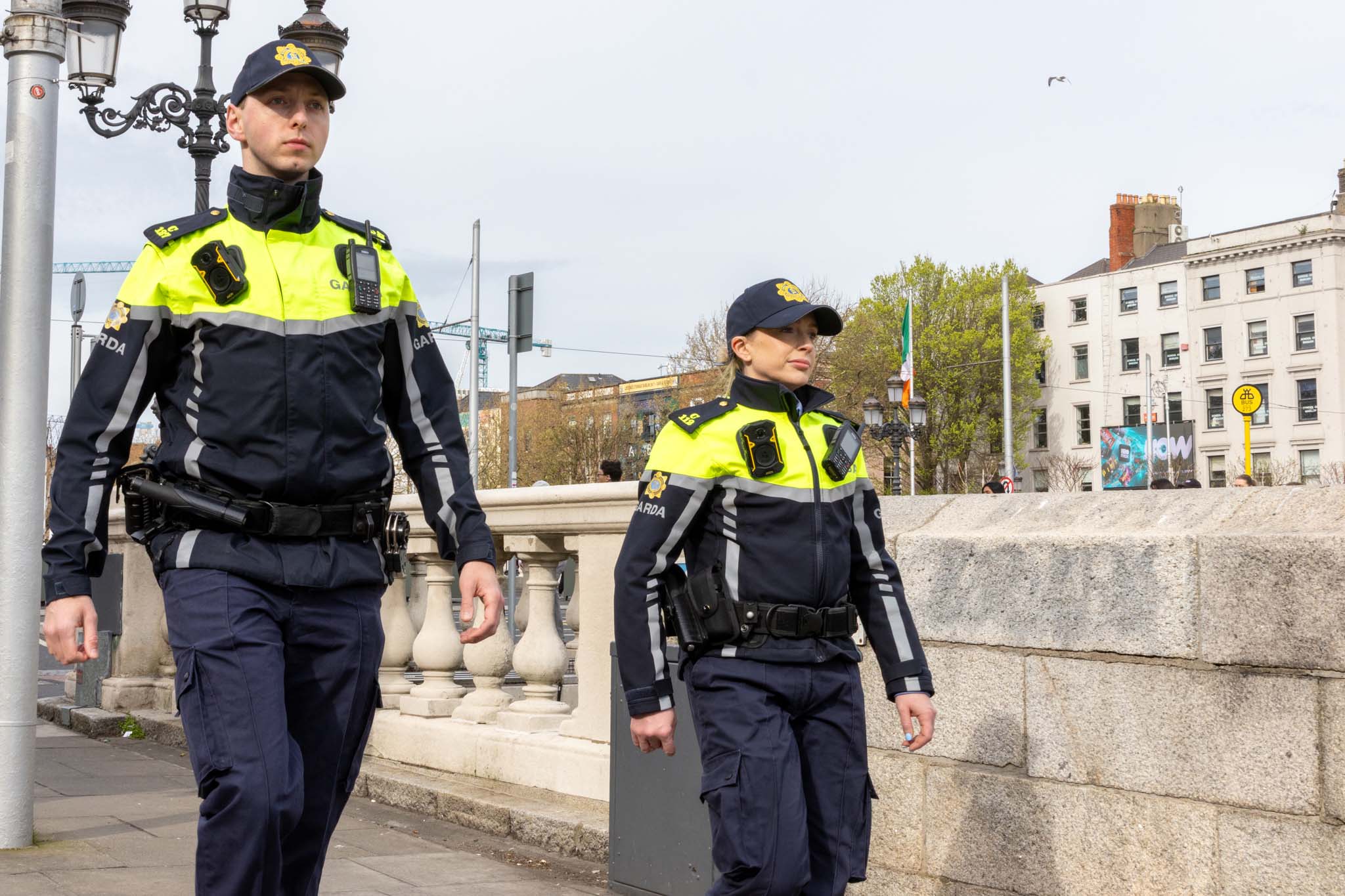 Garda Manus Murphy on the beat.
THREE STAGES
The Templemore programme moves through three stages. Phase one covers the foundations: crime and incident policing, roads policing, station duties, fitness. Phase two involves operational placement, with trainees observing real policing in stations close to home. Phase three covers more complex areas of legislation, including sexual offences, domestic violence, the Misuse of Drugs Act, and mental health.
Manus liked the variety of career paths on offer. Once a guard has logged time on the ground, they can steer their career into specialised units, including roads policing, drugs, detective work, the DPSU (which handles sexual offences), the National Bureau of Criminal Investigation (murders and major incidents), the Armed Support Unit, and specialist units like the dog unit, water unit, mounted unit and air support.
“After getting time on the ground and some genuine operational experience,” he says, “you can identify what areas you might be most interested in or best at. But there aren’t any two days that are the same.”
Ask any guard what the most rewarding part of the job is, and each one will give you a different answer. For Manus, the work pays off in court.
“Getting something finalised in the courts of justice in Ireland, is a very rewarding feeling,” he says. “You’re dealing directly with a victim. They’re going to have certain expectations of you if they were assaulted or if their purse or bag was stolen.
“You identify the suspect, you arrest them, and you’ve charged them. Securing a conviction is very, very satisfying because you can look that victim in the face and tell them. And you know you’ve done a good job because securing a conviction is not easy. There’s a lot of moving parts – a lot of spinning plates you’re directly responsible for.”
So what kind of person thrives in the guards?
“Someone who is positive and active,” Manus says. “Humility is a big part of it. No matter your age or what background you come from, you’re going into a whole new world, not just a job. You need to be humble and know when it’s time to actually listen and learn.”
Having a team mentality is also vital.
“You watch out for each other,” Manus says. “I’ve never worked in a job that requires teamwork so much as the guards, because you just couldn’t manage some tasks alone. You need good people around you.
“I have friends for life in this job. It’s the nature of working in an intense environment that you want to help and support one another. And so we do.
“Whether you’re looking to progress through the organisation, or to move in a different direction in the future, nobody is going to turn their noses up at the skill base you’ll build in the Gardaí.”
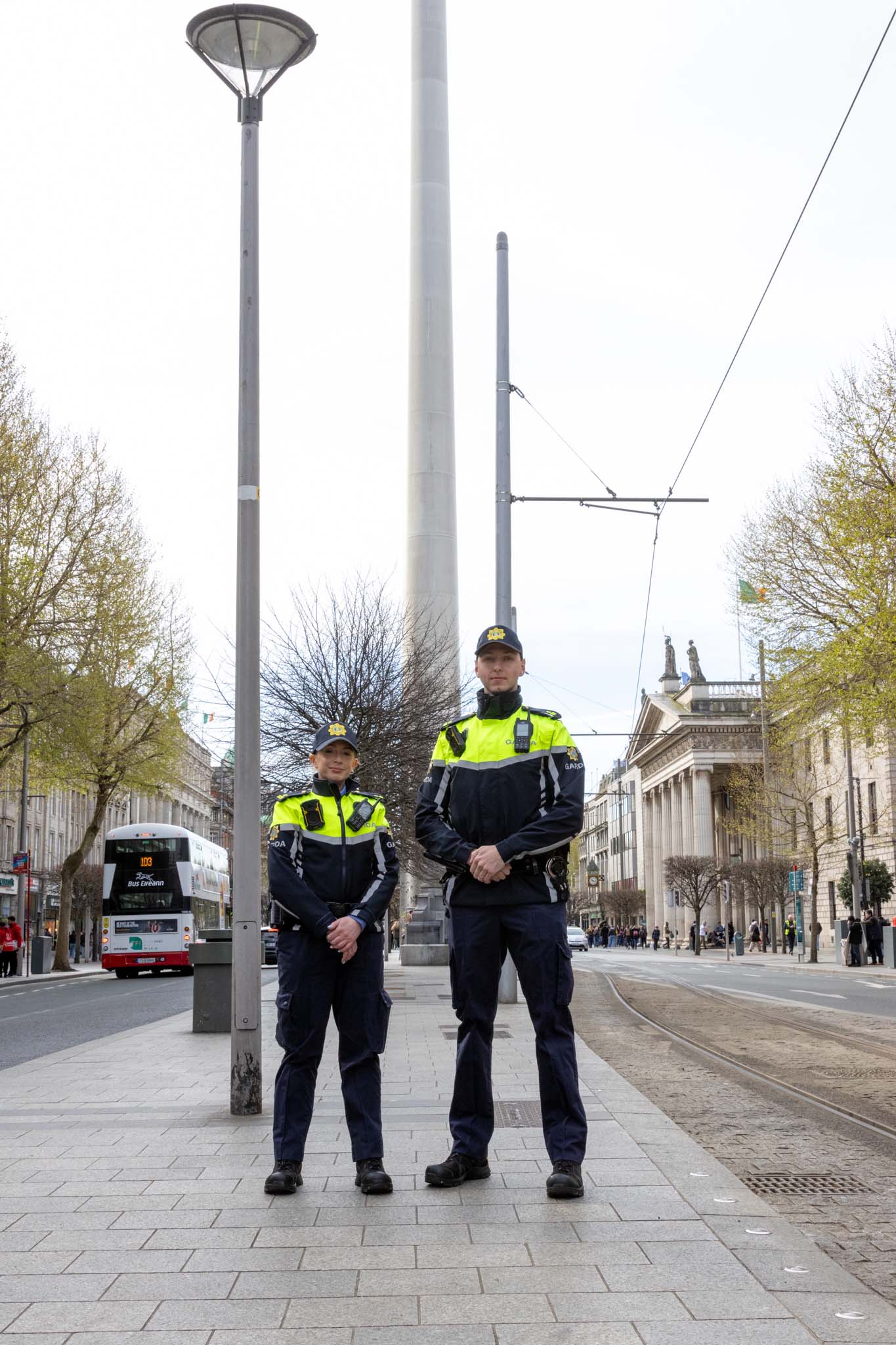 Garda Manus Murphy and a colleague at the Spire.
CALLING CAME EARLY
If Manus is the new wave, Garda Tara Brady is, as she puts it herself, old school.
By the age of 19, Tara was in Templemore. The first station she was posted to was Longford, followed by stint in Ashbourne in Co. Meath, where she worked as an Incident Room Coordinator, preparing files for the DPP under a Senior Investigating Officer.
In October 2025, she transferred to her current role at the DMR Driver Training School in Tallaght, which delivers the essential Garda driving courses, and instruction on vehicles like trucks, personnel carriers, armoured vehicles, jeeps and the water cannon.
For Tara, the calling came early.
“My mother reckons I was five when I started talking about it,” she laughs. “In my five-year-old mind, I wanted a motorbike, a Garda motorbike.”
Over the past two decades, the job has transformed around her.
“I pre-date the internet,” she says with a wry smile. “When I joined, the Pulse system was only starting and everything was handwritten. There were no Stab vests or ASP (batons). We all have our own mobility devices now: phones you can do reg checks through and issue tickets from. From 2005 to now, there’s been huge improvements.”
What hasn’t changed is the human aspect of it. One early lesson, from her own mother, has shaped how Tara carries the uniform. In 1992, when she was almost six, the Brady family suffered a cot death.
“My mother always remembered one of the guards from that day,” Tara recalls. “She said he was just so kind. ‘I will never forget him,’ she said. That’s from 1992. Thirty-three years ago.”
Many years later, when Tara was called out to a similar tragedy, her mother’s words came back.
“A lot of the people you meet are on their worst day,” she adds. “You have to be sensitive. It’s lovely to know that if you treat them right, they’ll remember that for a very long time.”
For anyone weighing up a career in the Gardaí today, Tara’s pitch is simple.
“If you want variety this is the job for you. What other job are you dealing with a house fire one day, shoplifters another day, and then doing community stuff, like celebrating the birthday of a Little Blue Hero – a child with a serious illness. There’s no other job like it.”
Other services are reactive – but the Gardaí are out there proactively working on making Ireland a better place for everyone who lives here.
“It is a vocation. It becomes all-encompassing sometimes, but the balance pays off. And you can always progress – you’re not stuck doing one thing for too long. I absolutely would still join the Gardaí today or tomorrow if I had to make a choice. I’m very proud of the work we do for the community.”
- You can apply to join An Garda Síochána on publicjobs.ie.


![Dublin Rose Suad Mooge: "As a child, I wasn’t looking at [the Rose of Tralee] thinking, ‘That could be me’ – because they looked nothing like me"](https://img.resized.co/hotpress/eyJkYXRhIjoie1widXJsXCI6XCJodHRwczpcXFwvXFxcL21lZGlhLmhvdHByZXNzLmNvbVxcXC91cGxvYWRzXFxcLzIwMjZcXFwvMDZcXFwvMTkxMTAzMzlcXFwvQ2F0X0d1bmRyeS1CZWNrX1N1YWRfTW9vZ2UtMDA2LWUxNzgxODYzNDc2MjUwLmpwZ1wiLFwid2lkdGhcIjpcIjMwOVwiLFwiaGVpZ2h0XCI6XCIyMTBcIixcImRlZmF1bHRcIjpcImh0dHBzOlxcXC9cXFwvd3d3LmhvdHByZXNzLmNvbVxcXC9pXFxcL25vLWltYWdlLnBuZz92PTlcIixcIm9wdGlvbnNcIjp7XCJvdXRwdXRcIjpcImF2aWZcIixcInF1YWxpdHlcIjpcIjU1XCJ9fSIsImhhc2giOiI5OGE3NzRlY2I2MmZkMzVjODU4YzdhMGQ3YzFkNzA2ZjczYTA1MWQzIn0=/cat-gundry-beck-suad-mooge-006-e1781863476250.jpg "Dublin Rose Suad Mooge: \"As a child, I wasn’t looking at [the Rose of Tralee] thinking, ‘That could be me’ – because they looked nothing like me\"")


