
- Opinion
- 30 Apr 26
Irish-Lebanese actor Natacha Karam: "What's happening is absolutely devastating"








With the Israeli war on Iran having expanded to the wider Middle East, Lebanon is among the countries to have come under attack, with dozens killed in the latest strikes. Irish-Lebanese actor Natacha Karam gives her perspective on the current situation, as well as Hollywood’s portrayal of Arab identity.
With Lebanon once again pulled into the world’s headlines, speaking to Irish-Lebanese actor Natacha Karam feels like a way of grounding the story in something human.
What emerges is not a dispatch on conflict, but a portrait of a life shaped by movement, contradiction, and a hard-earned resilience that doesn’t lend itself easily to soundbites. Natacha is on paper, recognisable – the actor from 9-1-1: Lone Star and The Brave, who is drawn to roles of strength and defiance. But that surface only gestures at something more layered – a woman formed between Ireland and Lebanon, between observation and action.
She is also a fighter in the literal sense – eight years training in the orbit of Freddie Roach’s Wild Card Gym in Los Angeles, once home to the likes of Manny Pacquiao, Oscar De La Hoya, James Toney, Amir Khan and Miguel Cotto. Karam’s identity is something lived, carrying history rather than narrating it.
“I think the roles that I am drawn to,” Natacha explains down the phone from Los Angeles, “have a certain tenacity and resilience. That is just a part of who I am, between the blood that’s in my body and the circumstances I was born into. I am a resilient human by nature, and the roles I play are women who don’t take shit. They get knocked down, but get back up again.
“There are parts that I absolutely love, and I endeavour to play more. Then there are other parts that sort of sit on the surface. They never fully go into who these women are, because the [creators] are too busy patting themselves on the back, for what one would call representation of diversity.
“The world is full of different human beings. It’s your choice to ignore them or celebrate them, or to just see them at the bare minimum. So the idea that I’m a go-to person for diverse representations of what Middle Eastern women are can feel a bit reductive.”
EAR INFECTION
What does that mean in practice for the roles she’s offered?
“I don’t often get to play flawed characters,” Natacha explains. “Because people are so worried about misrepresenting the thing they’re trying to give themselves props for. They’re too busy worrying about, ‘I’m going to do this really incredible, un-stereotypical portrayal of an Arab woman.’ But then they get so carried away with making her a superhero that you don’t get to see much humanity.
“With Lone Star, we had five seasons to get to the heart of this human being. And yet, although there was many things we did very well, I championed, encouraged and actually demanded that the writers hired a Muslim counsel to help them with their writing. So, they hired these consultants, the Muslim Public Affairs Council, and then their writing got a lot better.”
Was there a moment when she realised acting was what she wanted to do?
“Since I was about three,” Natacha swiftly replies, “I wanted to be an actor. I would look at people on TV and be like, ‘How did they get there? What do I have to do to become them?’ I was always really into storytelling and reading. I spent some of my childhood in a wheelchair. I think being on the outside of everything, always looking in, made me a really good observer and acutely aware of different people’s ways of being.
“I remember in primary school in Ireland, I was left indoors at lunchtime,” she adds. “They would all be in the playground, and I’d be inside. I was allowed to choose one friend who could stay in the class with me. So I would sit by the window and watch everyone crack on. I did often feel like I was on the other side of a window looking at everyone else living their life.”
There’s more than a hint of the Tyrone brogue in Natacha’s cadence.
She laughs, “Mommy was the first person to ever leave Ardboe in Tyrone. It was in the paper – ‘Oh, my God, she’s off!’”
Taking a job with Gulf Air, Natacha’s mother moved to the Middle East. She ended up working for the Kingdom of Saudi Arabia Royal Flight, which operates a specialised fleet for the royal family and government officials. Later, in Bahrain, she met Natacha’s Lebanese father.
“My Mom’s idea was to have all three kids born in Ireland,” Natacha expands. “My two brothers were. But when she was living in Saudi Arabia pregnant with me, she got an ear infection and couldn’t travel. So, I was born in Saudi, but that’s not a country that you get birth rights for, so I’m not Saudi.”
The family lived in many places in the Middle East, before moving back to Ireland when Natacha was seven, for a series of surgeries on her legs. They continued moving between Northern Ireland – Belfast, Cookstown, Magherafelt – and the Middle East. Natacha started secondary school in Derry, finished it in Dubai.
Many great actors grow up constantly moving, shaping their emotional range.
“It also broadens your horizons and understanding of the world,” Natacha opines. “It’s never just been where I am. There’s always been an awareness that there’s a big world out there, and there’s so many different ways of being or existing – so many similarities and differences between humans and their day-to-day lives.”
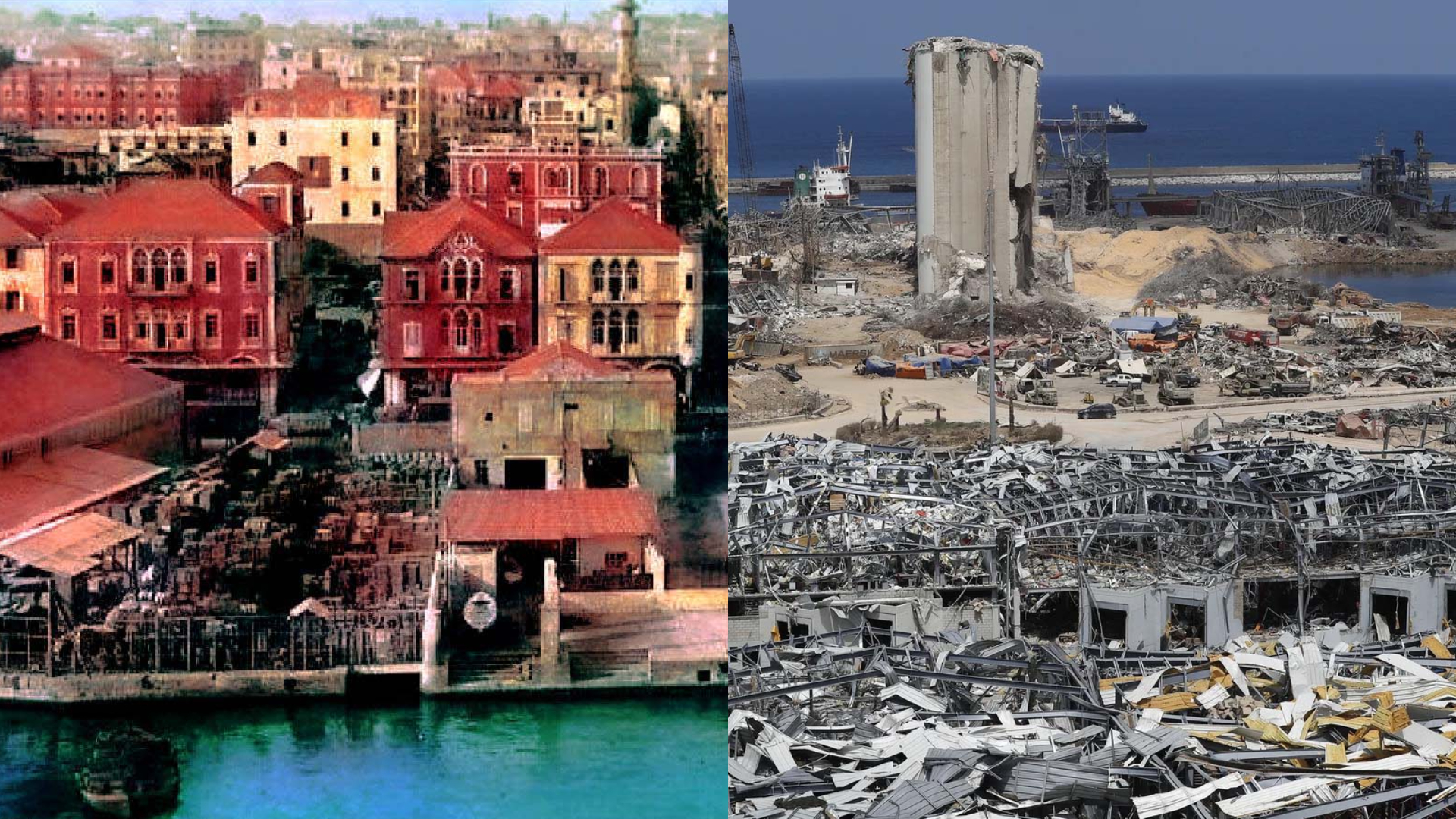 Before and after: Beirut in in the 1920s vs Beirut in 2023.
SEIZE THE DAY
Ireland and Lebanon share longstanding ties through UN peacekeeping missions, diplomatic engagement, humanitarian work and cultural understanding, strengthened by decades of Irish presence in southern Lebanon.
“What’s happening,” Natacha states, “is absolutely devastating. It’s a country that gets blown to bits, dismantled, broken down over and over again. I think there’s a similarity between the Irish and Lebanese in their sheer resilience, and ability to see that life can turn at any given moment, that nothing’s a given. Irish and Lebanese know how to make the most of every moment. As my mom would say, ‘Life’s a bitch, and then you die. So be merry and don’t piss anybody off.’”
Do people expect her to speak about Lebanon?
“It crops up a lot in interviews,” Natacha replies. “Everyone’s afraid to talk about it. It’s like everybody wants to eat the fish and spit out the bones. They want all the Arabness they can take from you, but then they don’t want the truth about what your country is going through.
“Nobody wants to talk about the fact that your family has to sleep with their windows open, because of the shockwaves breaking the glass and injuring them. I think they don’t want to tackle the thing head on. So, it’s like you talk around the thing. The UK is quite different, and Ireland has long stood with both Palestine and Lebanon.”
Do you have family on the ground now in Lebanon?
“Slowly over the years, they have dissipated.” Natacha explains, “But the matriarch of our family, which is my dad’s aunt, she’s still there, and she will never leave. And a lot of the younger ones, over the last couple of years, have found their way back. There used to be loads of them, but a lot of them have gone.”
What do people misunderstand most about Lebanon?
“I think how much joy there is there,” Natacha replies, “and what a beautiful country it is. At one point, Beirut was the Paris or the Vegas of the Middle East. It was stunning. It’s very romantic and the people are just so alive and fun. This idea of oppression is thrown over the Middle East, but there is also so much joy, poetry and beauty.
“Everything could change at the flip of a coin, so when that is your reality, you seize the day and every moment that you have. You make the most of it.”
When I ask Natacha what she thinks is going to occur in Lebanon, she replies, “I wouldn’t want to articulate my worst fear. I’d like to think that Lebanon gets the chance to rebuild as this symbol of resilience. But obviously that’s an optimism only afforded to those who aren’t living on the ground.”
RELATED


- Lifestyle & Sports
- 21 Sep 26
Student Special: "Saving money does not have to mean surviving exclusively on instant noodles and blind optimism"

- Opinion
- 20 Sep 26
Dylan Moran: "Time is literally all we have. It’s all we are"
RELATED


- Opinion
- 17 Sep 26
RTÉ confirms it will not participate in or broadcast Eurovision 2027


- Lifestyle & Sports
- 17 Sep 26