
- Opinion
- 25 Apr 26
1926 Census: "The language that’s used to describe people speaks to a conservative, moralistic, Catholic, patriarchal society"








The recent release of the Ireland 1926 Census offers a snapshot of a newly formed state finding its shape in the aftermath of war and revolution. Exactly a century on, these records do more than document a population – they invite us to encounter the texture of ordinary lives at an extraordinary point in Irish history. Director of the National Archives, Orlaith McBride, tells Will Russell why they’re such a historian’s dream.
The 1926 census was the first taken by the Irish Free State, since its establishment on 6 December 1922. The compilation of the census reflects both continuity with earlier British systems, and the administrative realities of a new state finding its footing.
The 1926 census data was released publicly by the National Archives of Ireland on April 18, 2026, marking exactly 100 years since it was gathered.
Inevitably, in an era long before computers had even been dreamt of, the process was both local and highly manual. What might surprise people is that the cops were centrally involved!
The idea behind a national census is to get a complete snapshot, on a given date of the whereabouts of the entire population of a country, along with whatever other items of information can be accommodated in the form – or equivalent – that people have to complete.
In this instance, in advance of census night – set for April 18, 1926 – 2,000 gardaí, acting as enumerators, delivered household forms to every dwelling in the Free State – from ordinary family homes through industrial schools and psychiatric hospitals to prisons.
The head of each household or institution was expected to complete the return, listing everyone present that night, along with details such as age, occupation, religion, birthplace, marital status and language ability.
On or shortly after census night, the enumerators returned to collect the forms. Where literacy was limited – as was still common, particularly in rural areas – the garda-enumerators would fill out the form themselves, based on oral responses. For this reason, many returns appear in the enumerators’ hands, rather than those of the householders.
Once gathered, the forms were checked locally and often altered by the Gardaí to reflect their local knowledge – and then sent to a central office under the Registrar General. There, clerks undertook the painstaking work of sorting and tabulating the data by hand to produce the published statistical reports. There was no automation – every total was counted, verified, and cross-checked manually.
Given the scale of the operation, there was a mountain of material to be sifted through 100 years later, and digitised for the recent release. By any standards it was a mammoth operation.
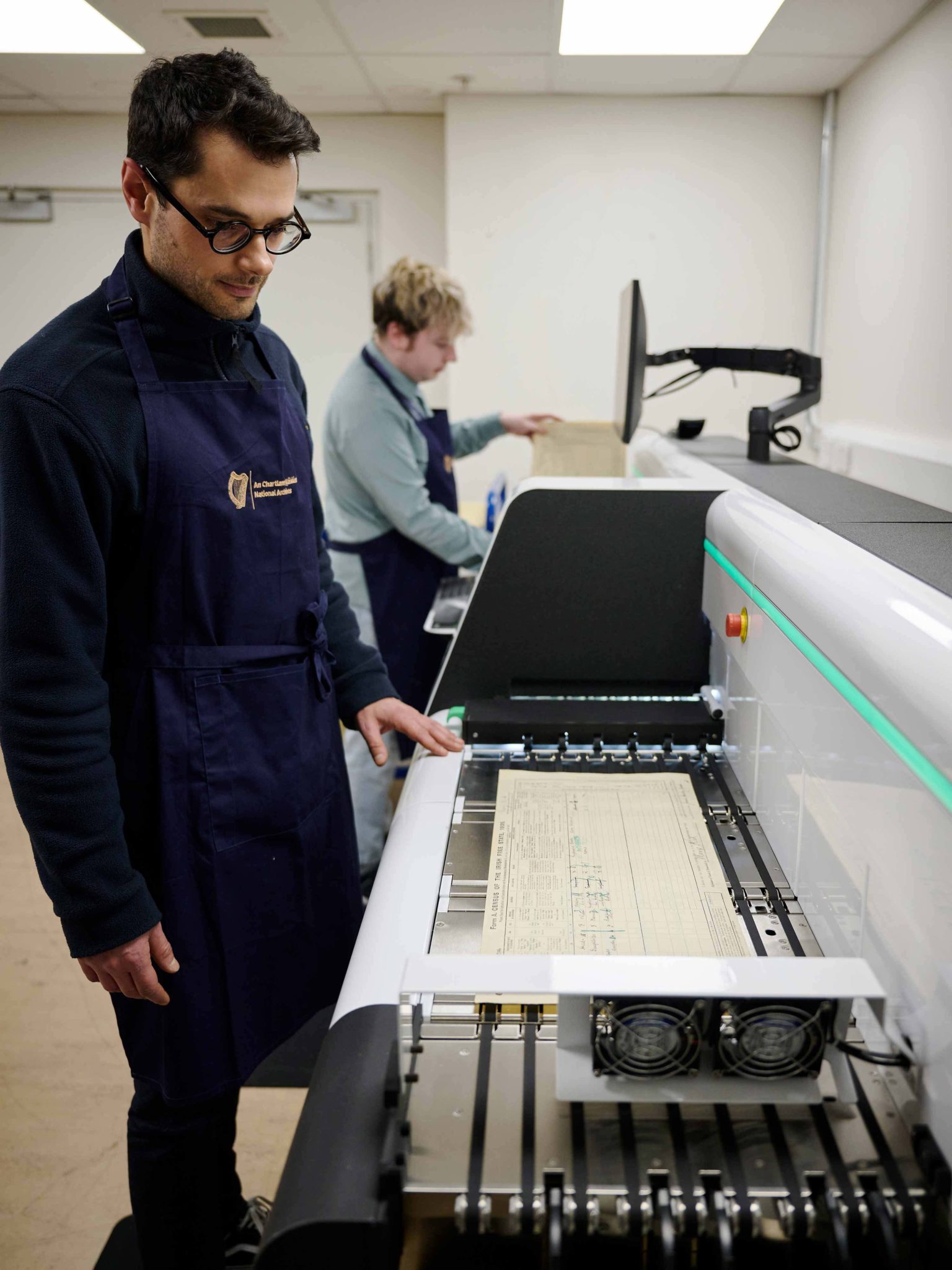
The 2026 release of the information, in digital form, is overseen institutionally by the National Archives of Ireland, which is the body legally responsible for making census records public after 100 years. At the centre of that process, is the Director of the National Archives, Orlaith McBride, who led the project to preserve, digitise, and ultimately release the census to the public, and is the key public voice around its significance and interpretation. It is a project in which she has been deeply invested.
PROTESTANT POPULATION
Orlaith sets the scene. “The 1926 Census,” she explains, “is the first census of the Free State. The last census before it was in 1911, and in those 15 years, you had World War One, the Easter Rising, the War of Independence, the Spanish Flu and the Civil War. Saorstát Éireann, the Irish Free State, was established in December 1922. The pro-treaty nationalists Cumann na nGaedheal were in government, led by WT Cosgrave.
“There was a real intent to make this new state work,” she reflects, “and as part of that, they took a couple of big, bold steps in those early years. The first would have been the establishment of the Shannon scheme and the hydroelectric dam in Ardnacrusha; and then the other, two years later, was to conduct a census of the population.”
For the first time in an Irish census, citizens could legally write their census return as Gaeilge, and were being asked about land ownership, and who was their employer. I wonder which of our present-day assumptions about Ireland in 1926 might be most challenged when confronted with the reality captured in the census.
“I’d say it affirms more than it challenges our understanding,” Orlaith counters. “Ireland was predominantly a Catholic, white, rural, agriculturally-based society. Over half the population was employed in agriculture. So that’s very significant. Also, because of partition, you see that heavy industry is really gone, because it was partitioned off to the northeast in Northern Ireland.”
What emerges, then, is a picture that feels broadly familiar in its outlines – but far more complex in its texture, where the apparent certainties of identity are frequently called into question under closer inspection. For example, 18% of the population assert that they are Irish-speaking, but only 1% of the returns are in Irish, which leads Orlaith to infer that the percentage gulf is due to illiteracy.
A jolting statistic is the decrease in the Protestant population, which declines by 32% between 1911 and 1926. Orlaith points to the significant casualties suffered during World War One, and to the fact that the British military and administration had left the country. She also points to the “inward migration of Protestants going to Northern Ireland, and you also have Catholics from Northern Ireland who are coming to the South to settle.”
When I ask what the census tells us about women’s lives, and probably more importantly what does it leave out, Orlaith says that “many women describe their occupation as ‘Home Duties’. Also 7% of the population were domestic servants. The middle classes were just beginning to emerge.”
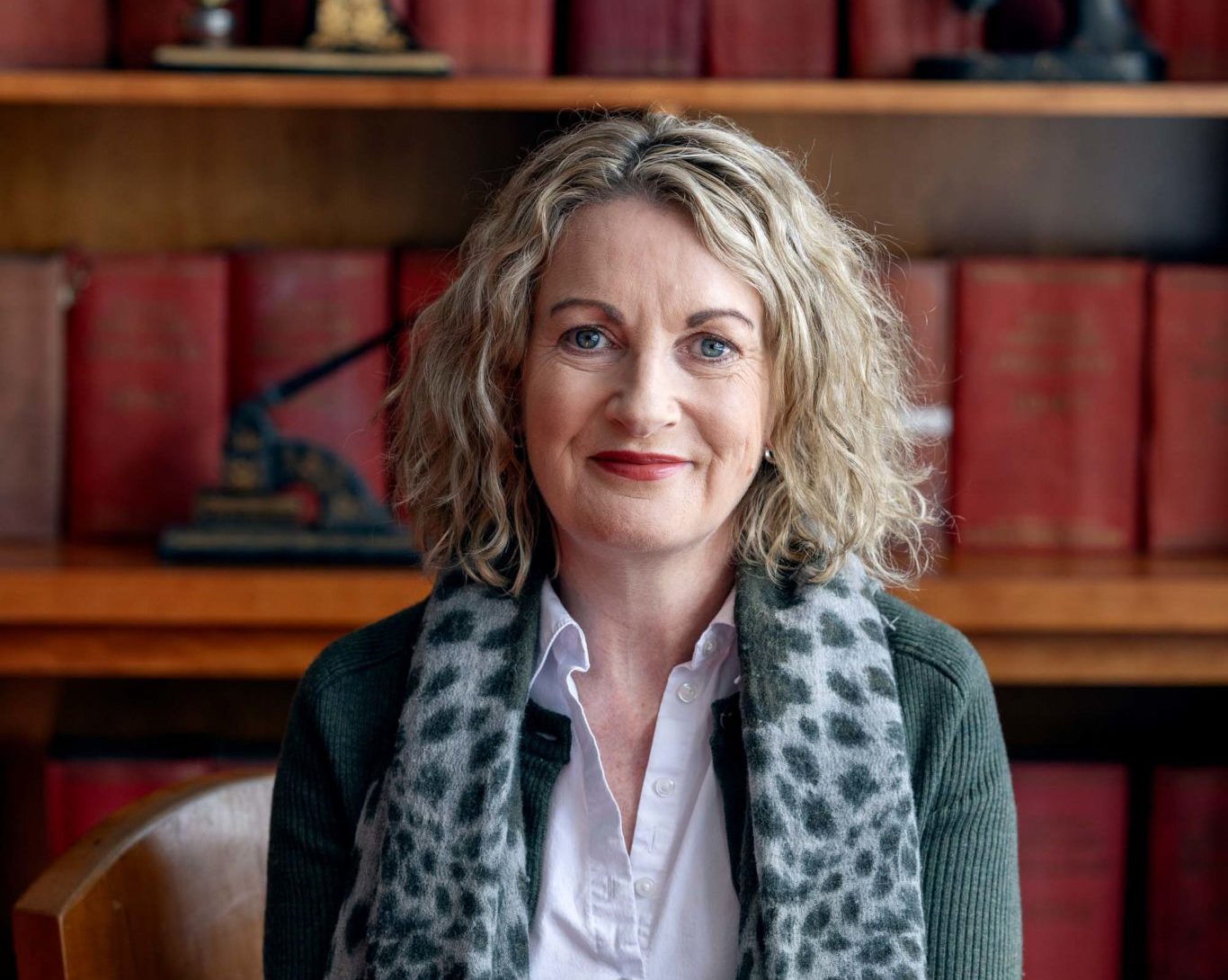
Orlaith McBride. Photo: Cat Gundry-Beck
REMARKABLE FIGURE
There are other big stories here that will doubtless be seen as the jumping-off point for future academic and political studies. Very ominously, the 1926 Census marks the beginning of religious convents being listed as Magdalene Laundries. For example, Orlaith describes “looking at High Park in Drumcondra on Grace Park Road, where the women in the laundry range from 17 years of age. They were all described as ‘Laundress’, right up to the oldest, who was 81 and described as ‘no longer fit for labour’.”
So these were places where inmates – if that’s the right word – were used as free labour...
“We’re also seeing industrial schools with children as young as three or four years of age in them. And you also see families with up to five brothers in Letterfrack, and both parents are alive. So, it isn’t about being sent to Letterfrack for misdemeanours. It is just abject poverty.”
“The language that’s used to describe people,” Orlaith continues, “speaks to a conservative, moralistic, Catholic, patriarchal society. It breaks your heart when you see all these children and their names and their ages, and you know that their parents are, as I say, still alive.”
What do we learn about class divide in 1926 Ireland?
“We don’t have so many of the big houses anymore,” Orlaith explains, “but we still have some, with not only the upstairs-downstairs hierarchy, but there’s a downstairs hierarchy discernible as well. Also, the local economy is sustained by these big houses or hotels. For example, at the Great Southern Hotel in Killarney, you see people coming from all over the country to work there.”
Orlaith also notes that large institutions – what were called asylums, as well as laundries, industrial schools and so on – were not just social fixtures, but economic ones, woven into the fabric of local life in ways that feel uncomfortably revealing.
Another remarkable figure is that the total population in the 26 counties was 2.9 million. That’s two-and-a-half-million less than the 2024 Census figure of 5.38 million – but it is also considerably higher than the lowest point in 1961, when the population dropped to 2.82 million.
HISTORIAN’S DREAM
Offering a unique window into our past, and the early days of the new State, it is a fascinating document of Ireland, 100 years ago. That people can now access it for free on the National Archives website, encompassing a gargantuan total of 700,000 historical records, is a fantastic achievement. How was it done?
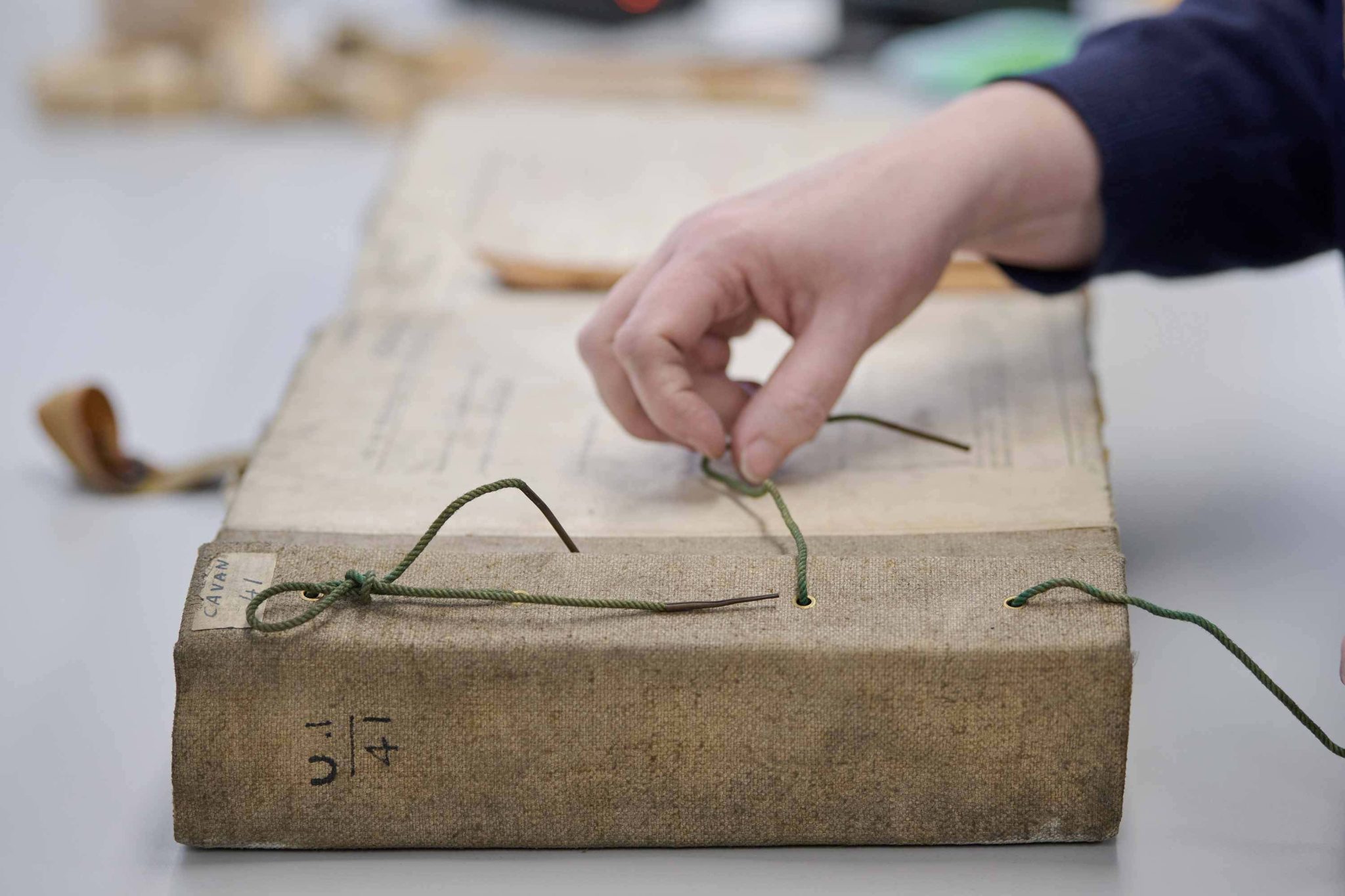
“All the books,” Orlaith explains, “were bound by lace, so we had to take the lace off all 2,400 books. Then every page went through a conservation surface clean, and about 70,000 pages needed direct intervention of mending. Every page went through digitisation. So, we had a team of six doing conservation and a team of six doing digitisation, taking two-and-a-half and three years respectively. We then used OCR (Optical Character Recognition) to help us with the transcription, but we still had a team of 50 checking and re-checking every entry.”
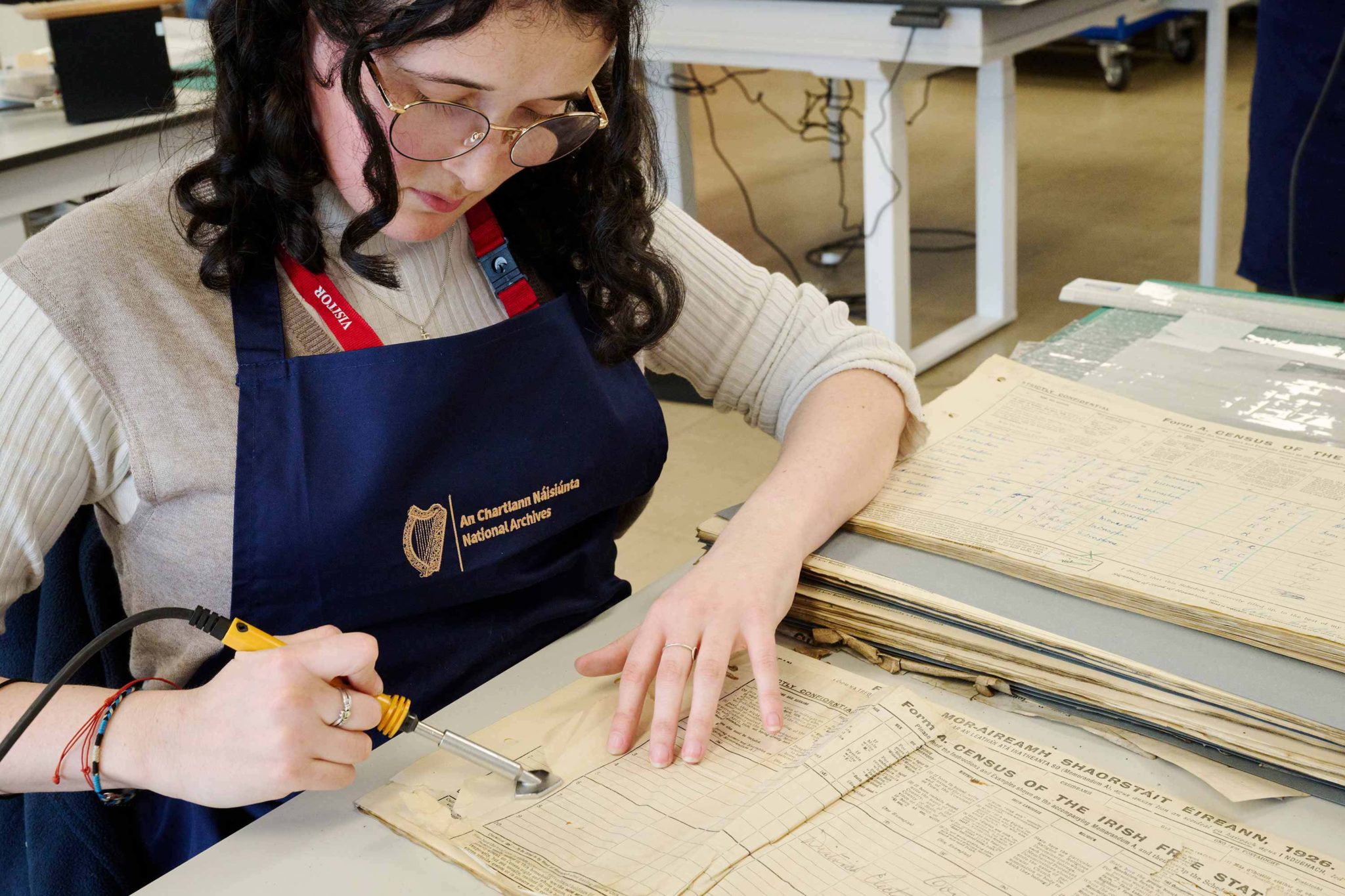
Rather impressively, there are 1,200 centenarians in Ireland who are in the 1926 Census. And 48 of these extraordinary individuals, born between 1920 and 1926, will be ‘Centenarian Ambassadors’ who will share personal testimonies.
“We contacted the Department of Social Protection,” Orlaith outlines, “and I wrote a letter, and they sent it to everybody who was in receipt of a centenarian bounty and was in the old age pension system. These people are in a unique position, in that their lives mirror the development of modern Ireland. So, we’re making a short film with a number of them, that will be put out on the 18th of April, that tells their story of their lives.”
In conjunction with the Centenarian Ambassador programme, Orlaith also details further events to celebrate the public release of the 1926 Census, which include a beautiful book, The Story Of Us; a theatre production, The Good Luck Club, by ANU Productions; and a landmark RTÉ documentary, which will air next month.
The programme also includes major exhibitions running at Dublin Castle, as well as in London and Boston. The exhibition will tour Ireland later in 2026, in partnership with local authorities around the country, and will reach 10 counties, as well as setting up at the National Ploughing Championships. It is a historian’s dream. Time to get reading – to find out where the ‘Russells’ really came from!
• The 1926 Irish Census can be accessed online for free on the National Archives of Ireland website: nationalarchives.ie
RELATED


RELATED

- Opinion
- 14 Aug 26
Spiking In Ireland: It's Time To Take Action


- Lifestyle & Sports
- 06 Aug 26
Ireland Palestine Solidarity Campaign: "No Israeli team should play at WUCC frisbee championships in Limerick"
- Opinion
- 30 Jul 26
