
- Film And TV
- 30 Apr 26
Roe McDermott: "The question is not whether we can separate art from artist. The question is what we do when we cannot"








Roe McDermott details the fascinating new series she’s curating with the IFI, which explores how we live with art that becomes morally complicated.
There is a particular discomfort that has settled into how we talk about art in recent years, a sense that something we once moved through intuitively now requires constant negotiation. I feel that discomfort acutely.
I am a feminist, someone whose work and life are shaped by questions of power, gender and justice, and I am also someone whose sense of self has been profoundly formed by art and cinema. Those two identities do not sit neatly alongside each other anymore, and I’m exploring this tension in a new series I’m curating with the IFI, called After the Monster: Cinema, Art & Accountability.
Our first event on April 16 looked at the experience of being a fan, and how our experience of loving something is troubled when we discover the creator has committed harm. Often this inner conflict is phrased as, ‘Can we separate the art from the artist?’ But to me, that has never felt like a description of what actually happens. We have never approached art in a neutral way.
We politicise identity constantly when it comes to creators who are women, people of colour and queer artists. We speak about “female directors”, “Black cinema” and “queer storytelling”, as if the life and perspective of the artist shapes the work in ways we want to recognise and celebrate.
We build canons around creators, and attach cultural authority to their names. And we know, empirically, that audiences do not engage equally with all identities. Men are far less likely to read books by women, or watch films centred on female characters. Identity is already doing enormous work in how art is made, valued and consumed.
So the idea that we can suddenly extract identity from art tends to emerge only in relation to harm. It is not a neutral principle. It is a coping mechanism. For me, the question often begins in the body rather than in theory. I have found it relatively easy, in some cases, to stop engaging with the work of creators who have committed harm. Not because I have arrived at a consistent ethical rule, but because my experience of the work changes.
It becomes saturated with associations that overwhelm whatever the art is offering. I cannot watch a Woody Allen film without noticing the age gaps; the dynamic between older men and younger women; and the tone that once read as romantic now feeling smarmy or entitled. The films do not feel the same, so the question of whether I should watch them becomes secondary to the fact I do not want to.
I do not engage with Roman Polanski’s work either, but I am aware the experience is different. If I were to watch Rosemary’s Baby or Chinatown, it would likely be easier for me than Manhattan, because the film itself does not provoke the same immediate, embodied connection to the harm. That inconsistency troubles me.
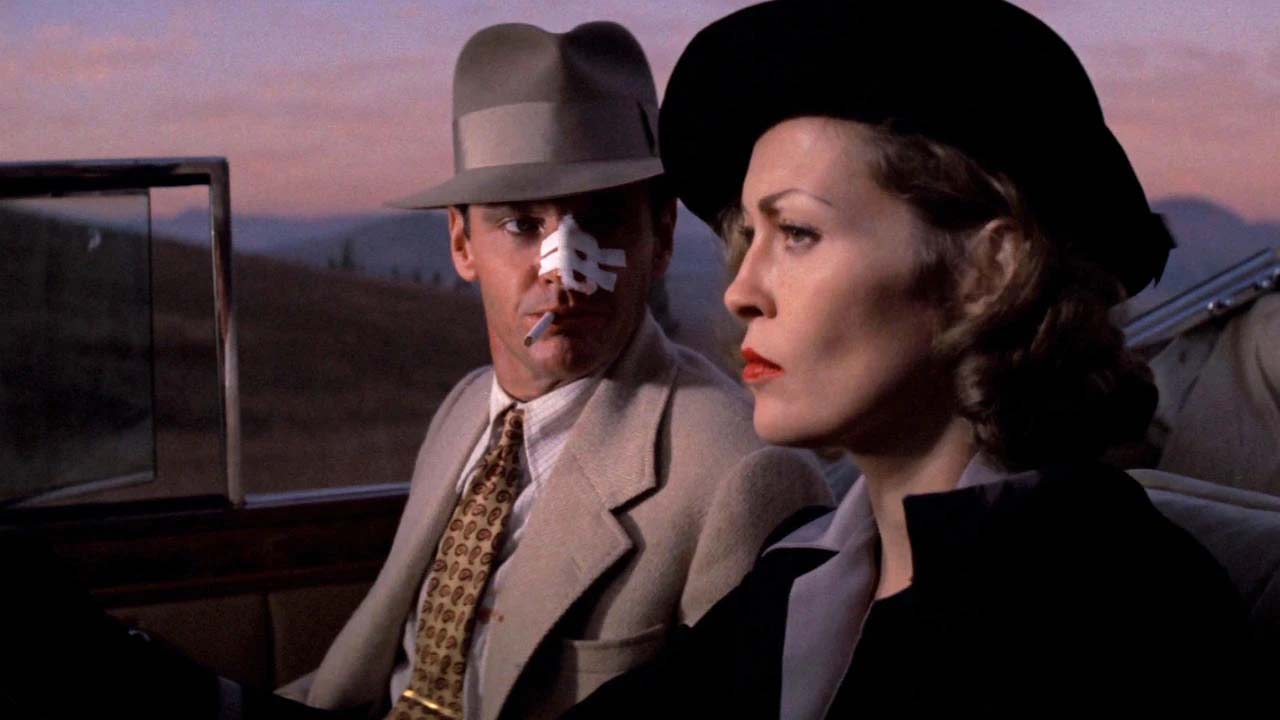
Chinatown
It raises questions about proximity, and how we process knowledge differently, depending on what we have lived through. That is the knot I keep returning to. What does it mean to identify as someone who has been shaped by art – and who also wants to be ethical and attentive to harm?
Because for many people, the relationship to art is not casual. It is formative. People have deep, enduring attachments to the work of figures like JK Rowling, Neil Gaiman, Joss Whedon, Woody Allen, Roman Polanski, Louis CK and Michael Jackson. Even when harm is acknowledged, the attachment does not simply dissolve.
I think we need to be able to hold space for that without collapsing into defensiveness or dismissal. There is a tendency in these conversations to draw hard moral lines, to sort people into those who are doing it “right” and those who are not, but that often obscures more than it reveals. People draw their lines in different places, and those differences are not arbitrary, and are often shaped by experience.
It does not surprise me that many women, queer people, and people of colour often find it harder to continue engaging with certain work. They are more likely to have direct or indirect experience of the kinds of harm being discussed. The distance that allows others to compartmentalise is not available in the same way.
That does not make one response more morally pure than another, but it does suggest that empathy should move in a particular direction. If something feels easier for you to overlook, it is worth asking why, and what it might mean to take seriously the experiences of those for whom it is not.
None of this leads to a neat resolution. I do not have a consistent set of rules that I apply across all cases. What I have instead is a heightened awareness of the tension, of the fact that loving art and wanting to be ethical are not always aligned, and that the work of navigating that gap is ongoing. It requires attention, honesty, and a willingness to sit with discomfort rather than rush to resolve it.
The question is not whether we can separate art from artist. The question is what we do when we cannot.
View this post on Instagram
RELATED


- Film And TV
- 25 Sep 26
FILM OF THE WEEK: The Lost Children of Tuam - Reviewed by Roe McDermott

- Film And TV
- 25 Sep 26
First look images of Charlie Brooker's Blackmere released
RELATED

- Film And TV
- 25 Sep 26
A24 film Primetime features new Phoebe Bridgers song 'On Video'

- Film And TV
- 24 Sep 26
Final trailer for Clayface has been released


- Film And TV
- 22 Sep 26
Andrew Scott's Elsinore wins Audience Award at Toronto Film Festival

- Film And TV
- 21 Sep 26