
- Film And TV
- 28 Feb 26
Saja Kilani on The Voice Of Hind Rajab: "Listening to her voice wasn’t easy, but through it we felt her love and courage"








Oscar and Golden Globe nominated, The Voice Of Hind Rajab tells the harrowing story of how a young child and six other members of her family were murdered in Gaza by the IDF. One of its stars, Saja Kilani, talks about feeling Hind’s love and courage while filming; her own family history; the bond between Ireland and Palestine; and the importance of Arab people telling their own stories.
“The Israeli Army orders the evacuation of the Tel al-Hawa neighbourhood.”
Those are the words emblazoned across the screen at the start of The Voice Of Hind Rajab, the Tunisian movie which set a new Venice Film Festival record by getting a 25-minute standing ovation. It has since gone on to score Golden Globe and Oscar nominations.
It tells the story of the titular five-year old Gazan girl who, along with her uncle, aunt and four cousins, was murdered by the Israel Defence Forces on January 29, 2024 whilst fleeing the imminent bombardment of their home.
The only survivors when the IDF first rake the family car with bullets – the ‘safe route’ out of Tel al-Hawa was anything but – the teenage Layan Hamadeh phones the Palestine Red Crescent Emergency Call Centre on the West Bank desperately seeking help for Hind and herself.
“They’re shooting at us, the tank is next to me!” Layan screams to the dispatch callers as the gunfire erupts again. They’re the last words she speaks. Silence. And then after what seems like an eternity, a child’s voice says: “I’m on my own. There’s no one with me. They’re covered in blood. Please don’t leave me.”
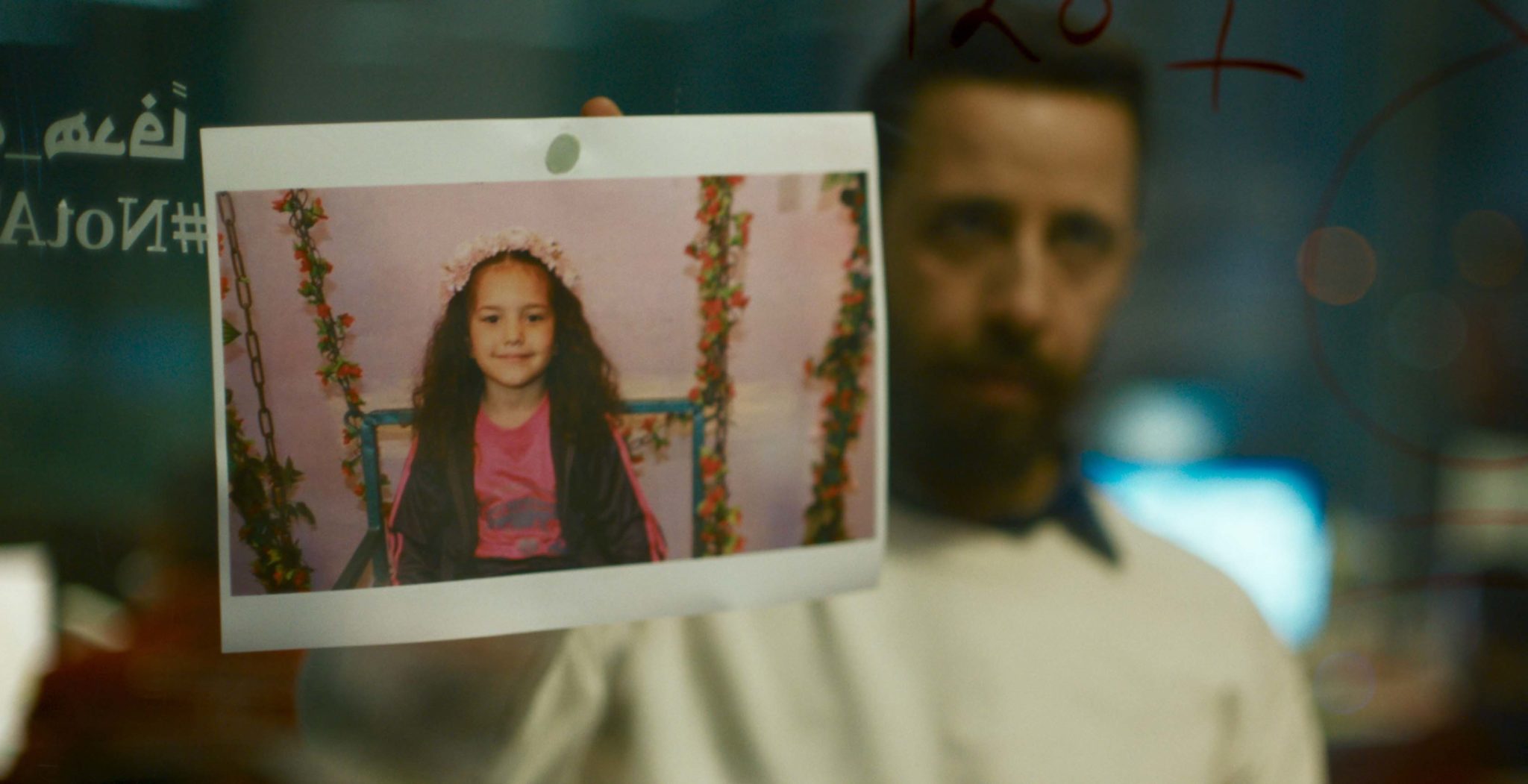
And so starts a three-hour conversation between Hind and Red Crescent volunteers Rana Faqih and Omar Al-Qam. She tells them that she’s in the Butterfly Class at the A Happy Childhood pre-school. They eventually lose contact with the little girl but manage to get permission from the IDF to send a rescue ambulance. As the ambulance arrives, it’s struck by an Israeli missile, instantly killing paramedics Yusuf Zeino and Ahmed al-Madhoun and Hind.
The IDF denied any involvement in the massacre. They were, of course, lying.
“The conversation between Hind and Rana went viral on the news at the time,” says Saja Kilani, the Jordanian-Palestinian actor who plays the latter. “For twelve days after the incident, we didn’t know what had happened to her. People were online trying to get information – the hope being that Hind was still alive. Eventually we found out that, no, she wasn’t. The truth is that tens of thousands of children have been indiscriminately killed in Gaza – and despite talk of a ‘ceasefire’, it hasn’t stopped.”
Asked about her own family history, Saja tells me that, “My Mum’s side is from Jerusalem and my Dad’s side is from Nazareth, so mine is a fully Palestinian background. My grandparents were kicked out, though, in 1948 during the Nakba and moved to Jordan which is where I was born. When I was 15, we moved to Toronto in Canada, which to say the least was a culture shock!
“My Mum’s cousins are one of the few Palestinian families still living in Jerusalem.There’s this beautiful thing there where Muslims hold the keys to the churches and Christians hold the keys to the mosques. So every morning they go and unlock one of the churches.”
The Voice Of Hind Rajab is written and directed by Kaouther Ben Hania, a Tunisian filmmaker whose work Saja has long admired.
“I love how she blends documentary and fiction,” Kilani resumes. “She did that in her previous film, Four Daughters, which I highly recommend; it’s on Netflix. It’s one of those movies which leaves you in total shock. I was silent for two hours after it. Honestly, I couldn’t speak.”
Focussing on the real life radicalisation of Rahma and Ghofrane, two teenage Tunisian sisters who left home to join Islamic State in Libya, it is indeed a must-watch.
“When my agent told me I had an audition for a project of Kaouther’s, I couldn’t believe it,” Saja resumes. “When I then met her, I had to really try and stop myself from being starstruck! It was only after filming that I admitted my admiration, which grew even more during the shoot. She’s one of those directors who’s so passionate but also down to earth. First on set, last to leave, very focused – she has this specific vision and you can only respect her.”
Saja auditioned blind, not knowing what the film was about.
“There was no script, she just gave a description of what she wanted – which had nothing to do with the phone call – and you had to improv,” Saja explains. “What she wanted to see from me was my emotional side, which made total sense when she revealed what the film was about at the callback.”
In similar fashion to Four Daughters, all the Red Crescent volunteers are played by actors while the call they’re responding to from first Layan and then Hind is real. What was the mood like on set?
“You’re surrounded by actors who are Palestinian. The extras in the background are Palestinian students who were studying in Tunis. The crew are Tunisian – who in my opinion are even more Palestinian than Palestinians! Everybody was there with so much respect for the story and wanted to tell it in a way that really honoured Hind and her family. I’m not going to lie – listening to her voice wasn’t easy but through it we felt her love and courage.”
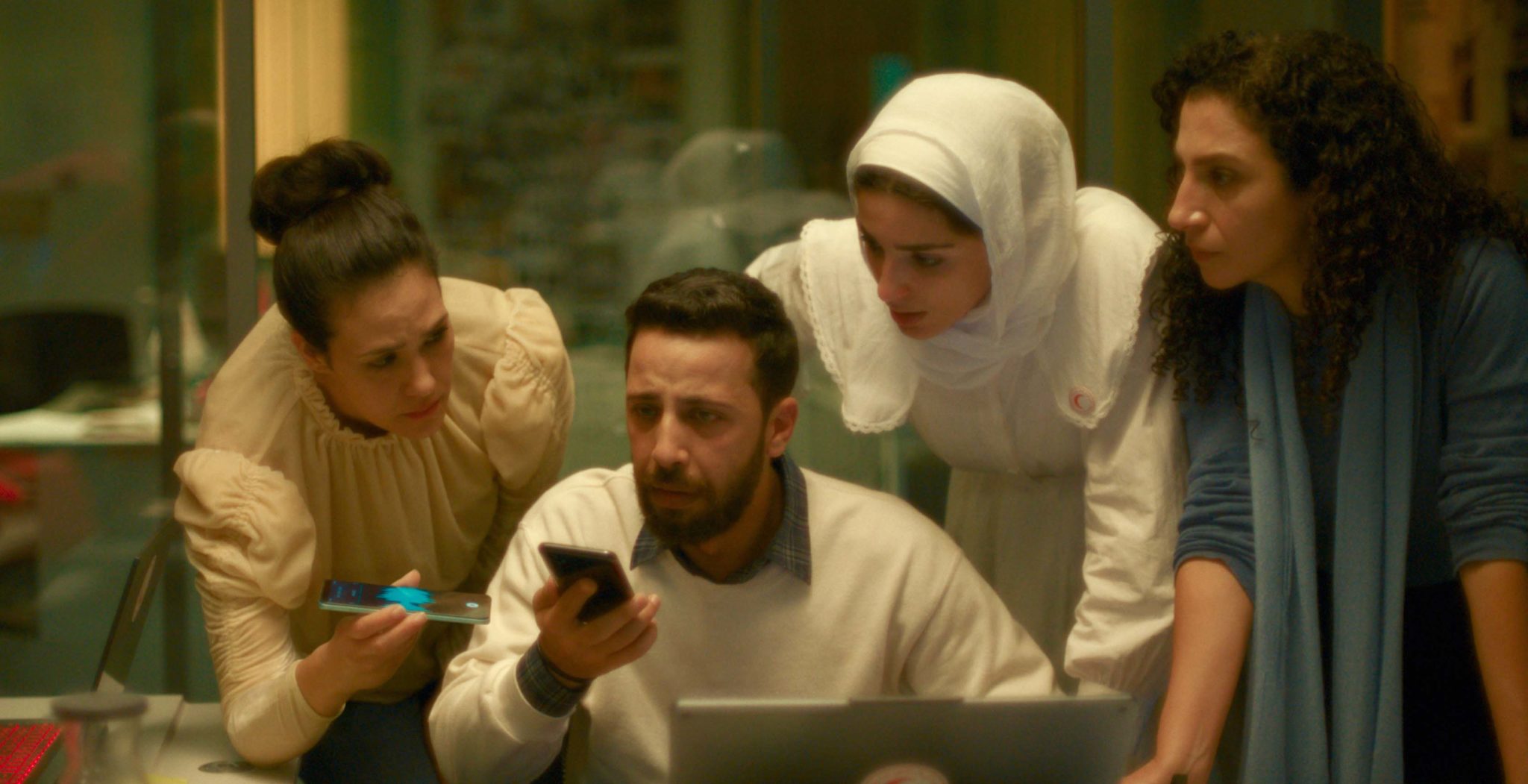
Did Saja meet Rana before playing her?
“The first thing I did after receiving the script was get in contact with her. We didn’t meet in person, though, until a few months ago in Qatar where I am right now. The Doja Film Festival not only invited the Red Crescent team, but also Hind’s mother so it was very emotional for all of us.”
The Voice of Hind Rajab ends with documentary footage of the blown up ambulance and car, which investigators found had 355 IDF bullets pumped into it.
We also see Hind’s mother, Wesam Rajab, standing over the dismembered bodies of her daughter and five other relatives.
Has she somehow managed to find a way through the terrible darkness?
“I was nervous meeting her because I didn’t know how to approach things - what do you say to somebody who’s lost so much? I was supposed to meet her one evening but we ran into each other earlier in the day, she saw I was getting quite emotional and she held me and said, ‘We’re not going to cry, we’re going to be strong.’ For that to come from her… it’s a strength I don’t think I’ve ever experienced before. It’s contagious; she’s very courageous and a strong woman. She understands now that Hind’s voice is not only representing her daughter and other children under occupation, but also anyone who’s been treated unfairly. She has wisdom that’s unheard of. Despite what’s happened she loves life and is going to as many places as she can to talk about Hind.”
Wesam Rejab has subsequently said: “I lost my daughter, my comfort, but I have not lost my humanity or my purpose. I stand here to be their voice when they’re silenced. To tell the world: Save the childhood of Gaza before its last light goes out.”
Where was Saja when she heard the news about October 7 attacks – and what was her gut reaction to them?
“It was my sister’s birthday and I was in Toronto,” she recalls. “It was definitely one of those moments where you sit and watch and try to comprehend the enormity of what’s happening. I couldn’t get my head around it.”
I’m never exactly sure what Executive Producers do but The Voice Of Hind Rajab ones include – wait for it – Brad Pitt, Joaquin Phoenix, Rooney Mara, Jonathan Glazer, Spike Lee, Alfonso Cuarón, Michael Moore and Jemima Khan.
“It was very important for this film to travel outside of the region and have names like theirs to amplify it,” Saja reflects. “They joined after the film had been completed and edited, so they didn’t have a say in the creative side of it. They just watched the film and wanted to push it as far as they can, which is so beautiful and we’re grateful for it.”
Would Palestinian people generally be aware of how much love and support there is for them in Ireland?
“Oh yes, definitely,” Saja instantly replies. “When you see a country that’s unfortunately had its own experience of genocide, like Ireland has, you feel a deep sense of solidarity. How similar and connected we are is very important, so please keep doing what you’re doing for us. I’ve never been to Ireland but I’d love to visit one day.”
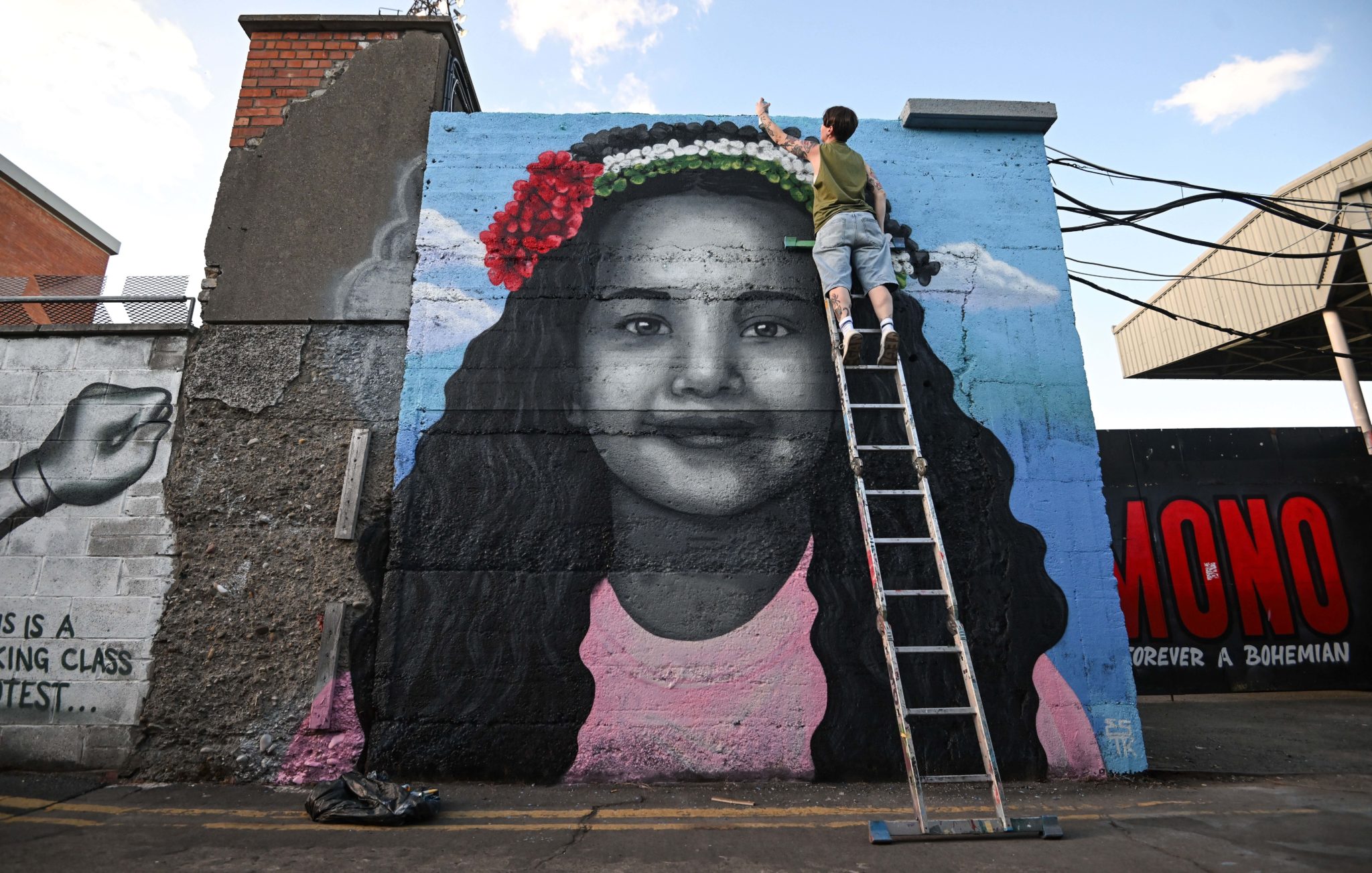
Emmalene Blake's mural of Hind at Dalymount Park
Over to you film festival organisers… In a recent Vogue Arabia cover story – the magazine is based in the UAE and has ruffled conservative feathers with its women’s rights agenda – Saja said: “The Western media’s portrayal of us is never right because it’s someone else telling the stories.” Does she feel that the success of The Voice Of Hind Rajab could be the start of something significant in terms of Arab filmmakers accessing foreign markets?
“Yes, absolutely,” she nods. “Besides my strong connection with the story, I really admired that it was written by an Arab. It’s time that we tell our own stories rather than somebody else doing it for us. For years on end, we’ve had to watch other people’s versions of who they think we are – and them getting it wrong. Now when you see films written by us, directed by us and acted by us, you’re finally getting the truth. I hope this opens the gates for not just trauma drama but anything based on true stories including comedy because, you know what? Arabs like to laugh too! That should be the case globally. Let countries speak their own truths.”
As part of their piece, Vogue Arabia introduced Kilani to Plestia Alaqad who last year penned The Eyes Of Gaza: A Diary Of Resilience, the story of a normal 21-year old woman trying to navigate her way through abnormal levels of human tragedy.
“She’s an incredible Palestinian journalist. We’d followed each other on social media but it wasn’t until Vogue Arabia put us together that we spoke. A lot of people who come out of war-torn situations have unfortunately had to age and mature prematurely, and Plestia again is an incredibly strong, brave woman. It’s the same with Hind - when you hear her talk, you can’t believe she’s only five but being under occupation does that to you.”
Next up for Saja is Chronicles From The Siege, the latest film from actor-director Abdallah Alkhatib who’s also starting to make waves internationally.
“It premiered at the Berlin Biennale this month. We actually shot that before … Hind Rajab but it was in post-production for a couple of years. It’s a feature but comprising five shorts which together tell the story of the director’s life under siege from the Syrian Army. He’s a Palestinian raised in a Syrian refugee camp where he experiences cold, hunger, a lack of blood, love and addiction. He has a dark comedic sensibility, which I think people are going to love.”
Whilst now rubbing shoulders at the Golden Globes with the likes of Mark Ruffalo – “I’ve wanted to meet him for so long and thank him for his humanity”, she says – Saja started out with very different career ambitions.
“The initial route I wanted to pursue was Law School but whilst doing my undergrad I took Theatre because I wanted to stay sane and that ended up being one of my majors,” she explains. “I did an internship at a law firm and realised it wasn’t where I saw myself, so I went to film school where I really studied the craft.”
She cites two people as key influences.
“I’m very inspired by Viola Davis who’s stood up for people who’ve been historically misrepresented. Being a boxing fan, another person I deeply admire is Muhammad Ali. He was so ethical throughout his life.”
When not filming, Saja likes to write poetry with one of her recent works, Dear Vitiligo, striking a deeply personal note.
“Vitiligo is a condition I grew up with, which kills the cells that give off pigmentation and determine your skin colour,” she explains. “Those cells protect you from the sun, so you have to be a bit careful with exposure to it. It can cause white patches of skin which, with social media deeming what is beautiful, made me feel very insecure. When I forgot about it was when I was on stage or in front of the camera portraying other people. It hit me that it’s all in my head and, because it’s just an aesthetic thing and not harmful, I’m not going to let it affect my life.”
Saja recently posted another poem which underlines much of what she’s said to us today: “I am a woman of Arab descent/ I speak in English/ But I dream in Arabic/ And what a picture I paint with my accent.”
• The Voice Of Hind Rajab can be seen on March 3 & 8 in the Light House Cinema, Dublin. Check thevoiceofhindrajabfilm.com for details of other screenings and hindrajabfoundation.org for more news on Gaza.
RELATED

- Film And TV
- 18 Oct 26
Sharon Horgan on exploring middle-age in Youth: "It's the sandwich generation"


- Film And TV
- 08 Oct 26
Trailer released for The Altruists starring Anthony Boyle and Julia Garner
RELATED

- Film And TV
- 07 Oct 26
Trailer released for Elsinore starring Andrew Scott


- Competitions
- 28 Aug 26
