
- Film And TV
- 27 Feb 26
Baz Luhrmann on Elvis Presley: "He’s funny and self-deprecating, goofy even. But he does that to disarm people"








Celebrated director Baz Luhrmann discusses his new extravaganza EPiC: Elvis Presley In Concert, which offers a fascinating insight into the musical icon.
From the candy-coloured heartbreak of Moulin Rouge!, to the champagne delirium of The Great Gatsby and the maximalist fever dream of Elvis, Baz Luhrmann’s films are built around performers who construct their own myths.
They are showmen and dreamers, people who build dazzling public selves even as something more fragile strains underneath. The camera adores them, but also worries at the cost of the performance. It was perhaps inevitable that he would circle back to Elvis Presley.
After the operatic sweep of his 2022 feature, Luhrmann has returned with a new documentary assembled from long-buried rehearsal footage, concert outtakes and restored sound. Where the feature dramatised Presley’s life as Shakespearean tragedy – all rise and fall – this film feels closer, looser, more immediate: Elvis not as monument, but as presence.
Focused largely on Elvis’ Las Vegas residency from July 1969 through December 1976, where the singer often performed twice a day, the director calls it “not a documentary, not a concert film”, but “a sort of poem, a dream escape of Elvis telling you his story.”
Speaking over Zoom wearing large black sunglasses and an Elvis sweatshirt, Luhrmann is animated as ever. Presley, he says, has been with him for decades.
“I’ve always been a great fan of Amadeus, the film,” he begins. “And Amadeus is taking Mozart’s life, but it’s really about jealousy. It’s about Salieri going, ‘I did everything right. Why is this disgusting human being gifted these powers by God?’ And I always thought, if I do a musical biopic, it’ll be about Elvis, because he represents the ’50s, ’60s and ’70s, and then there’s just a visceral connection I had to him as a kid.”
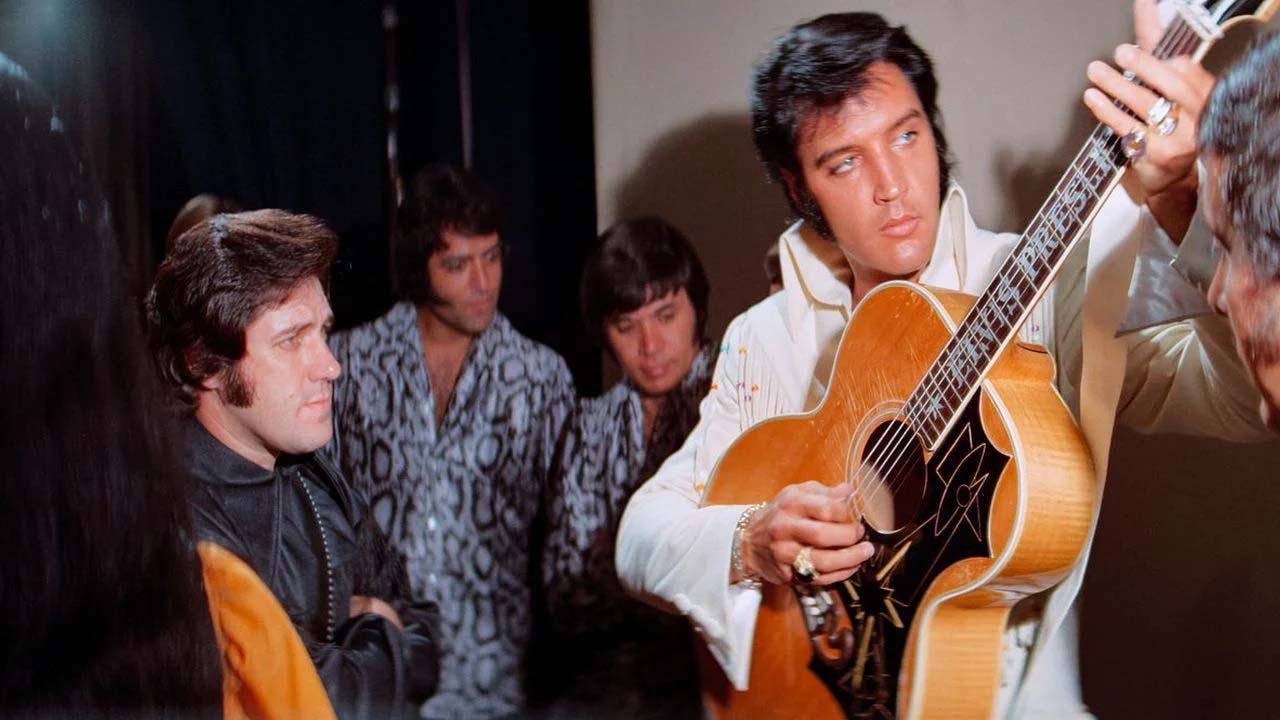
The feature grew from that instinct. The documentary, he insists, was almost an accident. While researching, he was told there might be a reel or two of unused material sitting in storage. Instead, he discovered boxes and boxes of film stock – 35mm, 16mm, 8mm – much of it silent, much of it unseen for decades.
“I came upon this footage really, literally in salt mines in Kansas City,” he says, laughing at the improbability of it. “Thinking there might be a reel. But then I get pictures of, like, 65 reels of negative.”
What began as curiosity became a two-year restoration project: syncing sound, cleaning images, piecing together fragments. And in the process, Luhrmann says, he felt the Presley paradox more sharply than ever.
“I discovered this paradox more profoundly in doing this work, between the creation of a God-like, aspirational, iconic image, and this kid who was from the poor of the poor in East Tupelo, whose father goes to jail… and creates Elvis Presley so brilliantly.”
That tension between the boy and the god powered the fiction film. But something else emerged from the archive: long, candid audio of Elvis speaking about his life.
“When we actually discovered this 140-minute audio of him talking about his life, the sheer humanity of it and the humility of it, I just went like, well, what if we got out of the way?” says Luhrmann. “So he tells his story, and the music does that.”
For a director known for baroque flourishes, the phrase “got out of the way” sounds almost radical. Yet that is the governing principle here. Instead of talking heads or heavy commentary, the film moves between rehearsals, performances and Elvis’s own voice, threading memory through music. It also restores something that earlier concert films seemed reluctant to show: Presley’s humanity.
Part of the reason, Luhrmann argues, lies with Colonel Tom Parker, Presley’s manager and, in Luhrmann’s telling, gatekeeper.
“If you see the early version of That’s The Way It Is, Colonel Tom Parker is credited as the technical advisor,” he says. “So much of that documentary is footage about how great the merch is going to be, and how great the hotel is preparing. So don’t think for a second the Colonel didn’t have a point of view about, show how well I’m selling Elvis.”
Parker, he suggests, believed mystery was marketable. “He can’t be goofy or funny or silly, because too human. He needs to be distant. Colonel didn’t want Elvis to be interviewed. Colonel didn’t want Elvis go on chat shows. He always had distance and control.”
CAREFULLY MANAGED
The result was a carefully managed icon. The material Luhrmann uncovered shows something messier. His interviews see him talk about his youth, losing his mother while drafted, and his frustration at being treated like a moral panic by pundits, and a one-note actor by Hollywood when he wanted to be more.
On stage, we see Elvis fooling around, teasing the band, trying things out. The shows are always sweaty, often sloppy, sometimes chaotic – always alive.
“He’s funny and self-deprecating, goofy even,” Luhrmann says. “But he does that to disarm people, because inside he’s still a very insecure, very poor kid from Tupelo. But on the outside he turns into this kind of physical God.”
He was also, Luhrmann adds, far more musically rigorous than the kitsch caricature suggests. “He actually created the music by singing it through, and how serious and laser-like he is, and how he completely uses his body to conduct the band. They could never take their eyes off him.”
Then comes the line that lingers: “I’ve never seen anyone so comfortable on stage. He loves being on stage. Off stage, probably no one’s so uncomfortable.”
The Las Vegas years sit at the centre of the film. In popular memory, they mark decline and caricature: the jumpsuits, the excess, the gilded cage. Luhrmann doesn’t disagree, but he insists on chronology.
“What you’re seeing is the very first show where Elvis is doing it, thinking he’s going to take it on a world tour,” he says. “He’s going to come to Europe, he’s going to come to England. He’s gonna go to Japan” – ambitions that never materialised, because Colonel Parker prevented him from travelling outside of the US. At first, Vegas is liberation: a place to experiment nightly, to reshape the setlist, to meet fans up close. Only later does repetition set in.
“For the next seven years, the Vegas showroom becomes like a cage,” Luhrmann says. “And he’s built these wings to fly around the world, but he can’t use his wings. He’s like a bird hitting a glass wall.”
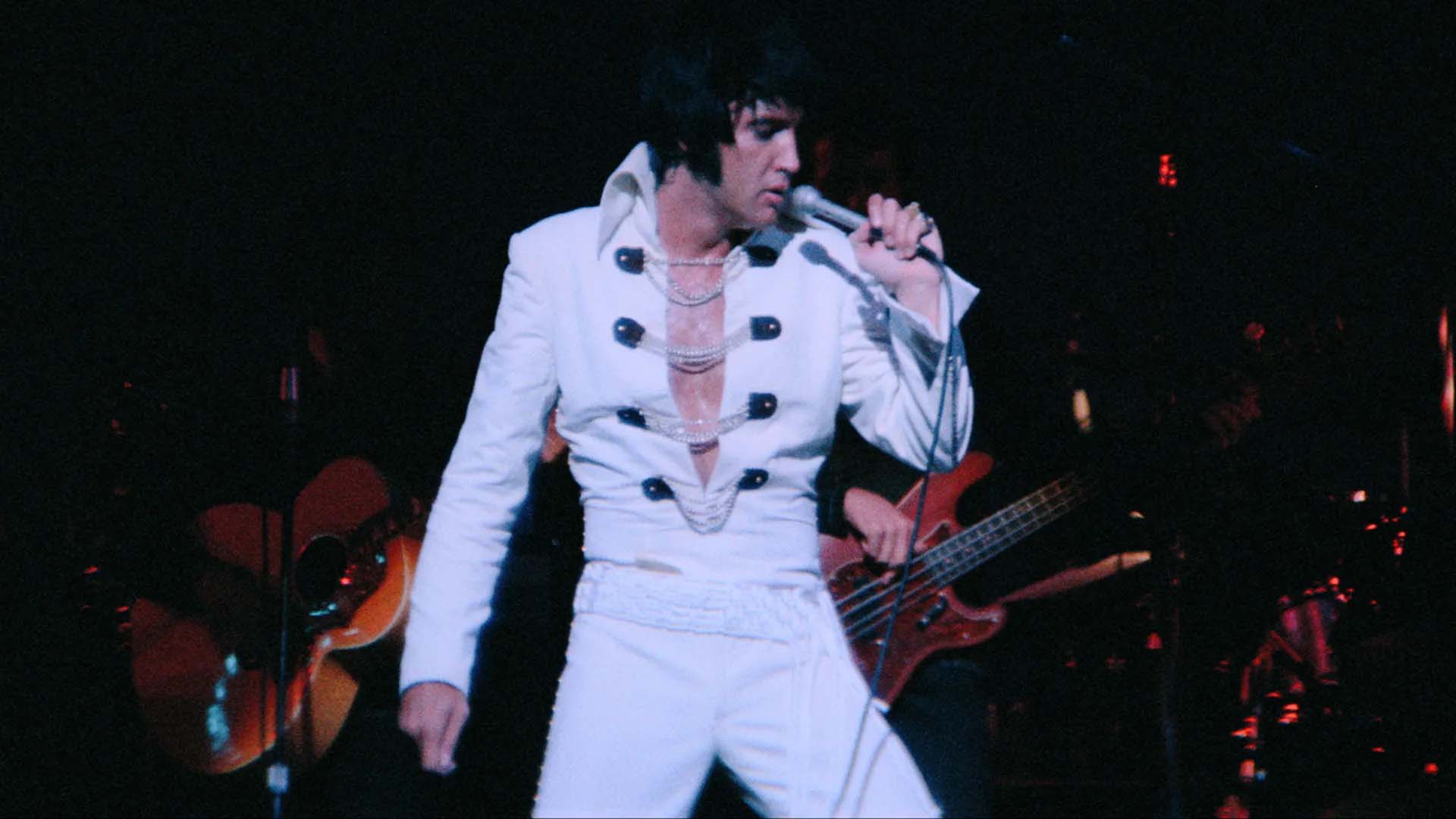
The tragedy, then, is slow. But the footage captured here shows the beginning, when the energy is still crackling, when the looseness reads as freedom rather than fatigue.
Politics, too, looks different at this proximity. Presley famously avoided explicit statements, a silence some critics have read as complicity. A moment where he’s asked about Vietnam and political protesters highlights this, but Luhrmann sees it as caution shaped by management and temperament.
“Elvis’s safe place is to express his true views through music,” Luhrmann says. “Often online now they put out the clip and go, ‘Well, I’m just an entertainer,’ but they never actually play the next question, which is when he’s asked, ‘Do you think other artists should not have political views?’ and he goes, ‘No, absolutely they should.’”
He leans forward, keen to correct the record. Presley, he argues, had simply learned to be cautious in interviews, to hold himself back verbally while saying everything in song.
DIFFERENT FEELING
“At the same time he was saying those things, he was singing a song like ‘Walk A Mile In My Shoes,’ which is, ‘There are people in the ghetto and on reservation, and but for the grace of God there go I – before you criticise and abuse, walk a mile in their shoes.’ They absolutely did not want Elvis to sing. No one. They said, ‘Do not sing ‘In The Ghetto’, it’s too political.’ So my view is that Elvis’s safe place is to express his true views through music.”
The director notes that after Martin Luther King Jr.’s assassination, Presley pushed to perform ‘If I Can Dream’.
“He just cried all night,” Luhrmann says. “He said, ‘Dr King, he always spoke the truth.’ I can’t speak for him, but his songs, I think, speak for himself.”
In the end, what seems to move Luhrmann most is not the legend but the man he glimpsed in those reels: talented, insecure, playful, serious, contradictory. A human being before he was a brand. For a filmmaker often associated with spectacle, the project sounds almost like a relief.
“It was one of the most enjoyable things I’ve ever done,” he says. “I didn’t have the burden or responsibility of getting the pictures. I knew my lead actor was pretty damn talented. The storytelling part isn’t different. But it’s a different feeling and experience.”
• EPiC: Elvis Presley In Concert is in cinemas now.


RELATED

- Film And TV
- 16 Jun 22
WATCH – Trailer for ELVIS, in cinemas 24th June

- Film And TV
- 10 Jun 22
In the new flip-cover issue: MuRli's Guide To Longitude & Baz Luhrmann on Elvis

- Film And TV
- 27 May 22
Baz Luhrmann's Elvis biopic reveals its second trailer

- Film And TV
- 21 Mar 22
U2 scripted Netflix series alongside JJ Abrams in 'early development stages'

- Film And TV
- 18 Feb 22
Baz Luhrmann unveils new teaser for King of Rock & Roll biopic, Elvis

- Film And TV
- 31 Dec 20