
- Culture
- 23 Mar 26
Gabriel Tallent: "I feel like friendship is perhaps a little undermined in literature"








Focusing on the intense friendship between a pair of rock climbing Californian teenagers, Gabriel Tallent’s novel Crux makes for an exhilarating read. The author discusses his own climbing adventures, the book’s allusions to Tool frontman Maynard James Keenan, and getting the seal of approval from Stephen King.
Having debuted in 2017 with the acclaimed novel My Absolute Darling, which was nominated for a raft of gongs, including the Dublin Literary Award, US author Gabriel Tallent has now returned with Crux. The story focuses on two Californian teenagers, Dan and Tamma, who grow up dirt poor near Joshua Tree National Park, where they indulge their love for rock climbing.
Entering their final year of high school, the duo attempt to realise their ambition of becoming legendary climbers. But as their outdoor adventures grow more dangerous, and their home lives ever more fraught, the pair’s introduction to adulthood proves an emotional rollercoaster.
When I catch up with Tallent in his Salt Lake City home, he’s in his basement office, where there are lifting weights in the background – clearly, this is a man of both physical and intellectual heft. I start by asking how he came to write a novel about rock climbing.
“I came to Utah around 2011,” he explains. “I moved here for my wife and started climbing with her. We’re not brilliant climbers, but we became seriously passionate about it, and began going out trad-climbing a lot. We go to Little Cottonwood Canyon, which is in our backyard. And then there’s Indian Creek, which is four hours south, and White Rim.
“We also go out to climb in Joshua Tree every year, so it’s a personal passion. Whenever you climb, rad shit happens, and you want to put it in a story.”
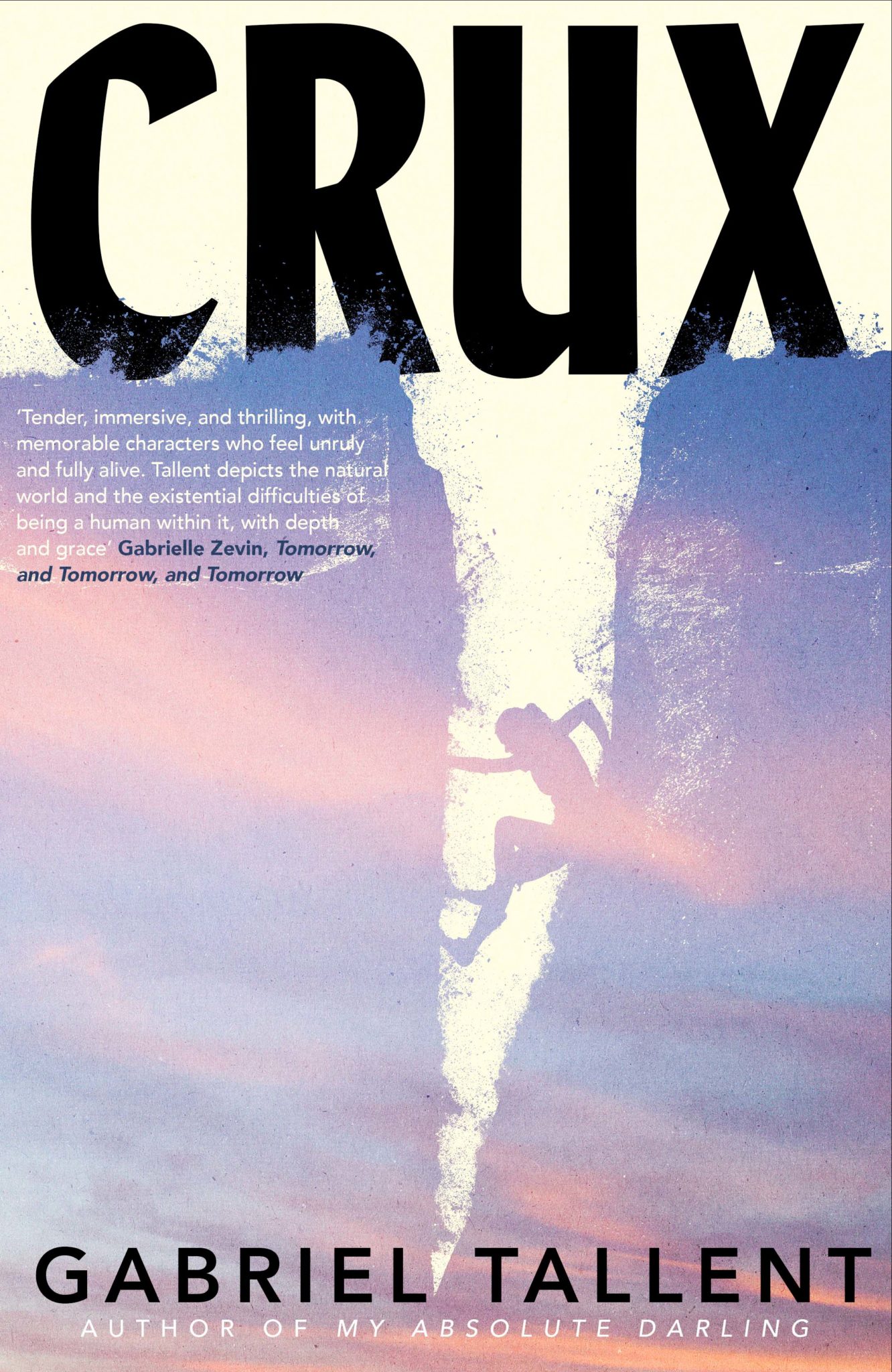 Crux.
Crux.In the nine-year gap since his debut, Tallent wrote two other novels he subsequently abandoned, including a separate one about rock climbing and another focused on cardiothoracic nursing.
Thus, the arduous rock climbing in Crux almost serves as a metaphor for the book’s own creation. But at the centre of it is the intense friendship between Dan and Tamma, which allowed the author to explore subject matter he thinks has been traditionally overlooked.
“I feel like friendship is perhaps a little undermined in literature,” suggests Tallent. “Not that there aren’t great books about it – Tomorrow, And Tomorrow, And Tomorrow by Gabrielle Zevin is one that comes to mind. But it feels like romantic love is the privileged relationship that we have, and friendship can get crowded out as something that maybe isn’t important.
“I don’t know if that is particularly American, but it feels very present here. I feel like we have models for risking your life, and for making big life decisions, for a partner or lover. But we don’t really have the same thing for friendship. It seemed to me a more interesting, difficult and complex dynamic to write about.”
Crux also examines the realities of the characters’ working class lives, although Tallent is quick to acknowledge his own upbringing had more advantages.
“Class is messed up in America,” he reflects. “I had way more opportunities than Dan and Tamma. But the terror of wanting to become a writer, and feeling like if you try for it and fuck up, you’ll have lost a lot of career opportunities – that was very real. It looks different now in hindsight, but at the time I graduated, we were in the midst of a profound recession.
“There were no jobs to be had, and the only functional career course appeared to be graduate school, so that’s what a lot of my peers did. I wouldn’t quite describe it as pressure, but my teachers were after me to go to graduate school. I was like, ‘No, I’m gonna be a writer.’ In the end, I applied for as many jobs as a I could, and I ended up scrubbing toilets at Target.”
He considers the subject further.
“There appeared to be no options, no future,” Gabriel continues. “That’s something I wanted to inject into the book, but I come from a much more functional family than the characters. My parents are very generous and encouraging – one of them is a professor at Stanford, and the other is an antiques dealer. So I don’t want to equate my circumstances.
NOIR VIBE
“But that struggle – those years of thinking it wasn’t going to come together and that I’d missed my window – was real.”
Another compelling aspect of the book is the way Tallent writes about the environs around Joshua Tree, which at times have a notable noir vibe.
“My friend Ruchika Tomar has written a noir set there, called A Prayer For Travellers,” he says. “The reason it’s in the book is, when I’d written that previous novel about climbing, there was a flashback to when the characters were kids climbing in Joshua Tree. And I have climbed there too. But when I scrapped the novel, I decided what I really wanted is people starting out, who have the dream to be great climbers. What is it like to embark?”
Aside from its inherent quality, another element likely to attract attention to Crux is the eye-catching blurb from legendary author Stephen King, who describes it as “one of the best novels I’ve ever read about friendship between a young man and a young woman.” Although I’ve been reading King for many years, it’s only recently I’ve come to realise he’s actually one of my favourite writers.
“I particularly liked It,” Gabriel enthuses. “After college, I was thinking a lot about who I wanted to be as a writer. You read a lot of classics, and you’re trying to figure out what excellence in writing consists of.
Then I read It and I was like, ‘This is batshit crazy – this shit is wild.’ It’ll go anywhere, and it made me realise, excellence in writing is not going to consist of adopting any style.
“It’s going to consist of being your own fucking self, in an intense, extravagant and wild way. You’re not going to succeed at being someone else. It is unlike anything else, although when I asked Stephen King about it, he was able to point to his influences – he sees himself as having an intellectual history. But to me, that book comes out of nowhere. It’s an astonishing work of intuition.
“It made me go, ‘This is the project. You’re not pursuing a style – you’re pursuing your own sense of what’s true.’”
Have you gotten to know him?
“I don’t know him well. I met up with him when I was in Maine, so I have met him. In terms of the blurb, I don’t know how that happened. Someone, not me or my editor, sent him the book, and he came across it.”
From a personal standpoint, my recent revelation about the full extent of King’s genius came while rewatching The Shawshank Redemption. It’s a story so perfect, literally 99 percent of writers would kill for it. And yet, it’s merely one of hundreds King has written, of which maybe a dozen have penetrated the popular consciousness. It’s not an easy achievement to get your head around.”
“I think there is some truth to that,” considers Gabriel. “I think a lot about what kind of writer I want to be. What’s extraordinary about Stephen King is he takes more riskier bites at the apple. He’s writing more stories, and with each one, you feel him learning something. That stands in contrast to the model of a writer where you move achingly slowly and carefully.”
In literature, I sometimes think the polarities of creativity are represented, at one end, by ultra-prolific authors like King, and at the other, by the likes of Donna Tartt, who might spend a decade or more painstakingly crafting a novel.
“My intention is to take more faster risks,” says Tallent. “I really want to be on the Stephen King schedule, not the Donna Tartt one. I’m with you, I admire Donna Tartt and I love those books. Maybe part of what’s going on there is those are both writers who are emphatically themselves. But I think I would rather risk more and fuck up more.”
KINDNESS AND GENEROSITY
What was it like like meeting King?
“I was really struck by his kindness and generosity,” says Tallent. “Publishing a novel, you meet a lot of people telling you who you have to be. The common narrative is you have to be sort of hard-nosed, self-obsessed, narcissistic. There’s an idea of writers ruining everyone around them – everything gets sucked into the black hole of their ambition to eke out good art.
“But my experience of meeting people I admire, like Stephen King, was that he was bracingly humble, generous and kind.”
Finally, I bring up a few of the musical references in the novel, including the allusions to Tool and Puscifer frontman Maynard James Keenan.
“I feel like I have terrible taste in music!” Tallent mock-protests. “But yeah, I listened to disgusting amounts of Puscifer writing the book. I don’t know why. Everyone’s just like, ‘Aren’t Tool terrible?’ But I think it’s a pretty cool choice, and I felt it fit for Tamma.”
• Crux is out now.
RELATED


RELATED

- Culture
- 28 Dec 25
My 2025: Lou Robbie - Hero of 2025? "Most definitely Catherine Connolly"


- Film And TV
- 15 Oct 25

