
- Culture
- 08 Jan 26
Leon Diop of Black & Irish: "I do think it’s possible to change people’s minds. I actually think that’s more aligned with our nature"








Activist and author Leon Diop discusses his new memoir, Mixed Up. Exploring themes of racism, growth and self-acceptance, it’s a book that is as pertinent as it is powerful in the context of modern Ireland
“I forgot my own name. I walked up to him to shake his hand and said, ‘It’s nice to meet you, sir.’ He said, ‘It’s nice to meet you too! ‘Do you have a name?’ I was like, ‘Oh yeah, it’s Leon.’ I told him that I run Black & Irish. And he said, ‘I’m proud of you and the work that you do.’”
The “I” in that anecdote is Leon Diop – author, activist and founder of Black & Irish – a non-profit dedicated to improving the lives of Black and Irish people. The “him” in that snippet has an even more impressive CV, it being Barack Obama and all. Still, meeting the former US President during his visit to Ireland in September was symbolic of how far Diop has come.
That journey is traversed in his powerful new memoir, Mixed Up, which details his upbringing as a mixed-race child in Tallaght, the long process of finding his identity, and using his voice for advocacy. It’s a story everyone could learn from, though Diop points out that young adults are the target audience.
“Young people have so much more to contend with,” he explains. “Social media has a negative influence on identity shaping. I see a lot of young people having to come across racist rhetoric online. I imagine myself and how I would have dealt with that as a teenager. I don’t think I would have dealt with it very well.”
The title reflects Diop’s own experience of being caught between identities as the son of a Senegalese father and Irish mother, a confusion which he says had a big influence on his confidence and self-esteem.
Writing the book forced him to revisit the difficult parts of his early life. There’s been violence, slurs and other forms of discrimination. It was however, Diop says, a healing experience, opening up conversations with his family.
His complicated relationship with his dad is one of the book’s central themes. After his parents separated, Diop had limited contact with his father (who comes across in the book as a difficult individual). When they did meet on weekends, he often felt embarrassed by his father’s visible signs of Africanness, like his traditional dress and accent, which stood out in 00s Tallaght.
His father would later move to France, where he died of cancer, adding to Diop’s sense of estrangement. It leads to some of the memoir’s most powerful chapters. After connecting with siblings he didn’t know existed, Diop and his brother Alex travelled to Dakar in Senegal to learn more about their roots.
“The relationship with my father was difficult,” he says. “And what it was doing was causing me to block off a part of myself. To know where you’re going, you have to know where you come from. Going to Senegal gave us an insight into that. When I was able to heal through the death of my father, I was also able to heal through the issues in our relationship, which meant a lot of those blocks began to lift.”
Witnessing Senegal firsthand deepened his understanding of global inequality.
“I did see a lot of poverty. I saw a lot of people who did not have a social net to catch them. There were levels of desperation I saw in people trying to sell me different wares. I ended up leaving with things that I didn’t need because I just wanted to buy something from someone. I’d say, ‘Sorry, no, I don’t need this,’ and they’d be like, ‘Please, we are hungry.’
“When I saw some of the challenges people were facing in Senegal, I understood why people were seeking asylum from those levels of poverty. We talk about migrants as if they are these abstract, far-away things that, once they come into your area, are immediately dangerous. It’s not the case. We need to know who’s coming into our area, we need to find ways to integrate them, and we need better systems if we are deeming someone not eligible to stay.
“A lot of these people don’t want to be away from their families or their communities. We need to recognise the roles we now have to play in making the global scene a better place.”
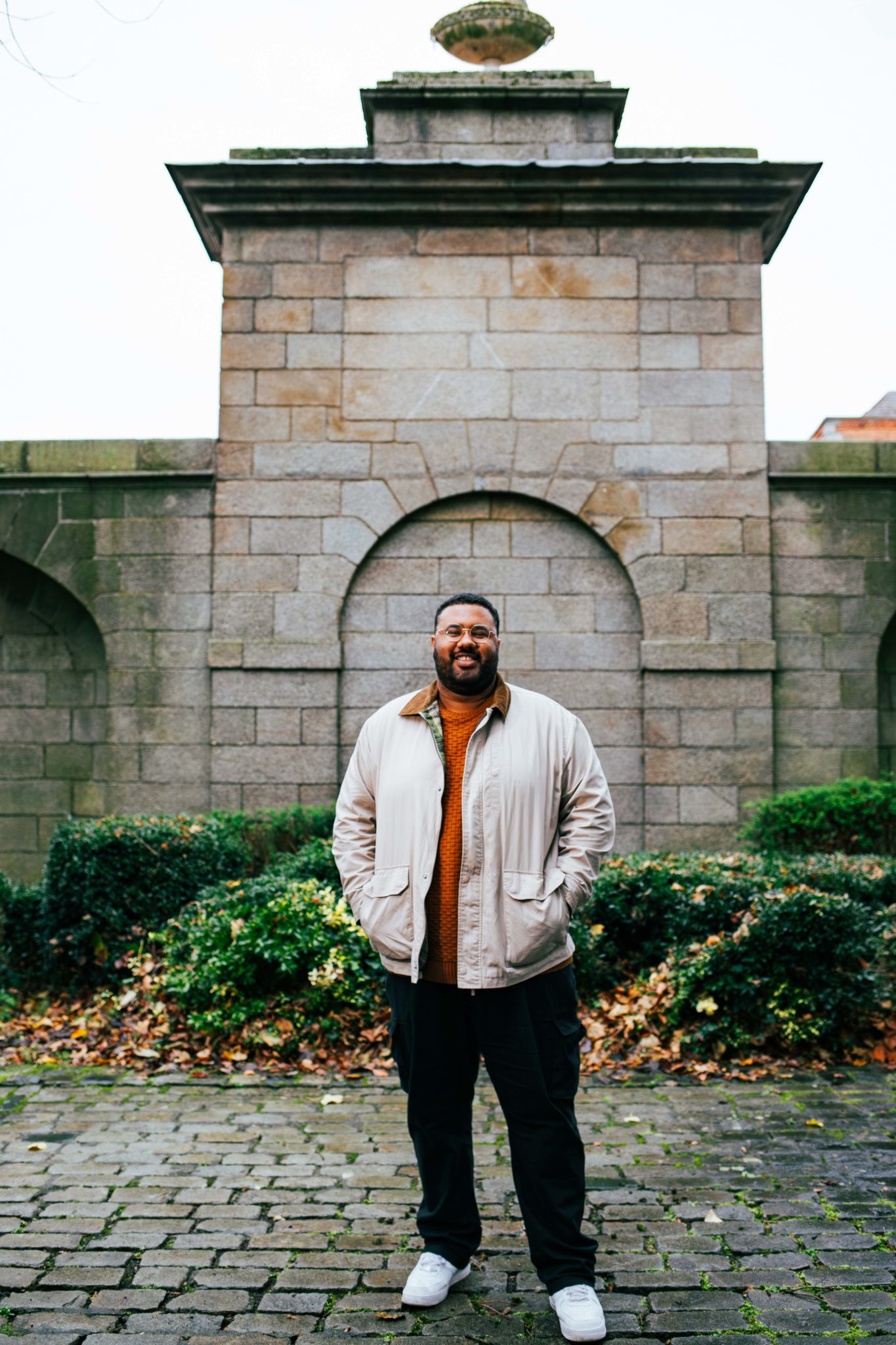 Leon Diop on November 26th, 2025. Copyright Abigail Ring/ hotpress.com
When Diop and I last spoke in October 2023, he had just released Black & Irish: Legends, Trailblazers & Everyday Heroes, another young adult book which highlighted the positive contribution that Black people have made in Ireland. A month later, riots erupted in Dublin after word disseminated that a child was stabbed by a migrant. This year there’s been Garda vans set on fire in Citywest and the burning of an IPAS centre in Drogheda.
“I don’t think it has ever been at this level before,” Diop says. “What we have are people living in deprivation, living in fear, and having these fears preyed upon by far-right agitators, who want to lay the blame of all of the issues that people are facing on the asylum seekers. We have incidents against women and girls in this country every single day.
“When a migrant is the person who’s at fault, there are not just protests but full-scale riots. We’ve got a lot of young people left behind in systems who are disenfranchised. This is something for them to engage in. They haven’t been given the opportunity to step out of a negative lifestyle and be offered something positive, which is something I talk about in my book.
“I was able to get out of the negative situation I was in because I had a positive situation to step into at Maynooth University.”
The geography of demonstrations and tricolours being erected indicates that this has become a class issue.
“100%,” Diop says. “Working-class people have to shoulder a lot of difficulties. We see IPAS centres being set up in working-class areas beside people who don’t know how they’re going to put their next meal on the table or pay next month’s rent, and that’s going to lead to fear, frustration and anger. That can be preyed upon by far-right agitators, who want to lay blame on the issues people are facing on the asylum seekers.
“The ‘Ireland is full’ slogan is one I’m seeing a lot in these working-class areas and they might feel that more than others, because they’re not able to get a doctor’s appointment for their child. So this is 100% a class issue.”
Social media is racism’s greatest amplifier. It was surreal to see rioters on the streets of Citywest being egged on by X owner Elon Musk.
“Billionaires are going to do the most they can in order to make the most money possible,” Diop says. “And the way they make the most money through social media is engagement. And how they get the most engagement is often through fear.
“If you’re sharing AI or disinformation and it’s causing other people to form feelings of hatred towards another society or community, then yes, it needs to be clamped down on.”
Diop maintains hope. His youth outreach work has been rewarding, while his efforts with Black & Irish have been instrumental in providing a platform for underrepresented communities.
But there’s still a lot of people who are frustrated, racist, or both. Is it possible to change their minds?
“I know it’s possible to change people’s minds because I changed my mind on what I wanted to do with my life,” Diop says. “What we need to ask people in Ireland to do is make a decision on the type of country they want to live in. Do you want to create a society that is welcoming and inclusive. That has good systems? That is able to welcome people into society if they need our help?
“I do think it’s possible to change people’s minds. I actually think that’s more aligned with our nature. The best way that we can survive is together.”
• Mixed Up is out now via Little Island.
RELATED


- Film And TV
- 16 Dec 25
Tributes pour in after homicide death of actor-director Rob Reiner and wife Michele

RELATED


- Opinion
- 02 Oct 25
President Higgins issues statement on Gaza Sumud Flotilla


- Culture
- 22 Sep 25
