
- Culture
- 27 Jun 26
Douglas Stuart: “From the age of 12 to just about 16, I had to be part of a Protestant gang and fight Catholics"








You’d be a complete fannybaws not to love John Of John, the latest novel from Douglas Stuart which might just win him a second Booker Prize. Forbidden love, bible-bashing, knitted erections, acid house, The Smiths, Oprah Winfrey, Dua Lipa and CMAT are all discussed as he meets Stuart Clark.
Bawbag, fannybaws, walloper, tadger, fud, fandan, bampot, spunktrumpet and rantallion.
Those are just some of the excellent new Scottish swear words I’ve learned courtesy of John Of John, novel number three from Glaswegian author Douglas Stuart whose Shuggie Bain debut won the 2020 Booker Prize, much to the disgust of some literature snobs who considered it far too working-class and edgy.
The aforementioned profanities are uttered by Ella, an octogenarian crofter living on the remote Isle of Harris with her son-in-law John and grandson John-Calum, both of whom are gay but frightened to admit it to their fundamentalist Hebridean Free Presbyterian neighbours.
“My favourite of those swear words is ‘plamph’ which is a man who likes to sniff women’s underwear,” beams Douglas who’s flown over to Dublin this morning from Bristol. “Ella was the best character to write, she’s the most fun I’ve ever had. I allowed myself to just approach her with joy. Because Cal has been called home from the mainland to take care of his grandmother who’s very ill, she had to be a woman who’s worthy of love.
“One of the ways she endears herself to Cal is trading swear words with him,” he continues. “I also love ‘snurger’ which is a bicycle saddle variation on plamph.”
Who said Hot Press wasn’t educational?! Despite her advanced years, Ella is still well able to kick against the pricks.
“Yeah,” Douglas agrees, “in this very devout Presbyterian community, she’s a bit of a corrupting influence, a Glaswegian who’s been on the island for fifty years but is still known as ‘the newly arrived…’”
Did he plan to write a book that’s far more pastoral than its predecessors or was it just a happy accident?
“Anyone who read The Young Mungo, which is about two teenage boys trying to be in love in sectarian Glasgow, will know it’s quite intense and violent,” he replies. “So for my next book I wanted to write something that was gentler on myself and also gentler on the world.
“I was the son of a single mother. She’d no money to show us the country beyond where we lived. As an adult, I found myself in New York before I found myself in Ullapool! I wanted to write about loneliness, the rural working-class and the shifts in society beyond the central belt that I didn’t know about. And where’s further from Glasgow and the central belt than the Outer Hebrides? So, I went in 2019 thinking, ‘If there’s not a novel in it, at least I’ll know my country better.’”
Douglas arrived on the Isle of Harris just as Shuggie Bain was about to be published.
“I didn’t know how anxious and nervy I was about it coming out until I said to my husband, ‘I’m gonna go and see the islands for twelve weeks’ and he was like, ‘You’re sure twelve weeks is enough?’ He just wanted rid of me! Anyway, I went to the Outer Hebrides and immediately fell in love with it.”
To take the edge off meeting his bible-bashing father again, Cal pops an E or, as they’re known in Scotland, an Eccy. Asked whether he was a raver himself, Douglas says, “I’m sorry, it’s a bit of a bummer of an answer but I’m often asked about Irvine Welsh’s influence on me and I say, ‘I love the man as an artist. I can see his power, he’s as bright as the sun. But I couldn’t get into his work as a kid because it celebrated that culture and drugs and I’d just watched my mother kill herself through addiction.’
“I was sixteen, had loved her my whole life, spent my entire childhood trying to save her and then she died. It just defeated her and suddenly Trainspotting that year was out and the hippest thing on the landscape. So I couldn’t get into acid house, I couldn’t get into Welsh.”
SHUGGY BAIN MURAL
One of John Of John’s subplots is Cal’s snail mail correspondence with William, an older gay man “living in a humdrum town where the rain falls hardest” and who’s “looking for my own Johnny Marr.”
Am I right in thinking that The Smiths played a prominent role in Douglas Stuart’s adolescence?
“They did,” he nods. “It wasn’t just Morrissey’s sexuality, it was also about intellectualism. Here was the son of a taxi driver in a coalmining community singing very smart lyrics and doing this fey thing which I found incredibly intriguing. I always think about that lyric: ‘Panic on the streets of Carlisle, Dublin, Dundee and Humberside.’ I wanted to write to him and say, ‘We were also panicking in Glasgow, Morrissey!’ The fact, though, that he was singing about predominantly working-class communities really struck a chord.”
Did he rush out and buy himself a hearing aid?
“I was only ten when they were at the height of their powers so I never got to see The Smiths live or copy Morrissey’s fashion statements,” he continues. “Doing so would have been difficult because his sort of femineity made my brothers and my cousins very nervous. They were real working men who didn’t quite understand the tulip-waving and the sensitivity and the poetry. Whereas I loved it and was dying for more – albeit it semi-secretly.
“When The Smiths absolutely became my life was when in 2000 I moved to America where Morrissey is a god.”
Cal’s postal relationship with William sours when he sends him a novel dick pic.
“I was going to read that section the other night in Bath but my handler said, ‘No, you’re not!” Douglas laughs. “I think it would have killed the audience!
“Cal is corresponding with William who as an end line says, ‘P.S. If it’s not too rude to ask, what’s your dick like?’ Cal thinks, ‘Obviously I can’t take a photo of it because Boots would call the police on you.
What else can I do?’ Being a textiles student – like I was – he lies on his bed and knits a replica around his own erection. He adds a couple of extra rows and stitches just in case it shrinks in the post!”
Whilst living in Glasgow, did Douglas experience the same friendship, love and tenderness that John and his neighbour Innes enjoy in their stolen moments?
“Not really, no,” he rues. “I grew up in a quite divided sectarian scheme. I never got off that housing estate. It was my whole world and certainly no one could be visibly gay. I was talking to Colm Tóibín about it recently. He’s twenty years older than me and said, ‘I know the world you write about because I used to come to Glasgow and you guys had one very sad gay bar underneath the train station. The only time I went in, it was wall-to-wall sweaty, hairy, self-loathing Presbyterians. That was formidable for a 16-year-old.’ I was like, ‘Colm, I don’t know what you’re talking about, that actually sounds quite hot!’
“I did through a strange stroke of luck meet my husband when I was twenty. I was an exchange student in America where he’s from, which was what eventually took me to New York. My life has been full of friendship, love and tenderness since then.”
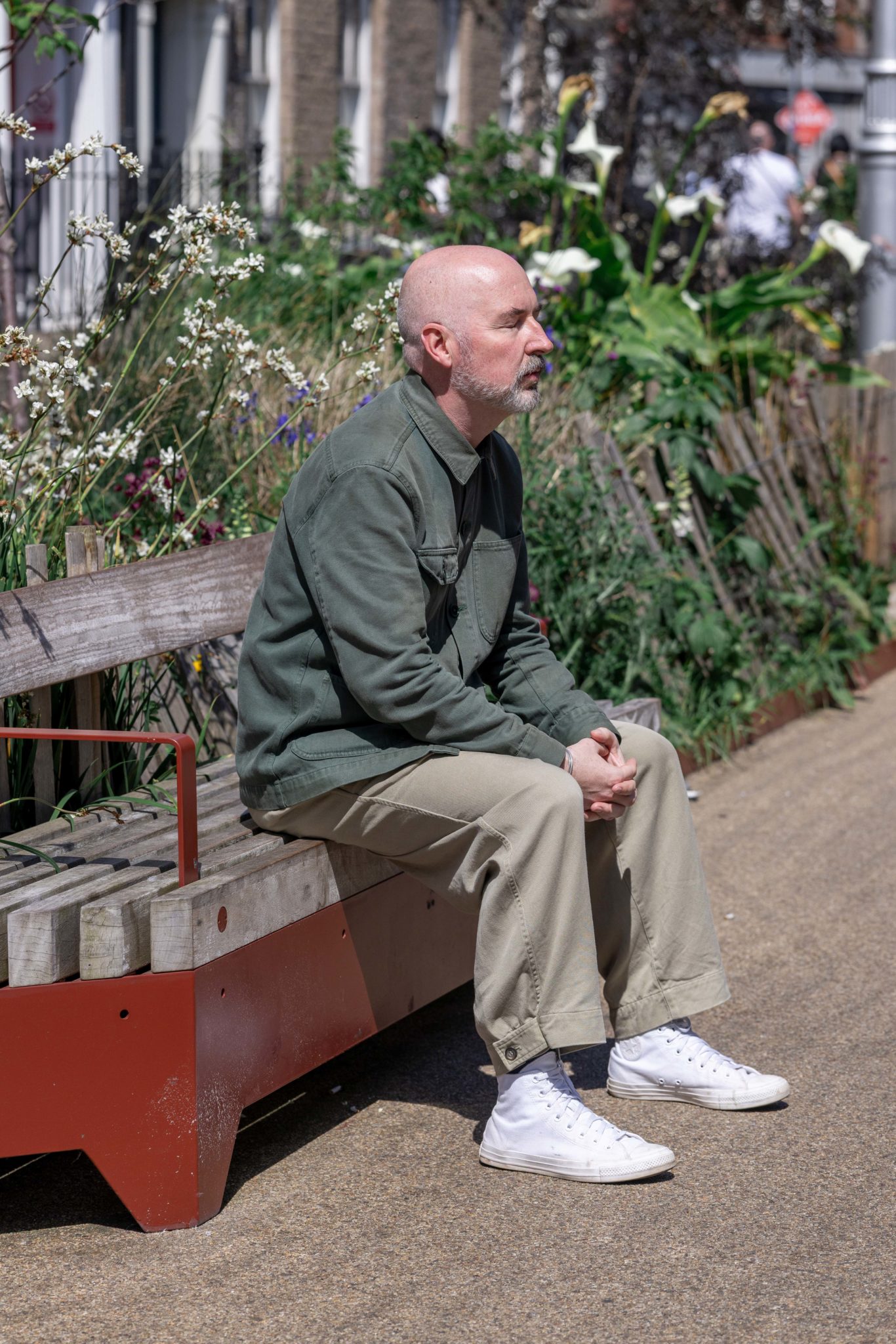 Douglas Stuart. Photo: Cat Gundry-beck
Despite John’s unvarnished bigotry and the shocking violence he subjects Cal to, Douglas has a degree of sympathy for the older man’s predicament.
“John is the deacon and the presenter in church,” he explains. “The Calvinist faith is a very hard faith but it also has moments of real beauty – especially in their worshipping and their psalm singing which is call and response because there can be no musical accompaniment. So, John stands before the congregation, he sets the line and they sing it back to him.
“The thing about Free Presbyterianism is that scriptures are the inerrable word of God. He’s not up for negotiation, he can’t ever be wrong. All relationships are between one man and his wife. So even though John has a long term love affair with another man, he doesn’t identify as gay. We often think that the solution to being yourself is coming out, but in John’s case there isn’t anyone to come out to.”
As Stuart walked around the Outer Hebrides on his twelve-week fact-finding mission, did he see Johns and Cals or versions of them?
“Yeah, absolutely,” he nods. “I ended up with hundreds of hours of audio recordings, which were just lovely kitchen table chats. I thought I was writing a novel about a son who’d just graduated from art school, was failing on the mainland and had no choice but to return home to a conservative crofting family.
“But then I started hearing about older men and women in every community who hadn’t married. Sometimes there were very practical reasons – they were taking care of their parents as they aged or men with an agrarian life who didn’t want to be bothered with the opposite sex. The standard line was, ‘Well, they missed their moment for love.’ When I was a bit too cosy one day and said to a woman, ‘Maybe some of them are gay’, she reared back and was like, ‘Oh, no, no, no, that’s not possible!’ It was neither cruel nor homophobic. For her gay people just weren’t possible.”
When violence is as visceral as it is in John Of John, is it hard to write?
“I don’t find it hard at all,” Douglas says. “Growing, there was always an undercurrent and threat of violence. It often lived in very close proximity to wonderful things. If you’ve ever been in a Glaswegian pub on a Friday night and you’re having the time of your life, you know it can turn in a minute and get very violent. I’m not trying to say something terrible about the city, it’s just a truth.
“Also, sex is inherently a violent act. Sometimes the best sex is very violent. When you’ve got a little bit of money you can avoid violence. But when you’ve no money at all, it’s just another colour of life.”
Lest there be any misunderstanding, the sex Douglas is talking about here is fully consensual.
As a gay man in the ‘80s and ‘90s, it must have been very difficult seeing so many members of your community getting sick and then dying.
“Interestingly, I can’t tell if you’re talking about the social aspect of the drink and drugs that come into places of high unemployment and/or the impact of HIV on the gay community,” Douglas proffers. “I saw both and, yes, it was really, really difficult.
“Everyone thinks that having a mother who’s suffering from addiction is a very individual problem, but I saw it as a social problem. When people lose hope and they know the cavalry’s not arriving and the generation’s going to be wasted, they turn to substances to numb themselves. Had I been a working-class single mother trying to raise three kids in that time and that place, I would also look for an out so I’ve no judgement there. But it was hard, I lost so many people that I loved to addiction.
“At the same time,” he continues, “you had extreme homophobia – Section 28, which was a state sponsored version of that homophobia, the church saying that we were absolute sinners and evil, and this horrible disease. There was no concept that I’d be alive today and certainly not that I’d be happy. It was a terrifying time.”
Inspiral Carpets, The Jesus And Mary Chain, John Peel, Pete Tong, The Face, Goodfellas, River Phoenix, Glasgow’s fabled Barrowland venue and Nirvana – Cal is going through a Kurt Cobain phase as he’s emotionally blackmailed into leaving his new life behind in Edinburgh – are among the other period pop culture references peppering John Of John’s 416 pages. Which is a lot of Ps!
“The first big gig I went to aged eleven was Wet Wet Wet,” Douglas says when asked about his love of music. “They did a free concert on Glasgow Green and the whole city turned out. I don’t know if you’ve been to the Barrowland (I have, S.C.) but it’s this amazing old 1930s ballroom with a sprung floor. Recently, I came all the way back from New York to see Restaurant, who are friends of mine, support Black Rebel Motorcycle Club in the Barras and to have a look at the Shuggie Bain mural that’s on the side of the venue. Forget the Booker, that’s a real honour! ”
OPRAH: SHE’S LIKE A SUNDIAL
As with his previous tomes, sectarianism is front and centre in John Of John with the father casually saying things like “Chinese, yes, Catholic no” and “I expect you met some Catholics; you might have even liked them” to his son who’s not only met but also fucked some left-footers.
“The funny thing about me is that my dad was a Protestant and my mum was Catholic, which was really taboo in the ‘70s in the East End of Glasgow,” Douglas reveals. “Most of the family did not come to the wedding. All of my schooling was in the Protestant faith but everything we did at home was Catholic.”
Was sectarianism something you could opt out of or were you were obliged to take sides?
“From the age of 12 to just about 16, I had to be part of a Protestant gang and fight Catholics,” he confesses. “We’d launch bricks and bottles at each other over a motorway bridge. I was representing the
Protestant boys and then going home to my mother who was Catholic.
“Interestingly, you’d take a brick to the head or a bottle to the face and be so proud to be on that battlefield. The last place you’d have found any of us, though, is actually inside a church!”
Did The Troubles reverberate in Glasgow?
“Of course,” he nods. “We have such a long history of cross-migration. My own grandfather’s family comes from Buncrana up in Donegal and were always very proud of their Irish roots. It became more distant for me but I’d listen to their stories and we also had a lot of Scottish Protestants going the other way.”
Would Douglas consider himself to be a political animal?
“Yes, I had politics foisted on me when I was four-years old,” he recalls. “Living in poverty, being queer, growing up in a mining community whilst Thatcher was decimating it, being raised by a single mum with serious addiction issues – every facet of myself was political.”
Is he pro-Scottish independence?
“God, yes!” he shoots back. “It’s so annoying that the older generation lost us the 2014 referendum. They were worried about pensions and health care and other stuff like that but young people were so resolutely for it.
“It’s not that wreckless, hedonistic, nihilistic sense of ‘I just want to be Scottish and Scottish alone!’ I love England, I do, but I’ve seen my nation consistently not vote along Westminster lines, and yet still being dragged through every failed policy. That has to end – and it will end! ”
Amen to that! Multiple doors have been opened for Douglas thanks to John Of John being the May pick for Oprah’s Book Club.
Introducing it to members, Ms. Winfrey opined: “Douglas Stuart brilliantly weaves a complex and compelling story that ultimately shows us the power of love in a world that is hostile, in a world that is judgmental.”
If you’re up for doing some HP book reviews Opes, give us a holler. How did Douglas find out that John Of John was about to get millions of dollars’ worth of free promotion?
“I answered my mobile and it was Oprah saying, ‘I’ve selected your novel for my book club,’” he says. “Normally, I’d have thought it was a friend winding me up, but instantly you know and believe it’s Oprah Winfrey because she’s such a singular human being. You can feel the energy in her voice even down the telephone line.
“I’m thrilled because it’s the first Scottish novel she’s ever chosen. Growing up in Britain literature felt like it was a very classist thing, and any discussion of it excluded working-class communities. Then in the ‘90s, I see Oprah’s televised book club, TV being a very democratic medium. She instantly says, ‘Books are for everyone, come in, come in, you’re all welcome!’ For me that was really powerful. She’s spent thirty years connecting writers and readers.”
Meeting her must have been surreal.
“You go to a television studio and she’s just so magnetic,” Douglas enthuses. “I can’t quite explain it, it’s radiating. When Oprah’s in the room, she draws everybody else’s energy. She’s like a sundial. I was nervous so I can’t say I enjoyed it – I felt very inadequate – but Oprah’s a wonderful human being and it’s an afternoon I’ll never forget.”
Douglas’ celebrity champions also include Dua Lipa who in 2023 chose Shuggie Bain as her own Service 95 Book Club.
“I have so much respect for her,” he says. “Here is a young pop star at the height of her powers. She could be doing anything in the world, no one would stop her. And yet she says, ‘Reading is really important to me.’ It’s such a powerful force and speaks of the deep respect Dua Lipa has for her fans. She doesn’t pick light, fluffy beach reads; these are difficult books she’s recommending to mainly 15 or 16-year olds.”
Douglas spoke earlier about his friendship with Colm Tóibín. Does he have any other favourite Irish authors?
“I did a reading of Kevin Barry’s The Flord Of Killary short story for the New Yorker and loved every syllable of it,” he concludes. “I’m also a massive John McGahern fan, two of my favourites being The Pornographer and Amongst Women. Elaine Feeney’s great on class and the silent suffering of women. Louise Kennedy and Sinéad Gleeson are must-reads as well. Then of course there’s the great Seamus
Heaney. You’re so blessed with your authors and poets.”
• John Of John is published by Picador.


RELATED


- Culture
- 28 Dec 25
My 2025: Lou Robbie - Hero of 2025? "Most definitely Catherine Connolly"


- Film And TV
- 15 Oct 25