
- Film And TV
- 17 Jul 26
Our Hero, Balthazar director Oscar Boyson: “We don’t talk about class enough in the United States. Hardly at all, really. It makes people uncomfortable"








Our Hero, Balthazar director Oscar Boyson discusses online performativity, school shootings and class politics onscreen with Roe McDermott.
By the time Our Hero, Balthazar reaches its final act, you’ve laughed, winced and probably questioned your own reactions more than once. Oscar Boyson’s feature debut, which screens at the Galway Film Fleadh ahead of its Irish release on July 16, is a pitch-black satirical comedy that feels difficult to categorise. It’s a film about privilege, poverty, performativity, and school shootings that asks what it means to come of age in a world where grief, heroism and identity have all become performances.
Boyson wrote the film with his lifelong friend Ricky Camilleri. Three events were on their minds while writing the film: Covid, a mass shooting at an elementary school in Uvalde Texas in 2022, where 19 students and 2 teachers were killed; and the 2018 high school shooting in Parkland, Florida, where 17 people were killed.
“Covid was still really fresh in everybody’s minds,” says Boyson. “It felt like it was behind us, but we were still carrying it. Then Uvalde happened, and there was this feeling of, ‘Here we go again.’ We all felt devastated after Parkland. Those kids were made to feel like they could change something. They were put on television, they were treated like heroes, and then... nothing changed.”
The moment that stayed with him after Uvalde was a story buried in the reporting afterwards. A fourteen-year-old girl in Germany had been messaging the shooter online on the day of the attack. He told her he had shot his grandmother and was about to attack an elementary school. She replied simply: “Cool.” Afterwards, strangers criticised her for not intervening.
“That just felt like such a perfect microcosm of what being on the internet is like now,” Boyson says. “You’re constantly being shown terrible things, and somehow it’s also your responsibility to do something about them. But you’re also thinking, ‘Is this real? Is this fake? Is this somebody trolling me?’ People were saying, ‘She should have called the police,’ but she’s fourteen, she’s in Germany, she doesn’t know this person, and he’s spent years sending crazy messages to strangers online. It’s completely understandable that she didn’t know what to believe.”
That question became the beginning of Our Hero, Balthazar. Who, Boyson wondered, would actually receive a message like that and believe it enough to intervene? At the same time, another idea had been occupying him.
“I’d become fascinated by this performed victimhood that seemed to explode during Covid,” he says. “These were kids who’d celebrated their twelfth and thirteenth birthdays by themselves. They’re at exactly the age where they’re trying to figure out who they are, and the only place they’re allowed to look is somewhere where everything is performed. I just kept thinking, ‘How are you supposed to process your own emotions if the only place you’re learning about emotions is somewhere that rewards performance?’”
It’s one of the reasons that Balthazar (played by Jaeden Martell) feels so unsettling. He’s desperate to be good, but his understanding of goodness has become inseparable from being seen to be good. Even his empathy feels curated, as he re-records videos of himself crying to post online.
“Teenagers are supposed to make mistakes,” says Boyson. “They’re supposed to be told, ‘Don’t do that,’ or, ‘Stop.’ That’s how you become an adult. But if everything around you is performance, and beyond that it’s all tied to money, likes, attention, engagement... how are you supposed to develop properly?”
He pauses.
“I just feel bad for them, honestly. I feel like the odds have been stacked against them.”
The adults in Our Hero, Balthazar are hardly better. Politicians, influencers, self-help gurus and wealthy parents are all trapped inside their own performances, monetising fear or grief while convincing themselves they’re helping.
“You’re surrounded by grift,” says Boyson. “And I don’t blame kids for looking around at that and thinking, ‘Well, I guess this is just how the world works.’”
Asa Butterfield is known for his roles as sweet, sensitive characters in Hugo and Sex Education. In this film, he plays plays Solomon, a lonely, isolated teenager from Texas who acts as an online troll. Boyson knew from the beginning he wanted an actor audiences instinctively trusted.
“Ricky and I spent a lot of time thinking about actors where your first instinct is, ‘I want to give this guy a hug.’ The audience naturally wants to accept them. Then, if you give them the right material and push them somewhere darker, they can get away with so much more. It’s the same thing Adam Sandler does in Uncut Gems,” Boyson observes, himself a long-time producer of the Safdie brothers.
“We all love Adam Sandler, so when he’s being a pretty despicable husband, you stay with him. Asa was on a very short list of actors who I thought could do that. Sometimes it’s even more exciting than discovering a new face. It’s seeing somebody you’ve watched for years suddenly do something you didn’t know they were capable of.”
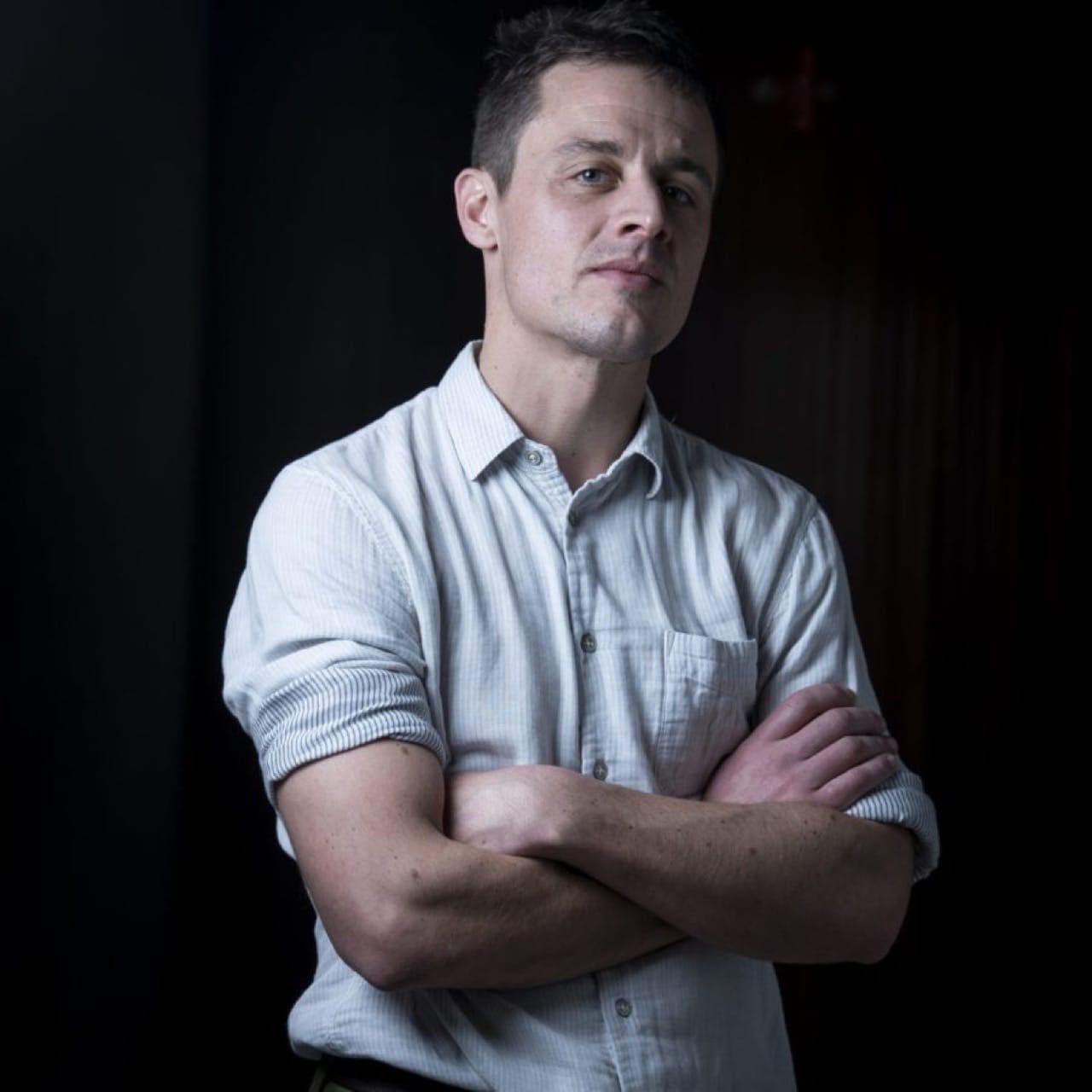 Oscar Boyson
Despite dealing with school shootings, radicalisation and online extremism, Our Hero, Balthazar is frequently very funny. It’s one of the reasons the film proves difficult to categorise.
“I know people keep calling it satire,” Boyson says, “but I don’t really like thinking about it that way because I think the word can become a little reductive. There are satirical targets in the movie, absolutely, but I never wanted people to think, ‘Oh, this is just a satire.’ I wanted Solomon to break your heart just as much as I wanted people laughing at Gore doing school-shooting preparedness training. Those feelings were equally important to me.”
Instead, he points to filmmakers like Todd Solondz, whose work often balances biting social observation with enormous compassion for damaged characters.
“We wanted to trick people a little,” he laughs. “At the beginning you think you’re watching another one of those rich-people movies, another Succession or The Menu, and then suddenly you’re in Texas and it’s like, ‘I dare you to laugh at this.’”
To Boyson, class representation in cinema is vital.
“We don’t talk about class enough in the United States. Hardly at all, really. It makes people uncomfortable. Some people are really enjoying the first twenty minutes and then we get to Texas and suddenly they’re uncomfortable, because now we’re talking about something real.”
It’s here that Boyson becomes particularly animated, arguing that while contemporary cinema has embraced stories about the excesses of the wealthy, it has become far less interested in depicting ordinary lives.
“Movies don’t really make dramas about poor people or middle-class people because it makes rich people uncomfortable,” he says. “There’s this whole wave of films making fun of the one per cent, and honestly I think a lot of them are pornography for rich people. I’ve been at Cannes. I’ve seen people sitting on yachts afterwards patting themselves on the back, saying, ‘Weren’t we clever?’ Nobody cares if you’re making fun of them. They just want to see themselves on screen. Poor people and middle-class people don’t care if you’re making fun of them either. They just want to see themselves at all. When ninety per cent of our movies are about the one per cent, I think we’re hopeless. That’s part of why movies don’t feel as culturally relevant as they once did.”
As our conversation winds down, Boyson reveals he’s already developing several new projects. Which one comes next remains undecided. One thing, however, is certain.
“There are a bunch of Irish actors I’d love to work with,” he says. “I just think the writing culture in Ireland is remarkable, and for a country that size the actors are extraordinary. When Cillian Murphy shows up in something like Oppenheimer, you genuinely don’t know what he’s going to do. He could be anything. Barry Keoghan has that too. Andrew Scott. Jessie Buckley. Paul Mescal. That’s exciting as an audience member.”
“A lot of American actors now only want to be the good guy,” he muses. “They have a brand they want to protect. But that’s such an outdated way of thinking about character because the audience already knows. There’s nothing left to be surprised by.”
• Our Hero, Balthazar is in cinemas on July 16.
RELATED

- Film And TV
- 24 Oct 26
Tom Skerritt dies at age 93

- Film And TV
- 22 Oct 26
First images released for The Day starring Louisa Harland

- Film And TV
- 22 Oct 26
Kid Cudi to star as Jean-Michel Basquiat in self-written film Jean
RELATED

- Film And TV
- 22 Oct 26
Watch: Fontaines D.C. perform on Later... with Jools Holland

- Film And TV
- 21 Oct 26
The Walsh Sisters acquired for US release by Howdy

- Film And TV
- 21 Oct 26
Glee reboot announced for Disney+

- Film And TV
- 20 Oct 26
Tall Tales & Murder set for international release as Season 2 begins development

- Film And TV
- 19 Oct 26
Phibsboro For All to screen Kinshasa Symphony and The Silent Echo

- Film And TV
- 19 Oct 26