
- Film And TV
- 04 Sep 26
Domhnall Gleeson: "I still feel just as ambitious as when I was younger – and I was very ambitious when I was younger"








Domhnall Gleeson on his excellent new comedy The Incomer, retaining his ambition, and appearing in Taylor Swift’s star-studded ‘Opalite’ video.
Domhnall Gleeson has always valued films that know what they want to be, no matter how genre-specific, strange, or off-kilter – just a confidence in their own tone and point of view.
It’s a particular certainty in voice that has led Gleeson, now 43, to many of his greatest swings – Lenny Abrahamson’s wonderfully strange tragicomedy, Frank; Alex Garland’s chilly, cerebral Ex Machina; Yorgos Lanthimos’ deadpan dystopian romance The Lobster; and psychological thriller series The Patient.
Even his excursions into blockbuster filmmaking have tended towards a distinct tone, with the Dubliner appearing in the Harry Potter films, and playing the splenetic, increasingly desperate General Hux in the Star Wars sequel trilogy.
His latest film, The Incomer, certainly knows itself. Written and directed by first-time filmmaker Louis Paxton, it’s a strange, enormously charming comedy about Isla and Sandy, siblings living an isolated and idiosyncratic existence on a remote Scottish island, and Daniel, the awkward council official sent to relocate them. The rules by which Isla and Sandy live initially seem bizarre; increasingly, however, the film makes you wonder whether the rules the rest of us have constructed around normality are any less arbitrary.
It’s quirky, strange, sometimes melancholic – and very funny.
“Within the first paragraph of the script, I knew it was very certain about its tone,” Gleeson says. “It was funny and interesting and unique. And then what I loved as it went along, was that it stayed all of those things. But there was a huge amount of heart, which grew and grew over the course of the script.”
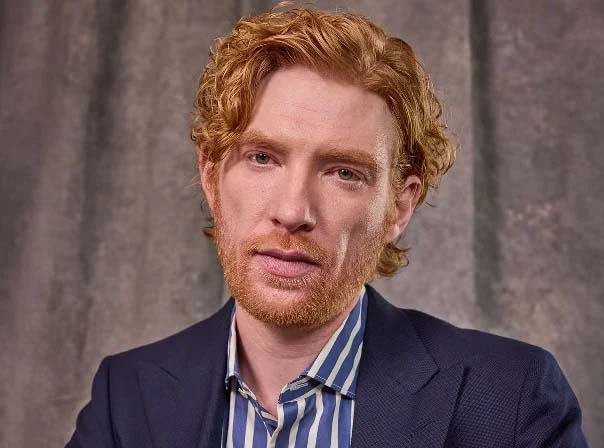
For an actor whose career has included huge franchises as well as acclaimed turns in Anna Karenina, The Revenant and sitcom The Paper, a small independent comedy might appear a considerable gear change. But Gleeson’s career has always been unusually resistant to a single trajectory, moving back and forth between blockbusters, theatre, television and odd, specific smaller projects. That movement is deliberate.
“You don’t really want to repeat yourself too much,” he says. “You don’t want to get bored in any line of work. I’m still interested in making art. And art can be anything, but this feels like such a specific thing, and I haven’t done anything like it in a while. It really relit my love of independent films and what they can be. The feeling on a crew like that, when you’re all together scrapping to make something work – it’s such a community.
“You build up such a mad little family. What those independent films give you is maybe a little harder to get when there are 200 people on set, and you can’t get to know everybody.”
Gleeson is speaking from London, where he has been promoting the film, before returning home to Dublin that evening. Despite the international nature of his career, Dublin has remained home.
INCREDIBLE MUSIC
That sense of remaining connected to the city has acquired a particular poignancy following the death of Glen Hansard in July. Hansard, who died aged 56, occupied a distinctive place within Irish cultural life: musician, actor, Oscar winner and activist, someone whose international success never appeared to loosen his relationship with Dublin.
Gleeson knew him only slightly and is careful not to overstate the connection.
“I met Glen a couple of times, and he seemed like a really nice man, and he made incredible music,” he says. “I know Enda [Walsh], who made the theatre version of Once, and I know people who worked on that musical, so that was the kind of way I knew Glen. And obviously the work he did for the homeless, that was the way I knew about him.
“But it’s a great loss. I don’t know. It’s unbearably sad. He had a young family, and in a way, I feel strange talking about it, because I didn’t know him that well. It feels weird to say anything as if it’s my tragedy.”
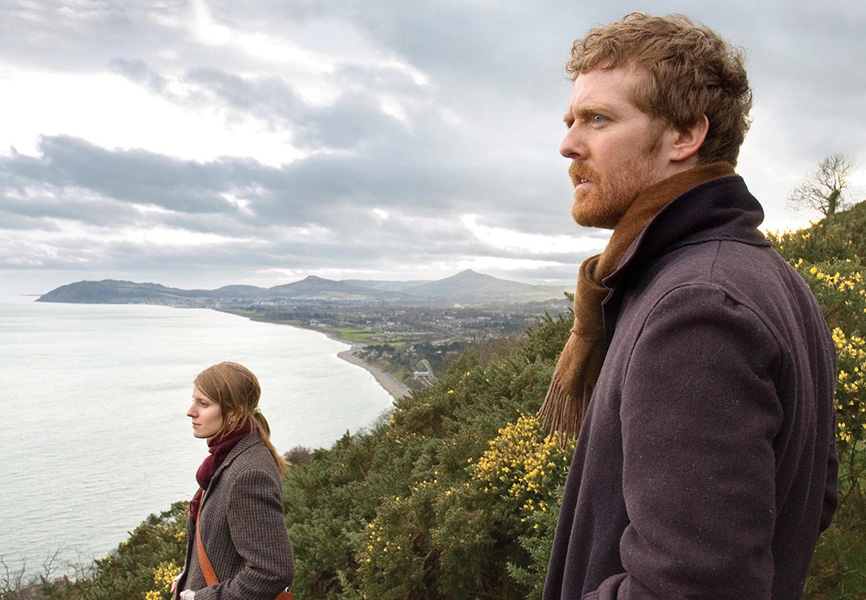
Glen Hansard in Once
Hansard’s rootedness prompts a wider question about Gleeson’s own relationship with Ireland. His father Brendan and brother Brian are embedded in Irish theatre and film, while Domhnall’s career has repeatedly taken him into vast international productions. Yet leaving Ireland permanently has never felt necessary.
“I can still seek work from Dublin and then go away when I get the work,” he says, “and that balance works very, very well for me. That’s one of the reasons I consider myself very lucky – that I’ve been able to do both those things. Live in Dublin, and then work outside it. That’s been brilliant.”
At this point, Gleeson has also been acting long enough to reconsider one of the engines that propelled his career in the first place: ambition.
“Ambition can be an amazing furnace where you can forge some remarkable things,” he considers. “And it can also engulf you if you let it. Finding a place where you have the right amount of ambition, and you let it affect you in positive ways, is the important thing. I still feel just as ambitious as when I was younger – and I was very ambitious when I was younger. But weirdly, I got ambitious once I started getting the parts.
AMBITIOUS FOR MORE
“I don’t think I started off that way. As I began to get things, that made me feel good. Not because I got them, or because of any of the stuff that goes along with it, but because doing the thing itself made me feel good – being good at my job made me feel good. Having those moments with older actors made me feel good. Then I got ambitious for more.”
What has changed is perhaps the nature of that ambition. After Harry Potter and Star Wars, after acclaimed performances and Hollywood leading roles, the instinct is not to consolidate a particular level of career, but to avoid becoming imprisoned by it.
“It’s a much more interesting way to live, to try to find new things and see how far you can push yourself. Failing sometimes means getting successes – artistic successes, I mean – you wouldn’t have had otherwise.”
He cites his father and brother as inspirations, saying, “Certainly my dad, my brother – the way they approach the work, and how wonderful the work itself is, and the way they live their lives, I find that very inspiring.”
Gleeson also nods to acclaimed filmmaker Martin McDonagh.
“I found his talent overwhelming,” he says, “but I found his ambition and dedication – I was like, well, maybe that I can replicate. I can’t be as talented as him, but I can try and replicate those things.”
In addition, the actor names Kerry Condon and his The Incomer co-star Gayle Rankin, noting, “There are lots of people you can be inspired by if you allow yourself to be.”
One person who was inspired by Gleeson recently was Taylor Swift, who met the actor on an episode of Graham Norton, then cast him in her music video for ‘Opalite’.
“I enjoyed the hell out of working with Taylor and getting to know her,” he enthuses. “I felt really privileged to be there, but she made me feel like she was lucky to have me. She’s so good, not just at what she does, but at treating people well, at being a good person.”
For all the international attention surrounding Irish performers right now, however, there are other issues. A remarkable number of Irish actors, filmmakers, writers and musicians are flourishing internationally, while the housing and cost-of-living crises – particularly in Dublin – make the precarious years required to establish an artistic career increasingly difficult to sustain. Gleeson acknowledges the issues facing young artists, but remains optimistic.
“I am very hopeful about the future of the arts in Ireland,” he says. “I was just working with Alison Oliver, who came through the Lir, and the amount of amazing people who’ve come through there is really inspiring. I didn’t go to acting college, and I don’t think you have to go to be a great actor. But I was like, ‘Oh my God, look at her generation. Look at her and the people around her, and how fantastic they all are.’ And they’re young people, so that gives me hope there’s lots more young people coming through.”
But there is still work to do.
“How we support the people who need support to stay in the arts is a different conversation, and incredibly important, and really difficult when living in Dublin is so expensive.”
• The Incomer is in cinemas now.
RELATED

- Film And TV
- 18 Oct 26
Sharon Horgan on exploring middle-age in Youth: "It's the sandwich generation"


- Film And TV
- 08 Oct 26
Trailer released for The Altruists starring Anthony Boyle and Julia Garner
RELATED

- Film And TV
- 07 Oct 26
Trailer released for Elsinore starring Andrew Scott


- Competitions
- 28 Aug 26
WATCH: Irish language heist thriller Aontas receives Oscar nod


- Film And TV
- 26 Aug 26