
- Culture
- 04 Jul 26
Maggie O'Farrell on Land: "I was really interested in the possibility of telling the whole story of a country... but all via one plot of land"








Maggie O’Farrell discusses her compelling new historical novel Land, and the hugely acclaimed film adaptation of her novel Hamnet, which famously landed Jessie Buckley Best Actress at this year’s Oscars.
Fresh from the success of Hamnet, the big screen adaption of her historical novel – for which she and director Chloé Zhao jointly received a Best Original Screenplay Oscar nomination – Maggie O’Farrell has returned with the hugely compelling Land. Set in the aftermath of the famine, the story focuses on the father and son duo of Tomás and 10-year-old Liam, who in 1865 set out to map Ireland as part of the great Ordnance Survey project.
After Tomás is thrown off course by a life-changing encounter in a copse, Liam has to figure out how he’ll complete the mapping and get them both home. Written with the author’s characteristic psychological insight, Land proves a fascinating exploration of both familial bonds and national history. The novel was initially inspired by the story of the author’s own great-great-grandfather, who worked on Ordnance Survey maps of Ireland.
“There’s always been a story in my family – it was a bit of a myth that one of our ancestors worked on the early maps of Ireland,” says O’Farrell, sitting in a quiet corner of The Garden Room restaurant in the Merrion Hotel, where fittingly, a statue of James Joyce stands looking at us in the garden outside. “I think all myths are part truth and part fiction, and they get kind of augmented and stretched. I always thought about how much truth there was in it. So I went looking for my great-great-grandfather.
“In the archives in Dublin, they’ve got extensive papers of the Ordnance Survey, so it took me a long time to find him. Mostly because if you were Irish and working for the Ordnance Survey in the 19th century, you weren’t allowed to sign your own name. Your work had to be signed by a British soldier. But I did find him eventually in certain payment ledgers, and I discovered the start of his employment was 1848.”
For the author, that proved another point of enormous interest.
“I thought, ‘That’s a strange time to be mapping Ireland,’” she continues. “They started the first lot of maps for the Ordnance Survey in the 1820s, and they thought it was going to take seven years, but it it took 20. They decided they weren’t going to use any Irish people at all, they were only going to use Brits, and it was a bit of a disaster. Because it took forever, and a lot of people were rightly alarmed when they suddenly realised there were soldiers arriving in their towns and parishes.
“After about 10 years or so, the Ordnance Survey realised they had to employ Irish people. They finished all the maps in about 1845/86, and of course, we know what happened.”
O’Farrell undertook considerable research for Land, with several visits to the Ordnance Survey archives in Dublin, and there were some remarkable discoveries.
“There was something suggested in the correspondence, that the same divisions of Irish workers had also been sent to Scotland to start the Ordnance Survey there,” says O’Farrell. “I’ve lived in Edinburgh for about 15 years, and I’ve been searching for this great-great-grandfather of mine, so I thought, I’ll just go along and give it a try. Anyway, in Scotland, he was allowed to sign his own work.
“When I got there, they said, ‘Oh yeah, we’ve got all this, which is his.’ Literally a mile from my house! I could see his sketch maps and all his field notes, which are these books with every detail. I mean, the level of detail they went into was astonishing. I discovered he’s a beautiful writer – he wrote beautifully.
“So I took lots of photographs of them, and went back to Dublin to see if I could work out which of the field notes were his. I couldn’t be 100 percent sure, but I found some I thought were probably his.”
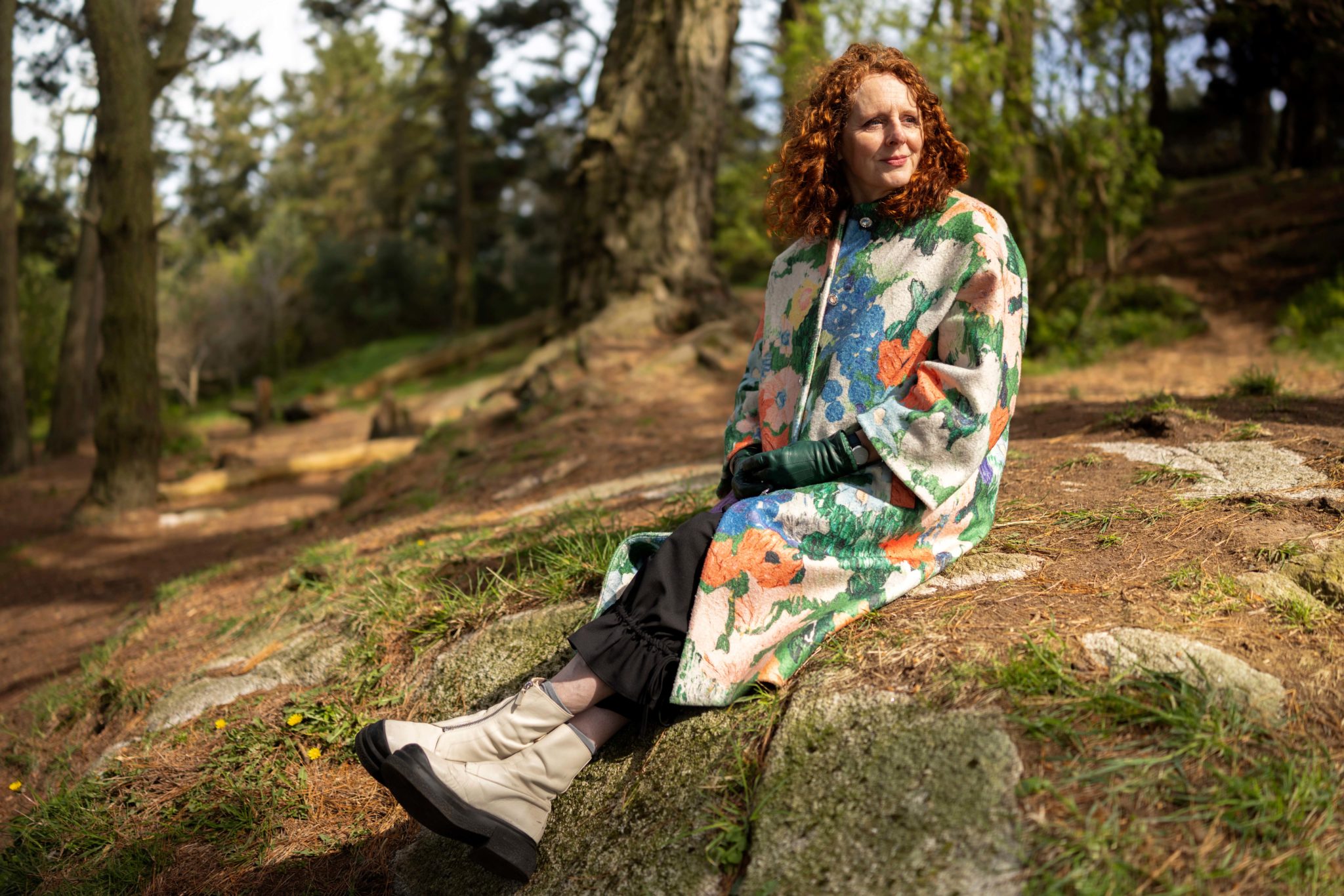
Credit: Chris Maddaloni
In writing the book, was O’Farrell primarily interested in the father-son dynamic, or in using that as a way to examine Ireland at the time?
“It was a bit of both,” says Maggie. “I was really interested in the possibility of telling the whole story of a country. Right from the ice age, in a sense, all the way through to the 20th century. I wanted to see if I could do it, but all via one plot of land. It’s unaware of all these different waves of invaders or occupiers. Sounds a bit grandiose, doesn’t it?!
“But I wanted to give it a shot. Mapping is such an interesting thing, as to why we do it. Humans were drawing maps before they were writing. Maps were this statement of, ‘This is where I am, where I’ve been and where I’m going.’ It reminds me a little bit of storytelling, it’s almost like an oral tradition you pass down. There’s a map from the iron age, I think, carved into a rock in the Italian alps.
“It’s called Bedolina. It’s astonishing. In a sense, I think mapping changed, particularly in the last few centuries. Probably even since Roman times, it’s become an act of colonialism and power. To map is to assume ownership and say, ‘This my map, these are my names and this is mine now.’”
I previously talked to O’Farrell in late 2022 for her historical thriller The Marriage Portrait, and at the time, Hamnet – which tells the story of how Shakespeare and his wife dealt with the loss of their titular young son – was still in development, having been optioned by Steven Spielberg. Given that many books bought for adaptation are never filmed, was the author surprised when the project started gathering momentum?
“Oh my god, so surprised,” Maggie acknowledges. “The normal trajectory of these things is you might sell the rights if you’re lucky, and then you might have a really excitable chat with someone. And they say, ‘It’s great, Glenn Close wants to be in it.’ You go, ‘Great’ – and then you never hear from them again.”
How did the writing process work with Chloé Zhao?
“Well, she was mostly in the States, and I was in Scotland or here,” explains Maggie. “So we mostly chatted over Zoom, and went back and forth. Chloé’s a great leaver of voice notes – they’re epic. The longest she ever left me was 58 minutes. I was playing it in the kitchen, and my daughter came in and said, ‘Why are you listening to a podcast?’ The way Chloé works out how she feels about things is to talk. Whereas I’m the opposite – I need to write things down.
“So we were handing it back and forth. I’ve heard terrible stories about collaborating and writers getting really shafted, but I never felt like that. It didn’t feel like handing it over, it felt like opening it out.”
Did you enjoy it the award seasons campaigning?
“In a way,” O’Farrell considers. “It was kind of exhausting, but fascinating. You go to something like the Golden Globes and it’s like a really weird dream. You look around and everybody you’ve seen on a TV or film screen is there. It’s like, there’s the Studio table, there’s One Battle After Another. There’s Leonardo DiCaprio and Chase Infiniti, who’s literally the most beautiful human being I’ve ever seen in my life. And there’s George Clooney and Julia Roberts… it’s just weird.
“Then you think, ‘That’s what they look like in real life.’ I mean, I know there’s a lot to make-up and hair that goes into it all, but yeah, it’s so strange. The award ceremonies are really long. You start getting ready for the Oscars at 10am, in your evening clothes. You’re there by noon and you’re there until 9.30. I was so hungry, I was about to eat the upholstery. Honestly, I thought, ‘If I don’t get fed soon, I’m gonna eat this seat!’”
There was of course huge acclaim for the performances of Paul Mescal and Jessie Buckley in Hamnet, particularly the latter, who ultimately scooped Best Actress at this year’s Oscars.
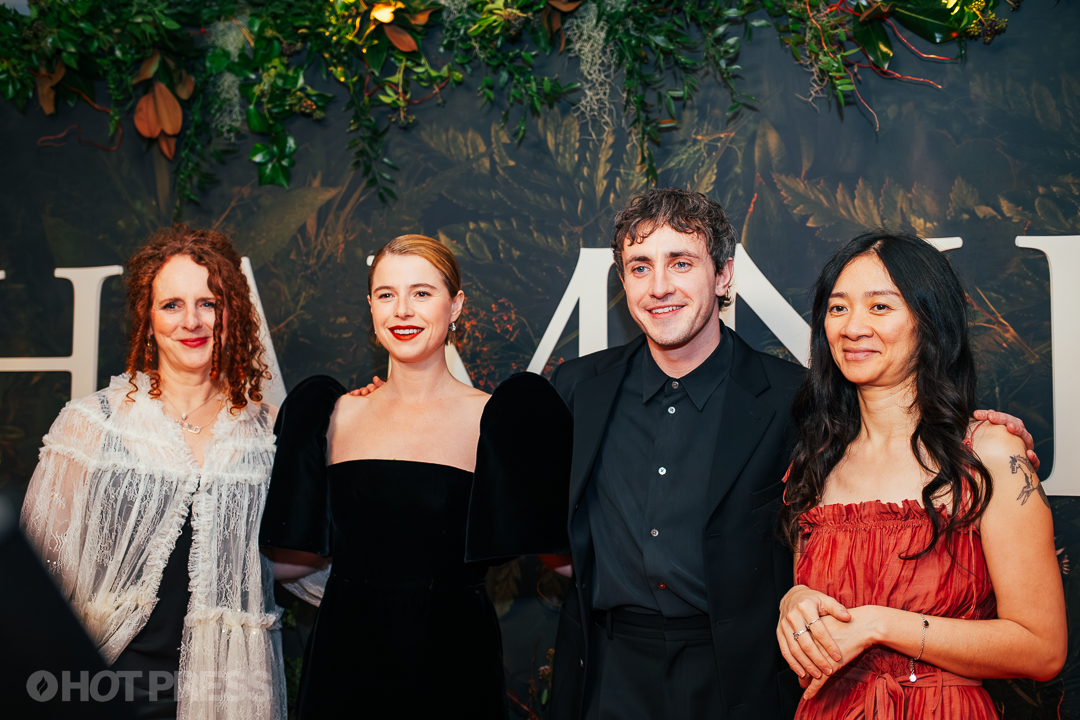
Maggie O'Farrell (left), Jessie Buckley, Paul Mescal and Chloé Zhao at the Hamnet Premiere at Light House Cinema on December 13th, 2025. Copyright Abigail Ring/ hotpress.com
“She really knocked it out of the park,” O’Farrell enthuses. “I’m just a lay person in terms of the film world. But what I found so astonishing, was that I’d be sitting in the tent with the headphones on, and I’d see Paul and Jessie do a take. I’d think, ‘Wow, fuck me – incredible!’ Then Chloé’d say, ‘Okay, we’re going again.’ And I’d think, ‘Oh my god, they’ve done it again.’ And then again and again! I don’t know much about acting, but it was incredible seeing them do it.”
The author recalls her initial meeting with Buckley.
“Jessie and I were both at quite a fancy party in London,” she reflects. “This was at a point where I don’t think Chloé and I had even started writing it – it was all very tentative. We both kind of sidled up to each other and said, ‘Hi!’ It was like, ‘Do we both know what we’re talking about?’ It turned out we did! We actually sent a photograph of us to Chloé, and I went, ‘Look who I’m hanging out with!’ So it was quite funny and we had a very long chat.
“Jessie is so exceptionally lovely. I don’t know, lovely’s the wrong word – she’s just got such an enormous heart, and she’s so easy to talk to. So we hit it off. Chloé always said it had to be her, and she’s so perfect for that role. She absolutely pours herself – heart, soul, blood and bone – into it.
“You can’t see the joins between her and the part – and yes, they are just one, I think.”
• Land is out now.


