
- Culture
- 02 Apr 26
John Minihan: "That's how important photography is – words today are playing second fiddle to the image"








Born in Dublin and raised in Athy, Co. Kildare, John Minihan is one of the most revered photographers of the modern era. In an extraordinary career, he has photographed many of Ireland’s leading artists – including Van Morrison, Taste, Sinéad O’Connor, Seamus Heaney, Edna O’Brien and Samuel Beckett – the iconic photos of whom secured his reputation – as well as The Rolling Stones, Bruce Springsteen, Diana Spencer, William Burroughs and many more.
When I think of Samuel Beckett, I don’t picture the austere Nobel laureate of literary mythology. Rather a particular photograph comes to mind: Beckett entering his ninth decade, a shock of black in his silver mane, snug in duffel coat and scarf, hovering over cigarettes and coffee in a Parisian cafe – at once ruminative yet vitally present, private but spectacularly cinematic.
The photograph was taken by the legendary photographer John Minihan, who sits across from me in the splendid surrounds of The Shelbourne Hotel, on a tranquil Friday morning.
Beckett was famously camera-shy. He disliked publicity and guarded his privacy with quiet determination. And yet, paradoxically, some of the most enduring images of the writer exist precisely because Minihan managed to photograph him not as a monumentally important writer, but as a man. The famous portraits taken at Le Petit Café on Boulevard Saint-Jacques in Paris in 1985 have since become the default visual shorthand for the playwright.
Minihan’s portraits do not feel staged or reverential. Instead, they possess the quiet observational quality of documentary photography, the sense that Beckett has simply paused during a walk through Paris and allowed the camera a moment’s attention.
This instinct, to see the humanity in cultural figures, rather than deifying them, runs through Minihan’s work – across Samuel Beckett, Francis Bacon, Edna O’Brien, Seamus Heaney, Sinead O’Connor, Van Morrison, William Burroughs, Bruce Springsteen, Chuck Berry and countless others. These images never feel like publicity shots. They are encounters. There is always the sense of the photographer waiting patiently for the right moment, perhaps when a person’s public front slips away and something more elemental appears.
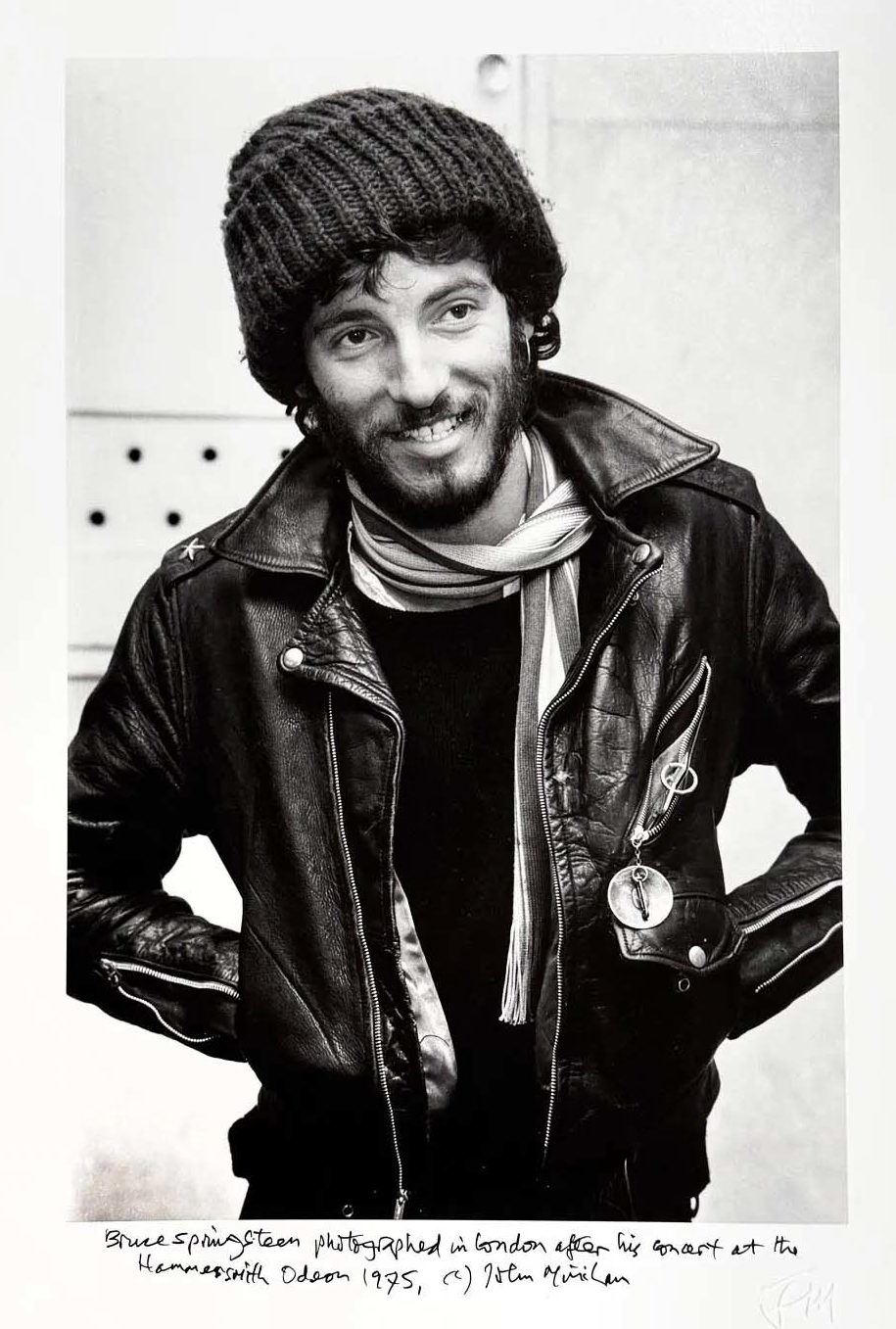
Bruce Springsteen in London in 1975 by John Minihan
What Minihan’s photographs seem to do is distill a person. Of course, there is an element of supposition here; or perhaps of belief in a kind of magic. But they have a unique, uncanny feel.
Of countless hundreds of thousands of expressions, gestures and passing moods, the art is to find the moment that crystallises – or seems to crystallise – character, that inexplicable essence that consciously, and unconsciously alike, shapes what we are, what we do and how we engage, or decline to engage, with the world. The feeling created is that a John Minihan portrait doesn’t merely record appearance: it captures an attitude, a posture towards the world. The camera becomes a kind of editorial device, selecting a single frame that offers a key, opening the door into a greater sense of an entire life.
Once that image circulates – whether on book covers, newspapers, posters, the endless archive of the internet – it has the power to overwrite other possibilities. The photograph itself becomes a kind of shorthand. The person and the portrait fuse together in public consciousness until the two are almost inseparable.
Thus, in his work over the past 60 years – captured in the exhibition Visual Poetry: The Photography of John Minihan, currently showing at the National Gallery of Ireland – John Minihan has been not just an observer, or a documentarist, but a quiet architect of cultural memory. He is also superb company, strutting into the lobby, donned in aviator leather jacket, combat shirt, blue jeans, flat cap and with his ever-faithful Leica camera strapped around his neck. “Will!” he calls out. “Come on, let’s get coffee.”
He is already chatting effusively on the way to our table, telling me about photographing none other than Jackie Kennedy. It’s as good a place as any to start...
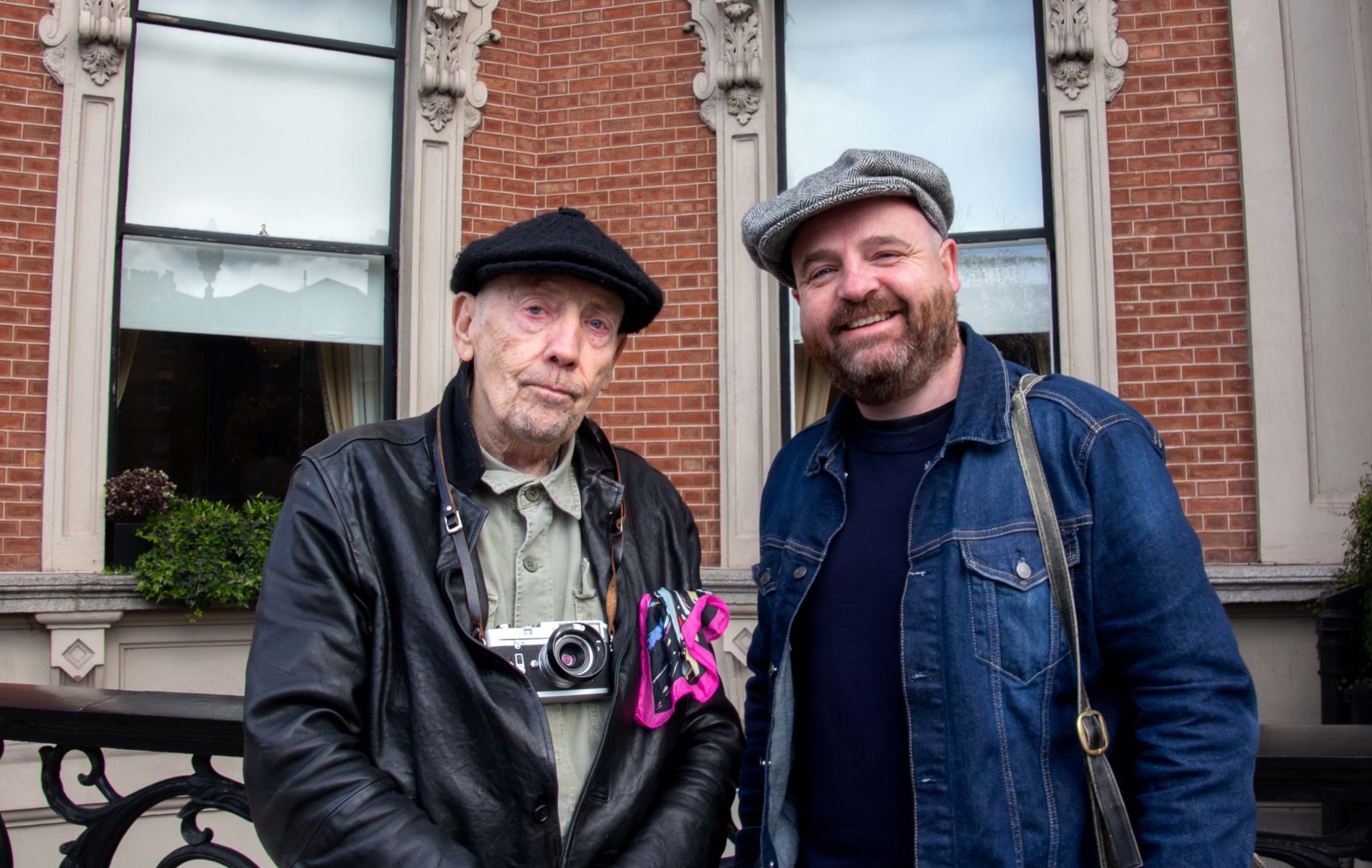
John Minihan and Will Russell. Copyright Maizy Kharrazian/www.hotpress.com
How did you first meet Jackie?
Jackie Kennedy got married to a man called Aristotle Onassis. Her sister Lee Radzivill used to live in Buckinghamshire, and everyone descended upon this place because Jackie Onassis was supposed to be there visiting her sister. I was down there working for an evening paper, and I saw in the distance, through my 200 mm lens, Jackie Kennedy Onassis grooming a horse with her sister. I ran straight across the field being chased by a security guard and as I got closer, I said “Mrs Kennedy, I’m an Irish photographer!” She smiled at this. I think she was smiling at the fact I was being chased by this big security guy who obviously couldn’t keep up with me. She agreed to me photographing her, simply saying, “Don’t make it look posed.” So, I took four or five frames, and it made the last edition – Jackie Kennedy smiling, grooming a horse. Years afterwards, I met her again. I saw her coming out of Claridge’s in London, and as she went into Curzon Street, I said, “Mrs. Kennedy, I’m the Irish photographer!” There is a picture of our meeting that day, which is now part of my collection that is archived at University College Cork.
I suspect being at the Daily Mail taught you to work quickly.
There was never enough time. But once you knew you had the picture, it was exciting. At the time it was developed on site, we’d print about three or four photographs, probably about the size of a six by four, and they were fitted onto what was called a Muirhead drum. This little light photographed the image and then transmitted it back to London and to other regional offices – say, Glasgow, Manchester or Cardiff. Now, of course, we live in the instant world. Most people go by helicopter up the mountain. I still prefer to climb the mountain, because otherwise the instant lacks passion.
Photography was far from instant when you started out...
With analogue photography, when you see something appearing before your eyes in a dish, that’s magic. A lot of young photographers don’t understand that. Today, for example, I’ve just got a Leica 35mm film camera – but normally I’d have a twin lens Roliflex which only takes 12 images. That’s anathema to some young photographers. They say, “But John, only 12 images?” But it means you have to think and you have to look; I think today that kind of passion is gone. I was a big fan of Sebastião Salgado, but when he went digital around about 2003…
You believe his art dipped?
Well, our eyes don’t see like that. I think after that, it lost its passion for me. You see, photographers are like poets. It’s all about the image, but similar to my dear friend Seamus Heaney, or my other favourite Northern Ireland poet, Padraic Fiacc, the poet of the Troubles – who most of his life, published in pages held together by thread. But the passion was in there – and Padraic Fiacc’s work will endure in the same way as Seamus’ will.
Seamus Heaney told a story about seeing a girl at a dance, fancying her, and having to wait weeks to see her again – but using that distance and anticipation to write beautiful words of yearning. Nowadays, he’d have checked out her social media before the lights went on.
Well, you nailed it. That’s exactly what I mean. Photographic film is expensive; five rows of film for my Roliflex, which only takes 12 images, is nearly 100 euros – and that’s before you have it developed. The other thing is that film is about mirrors and digital is about numbers; when it goes onto the computer you don’t really own anything. I buy the roll of film, it’s processed, and I’m holding up the film. I like the sense of tacticity. I’m involved, and it belongs to me. I had an exhibition in New York – To Love Two Countries – about the Irish who left in the ’20s, ’30s, ’40s and ’50s, and all they had was their literature, their poetry, their religion and their music.
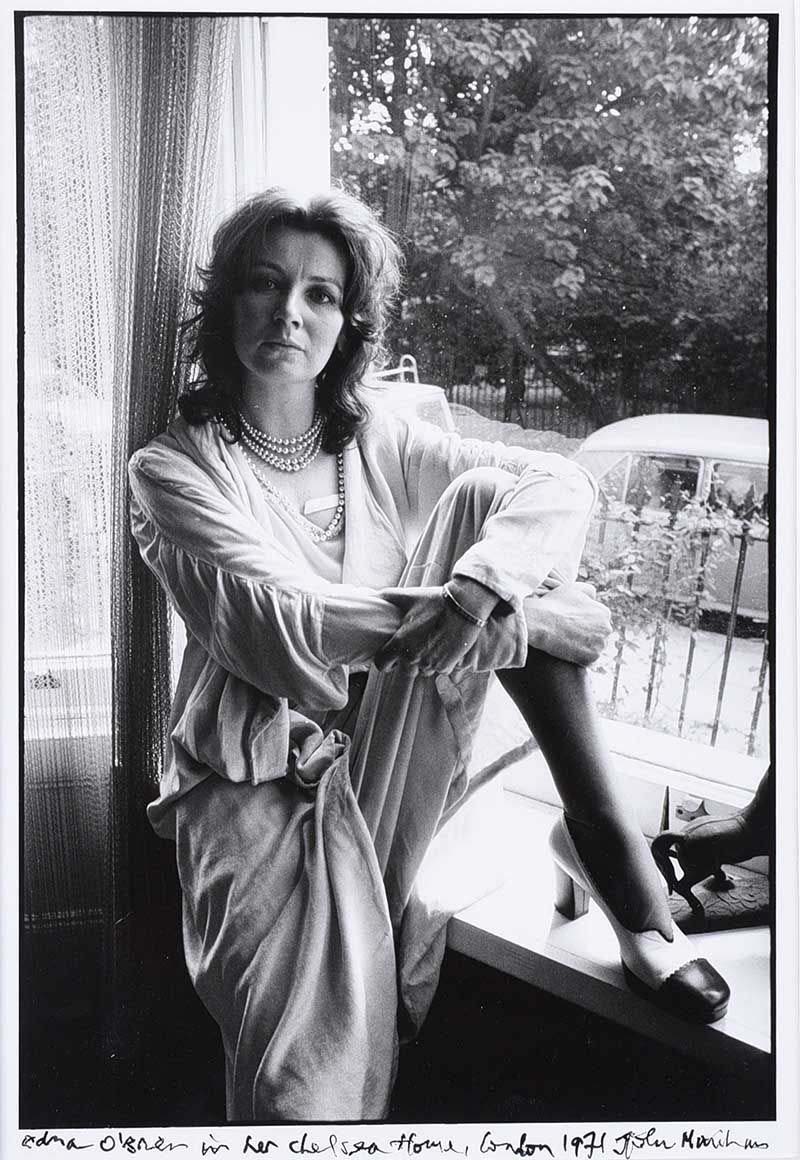
Edna O'Brien at her Chelsea home, 1971, by John Minihan
Where did that idea come from?
The concept was put together by the then ambassador in New York, Niall Burgess, a wonderful man. Niall had this idea we’d go and find 30 people in and around New York, the Bronx, New Jersey – going into homes. And the lampshade is adorned with the rosary beads, and on the mantelpiece there would be photographs of their children in military uniforms.
Was the Irish connection helpful in your work?
I got permission from the then Commissioner of Police, who was Irish of course, to photograph Irish cops in Hell’s Kitchen. I was assigned to the 18th Precinct, where I met a man called Pat Thomsey from Belfast, and he had a partner called Frank Nealon. They worked Manhattan, around Times Square, Broadway. Hell’s Kitchen, on 42nd St., was a different place than it is now. It had a spark about it, an edginess. The point I’m trying to make is that photographic film is like a wedding album, it’s cherished. I love film. I love touching it. I love looking at it.
What was the first photograph you ever saw?
I was born in the Rotunda Hospital in Dublin. My mother left me with her sister back in Dublin in 1946 when I was born and went to England, married again. So from the age of six months old, I was reared in Athy, County Kildare by my aunt and uncle. Plewman’s Terrace, Athy gave me a sense of place. And of course, being taken to Mass, looking at an open prayer book bulging with memoriam cards. Generally speaking, there was a muzzy black and white photograph of a loved one. And they always fascinated me, those memoriam cards, because – living in Athy – I was very familiar with the dying. If somebody died, there was a wonderful neighbourliness. People came together with wooden kegs of Guinness and sandwiches. I was only about four or five, looking down the room at a dead person, and saw these silhouetted figures, women dressing the body in preparation, and the hearse pulling up outside. Like I say, I was completely fascinated by that.
You became an apprentice photographer with the Daily Mail, but returned every year to Athy to record the people and their daily lives.
I started photographing Athy in 1962. At that point, I was an apprentice in the Daily Mail dark room. I was running around Soho with a camera because I was paid nothing as an apprentice. So, a lot of my life at that time was spent in Soho photographing bands – The Animals, Rory Gallagher’s Taste, Rod Stewart with The Faces and Ronnie Scott’s jazz club, where I photographed Nina Simone, Mose Allison and Georgie Fame. Then in 1970, I did the Isle of Wight Festival, where Jimi Hendrix was headlining with The Doors, The Who, Miles Davies, Joni Mitchell, Joan Baez and Rory. Recently I was at a dinner in Paris and Joan Baez was there. I said to her, “You probably don’t remember, but in 1970 I photographed you at the Isle of Wight.” Her eyes lit up – she remembered. There’s a picture of me and her at the Isle of Wight, with her arms around me.
Tell me more about photographing The Wake of Katy Tyrell.
After the Mail, I worked on the editorial floor of the Evening Standard, with its melody of hundreds of typewriters, telephones ringing and tape machines spewing out folios from United Press International, from Reuters, from the Press Association. I used to go back to Athy two or three times a year because I was just fascinated. I wanted to record what I’d seen as a young fellow going to the Christian Brothers school – people from Athy going over the canal bridge. There was the Guinness brewery – the Malt House, as they call it. As Paddy Kavanagh said in his poem, “Barges bring it from Athy.” The air was almost like food – the wonderful smell of the malt.
Which, in a roundabout way, brings us to Katy!
When Katy Tyrrell was taken out of where she died, in Woodstock Street, she went down past all those pubs where one half would have been a public place to drink, and the other half would be selling a big leg of bacon with metal buckets hanging on the ceiling. So, all of these things fascinated me, and I hoovered up a lot of images in Athy. When I was publishing the pictures of Beckett, I said to Secker & Warburg, “You can only publish them if you publish my Athy pictures” – because otherwise they wouldn’t have seen the light of day. My Beckett photographs were published in 1995 and in 1996 a hardback copy of my Athy photographs – which included the wake, which were taken in February 1977 – were published.
You photographed Katy Tyrell’s wake for two nights and three days. The photographs are beautiful – it struck me that she looks Native American.
She looks Native American and she’s dressed in the Legion of Mary burial shroud, which is blue, associated with the Madonna. I have a particular interest in Marian devotion. That morning in February 1977, I was in Bertie Doyle’s pub on Woodstock Street. When I was photographing the town, I would always be in Bertie’s for a pint and a slab of cheese, which was de rigueur at that time when you were hungry. The old gentlemen would come down from the County Home. Bertie would change their social security cheques, and they would sit by the fire and tell stories.
At that time, was there any photographer that was inspiring you?
The photographer Walker Evans collaborated with the writer Jame Agee on a book called Let Us Now Praise Famous Men. It was about the Dust Bowl period in America. Amongst those pictures, there’s an image of a mother and child, it’s Madonnaesque. Now, people will forget the magnificent Agee’s prose, but people won’t forget that image of a mother and child. And that’s how important photography is, because words today are playing second fiddle to the image.
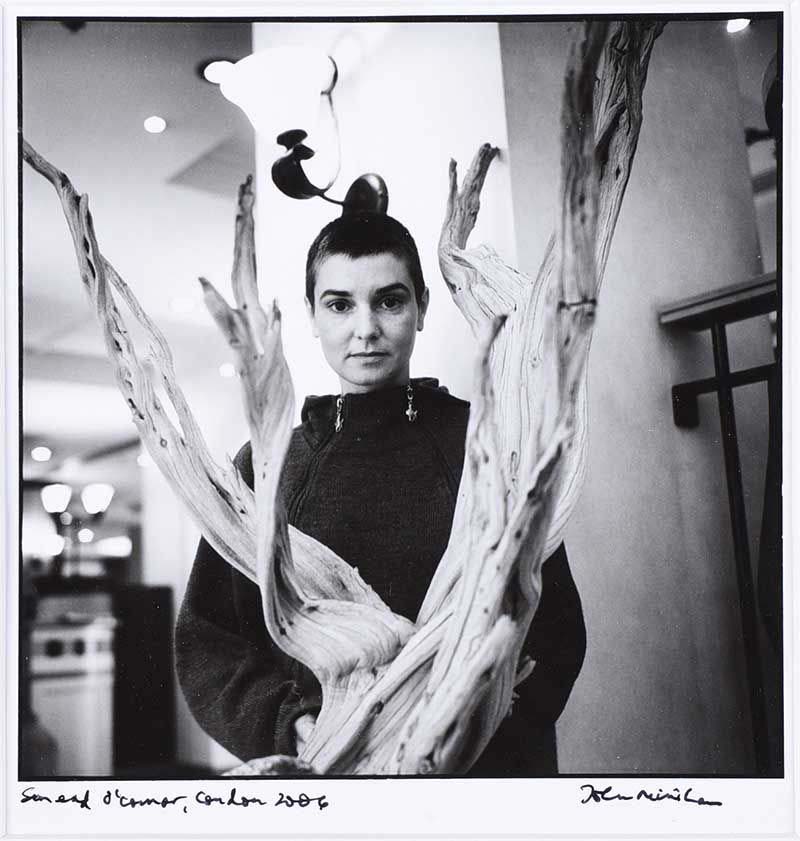
Sinéad O'Connor in London, 2006, by John Minihan
It strikes me your talent isn’t just about your eye for a photograph; it is your whole ambience, in that your subjects appear to forget you are there.
It’s about trust. Professors of literature from Princeton to Harvard to UCLA ask “John, what did you and Beckett talk about?” And I have to tell them the truth. He asked me, “How much is the pint of stout in McDaid’s nowadays?!” One of my great buddies was the writer, Stan Gebler Davies. He loved smoking French cigarettes. He loved his glass of whiskey, and he had a lovely turn with the pen. We spent a lot of time together in London. He advised me to talk to Sam about cricket. But Beckett was one of those writers who was fascinated by photography.
Caspar David Friedrich’s Two Men Contemplating the Moon is arguably a key influence on Waiting for Godot.
That it was. Yet when I was with Sam in Paris that weekend in December 1985, he sent me a note, “John, I’d be happy to see you in Paris, provided you leave your camera at home.” Well, he would say that because he was in his chosen city – the city that gave birth to photography when Louis Daguerre, in 1839, ran onto his balcony and exclaimed, “I’ve arrested the light!”
How much of your talent is innate and how much is learned?
I’ve always seen myself as God’s photographer. When I was young in Athy, some of the first images I ever saw were Leonardo da Vinci’s The Last Supper, Child of Prague statues and the Madonna and Child. In these Corporation houses, there was a plethora of art from Botticelli to Giotto, which fascinated me. To this day, I go into cathedrals and chapels. When I saw an image appear in a dish before my eyes of Sam in that cafe in Paris, that was a miracle. Beckett said very eloquently in Waiting for Godot – “Born astride of a grave” – we’re born and we’re going to die, but in the meantime we have a lot of chances to understand the magic of nature.
When people think of Samuel Beckett, they tend to picture him as you photographed him, similar to the way that when people picture James Joyce, they are thinking of Gisèle Freund’s photographs of him.
Writers have always been fascinated by photography. Emile Zola said, “You can’t claim to have seen something until you photographed it.” I understand that. I’ve always been fascinated by the collaboration you mentioned, between Gisèle Freund and James Joyce. I met her in Paris many, many years ago, I never photographed her, but Gisèle Freund spent three days with Joyce in Paris for a Time magazine cover back in the 1930s. And of course, you have Henry Miller and his wonderful collaboration with Brassaï, who photographed a lot of the nightlife in Paris at the time. Also, we wouldn’t know what Baudelaire or Victor Hugo looked like if it hadn’t been for Nadar; or what Alfred Lord Tennyson looked like if we didn’t have the photographs of Julia Margaret Cameron.
It’s been said that writers and photographers ultimately share the same task – to hold a fragile human presence in time, whether through words or through light.
At the National Gallery, there’s two statues of Shaw, one inside the new entrance and one in the main entrance. And I always give Shaw a nod, because George Bernard Shaw was an accomplished photographer. A lot of people didn’t know that. In the late 1870s, he was roaming around Ireland with his camera. And him and his wife, Charlotte, they were forever doing self-portraits, now they’re called selfies. He also wrote a lot about photography for the British Journal of Photography.
What about Synge?
John Millington Synge was also an enthusiast. He used to take pictures in the Aran Islands to remind him of what the islanders were wearing. Back in the 1960s, there was a very distinguished publisher called Liam Miller, who published John Montague and Derek Mahon. He published a book, My Wallet of Photographs: The Collected Photographs by J.M Synge, which I bought a copy of years ago and some bastard tea leafed it. In the book, there’s pictures of the Aran Islanders and there’s also some tramps on a Wicklow road – and one of the tramps is wearing a bowler hat and hob nailed boots. It could be Vladimir or Estragon. And I know Sam was a fan of Synge.
Any other literary connections, while we’re on the subject?
George Bernard Shaw introduced the American photographer, Alvin Langdon Coburn, to WB Yeats, so we wouldn’t have so many wonderful pictures of Yeats if it wasn’t for him. Francis Bacon had an appreciation of photographers and photography, because without photographs, artists like him and Andy Warhol, who I also photographed, would be inconsequential, because both he and Warhol used photographs to work from.
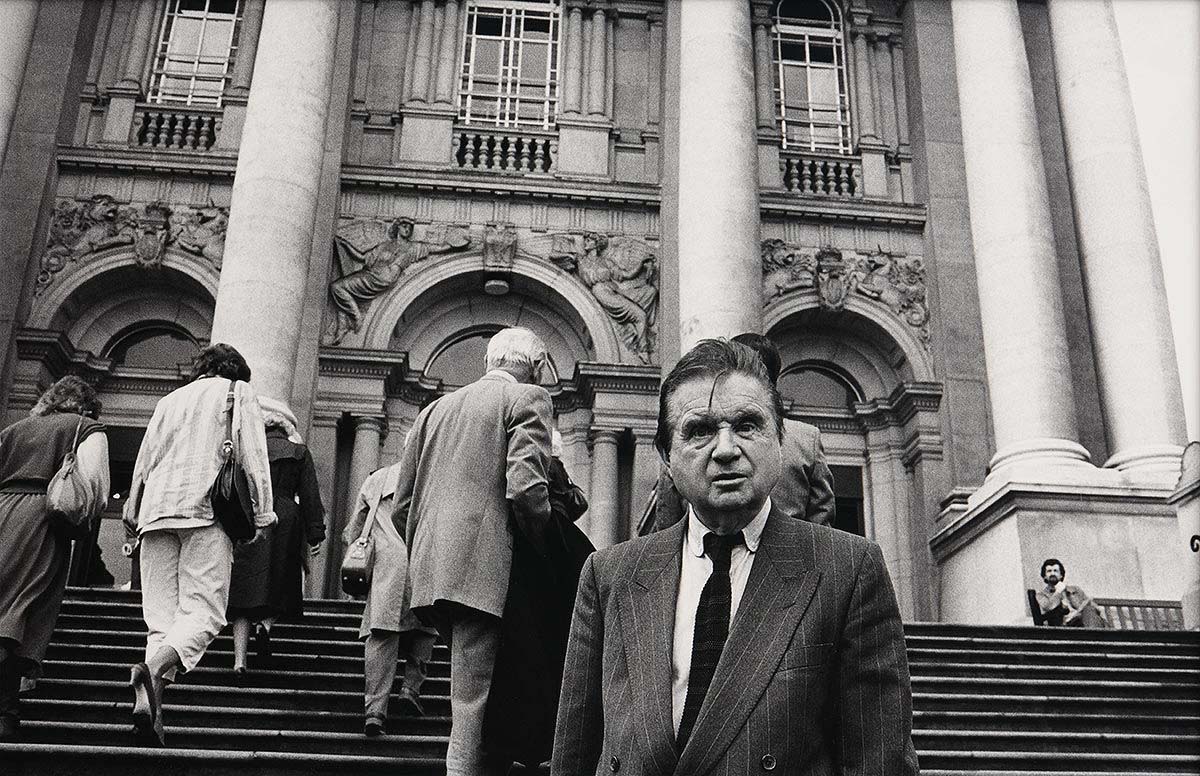
Francis Bacon in 1985, by John Minihan
John, your career suggests a certain tenacity – how important has persistence been in gaining the access needed to capture your most memorable portraits?
I remember sitting down in this greasy spoon one morning in September 1980 reading the Daily Mail – reading Nigel Dempster’s column who was well linked to the Royal Family. And there was a paragraph that said, “Prince Charles has relinquished his relationship with Lady Sarah Spencer, and he’s now seeing her younger sister Diana, who works in a kindergarten in Pimlico.” And I’m thinking, “That’s only five minutes up the road for me.” So, I drove straight up to the kindergarten, knocked on the door and said, “Look, there’s a story in today’s Daily Mail by Nigel Dempster and I’d like to speak to Lady Diana Spencer.” Within about four or five minutes, this vivacious, bubbly teenager came out and greeted me.
That’s extraordinary.
I took her out into the sunshine, I was shooting then on a Nikon F. That was the prototype camera during the Vietnam War – Don McCullin had one that still has a bullet in it, which saved his life, they’re very heavy Japanese cameras. But as I looked through the 35mm lens on the camera, I saw this Madonna image, completely illuminated by the light. I just thought, “That’s stunning. Wonderful. Time Bomb.” I sent it back by dispatch rider and two hours later, that picture’s on the front page. There’s never a day goes by that she’s not in my thoughts and prayers, because she was the human face of the Royal Family.
You first met Samuel Beckett when he was directing Endgame at the Riverside Studios in Hammersmith, west London, in the summer of 1980. A friend told you that Beckett was staying at the Hyde Park Hotel and you left a note for him. He replied saying that he was interested in seeing your pictures of The Wake of Katy Tyrell.
Beckett’s American publisher Barney Rosset asked Sam to write something for the cinema, and Beckett couldn’t refuse his friend anything, and so he wrote this 28mm silent movie which he called Film. Buster Keaton’s in it. Buster, as I understand it, was living in a condominium in Florida, and was short of the readies, and of course, he did it. But it’s basically the same time as Beckett wanted to see my photographs. We met up in Room 604 of the Hyde Park Hotel in 1980, to look at my photographs of The Wake of Katie Tyrrell.
Was there a connection?
When I walked into the wake room, I took a general view shot of a mirror surrounded with a white sheet. Mrs. Tyrell is lying on the bed. Her hands are draped in the rosary beads. Above her head is one of her daughters who died many years before her, and as you say, she’s looking like an indigenous North American Indian, another race that lost their land. And when Beckett is looking at these photographs, I’m thinking he wrote Film based on the dictum – “To be is to be perceived.”
Which meant a lot more then...
Of course, we’re all now being perceived. You can’t drive down the motorway without cameras looking at you. But in Film, when Buster Keaton is walking back to his apartment, he knows he’s being perceived, because in the play sheet published by Faber & Faber, on the cover is Samuel Beckett looking at a strip of film. Jean-Luc Godard replicated the same thing – looking at a strip of film. Many directors have done that. You know, Beckett wrote to Sergei Eisenstein in 1930, because he’d seen a film called Battleship Potemkin. Francis Bacon was also mesmerised by that image of the nurse on the Odessa steps – that’s where The Screaming Pope come from. But he never managed to execute it quite as good as they did in the Battleship Potemkin. But there is a scene in Film where Buster Keaton opens up the door to his apartment, and in front of him there’s a mirror, and he runs over with a white sheet, puts it over the mirror, and then sits down on the chair.
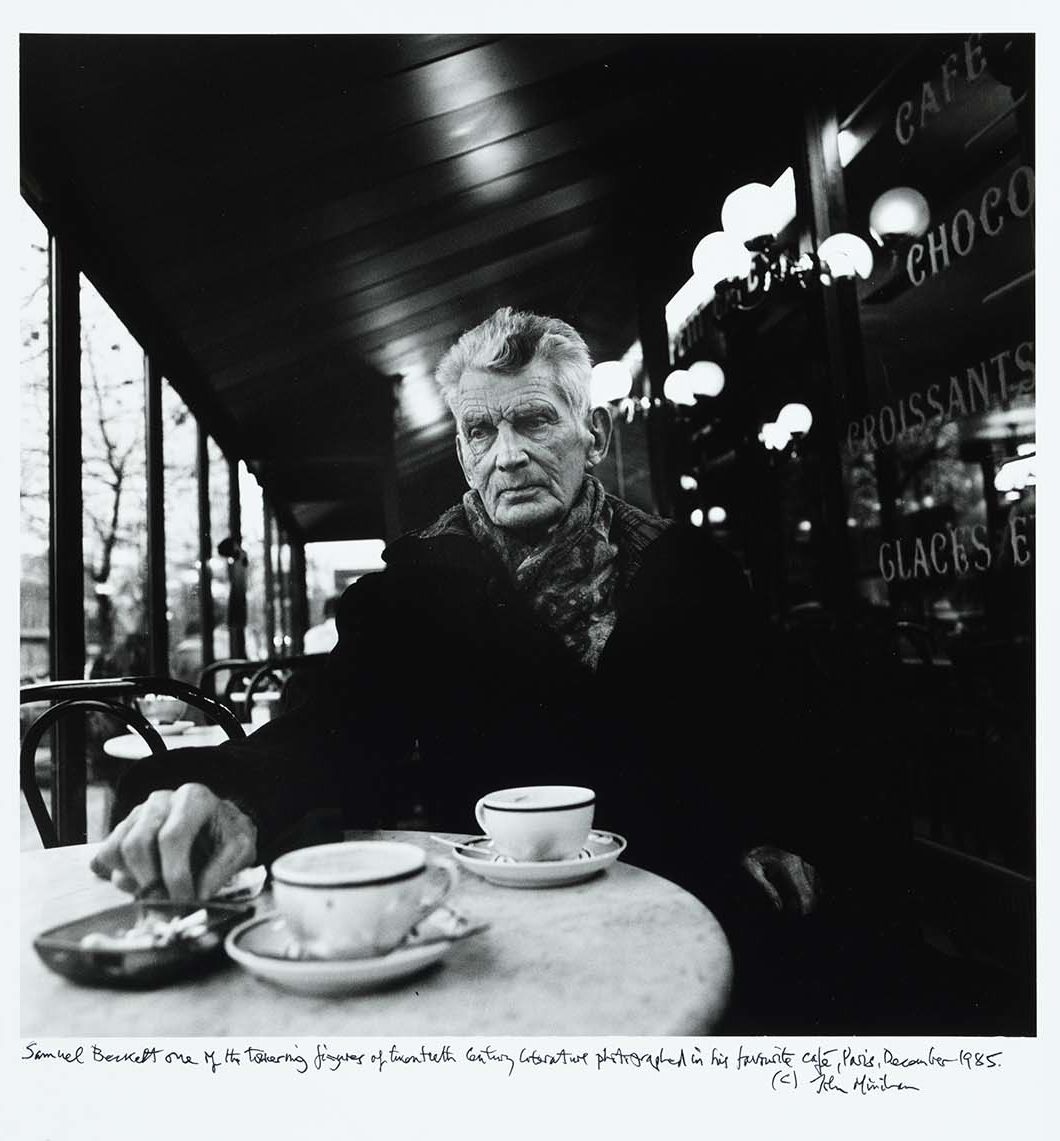
Samuel Beckett in Paris, 1985, by John Minihan
Writers are sponges John – you know that! Over 40 years later, your collaboration with Beckett is about to continue through Gary Oldman...
I’ve always loved Gary Oldman as an actor, anyone who can play Sid Vicious and Winston Churchill is a genius. He has a terrific understanding of people. My friend Adrian Dunbar and Gary started off together as young thespians at the Royal Court Theatre in Sloane Square. Gary is reprising Krapp’s Last Tape in May at the Royal Court Theatre, and I’m going over to shoot some pictures.
The fire’s still in you John.
Every time I pick up a camera, my heart beats faster. Last year, I photographed Joe Bonamassa and John C Reilly. Also, last summer, at West Cork Film Studios, they were doing a movie – Everybody Digs Bill Evans – directed by Grant Gee. Grant was having coffee in one of the coffee shops in Skibbereen, and says, “Get Minahan.” He gave me two days in the movie, where I shot pictures in black and white, and got a cameo role in it. I played the part of a photographer called W. Eugene Smith, who Johnny Depp played in a movie called Minamata.
The romance goes on...
Photography, for me, is so important because when I take pictures and I look at them again, I see things that I never saw first time around. Proust said, “Photograph is a mirror with a memory.” That about nails it.
• Visual Poetry: The Photography of John Minihan is at the National Gallery of Ireland until October 11.
RELATED

- Culture
- 28 Sep 26
David McSavage coming to 3Olympia Theatre with Says I To You

- Culture
- 28 Sep 26
Angela Scanlon to take over Sara Cox's Drivetime slot on BBC Radio 2

RELATED


- Opinion
- 20 Sep 26
Dylan Moran: "Time is literally all we have. It’s all we are"

- Competitions
- 18 Sep 26
WIN: Tickets to ANIMALS, an adaption of Blindboy's short stories, at the Abbey Theatre

- Culture
- 18 Sep 26
What's happening for Culture Night in Monaghan this year

- Culture
- 18 Sep 26
What's happening for Culture Night in Kilkenny this year

- Culture
- 18 Sep 26