
- Lifestyle & Sports
- 07 Feb 26
Ireland’s fastest man Israel Olatunde: "I had quiet confidence and said, 'This is going to happen to me eventually'"








After breaking his own records in 2025, Ireland’s fastest man, Israel Olatunde, talks training with the world’s best coaches, Irish athletic camaraderie, and his goals for 2026.
What’s it like to be the fastest Irishman ever? You know you’re good when you can answer that question with: “The first time I broke the record…”
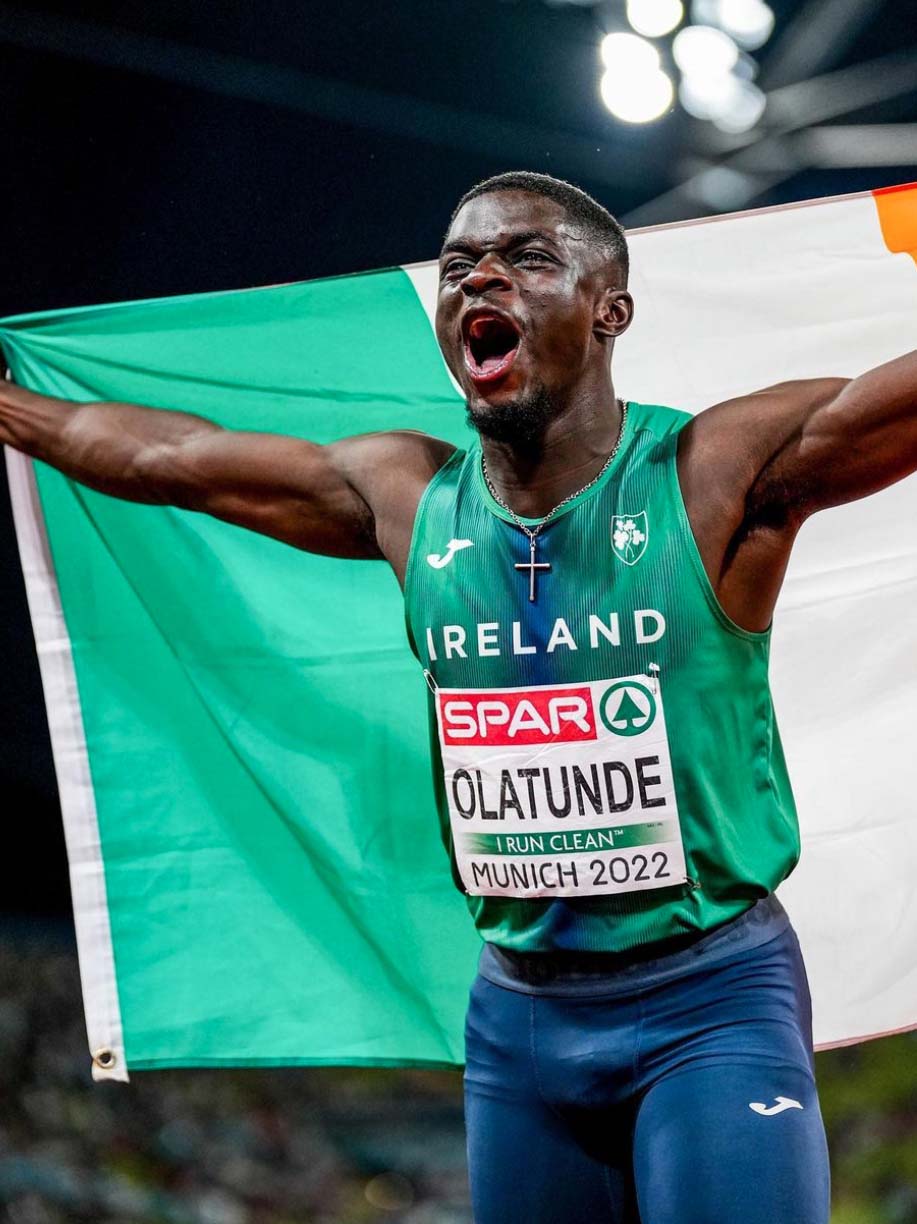
The first time was in 2022, in front of 50,000 people at the final of the European Athletics Championships in Munich’s Olympiastadion. Then 20-year-old Israel Olatunde, born and raised in Louth to Nigerian immigrant parents, ran a time of 10.17 seconds, a millisecond less than Paul Hession’s Irish record which had stood for 15 years.
Olatunde has made a hobby of lowering his own record since. The most recent breakthrough came in August 2025, when he clocked 10.08 seconds over 100m at the BFTTA Open in London. 10.08 seconds. It takes most of us longer to get off the couch. For Olatunde, it’s still not quite enough; one of his goals for next season is turning four digits into three. And he’s got all the means to do it.
Now 23 and entering his prime, he answers the video call from Clermont, Florida, where he’s training with the world’s best runners and coach Lance Brauman – whose PURE Athletics group has won over 50 medals at Olympic and world championships since 2004.
What drove you to relocate to Florida? Was it the coaches, facilities, or something else?
Yeah, pretty much. Right now I’m training with the Olympic 100 metre champion Noah Lyles. We have the same coach as well. The best training partners, the best coaches, and the best facilities are all out here in America. And the best weather as well!
It’s been pretty good. I joined this group last year so this is my second year. Getting to train with one of the fastest men ever to live has been great. He’s a great guy, honestly, and he’s always giving me tips. It’s really my development over the last couple of years.
What have been some of the biggest changes to your training since moving?
The main thing is my own approach to the sport. Training in Ireland, you close your mindset a little bit. It’s great to be the national champion and Irish record holder, but when you get into this group, you’re surrounded by Olympic and world champions. It fixed my mindset onto there being more out there to achieve.
Being around these people and seeing what they do, and seeing I’m not that far off them, really opens my ind that there’s a next step I need to take to get to that level. Being around them really encourages me to fix my goals onto the world stage for sure.
What was the jump from competing in Ireland to competing internationally like?
It was pretty seamless for me. I feel like it happened before I realised it. One season I went from competing locally in Louth to getting called up for the Irish under-18 team and then the under-20 team, and then the senior team eventually. So it was seamless, year on year, making small improvements.
I was a bit oblivious to it until I took a step back one time and realised, “Oh crap, I’m achieving my dreams right now!”
Tell me about your time in Louth growing up. What pushed you towards athletics in the first place?
I used to play soccer when I was younger, but I was never any good. So I let it go. My sister did athletics and I used to go with my mom and dad to pick her up from training. I saw that it looked pretty fun and thought, “I’m pretty fast, let’s just see what this is all about.”
That’s where I took off, at about age 12, and I started taking it seriously when I was about 15. That’s when I dropped football.
Was there a moment where it clicked for you and you said, “Wow, I can go really far with this”?
I never went into it thinking, “I want to be a professional, I want to be the best.” I did want those things, but it just seemed so far off. So I didn’t really think about it too much.
So I had dreams of being a professional athlete and being the best, but I really just enjoyed the environment around athletics. My coach Gerry McArdle made it a very positive environment to chase your goals.
So the environment that my childhood coach set up for us to be able to chase our goals inspired me a lot.
Can you describe the emotions when you became Ireland’s fastest man?
The first time I broke the record was in 2022 at the European Championships. I had been chipping away for a few years, but made my big break that year. I dropped my times down to break the record and it happened in front of a crowd of about 50-60k in Munich.
I had quiet confidence and said, “This is going to happen to me eventually.” But when it did happen, I was really shocked and surprised. It was a really special moment for me, it was one of those moments where you look back at yourself and the journey you’ve been on, and realise you’re actually living out your dreams.
2025 was a good year for you. You broke your own 100m Irish record, as well as the 4x100m relay Irish record.
Yeah for sure. Last year was definitely challenging for me. Joining a new training group here in America and adjusting to that. I have such a good coach, I’m training with the best coach in the world, in my opinion: Lance Brauman. We knew this year was going to be a bit challenging, getting used to the new system of training.
To be able to come away with that new national record, a new personal best and bringing the Irish record down to 10.08 is a really special moment for me. I showed that all my hard work is paying off and I’m going in the right direction. I can’t complain with the season I’ve had.
There were definitely some trials and injuries, but to come out of it better, I can’t ask for any more, really.
Tell us about the training that goes into whittling away milliseconds.
There are two sides to it. People think sprinting is all about speed. Speed is obviously important, but the main thing, or one of the main things, is power – how quickly can you apply your forces?
That’s the main thing I’ve been working on this year. I’m in the gym doing squats, hand cleans and power cleans. I feel like all that training has translated onto the track. I’ve gotten way stronger and I’ve been working on the track, doing a lot more speed work and speed endurance. The volume of training has definitely increased.
We are able to train a lot more here because the weather is so good – it was over 30 degrees at Christmas. I’m able to be out there on the track for hours. The volume keeps stacking up and then later in the season, you’re going to see that pay off for sure.
You mentioned a few trials and injuries. How important is the mental side of athletics?
I think the mental side is maybe 80% of it, because if you’re not in the right mindset, you’re not going to be able to achieve what you can. In athletics you can’t hide, because you’re the only person there. It’s not like you’re going to be judged by judges, but you’re against the clock and the clock doesn’t lie.
It can be very harsh sometimes, and because the clock doesn’t lie, it can get you sometimes if it’s not what you think you’re capable of. It’s definitely all about staying patient, having your goals in clear view and not getting ahead of yourself, because we all want to run fast. Every single time we step on the track, we want to run fast, but it’s all a journey, really. You can’t run your best every race, you have to build towards it.
We always have a goal to run our fastest by the end of the season, so we don’t get caught up in the early season, and that’s really important, because one slip-up of the mind and those are milliseconds gone, which is huge. That’s what separates the champion from fourth place.
What events are you looking forward to this year?
My main goal is the European Championships in Birmingham, and they start on August 10. So that’s what we’re training for. I definitely want to get back in the final mix and be in the mix for a medal for sure. So that’s our main focus.
But overall, I just want to have a very healthy season and compete all around the world and show everyone what I can do.
What would success look like for you this year?
Improvement. Just with my times and my approach and the mental side as well, how I approach each race. It’s something personal. I also still want to run fast. I’m inching closer to sub-10 seconds, which means 9 seconds is on the horizon. That’s on my mind for sure.
Irish athletics has been improving across the board in recent years. Where do you think that success is coming from?
Everyone just feeds off each other really. When there’s one great performance, one great breakthrough, I feel like everyone gets encouraged by that.
Irish athletics is a very close-knit group, we would have all grown up together. You feed off each other’s energy. When you see someone doing good, you realise it’s possible for you to do that too.
When I was a younger athlete, having role models in the sport such as Ciara Mageean and Thomas Barr, and seeing what they’d achieved, showed me that it’s possible.
Is athletics a team sport?
I think it’s a team sport until you step on the line. At my training camp we train like we are a soccer team. We root for each other and we’re all working together and training.
But when you step on the line, it’s kill or be killed. We’re all going at each other. After it all we’ll shake hands, hug it out and get back to work.
On the international stage, the Irish team are really like a family, honestly. Everyone’s so supportive of each other. There’s so much respect and I think it plays such a huge part in not feeling isolated and alone. We mentioned earlier that the mental side is so important. Having that support really helps you to stay grounded and focused. It removes unnecessary stress and tension.
I read an Irish Independent article which complemented how much you and Rhasidat Adeleke were doing for diversity in Ireland. How aware are you of your impact off the track?
I’ve been made aware of it because I’ve received so much love and support from everybody. I think that makes me realise that I am having an impact on people, especially young people.
I love racing in Ireland. You really feel the love and support, and it’s great to feel, but I also love to give the people something. I’m only running in straight lines, I’m not saving lives out here, but people get entertained. They can feel the emotions about what I do. This is an art form for me. I want to make something beautiful, not just through my running, but through my actions, through how I portray my emotions. It’s almost a performance, and I want to give the people something to relate to, something they can feel.
I’ve been made aware that people seem to resonate a lot with what I do. I’m myself, I don’t try to be anyone else and I also give 100% of me.
How do you switch off when you’re not training?
I read a lot. I love classical books and Japanese comics. I have The Iliad and Divine Comedy back there as well. I love books that make me feel something and can teach me something too. I have a Julius Caesar biography right here, and I also have Meditations by Marcus Aurelius.
I like some romantic books as well. Norwegian Wood was one of my favourites from last year. I like to be in my feels as well. I also love to take pictures. I like anything that helps me to slow down. My girlfriend got me a camera a couple of years ago for my birthday and that’s been such a great gift, because it allows me to slow down and capture a moment and be able to look back on it.
What about music?
My Spotify Wrapped came out a couple of weeks ago and it was a bit murky… I think Maverick City Music were top. They are a gospel band from the States and I love them a lot. I went to see them live when I first moved to America and it was a very cool experience for me.
Do you have a hype playlist before a big race?
Before races I train and just go with the flow, because one of my training partners will bring a speaker. Sometimes I’ll take responsibility for it, but there’s always music popping at training. Whenever I’m on the speaker, they always complain that my music is very moody and emotional, so I guess that’s what I like.
Before a race, I definitely just listen to whatever I’m listening to normally. I usually listen to something slower or contemporary. I do sometimes go for rap, but I do like classical music, like Ryuichi Sakamoto. He’s a Japanese composer, and he’s my go-to.
Finally, what’s your message for the world in 2026?
I think everyone should find something that they like to do and give it their all. The point in life is to find something that you love. You don’t have to be a master at it. You don’t have to become a legend, but find something you love and keep chipping away at it each day, trying to be better.
I’ve been blessed to make it this far. But I think even if I wasn’t a professional athlete, having something that lights your heart on fire and pushes you to be better, that’s the most important thing.
RELATED

- Lifestyle & Sports
- 30 Jul 25
Palestinian boxers to tour Ireland in August

- Lifestyle & Sports
- 08 Aug 24
Rhasidat Adeleke becomes first Irish woman in Olympic sprint final

- Lifestyle & Sports
- 29 Jul 24
Top Irish Athletes to watch at the Olympics - Best of Ireland
RELATED

- Lifestyle & Sports
- 17 Jun 24
Sport Against Racism Ireland "appalled but unsurprised" by online racist abuse of Irish athlete Rhasidat Adeleke

- Lifestyle & Sports
- 25 Sep 23
Simone Biles responds to viral Irish video of young black gymnast being denied a medal
- Lifestyle & Sports
- 22 Aug 23
Rhasidat Adeleke qualifies for 400m World Final in Budapest.

- Lifestyle & Sports
- 10 May 23
Dublin Marathon introduces non-binary category: "When everyone is made to feel welcome, we all win"
- Lifestyle & Sports
- 18 Aug 22
Tallaght's Rhasidat Adeleke sets Irish record in European 400m final to finish fifth

- Lifestyle & Sports
- 17 Aug 22