
- Film And TV
- 09 Sep 26
After The Monster: Who Owns a Film When One of Its Makers Causes Harm?







When a filmmaker is exposed as having caused serious harm, what happens to the hundreds of other people whose work lives inside their films? On September 10 in the Irish Film Institute, Hot Press Film Editor Roe McDermott explores the question at the latest instalment of her IFI series After The Monster, joined by Mark O’Halloran, Hugh O’Conor and Cara O’Doherty, with a special virtual conversation with Harvey Weinstein whistleblower Laura Madden.
When a filmmaker is exposed as having caused serious harm, what happens to the hundreds of other people whose work lives inside their films? On September 10 in the Irish Film Institute, Hot Press Film Editor Roe McDermott explores the question at the latest instalment of her IFI series After The Monster, joined by Mark O’Halloran, Hugh O’Conor and Cara O’Doherty, with a special virtual conversation with Harvey Weinstein whistleblower Laura Madden.
Film has always had a strange relationship with authorship. Hundreds of people can spend months, sometimes years, making a film, but when it reaches us, we tend to reduce it to a handful of names. A director, a star, occasionally a writer. We talk about “a Woody Allen film” or “a Roman Polanski film”, as though the cinematographer, editor, costume designer, production designer, performers and enormous crew didn’t also make that film come into existence; as if everyone else’s individual contributions some dissipated, instead dissolving in order to serve one singular creative consciousness.
That habit becomes particularly complicated when the person whose name has come to represent a film is accused of, or exposed as having committed, serious harm.
Over the past year, I’ve been exploring some of these questions in After The Monster, a series I curate and host at the Irish Film Institute examining what happens to our relationship with art when somebody involved in making it has caused harm. As an arts writer and film critic here at Hot Press, these aren't abstract questions. Critics participate in deciding which films remain part of cultural conversation, whose work is celebrated, and whose names come to stand for work that was always collaborative.
Our first event began with the audience, with a keynote from Monsters: A Fan’s Dilemma author Claire Dederer, asking what happens when something we love becomes morally complicated by what we know about its creator. Our second shifted the focus to cultural institutions, began with an interview with Tricia Tuttle, director of the Berlinale Film Festival before a panel of festival and cinema programmers, asking how cinemas and festivals should approach difficult or contested work.
The third event, Collateral Damage, turns to the people who actually make films.
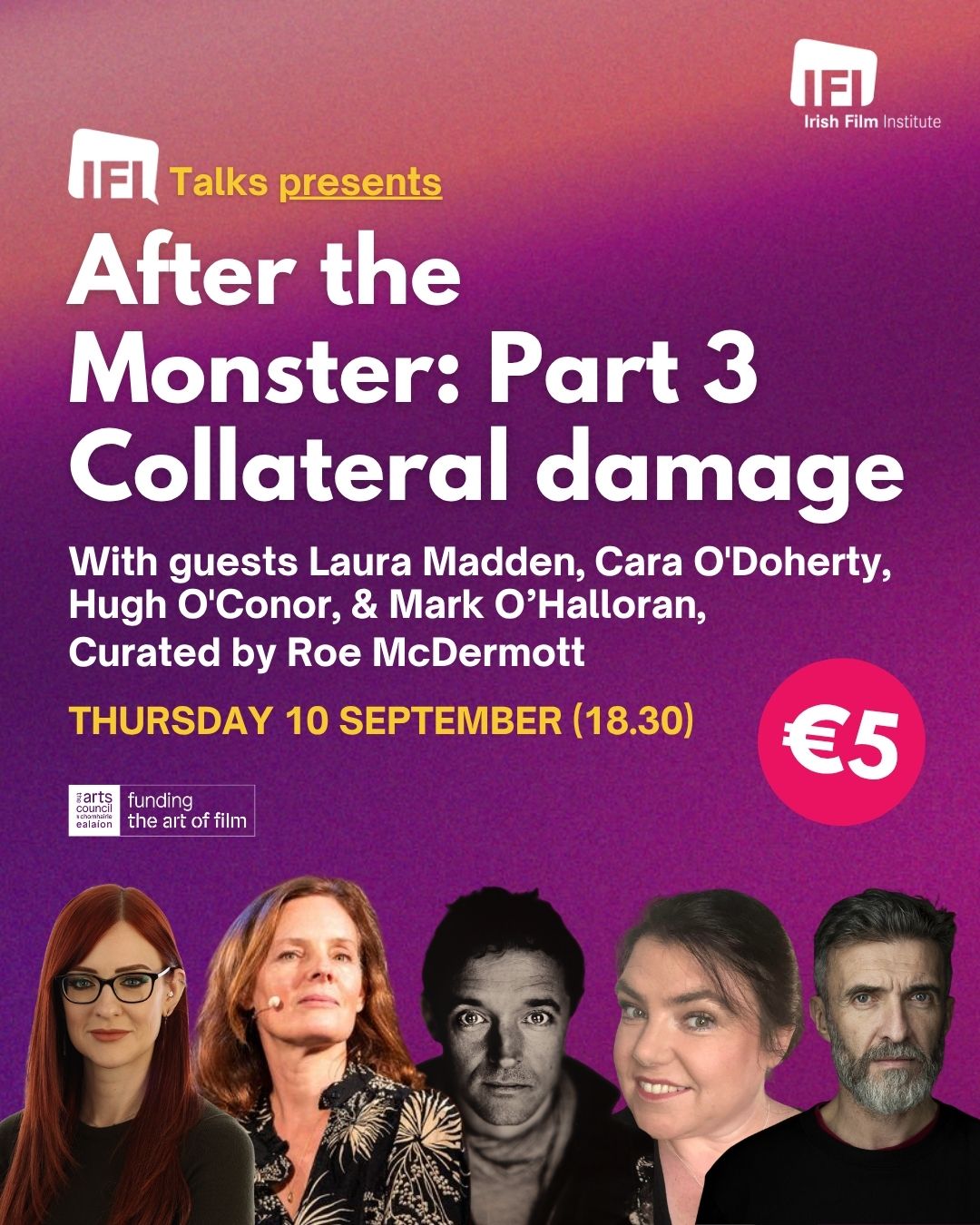
On Thursday September 10, I'll be joined at the IFI by actor, writer and director Mark O’Halloran, actor and filmmaker Hugh O’Conor, and film critic Cara O’Doherty to ask what happens when the actions of one prominent individual come to overshadow something hundreds of other people created.
If a film disappears from cultural life because of one person, whose work disappears with it? What happens to a magnificent performance, screenplay or score? What about the crew member for whom the film represents months of labour, an important credit, or a step towards their next job? Is there a meaningful distinction between preserving a film and celebrating the person who caused harm?
But the idea of “collateral damage” becomes more complicated again when we ask who is missing from that formulation.
The evening will begin with a virtual conversation with Laura Madden, the Irish former film production executive who became one of the first women to speak publicly about Harvey Weinstein's sexual misconduct. Madden was among the women who went on the record for Jodi Kantor and Megan Twohey's landmark 2017 New York Times investigation, helping to precipitate the reckoning that became #MeToo.
In speaking to Madden ahead of the event, one question kept returning: when we worry about losing the work of innocent collaborators, what about the work we have already lost? What about women who were harassed, assaulted, silenced, blacklisted or driven from industries before they could make the films they might otherwise have made? We can point to an existing film and mourn its disappearance from cultural memory. We cannot point to a film that was never made.
There is another uncomfortable possibility here too. Perhaps our response to revelations about powerful filmmakers can inadvertently reproduce the very mythology we're supposedly interrogating. If every conversation about Rosemary’s Baby becomes exclusively a conversation about Roman Polanski, what happens to Mia Farrow's extraordinary performance? If we decide the film belongs so completely to him that rejecting him requires rejecting it, have we challenged the mythology of the singular male auteur, or accepted it?
Maybe “Can we separate the art from the artist?” is the wrong question for cinema. Perhaps we should start by asking why we ever pretended there was only one artist in the first place.
- After The Monster: Collateral Damage takes place at the Irish Film Institute on September 1o at 6.30pm Tickets are only €5 and are available here.
RELATED


- Film And TV
- 18 Aug 26
Watch: official trailer for Oasis documentary Don't Look Back in Anger
RELATED

- Film And TV
- 11 Aug 26
Final trailer released for D-Day drama Pressure starring Andrew Scott and Kerry Condon

- Film And TV
- 07 Aug 26
FILM OF THE WEEK: Love Me Tender - Reviewed by Roe McDermott


- Film And TV
- 21 Jul 26
Universal Pictures release trailer for Other Mommy

- Film And TV
- 14 Jul 26
