
- Culture
- 27 May 26
Mick Flannery on The House Must Win: “I wanted to sing these songs in their new form. So that’s what we did – on the album, I played multiple characters"








Mick Flannery talks to Will Russell about The House Must Win, a double album that traces the full emotional arc of his recent acclaimed stage production – a work more than two decades in the making.
"He seems to have sprung from nowhere fully formed, this folk-inspired singer-songwriter with a collection of sepia-toned songs from another time and place,” Colm O’Hare wrote in a mighty review of Mick Flannery’s debut album, Evening Train, in Hot Press almost 20 years ago, in March 2007.
"But Cork-based Flannery,” Colm continued, “is just 23 years old, and on the evidence of his debut, he could well be the next big thing to come out of this country (despite his youth, he has paid his dues, having performed in the bars of the Bowery in New York, in Canada and around Ireland).
“Flannery’s songs are evocative, cinematic and memorable, while his lived-in, raspy voice falls somewhere between that of Ray LaMontagne, Antony (of the Johnsons fame) and Leonard Cohen, with nods to Tom Waits and Nick Cave.”
I remember well the buzz around Evening Train and his sophomore White Lies. Having fallen in with a family of devoted Flannery fanatics, I took in a load of shows, which were more High Mass than mere gig – mendicants hanging on every word in reverent silence. Aye, he really was, out of the box, that damn good.
Where were we sonically in Ireland two decades ago? Well, Bell X1 were in their majestic pomp, balancing emotional intelligence with sophisticated songwriting. The Frames retained enormous cultural influence, particularly through the remarkable success of John Carney’s Once – its stripped-back emotional realism, and the chemistry between Glen Hansard and Markéta Irglová, transformed how Irish music was perceived internationally. The eventual Academy Award for ‘Falling Slowly’ gave Irish songwriting a renewed cultural seriousness abroad.
Elsewhere, Delorentos brought sharp-edged indie energy influenced by British post-punk revivalism. Director mixed gothic theatricality with angular guitar music. The Blizzards represented a more commercially buoyant midlands guitar-pop sound. Republic Of Loose cultivated a chaotic, groove-heavy fusion of funk, hip-hop and rock. And Snow Patrol were channelling widescreen emotionalism into arena-sized indie anthems.
At the same time, singer-songwriters occupied a central place in Irish culture. Damien Rice had already established a template for emotionally exposed, internationally viable Irish folk music. Damien Dempsey was making boss records. Gemma Hayes, Cathy Davey, David Kitt, Lisa Hannigan and Paddy Casey also formed part of a broader movement toward intimate, literary songwriting.
Mick Flannery emerged into this atmosphere. His debut Evening Train felt darker and more inward-looking than much of the acoustic music surrounding it. Fast forward 20 years – and here we are again. Mick’s ninth album The House Must Win features 20 tracks – including reimaginings from Evening Train and 10 brand new songs. It also sees him unite variously with Anaïs Mitchell, Jeffrey Martin, Jenn Grant, Lisa Hannigan, Susan O’Neill, Marybeth O’Mahony, and his three brothers.
It was recorded in Cork, meanwhile, with Christian Best, and American producer and arranger Liam Robinson. And wait, there’s more. The House Must Win is a double album that spans the full story of Flannery’s recent stage production of the same name, which had its world premiere at the Pavilion Theatre, before transferring to the Everyman, Cork.
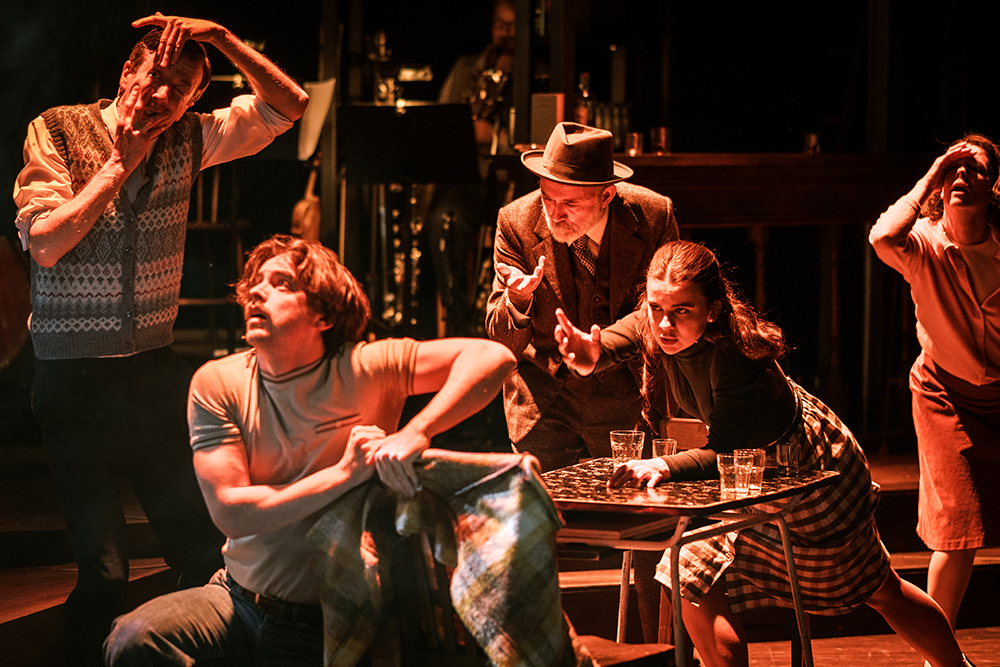
The House Must Win. Photo: Ruth Medjber
It’s outside the Victorian theatre on MacCurtain Street that I chat with the man himself. It’s opening night, and inside the stellar cast – Tommy Tiernan (making his musical theatre debut), Belfast actor and singer-songwriter Tabitha Smyth, Ferdia Walsh-Peelo, Niall McNamee, John McCarthy, Orlagh De Bhaldraithe and Damian Kearney – are going through their final processes.
There is much to unpack. So, let’s go right back to that debut album, Evening Train. Mick rips the plaster off.
“I find it hard to listen to,” he frankly states, “because I can hear my Tom Waits impression coming out. He was my biggest influence. I guess it was the way he wrote songs in story form, using a lot of dialogue – that I was attracted to.
“The first song on the album, ‘Creak In The Door’, was one of the first songs I ever wrote. I was doing a course in Music Management & Sound at Coláiste Stiofáin Naofa in Cork, and in the second year, I was trying to write as many songs as I could – but I found myself lacking subject matter.
“So, I said to myself, ‘I’ll just try and expand that song into a musical’. That’s the project I set for myself. But I gave up on the script writing element of it early and decided to just make it into a concept album.”
At the time, Mick understood instinctively that he was building a world of characters, tension and atmosphere. But he hadn’t yet grasped the architecture of a musical itself. Many of the songs, he reflects now, functioned more as lyrical vignettes than engines of narrative momentum.
Through writing The House Must Win he began to understand the deeper mechanics of musical theatre – that songs must not simply evoke emotion, but alter the emotional temperature of a scene, shifting characters internally even as the story moves forward.
We chat about the Tom Waits’ influence. “I’m pretty sure I’ve listened to everything that he has released,” Mick says with a smile.
Including Waits’ Frank’s Wild Years. The third album in a loose trilogy that began with Swordfishtrombones, it contains songs written by Waits and collaborators (mainly his wife, Kathleen Brennan) for a play of the same name, which was later performed by the legendary Steppenwolf Theatre Company. That made it a reference point for Flannery when writing Evening Train.
Flannery also remembers hearing his uncles and aunts singing ‘Martha’ and ‘I Hope I Don’t Fall In Love With You’, two songs off Waits’ legendary debut album, Closing Time.
“Those songs became what a song was supposed to be in my head,” he recalls. “They were to tell a story, and a story could be told in anyone’s voice. It didn’t need to be Tom Waits’. That remained true for all of my favourite songs: ‘The Weight’ by The Band, and lots of Dylan songs, like ‘I Shall Be Released’, ‘Forever Young’ and ‘Shelter From The Storm’.
“The sign of a great song,” he adds, “is that it can be sung by a singer, either a cappella or just with one instrument accompanying them, and it still stands up and holds the attention of the listener. In my experience of writing and recording songs, when you have a song that you need help with in the studio – which you need to massage into being something listenable, or which you need to orchestrate in such a way that it will remain interesting – it’s because its lacking that fundamental element of being a song that would live just with a guitar.”
In the original Evening Train liner notes, there’s a narrative written between the lyrics, describing what’s happening from song to song, and telling the bones of the story between the three main characters, which is a naive young person’s love triangle.
“That remains the skeleton of the musical,” Mick says now. “There’s aspects of the old songs I found very hard to rewrite, so I kept the story that my 20-year-old self wrote. Even though a 20-year-old is not concerned with an overall theme that most musicals generally have.”
He grins widely, adding, “I’d be in a much better position now if I had the energy to start from scratch.”
I feel the need to interject that Evening Train is a damn fine record. There were others, in addition to Hot Press, who raved about Flannery arriving fully formed. But Mick confirms the songs were the first he ever wrote.
“I was set up in a good way by my aunts and uncles,” he explains, “and my father was very supportive. He had two sayings he repeated to me a couple of times. One was, ‘Only listen to the masters. Don’t listen to any middle of the road stuff. Don’t get caught up by fads.’ The other one was, ‘You have to get your shit done before you’re 35.’ Which was actually pretty clever. He was aware that a person’s creativity is tied to their naivety and their ignorance in a lot of ways.”
It helps if you are trying to discover who you are and what you have to say...
“The things they don’t understand about themselves, or the world,” he reflects, “are heightened when the person is in the mix of trying to figure themselves out. And once you get to 35, the first one disappears, you start to recognise, ‘Oh, this is who I am. This is settling down. And so now all I’ve got left is an outlook on the world’.
“Which may not be exciting, especially to an audience who is still in their youth. It’s self-evident that every generation wants to hear the anxieties of their contemporaries. They want to feel an affinity with the pop star of the day, or the rock star of the day, who’s their age, dealing with the same type of interpersonal problems they have – but who also has that little bit of magical fame and mystery.
“They won’t go back to Bob Dylan’s anxious years to get that feeling from him,” he offers. “I reckon that for people born in the 1940s, Bob Dylan must feel like a lifelong companion. He carried them through youth, protest and disillusionment, and now, in his eighties, Rough And Rowdy Ways confronts mortality itself. Few artists have aged alongside their audience so completely, or so honestly. This is the guy who kind of got you through your first love, and here he is telling you about death…
“He’s closing your eyelids,” Mick finishes and we both laugh loudly. “Leonard Cohen’s Thanks For The Dance did that for me. He’s obviously passed away and he’s a good deal older than I am, but I find that album fascinating from that point of view – ‘I can’t make the hills / The system is shot’. I think it must be my favourite of the last few years.”
What becomes clear speaking to Mick is just how deeply embedded he has been in The House Must Win stage production from its very genesis. This was never a case of handing songs over to theatre people and stepping aside. Rather, he immersed himself in every aspect of the process – script development, character arcs, narrative structure and the mechanics of musical storytelling itself.
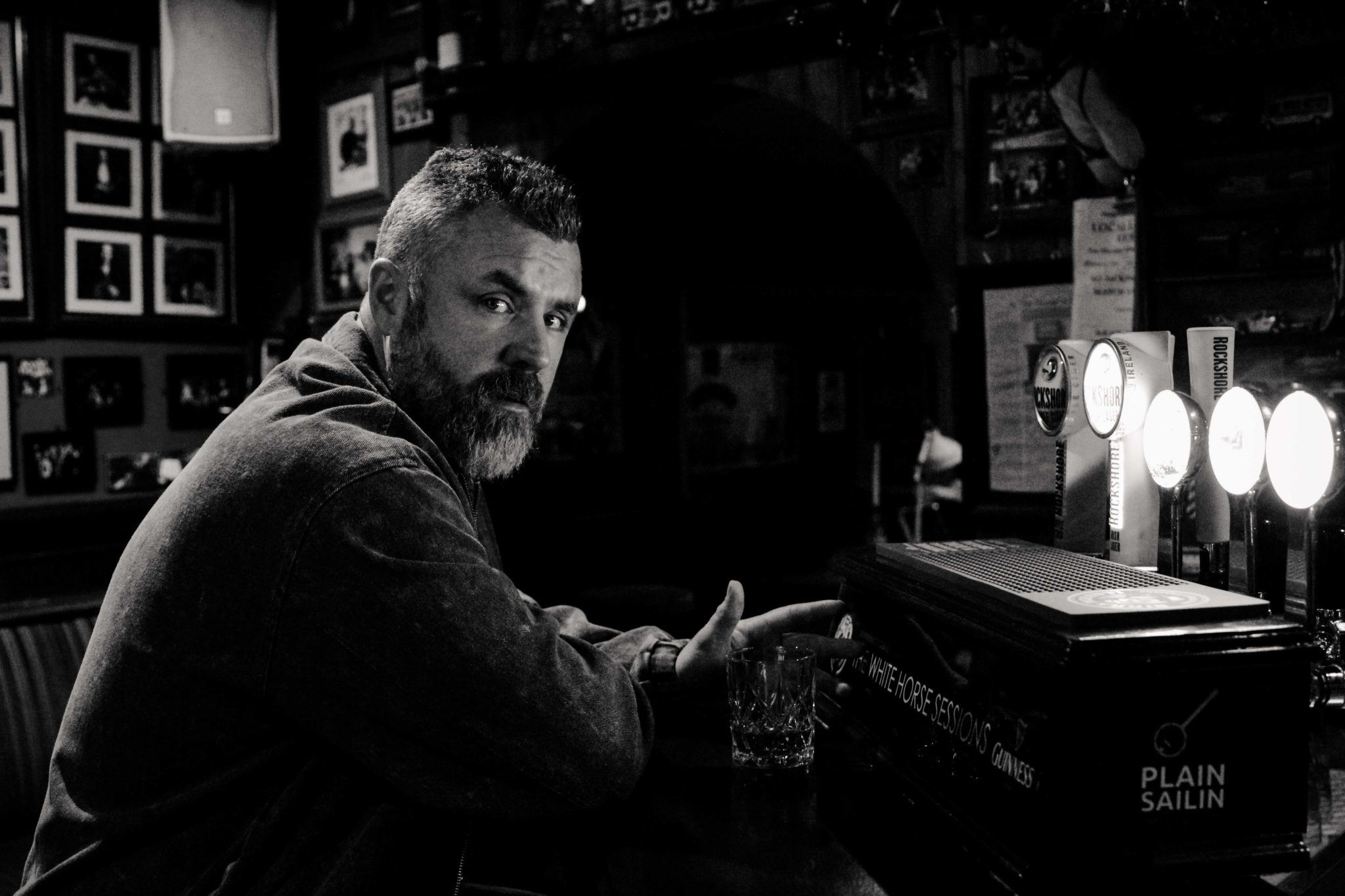
Mick Flannery. Credit: Susie Conroy
“I learned a lot,” he confirms. “It was a very steep learning curve about ‘Show. Don’t tell.’ Don’t spoon-feed the audience. Avoid expositional material, which is a kind of reverse gear from my brain when it comes to writing, because songs are all about telling as quickly as you can. Like in four minutes, Tom Waits gets across a whole love story, start to finish, and you’ve been told everything in that four minutes.
“And in a script, you are not to tell anyone anything. You’re just to show how events are moulding characters into making different decisions. It’s a very interesting way of attacking something. I made lots of mistakes. I was embarrassed a lot of the time, things that I wrote that didn’t make sense or didn’t track. Also, I was used to writing songs, where I’d write the song, I’d finish it and I wouldn’t have shown anyone any shit draft of it. But in this script situation, you have to work through all these drafts, and everyone knows how shit it was.”
Ex-Everyman artistic guru Julie Kelleher is the director.
“Julie has been on this project since before 2019,” Mick conveys. “When I took the script responsibilities onto myself, Julie took on the directing responsibilities. It has worked out great, because Julie already had a good sense of what the thing was supposed to be. She was very supportive, because it’s tough when you’re trying to tell someone that’s writing something that they’re not getting it.”
Mick describes the making of The House Must Win as involving a room full of people entirely committed to their vocation, trying collectively to will something meaningful into existence. He speaks about the experience with gratitude, conscious of the privilege of being part of it. And, yet, I imagine on opening night, he felt like a football manager, unable to influence proceedings once his team has taken to the pitch.
“Yeah,” he agrees, “it is that type of feeling. I’m learning the whole time as well. I’m still fixing things. I was making cuts there yesterday, just losing a little bit of fat here and there. We had a preview in Ballybunion three weeks ago, which was our first ever show. We had done two weeks of rehearsals with the set in this theatre, which was a privilege. The reaction was electric. They were well into it; there was almost a panto level reaction.
“A very knowledgeable sound engineer who’s working on the set, said, ‘You won’t get that in Dun Laoghaire. Steel yourself for some temperance there now’. And she was right, you get into a more intimate, smaller theatre in Dublin, and the audiences were a little more reserved. Everything went fine. The reactions were still good, but – maybe, like the football manager analogy – when you bring your team to certain stadiums, you think, ‘Oh fuck, this is a different place’.”
Of course, Mick also went and recorded a sprawling double album – a project that feels emotionally and creatively enormous.
“It’s a little insane to be honest,” he laughs. “I was to go into a studio in January and record a new album, but I actually wasn’t ready. And over the previous weeks, I had been in a workshop for the musical where I was listening to the arrangements that Liam Robinson had done for all these songs, which brought them to a new place that I was really happy with.”
Mick got jealous.
“I wanted to sing these songs in their new form,” he reveals. “So that’s what we did – on the album, I played multiple characters. We had lots of guests come in, and it was great.”
The album will be played over two summer evenings in Vicar St., in June.
“We’re going to do it,” he explains, “as two album launch nights, where we’ll sing through the songbook of the musical with lots of special guests, and with the band that has been on the project the whole time.”
Will the brothers Flannery who appear on ‘Take It On The Chin’ be attending?
“Yeah, they’re coming,” Mick smiles. “Jeffrey Martin is coming from America, Jenn Grant I think is coming. We’ll do it in sequence. I might give a little synopsis of the story as we go, but I should make it clear that it is not the actual play. Sometimes we get some confusion. We have to make it very clear that I was not in the musical – and that the Vicar St. gigs are not the musical. We don’t want to be upsetting people!”
• The House Must Win is out now. Mick Flannery plays Vicar St., Dublin on June 25 & 26. He also plays with Susan O’Neill at When Next We Meet in Clonmel on May 30. See his full list of dates here.
RELATED


- Culture
- 05 Sep 25
Album Review: Michael D. Higgins, Against All Certainty

- Film And TV
- 30 Jan 25
Andrew Scott stars in music video for Sam Fender's 'People Watching'
RELATED

- Opinion
- 03 Apr 24
The Pogues: 'Dark Streets of London' – 40 Years On


- Culture
- 10 Nov 23
Album Review: Bob Dylan, The Complete Budokan 1978

- Culture
- 09 Nov 23
November 9 is now officially Wu-Tang day in New York City

- Culture
- 25 Sep 23
Usher has been announced as the 2024 Super Bowl Halftime Show headliner

- Culture
- 20 Sep 23