
- Culture
- 10 Nov 26
Meet the Arts Officers: We want to change the perception of Longford


From the young bands of Abú Fest to the illuminated spectacle of Longford Lights, Arts Officer Shane Crossan is helping Longford find its creative confidence – and giving its residents more reasons to get out, join in and make art.
Longford is often seen as one of Ireland’s struggling counties. It’s an understandable view, if you’re looking at stats. In the year to August 2026, it recorded the lowest median dwelling price in the country, while Census 2022 put its unemployment rate at 11 per cent, jointly the highest among the counties.
Spend some time around its vibrant music scene, however, and another Longford comes into focus. Young bands are forming, breaking up and forming again. Almost Famous, a youth-led music and event collective in Longford Town, has provided a platform for an emerging punk and alternative scene. In venues such as Lyons, Valentines and PV’s, musicians are assembling audiences and putting on shows.
Elsewhere, Longford Lights has turned the former military barracks into a setting for illuminated artworks, drawing residents to participate in their creation. And, adjacent to the Arts Officer’s brief, there’s a Night-Time Economy Advisor which sees the local authority experimenting with ways to bring people into Longford town after dark.
These undertakings differ in scale and ambition, but together they suggest a place where there’s a growing appetite for making things happen.
THE SHINY PENNIES
A recurring presence in these positive moves is Shane Crossan, Longford County Council’s Arts Officer. Sometimes his office supplies funding; sometimes advice, equipment or the connections that get an idea moving. Often Shane finds himself producing the event. Working alongside young promoters, artists, publicans and council colleagues, he occupies a position whose influence is far-reaching.
His route into the role is equally interesting, involving a History & English degree, a move to New York at 21 to pursue acting, and then community television and youth projects in Dublin’s north inner city. Chuck in carnival work and street theatre, and Shane has had plenty of experience in getting things up and running – and in getting people involved.
He moved to Longford in 2012, continuing to work in film. In a parallel move, he began School of Rock in 2014 with a couple of early school leavers. By the pandemic, he says, almost 200 young people were involved. After lockdown, he handed the school over to Music Generation. He had also built a mobile gig rig where the young musicians could perform.
By 2020, he had gradually shifted into community and cultural projects, marked by the formation of his Republic of Culture umbrella. When pandemic-era outdoor programming needed stages and production expertise, he was unusually well equipped. As an arts activist, he was doing things he wanted to see happen.
With all of that under his belt, he was fully prepared for the role of Arts Officer with Longford County Council, when it became available in 2022.
“There are 28 Arts Officers in the Republic,” Shane explains. “In a way, it’s a very unusual fit for a Council. They’re naturally cautious people – they’re there to ensure taxpayers’ money is spent properly.”
But it has increasingly been recognised that this responsibility extends to local authorities embracing the need for a cultural programme. Hence the emergence of the role of Arts Officer – an increasingly important expression of a council’s wider mandate.
“An Arts Officer is what they call a specialist position and it’s recruited externally,” Shane explains. “Everything is standardised in the Council, but there’s nothing standardised about the Arts Office because all art is unique. All artists are unique.”
Shane is less concerned with being seen to supercharge the next breakthrough act than with encouraging a scene to sustain itself. Band names change, line-ups dissolve and musicians regroup. That’s par for the course. But what’s important is that he can encourage then to express themselves, to grow and to develop – as artists.
With that in mind, he admires “the shiny pennies” – those capable, resourceful characters who have begun organising gigs themselves, securing pub rooms, bringing in sound engineers and charging admission. He loves the “happy chaos” of it all.
Around them is a wider cohort, drawn to hip-hop, indie, emo, punk and rock ’n’ roll. “The beautiful weirdos,” he says affectionately.
“Every town has creatively-inclined young people,” he adds. The challenge is to give them enough opportunities to find one another and develop. Too often, those formative encounters wait until they leave for a city, university or art college.
“I think there is a tribe in Longford,” Shane states. An important part of his role is to encourage them to find their voices now.
COMMUNITY OF ACTIVISTS
Abú Fest, the youth-led music festival in Ballymahon, is one of the Arts Office’s great successes. Longford Lights, the community festival of illuminated Art, is another.
Abú Fest grew out of the young music scene Shane had watched develop through School of Rock. He gathered five or six young musicians and proposed a summer festival. Skelly’s in Ballymahon offered a large back area and an enthusiastic owner, with a stretch tent and a converted barn, supplying the two stages.
The teenagers designed backdrops, developed the branding and chose the acts, with funding and support from the Arts Office. GrooveLine – a brilliant, genre-bending funk outfit from the North-West – headlined, and Crossan estimates around 400 people attended.
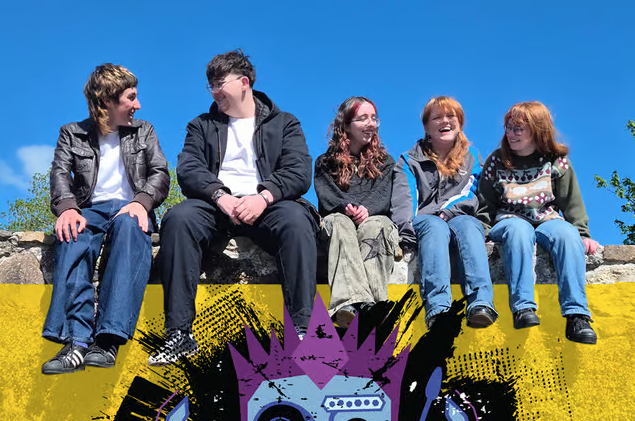
“They programmed it,” he says. “I wouldn’t have had a clue.”
Longford Lights draws on a broader pool of participants. Crossan estimates that in some years around 2,000 people have helped make the artworks. Alongside developing the local artistic community, the festival gives migrant communities and people with additional needs opportunities to shape how their town looks and feels.
“It allows them to be visible,” Shane emphasises.
In addition, Ireland’s Night-Time Economy programme aims to develop cultural, social and economic activity after 6pm – and Longford was chosen as one of nine national pilot locations.
The programme is run by Karen Reilly, the Night-Time Economy Advisor with the council, who has shown an admirable willingness to experiment, testing different musical offerings, alongside coffee evenings for people who want somewhere to socialise without drinking.
“Some of them worked very well, and some less well,” Shane says, nominating a Boys From The Black Stuff and Mundy event at Lyons among its biggest successes. He also recalls a Culture Night celebration of fiddler Thomas ‘Blind’ Kiernan, combining music, projection and artwork, with Kíla headlining and a Ukrainian classical quintet participating.
Brilliant events like that live long in the memory, but the real challenge is building towards a lasting change in how a town like Longford – joked about by The 2 Johnnies as the most forgotten about place in Ireland – is perceived.
Shane points to Limerick as a metropolis whose public image has changed, reasoning that these things are not immutable. For him, however, there is more to it than subsidising the existing entertainment and cultural offering.
Consulted on the redevelopment of Connolly Barracks, he asked for a creative space where residents could work alongside artists. As Arts Officer, he explains, what matters is finding workspaces, bringing people together and enabling artistic consultation, inspiration and creation.
“I need a place where I can bring all kinds of citizens to make art,” he maintains.
That ambition extends onto the streets. The recent Samhain Procession in Longford Town was magnificently epic and a proposed festival next August would bring community samba bands to Longford, along with circus performances for families, if funding allows.
What’s good for the arts is also good for business – and for morale. Shane is also fostering relationships with Arts Officers in neighbouring counties, with the aim of building a community of cultural activists who can share their resources and skills. His belief is that county boundaries needn’t limit the possibilities.
“You can do anything you want in life,” he says, “but you can’t do everything. For now, the priority for me as Arts Officer here is getting people involved. I want to reach the point where Longford residents can look around their town and say: ‘There’s loads of Art in Longford’ . And a vital part of that is that they feel it is accessible to them. We want everyone to be involved.”
Which may well be as good a way of summing up the council’s mandate as you could get.
• Funded by the Local Democracy Reporting Scheme
RELATED

- Culture
- 10 Nov 26
Sci-fi author M. John Harrison becomes oldest winner of Booker Prize

- Culture
- 09 Nov 26


