
- Opinion
- 15 Jun 26
The Gaza Flotilla spotlighted torture – how many more Palestinian victims before the world acts?








Caoimhe Butterly reflects on the recent violent abuse of flotilla activists, and the more invisibilised plight of Palestinian political prisoners.
In 2008, two humble fishing boats set sail from Cyprus towards Gaza with 44 participants, medical supplies and 200 hearing aids on board. Two days of motoring later they docked – the first boats to arrive on Gaza's shores in over 40 years.
Tens of thousands of Palestinians – families, educators, healthcare workers, university students, mariners, musicians, athletes and schoolchildren – awaited at port and along the coastline to welcome a momentary, if symbolic, breach of the hermetic Israeli siege.
Also waiting was Shams, a psychosocial supports worker with the Gaza Community Mental Health Centre, which has provided decades-long PTSD supports and psychological resourcing to adults and children across Gaza.
She stated then that watching the boats arrive was a powerful experience.
"We felt," she said, "like we could breathe. That we weren't forgotten, that we weren't alone."
When the boats of the first three Free Gaza Movement missions departed Gaza, some of us chose to stay – to volunteer with Palestinian ambulance crews and to accompany farmers and fishermen under fire. Two months later, in December 2008, the Cast Lead offensive began, with Israeli aerial bombardment and ground invasions killing over 1,400 Palestinians during a three-week onslaught.
For much of Cast Lead, our small group of international volunteers were based in Kamal Adwan and Al Awda hospitals, working alongside courageous and committed Palestinian Red Crescent paramedics. We rode on ambulances as support First Responders – as attempt to mitigate against the already systematic, deliberate targeting of Palestinian healthcare workers.
IN THE BACK OF AN AMBULANCE
One night, while in the ambulance station of Kamal Adwan hospital – the director of which, Doctor Hussam Abu Safiya, is now a political prisoner enduring sustained torture in Israeli prisons, along with hundreds of other imprisoned healthcare workers from Gaza – we received a call from a home in the Shujaiya neighbourhood.
The once bustling area was almost deserted, many families having fled as Israeli tanks and soldiers took up position. Other residents remained – silent in the dark, cold confines of their homes, crouching as they moved from room to room to avoid sniper fire through already shattered windows.
We arrived to the sound of drones above us, the front lights of the ambulances spotlighting devastation. Those operating the drones were by then using what has become known as a ‘double-tap’ method – bombing and then attacking again when rescuers arrived at the scene – causing further casualties amongst paramedics and bystanders responding to those injured by the first missile impact.
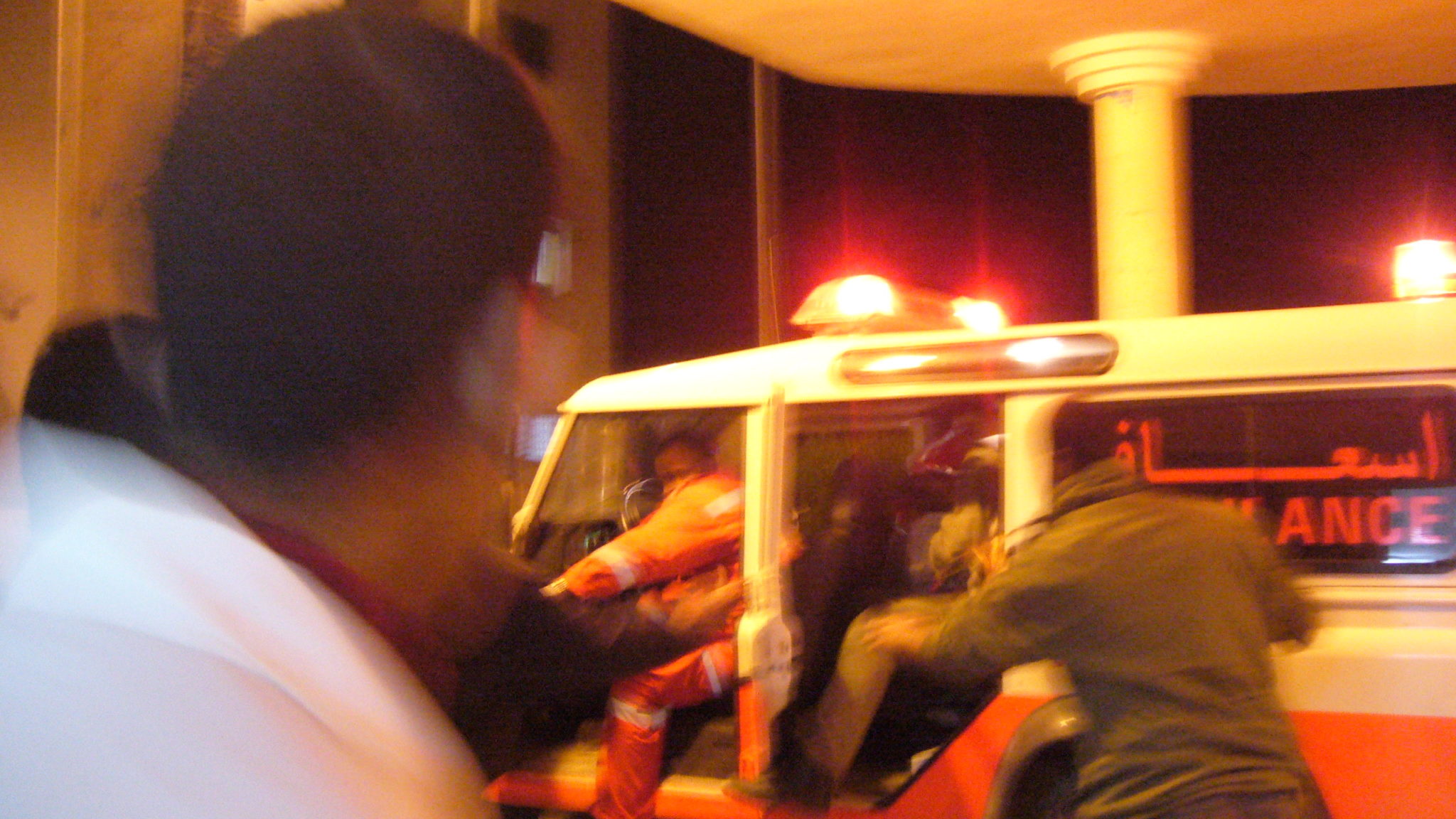
Credit: Sabr Zaaneen
We approached the bodies on the ground slowly with our hands held above our heads, breath held, waiting for the next explosion, hoping our visible medical vests might stall it.
Four male members of an extended family had ventured out in search of food. Two plastic bags of bread and tinned beans lay close to one of their now lifeless bodies. They had arrived home, to the door of their multi-family house, when they were targeted – the key still in the lock of a steel door mangled by the force of the explosion. Inside we could hear keening and muffled crying, a small voice calling for her father.
We lifted the little voice’s father – her baba’s – mangled body, and those of her uncles into body bags before we forced open the door. We carried the children to the ambulance first, trying to shield their vision with our chests, their bodies rigid with shock.
I held the hand of one of their mothers, Reem, as we exited her home, grief pulsing through her touch and words. Her youngest daughter, Fidaa – curls framing her face, alert brown eyes unblinking – crawled into my lap in the back of the ambulance as we drove towards Gaza city. Her small body shook the whole way, her rapidly beating heart pressed close to mine.
Fidaa means ‘sacrifice’, to devotionally give, to land and people.
GAZA AS COMPASS
Eighteen years later, this past April, we set sail again from Barcelona with the Global Sumud Flotilla – the latest in a number of Freedom Flotilla Coalition, Global Sumud Flotilla and Thousand Madleens to Gaza attempts to break the siege during the years of the ongoing genocide.
Participants from dozens of countries – from South Africa to Sri Lanka, Peru to Poland, Algeria to Argentina, Vietnam, Korea and beyond – boarded sail-boats in Mediterranean ports. Volunteers from a multiplicity of life-paths and professions – sailors, medics, marine biologists, activists, artists, teachers, students, eco-builders, mental healthcare and harm reduction workers, musicians, writers and land-workers – united in a commitment to translate grief, outrage and solidarity into practical political action.
The flotillas are both human rights actions and inherently political ones, rooted in international humanitarian and maritime law. The amount of humanitarian aid on board is symbolic, the commitment to justice for Palestine is not. As articulated since the initial sea missions, “When governments fail, the people sail” – over 40 attempted sea missions spanning almost two decades.
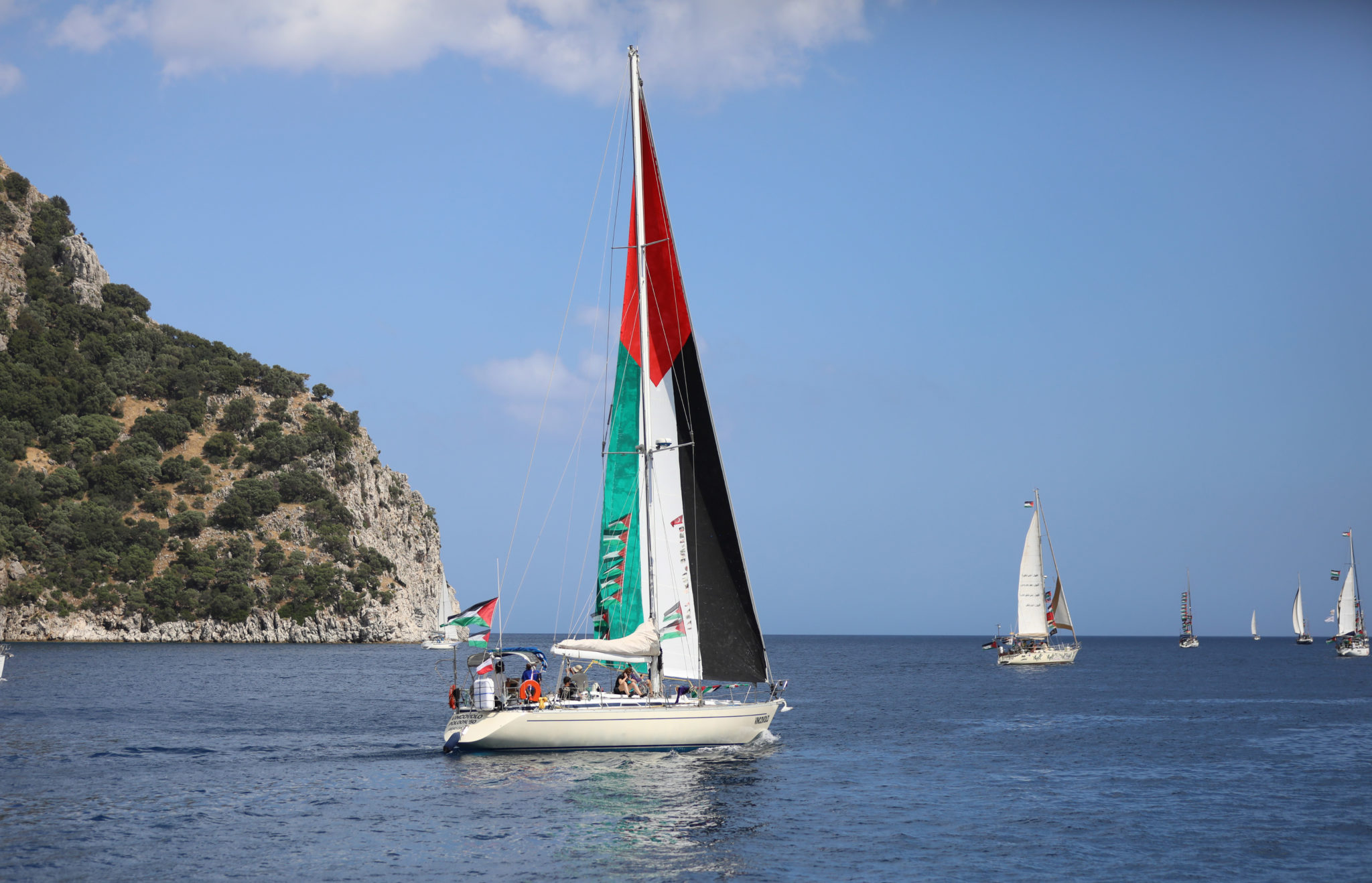
Credit: Abdelrahman Al Kahlout
This time, we sailed with the flotilla for five weeks on an independent support boat, the Shireen – named after the slain Palestinian-American journalist, and friend, Shireen Abu Akleh. Four years after her killing by Israeli soldiers, her nieces, brother and family pursue the small solace that legal accountability, still denied, might bring.
On-board were human rights observers and a small team of therapists and trauma workers. Though our psychosocial supports were humble, we tried to provide basic psychological first aid in the aftermath of both violent, illegal interceptions, the first off the coast of Crete, over 500 nautical miles from Gaza.
PREPARING FOR INTERCEPTION
As we sailed onwards from Sicily, sails adorned with art, each boat carrying the name of a destroyed Palestinian village, the emotional bonds on-board deepened. Crews and participants shared their motivations for sailing, the worry of their families, the anxieties and unknowns of the journey, the values that united them, the points of divergence, the necessity of bearing witness and holding hope amidst the broader dystopic geo-political violence.
Sunsets and sunrises were greeted by those on night watch, surveillance drone activity tracked, calls made to loved ones at home and spirits steadied, as the threats escalated, nautical mile by mile, closer to Gaza.
Two days before the second, violent attack on the flotilla, our team pivoted to land, to prepare the Shireen, our boat, for donation to a Palestinian Sailing School in exile, which will work to provide sea-based PTSD supports to Gazan teenage survivors of the genocide.
I spent the day before the final leg departure on a dinghy with a crew friend, speeding between anchored flotilla boats in a small, quiet, picturesque bay near Antalya. As we delivered medical supplies and spare parts and picked up bags of garbage, I hopped on and off boats for goodbye hugs and brief chats. The love, and hope, was palpable. Gaza seemed so close.
They sailed on while the land teams readied ourselves for whatever happened next – the legal, family supports, crisis and nautical-watch teams preparing for whichever scenario played out – a range of possibilities from breaking the siege to pre-emptive drone attacks.
When the illegal interceptions by the Israeli army began, slowly, over the course of the next day and night, boat after boat went quiet, communications ending as participants intentionally dropped their phones into the sea, pre commandos boarding their vessels.
We stayed in contact with the last boat to be intercepted, the Lina al Nabulsi – named after a Palestinian teenager killed at 16 years old in 1976, while walking home from school in Nablus – as her crew sailed closer and closer to Gaza. They felt, they said, that her spirit was present as they sailed towards her homeland: the wind in the sails, a bird perched on deck, the courage communicated in each others faces.
INCOMMUNICADO DAYS
When the period of incommunicado silence began – four days of fragments of news and disturbing updates from Adalah, the tireless Palestinian legal and advocacy organisation who had access to Ashdod port – I thought of Palestinian political prisoner friends. Of their descriptions of the sensory and sleep deprivation and prolonged solitary confinement before the torture began, in K’tziot prison, the same prison where our friends and comrades were now being briefly held.
One of them, Ali al Samoudi, a veteran journalist from Jenin, was recently released from a year in administrative detention, during which he lost 40 kgs in body weight. He was with Shireen Abu Akleh, his long-term colleague and comrade, when she was killed in Jenin in 2022, one of now hundreds of Palestinian journalists assassinated in Gaza and the West Bank. He was wounded in the same attack and was also with me two decades before, when I was shot during another invasion of the camp in 2002, and was a loyal friend through a long hospital stay.
When Ali was released, a gaunt, dramatically aged physical shadow of himself, he referred to the physical, psychological and sexual violence in prison, describing it as a “graveyard of the living” and “nothing but siege, isolation and starvation."
Days later, when interviewed back at home with his long-awaited months-old granddaughter, he emphasised that his journalistic work would continue, as it had for decades, saying, “I believe in the sanctity of my mission as a journalist – to convey the message of life, justice, democracy, and dignity. I belong to... the principles of my people."
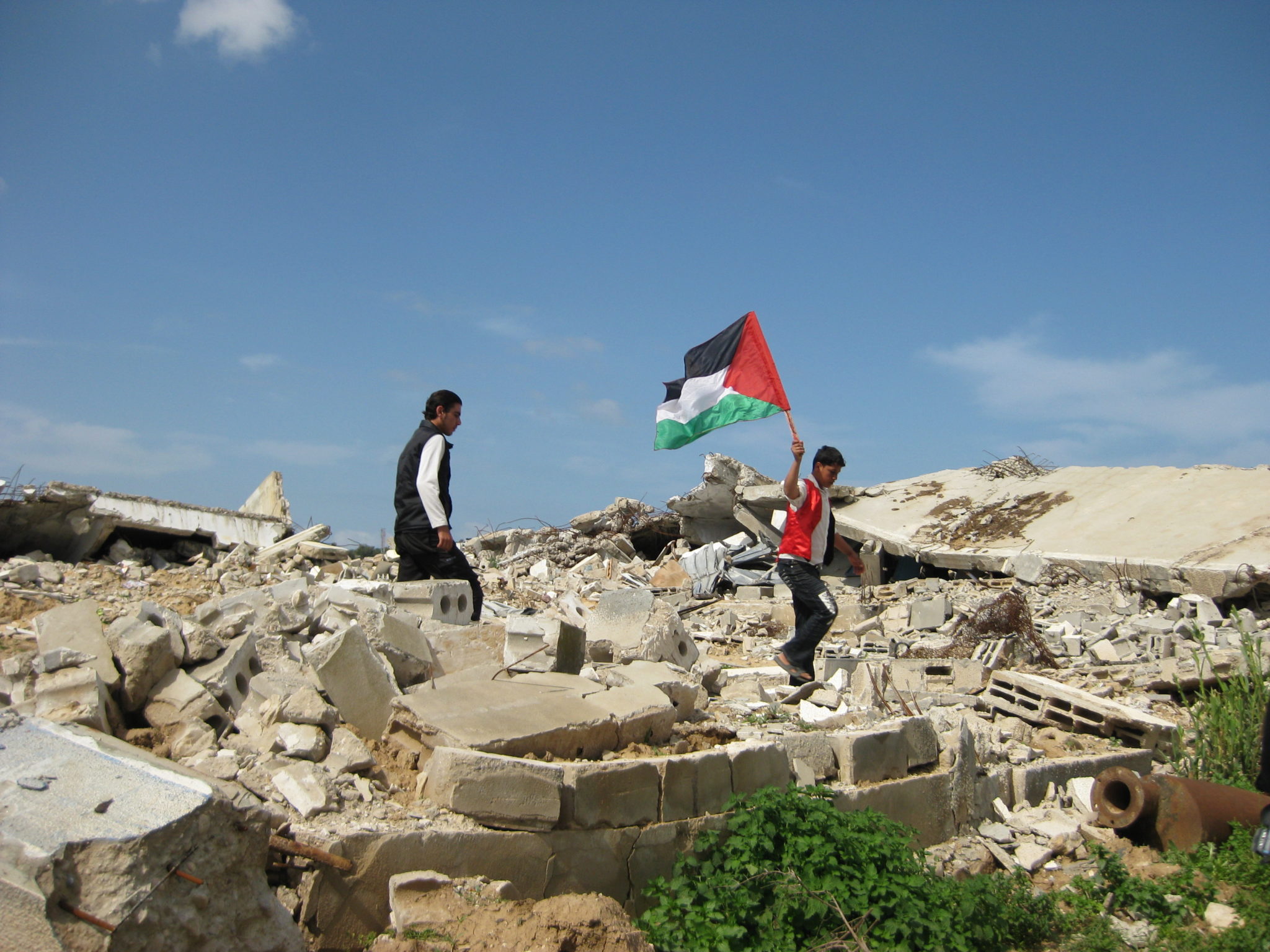
Credit: Ewa Jasciewicz
INJURY AND TRAUMA
When the over 400 flotilla participants were freed, via deportation flights to Istanbul, four days later, the brutalisation of their bodies and spirits was evident in every hug.
The violent escalation was the most significant one since 2010, when lethal force was used, and ten flotilla participants, including 18 year old Turkish-American teenager, Furkan Doĝan, were killed by Israeli commandos.
Our small team of trauma therapists sat with and debriefed with many of our comrades – absorbing dozens of accounts of the racialised spectrum of extreme physical, psychological and sexual violence visited on them on the prison ships, at Ashdod port and in K’tziot prison.
A Māori friend, a wise and steady community worker and educator from Aotearoa/New Zealand, described the ‘sadistic’ violence inflicted on him until he lost consciousness by a particular soldier; an Australian comrade, a mother, sailor and activist, described her sexual assault and being bound hand and ankles, with her face in a pool of sea-water, thinking she would die; a French-Algerian, gently spoken healthcare worker colleague, recounted her beating and assault by five male soldiers in one of the darkened shipping containers in the second prison ship.
A 72-year old friend from Bahrain with mobility issues, who sailed for the children of Gaza – in response to infanticide, she stated, and the broken, massacred bodies of Palestinian children – described being physically assaulted after her walking stick was thrown in a corner, and being forced to maintain the same stress positions as everyone else, in the sun, for hours on end, without water or relief.
Medical teams documented the fractured ribs or broken bones of over 30 participants, as well as five head injuries – including the concussion of an Irish participant – the punctured lung of a captain, fractured vertebrae of another crew member, dozens of Taser-use burns, injuries from rubber bullets and beanbag rounds shot at close range. There were over a dozen reports of sexual assault on one prison ship alone, and many sprains, contusions and dislocated shoulders from participants being kept in stress positions for days.
The psychological and traumatic impacts were also evident in many – the visible shock, hyper-vigilance and nervous system overwhelm, or numbness and disassociation. The memories of humiliation resurfaced as people spoke.
In media interviews, however, flotilla colleagues emphasised that what was experienced, in all its violence, was only a glimpse of what the over 10,000 Palestinian political prisoners left behind experience, over 350 of them children. Routine, documented and systematic torture. Physical, psychological and sexual violence that has been practised for decades- and which has accelerated steadily in the past three years.
It was this that inflicted the deepest moral injury on many – a knowledge of the disproportionate media and political attention given to the abuse of flotilla participants, while Palestinian prisoners continue to suffer in comparative obscurity – prisons a graveyard for their bodies, and their psyches.
Crews resourced each-other and continued to make meaning of the collective experience. A young Tunisian participant on the past two flotillas spoke about solidarity-in-action, saying, “We will suffer together and we will heal together, when Palestine is free."
Many flotilla participants have voiced this understanding of fidaa, of a conscious decision to sacrifice privilege and protection in the face of risk and impunity; as an understanding that our collective freedom is intertwined and inter-dependent.
Dr Samah Jabr, Palestinian psychiatrist and academic, speaks of Palestinian community resilience as not just being survival, but a refusal to be dehumanised. By extension, international solidarity with Palestine can be understood as a refusal to be a bystander in the violent dehumanisation of others.
In a time in which the urgency of Palestine as global moral compass deepens by the day, those mobilising to retain this humanity – on land and at sea, in university campuses, streets and dockyards, through boycotts, the disruption and dismantling of weapons manufacturers, vigils and mutual aid – recognise that through action, beyond borders and geographies, languages and life paths – comes a freedom in itself.
From Gaza, an old friend from Beit Hanoun in the North, Sabr, sends a voice message of emotional solidarity the day the deported boat crews arrive home. Sabr – whose name means patience, and to endure – is a long-term human rights and community worker, football coach and now – following injuries sustained during an air strike – also an amputee survivor.
With the sound of military drones and children’s laughter in the forced displacement camp audible in the background around him, he says: “We have no choice but to continue, all of us together."
Caoimhe Butterly is an Irish human rights activist, family therapist and healthcare worker. She sailed on a support boat with the recent Global Sumud Flotilla and has been involved in sea missions to Gaza since 2008.
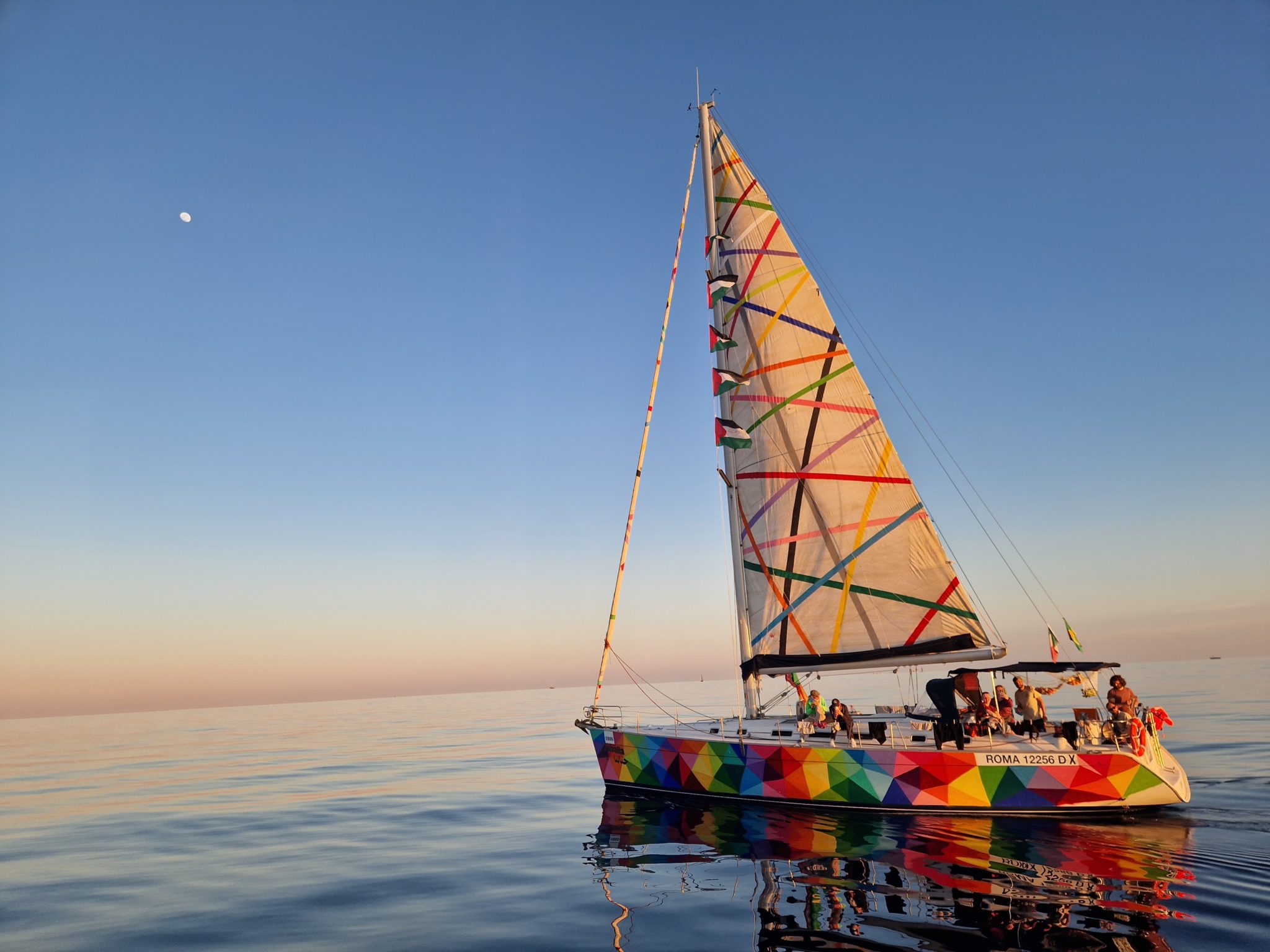
Credit: Caoimhe Butterly


RELATED


- Pics & Vids
- 18 Aug 21
Filmmaker Fellipe Lopes on the "time-bomb" Refugee Camps on Lesvos

- Opinion
- 13 May 21
Life and Death in Gaza

- Opinion
- 08 May 20

