
- Opinion
- 20 Sep 26
Dylan Moran: "Time is literally all we have. It’s all we are"








Comedy supremo Dylan Moran discusses his keenly anticipated new show, Looking For Trouble, in which he examines what it means to be human in an age of permanent distraction.
I’m speaking to Dylan Moran from Dingle, with sketchy wi-fi and Mount Brandon somewhere beyond the window. Every few minutes, the connection threatens to buckle; outside, the mountain remains serenely indifferent to bandwidth, algorithms, AI and whatever fresh technological emergency has occurred since breakfast.
It feels apt. Dylan is about to head out with Looking For Trouble, a new show preoccupied with the speed, absurdity and permanent agitation of contemporary life. For decades, the Navan-born comedian – Perrier winner, co-creator and star of Black Books, and actor in Shaun Of The Dead and Calvary – has made an art of locating the existential crisis inside the everyday inconvenience. Increasingly, the crisis has got bigger.
What interests him now is not simply technology, but what it is doing to attention, solitude and time. “If you’re not able to be alone, who are you?” he asks at one point. Eventually, phones and social media fall away, and Dylan arrives at the thing underneath them.
“Time is literally all we have,” he says. “It’s all we are.”
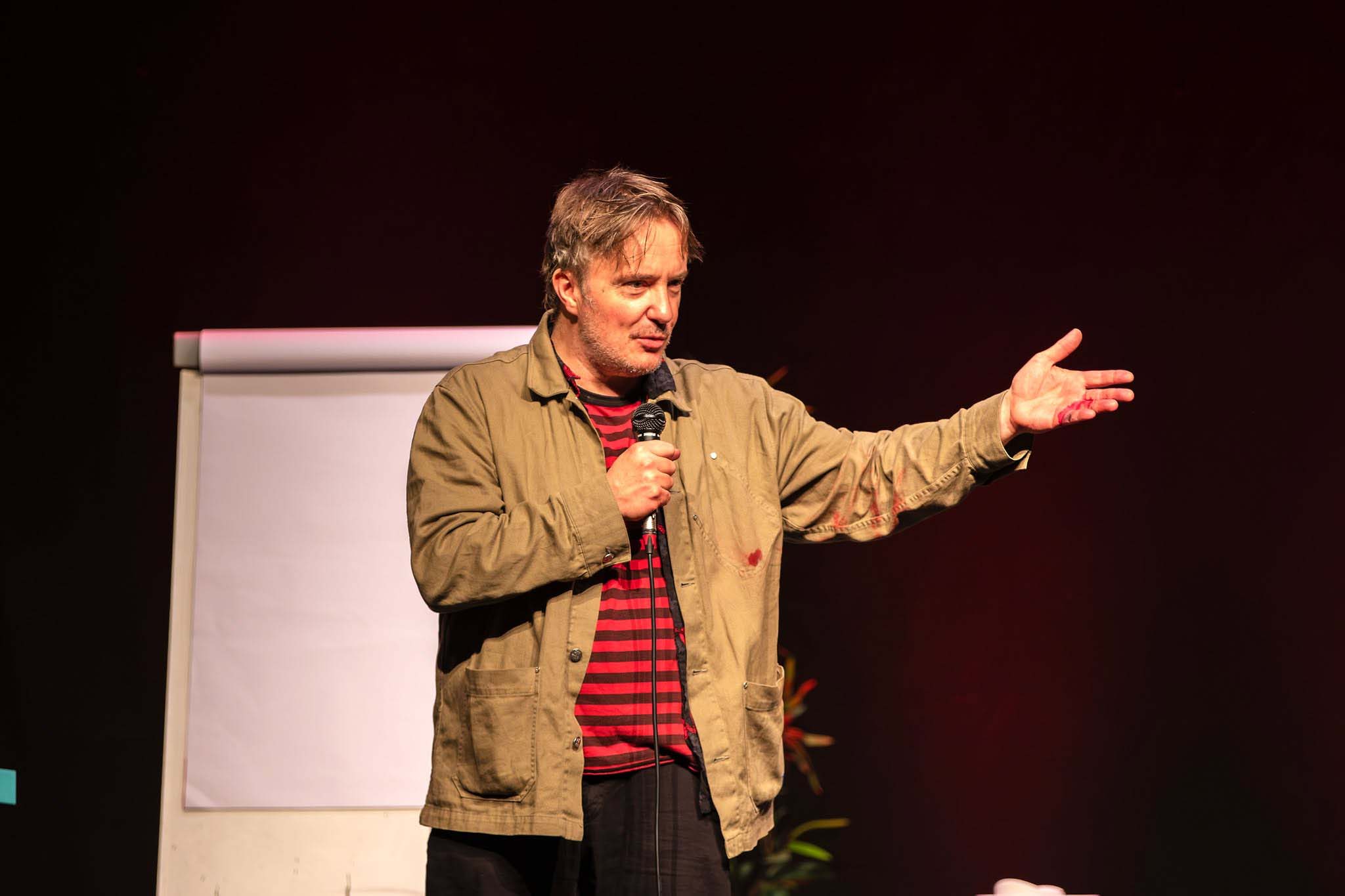
The new show is still evolving as you take it around Europe. What is it about?
What’s anything about? It’s about being alive. It’s about the state of us. I can’t really tell you exactly what it’s about. If I was able to do that, I wouldn’t be able to do the show, because I have to not know. But essentially, I’m talking about what’s going on around us – the incredible velocity of our times, the horror and the sheer speed of it, its ability to endlessly morph into something even more bizarre every other day. It feels like we’re in an infinitely accelerating sort of spinner, and we’re all getting turned into some kind of suspect yoghurt. I suppose the show is about how to digest the indigestible, because nobody can process what’s around us.
Do have any solutions for digesting it?
No. Obviously I don’t arrive with a bag of solutions, otherwise there’d be no show. I’m talking about what it’s like.
The biggest change from the Ireland we grew up in seems to be the sheer pace of everything.
That’s probably the biggest single change – the sheer pace. Everything before yesterday seems a lot slower. I guess there’s an opt-in/opt-out possibility. You either buy into the idea that we have to go this fast, or you say, ‘Hang on, is this something I can decide not to do and just carry on with my own thing?’ It’s FOMO taken to an existential degree.
The “they” behind whatever wall of stuff is selling us everything, seem to require us to be in permanent apoplexy with a credit card in our hands, to make the pains go away. What I’m trying to advocate, I suppose, is turning to each other rather than selling to each other. Just hanging out.
The strange thing, like you say, is that we can opt out.
You can. You’d have to tell one or two other people and ask if they wanted to do it as well, because otherwise you’re going to be on your Jack.
And yet we queue up to join things that make us agitated. Why?
We’re hurried, aren’t we? People are terrified of being left out, so they sign up for whatever bullshit seems to be required that day to be in the gang.
The internet arrived with such idealism. Now it is often viewed as absolute cynicism.
I’m ignorant and stupid about tech and machines. I was just as ignorant and stupid then as I am now about whatever new excitement they’re speaking about. But it doesn’t seem to make people very happy. That’s a very ordinary, banal observation. If it doesn’t inspire much joy, I don’t really know why more and more people are clustering around the pot.
Maybe it’s less about technology than addiction.
Maybe it is. Maybe it’s more about addiction than the internet – our inability to regulate ourselves. It seems to excite this crazy way of being where you don’t really look after yourself, where you’re kind of zombified. But I suppose what I’m getting at is – what’s gone? What’s gone is us, because if you’re not able to be alone, who are you? You’re not an endlessly social self. A social self is what you’re presenting, what’s in the gang and the group. But who are you when you’re alone? And if you’re never alone, presumably there’s less you.
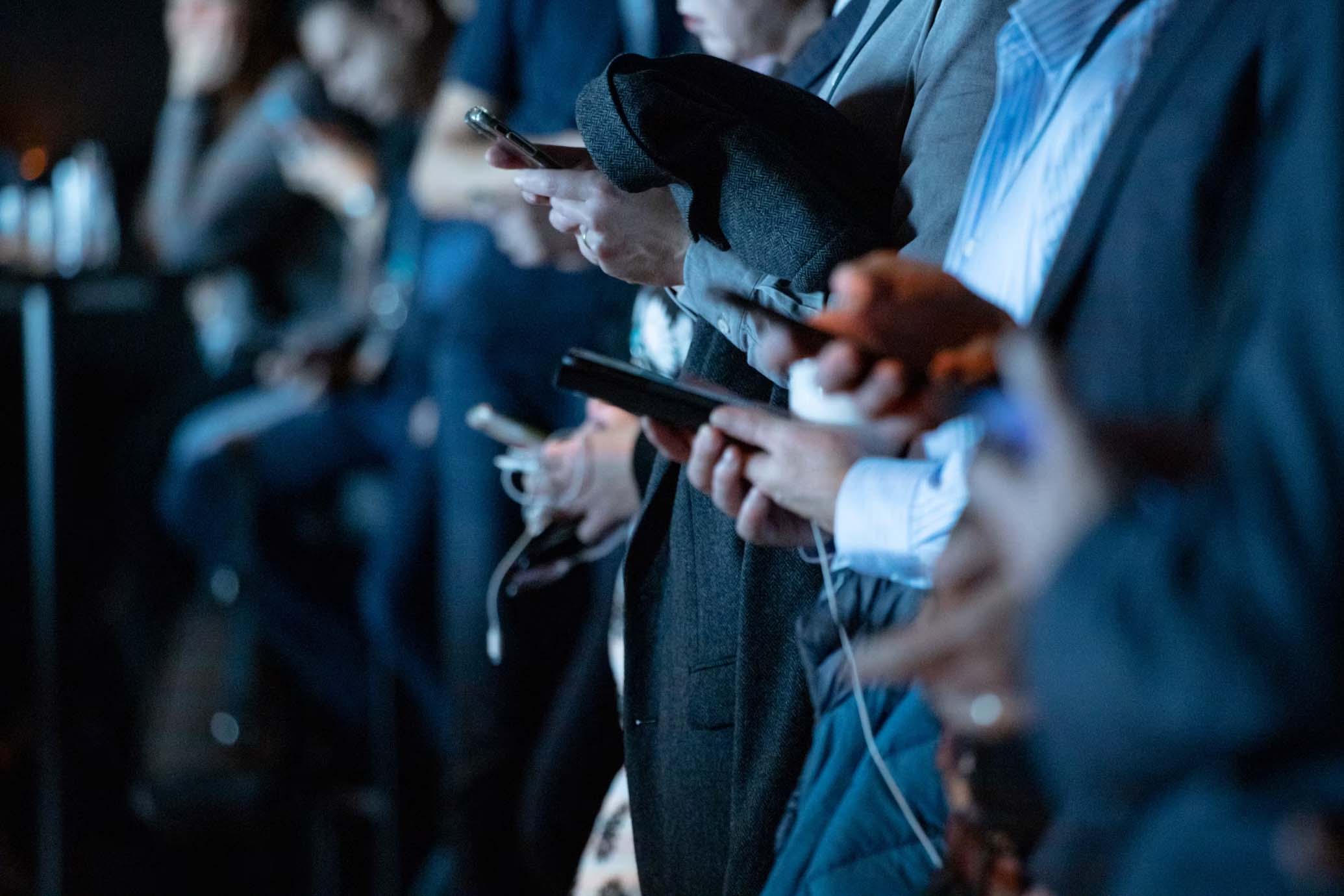
So, we’re losing that interior space?
Yeah. I think we’ve come to value that interior space less because it doesn’t make any money.
I tend to blame social media rather than the entire internet. But perhaps that’s too simple.
I don’t know, because I’m not familiar enough with it. I couldn’t confidently point to this or that element of the technological universe and say, “That’s the thing to blame.” I think you’re probably more accurate when you talk about addiction, because it’s less about the tool than what you’re doing with it. And what we’re doing with it is exploring our anxiety, I suppose. We’re in this dizzy, freaked out, desiccated, unnecessarily worried state all the time. We’re completely fried with this stuff. We need a break.
People our age can at least remember another world. Does that matter?
You’re going to get intergenerational confusion because if you’re born into this, everything is normalised. You probably think the likes of you and me are defunct and should be pushed over a cliff, because we’re getting in the way of all the exciting new developments. Maybe different generations will peel off into their own time zones, depending on how much speed they accept. Maybe there’ll be parks for people like you and me.
But having a foot in both worlds means we know another way of living is possible.
I think it’s a great thing. You’re talking about originality of thought as well, because you can’t do everything by committee. If you’re not alone, you don’t have thinking time. And that can’t just be the preserve of academics or people in a certain income bracket. Everybody has to have that.
So, what we really need to revalue is time. You can talk about agitation and social anxiety and blah blah, or you can talk about time. What are we doing with time? Time is literally all we have. It’s all we are. You have a clear choice. Are you going to be anxious? On the edge of your seat? Running around?
What are you going to do with your time? And what the vast majority of us have chosen to do is watch the door.
Watch the door?
We’re watching the door to see what comes in next. That’s what people do when they grow up in an unsafe house. And that’s what humanity is doing. We’re watching the door. We don’t feel safe in our own house – in our own house of humanity – because of the way we’re living. You can tell it’s out of balance.
We had enormous amounts of boredom growing up. Looking back, it was almost accidental meditation.
Exactly. Ireland was full of Zen masters in the ’80s.
There was scarcity around art too. If you got hold of a record or book, you persevered with it.
It was so hard to get your hands on something somebody else had done, there was a danger you were going to do it yourself.
How does having everything instantly available change our relationship with art?
Look, it’s important not to say everything is bad. Obviously, it’s great to have access to all this stuff. But access used to be a problem and it sure isn’t now. You put your hand out and get whatever it is. It doesn’t feel like the adventure it used to be, because that was how you made your own self in front of yourself – seeking out this record, that band, that novel, deciding what spoke to you, what you liked and what you didn’t.
Then you met other people into the same stuff and talked about it. There you go – social life, friends, romantic relationships, and you’re off. Now friends and romantic relationships are almost another item beside cultural interests – something you press a button for or take down from a shelf. I can’t pretend to understand the way life is lived now. In its appearances it’s really different.
But the essentials are the same. People haven’t changed fundamentally. We’re endlessly innocent. We always think we’ve come to the end of the rainbow. We think we’re very jaded, but human beings seem endlessly innocent to me.
Is the live room one of the few places where people can still escape the digital world?
Not really. People film you. Now it’s ordinary for people to hold their phones up from the beginning. Even while they’re having the experience, they’re afraid they’re not having the experience. On some level, they don’t trust themselves to be fully having it without the technology to back it up. It used to drive me nuts. I don’t really care anymore. I just go, well, good luck to you. What do you do?
Did you used to tell them to put the phone away?
I did, but more for them than for me. I’d say – “You’re not really going to feel this or be able to pay attention if you’re doing that as well, so just give it up and be here.” I’m not militant about it. What matters is that I get joy out of performance.
I get joy out of meeting an audience and seeing where we can go, what the show will be like. The audience co-authors the show every night. It’s a made thing. It’s a conversation, despite appearances. It requires me to be present, excited and into it, and I am. I want to do it.
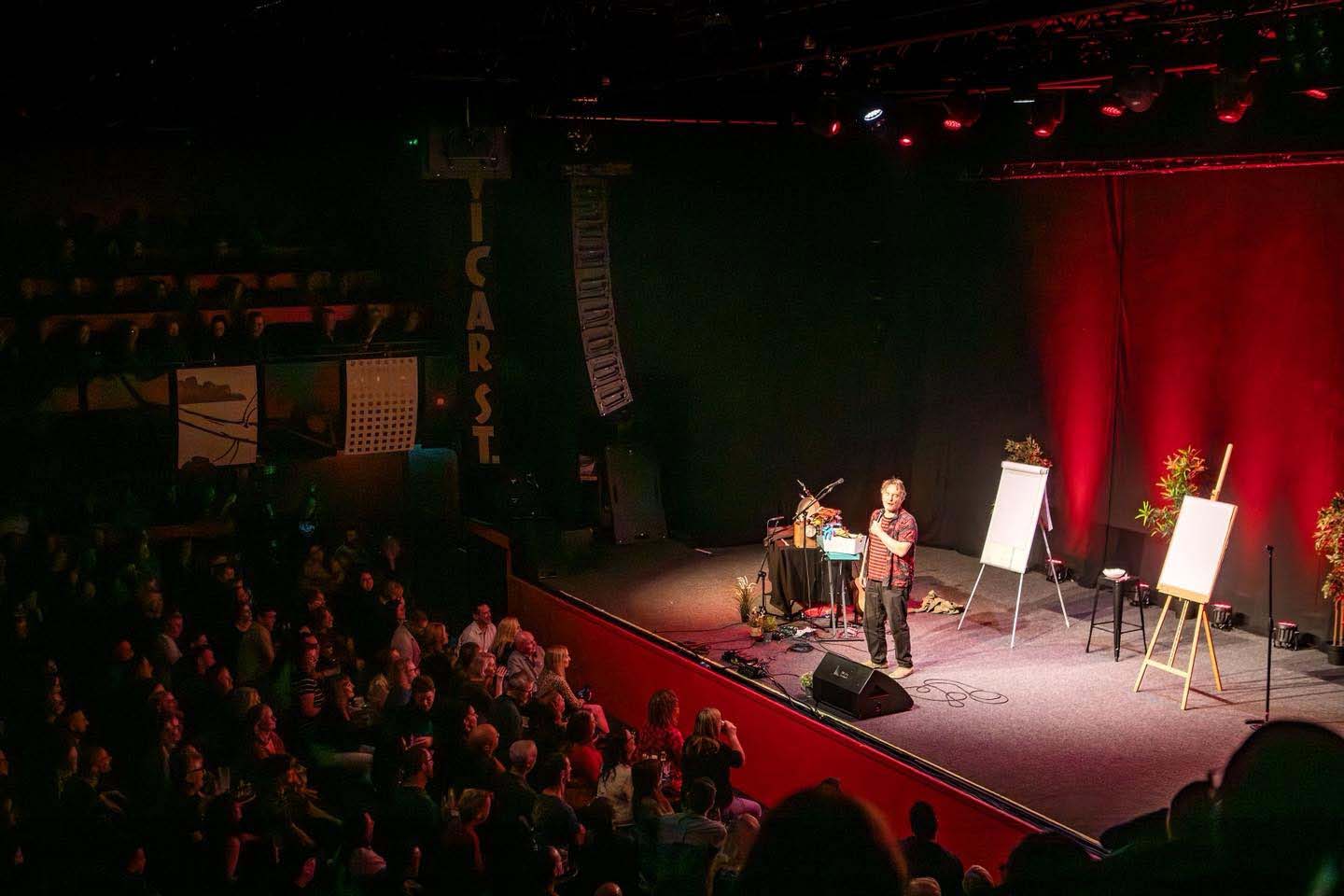
Can you feel a difference between a room in Brussels and one in Ireland?
Sure. Every room is different. Going out means something different in every place. Somewhere like Brussels is a sophisticated, multicultural hub; people might see you and go to the opera or a rock band the next night. In a smaller place, there may be less going on, but everyone might be talking about the big gig. Everywhere is different. But going out still means something everywhere.
You’re doing a huge number of dates. Do you like the road?
If you don’t like the road, it’ll kill you. You have to learn to like it. In the end, like most human experience, it becomes addictive on some level. There’s a rhythm to it. I’ve spent years of my life on the road. I have to like it, and I do.
Are you constantly making things while you travel?
Yeah. I’m always making the stuff. I’m talking to you now surrounded by notebooks. I used to say it was like making a dry-stone wall. You don’t pay too much attention. You keep your head down, you’re out and busy, and then you find you’ve made it. I’m finding that again with this show.
But this one is different because, to go back to everything changing all the time, one consequence of that pace is that it’s very hard to get a sense of consequence. Formerly, things were of a certain weight. When there was a war on, that was of a certain weight. But now we’ve had this permanently conflictual state for quite a long time.
Ukraine has been rattling on for years and people are suffering awfully, alongside breakneck change in politics and other spheres. It becomes harder to get a sense of consequence – of how things add up day to day.
And because we’re all plugged into the same stream, do audiences increasingly share the same narrative?
That’s the assumption. What’s really interesting is that we’re all plugged into the same broken thing – the same divisions. It’s very much teams of right and left, and then variations or degrees within them.
• Dylan Moran brings Looking For Trouble to Waterfront Hall, Belfast, on May 14, 2027. See his full list of tour dates here.


