
- Music
- 23 Sep 26
U2: Their first major interview in Hot Press








Already, we’d hailed their victory in the Pop Group ’78 competition in Limerick. Now, it was time for a proper conversation with the emerging young Northsiders – with Adam Clayton and Bono acting as spokespeople. In many ways, even in those very early days, Bill Graham’s report – original banner 'U-2 Could Be A Headline' – revealed extraordinary predictive powers...
It started with a telephone call – to be more accurate a barrage of such communications – from U2’s bassist Adam Clayton, part of a prolonged campaign that eventually dragged me out of house and home, and across the river, to meet with members of the band. I hadn’t seen them play, but I was aware they’d won some sort of a band competition in Limerick, an achievement sufficient to impel me to negotiate the cross-town traffic but hardly the ultimate seal of approval given the doubtful merits of Irish music competitions.
Which is where it all began. Frankly, this can’t be unbiased judicial journalism. I happen to be a fan of U2, believing them to be a group of very special talents. But trying to retain some sense of semi-detachment, I’ve got to reckon with the possibility that I’ve been snowed by my own self-hype. Moreover, in the small world of Irish rock, roles get duplicated. Besides being a fan, one ends up as some species of friend and adviser, with all the self-involvement that entails – in my case to the point of making the connection that lined them up with their manager, Paul McGuinness. You can understand my credit's on the line.
As I repeat, I hadn’t heard them play. But that first encounter brought me face to face with a foursome who had a precociousness, open-mindedness and willingness to learn that was unusual among Irish bands I had met heretofore, a demeanour that implied that, if their personality was anything to go by, U2 were a band worth keeping a line open to.
First playing impressions were favourable but not immediately sufficient to lift them unchallengeably above the ruck of bands wandering around last summer. It wasn’t ’till the Autumn that U2 began to implant themselves indelibly in my consciousness.
The last six months of ’78 were depressing. Very little energy was being generated, the first Dublin wave – The Vipers, Sacre Bleu, Revolver, Fit Killkenny and The Remoulds – all passing through a phase of reassessment and, to some extent, an examination of their rock consciences. Satisfaction wasn’t easily to be found.
U2 increasingly came to fill that gap. Part of it was due to their exuberance – U2 have a vaulting unclouded optimism that’s very special – a virtue all the more welcome given the misanthropic weather that was reaching us from London, a mould that I didn’t react to equably. Yet aside from any similarity of temperament, U2 were a band whose basic direction was set and on course, whose playing capacity was consistently evolving and whose songs both provided new vistas at each hearing and were unfussed by trends above or beneath them. They delivered when I needed it and I can’t say more.
NOT EASILY CATEGORISABLE
They started as a band at Mount Temple, a five piece that also included Dave Edge’s brother Dik (on second guitar), who left them for the Virgin Prunes when they settled for a four-piece line-up. They weren’t called U2 then, instead initially calling themselves The Hype, a title later ditched because they felt it out of line with the times. None of the others had been in a band except bassist Adam Clayton, who had been with The Max Quad Band, an aggregation that then included George Sweeney, current guitarist with The Vipers.
It wasn’t as if they began programmed with the intention of taking over the world. Rather, one gig and contact led to another, the victory in the Limerick band competition bringing them to the attention of CBS’s Jackie Hayden, who had been a judge – and he consequently took them into Keystone Studios for a demo session. A hurried run-through, it wasn’t to their liking and although all credit to Hayden for his perceptive scouting, the encounter was premature given the band’s development since.
A contract was vaguely mooted, but U2 weren’t taking up any options and the nine months since Limerick have found them concentrating on refining their abilities, undertaking an apprenticeship that along the way has gained support slots with both The Stranglers and The Greedy Bastards (an occasional good-time band, including Phil Lynott, members of The Sex Pistols and Bob Geldof – Ed). But their most convincing performances have been in McGonagles – the band played an early Autumn date with Revolver that gained them the esteem of both Johnny Fingers and Phil Chevron, I pick their Hot Press Christmas party date and manager Paul McGuinness selects an early January performance – yet each gig had the appearance of a young band flexing and exercising their wings before taking the flight from the nest. But Adam Clayton may have the wisest word when he says, “We’re only now getting the feel of our identity”.
Certainly, U2 are ready, teetering on the verge of a recording contract. A second and more settled demo session was overseen in December by Barry Devlin of Horslips, with superior results, and for once a band’s self-confident impatience is equaled by their achievements. If their emergence has been slower than Dublin bands of equivalent age, it’s partially due to the caution of McGuinness, whose management philosophy downplays the importance of Irish status during a band’s adolescence – i.e. spray-cans do not a hit-act make – emphasising instead a band’s capacity to be judged by their international potential and not by their position among their local peers.
The point is to be satisfied by nothing less than the best and U2’s values veer towards the same perfectionism. Thus, they’ve decided to remodel the set they’ve been peddling these last six months, a brave undertaking given its undeniable quality. Explains vocalist Bono: “We’re now working on a new set that’s more visual. We’ll be using a projector and tapes and rewriting and rearranging some of the songs and bringing new ones in”.
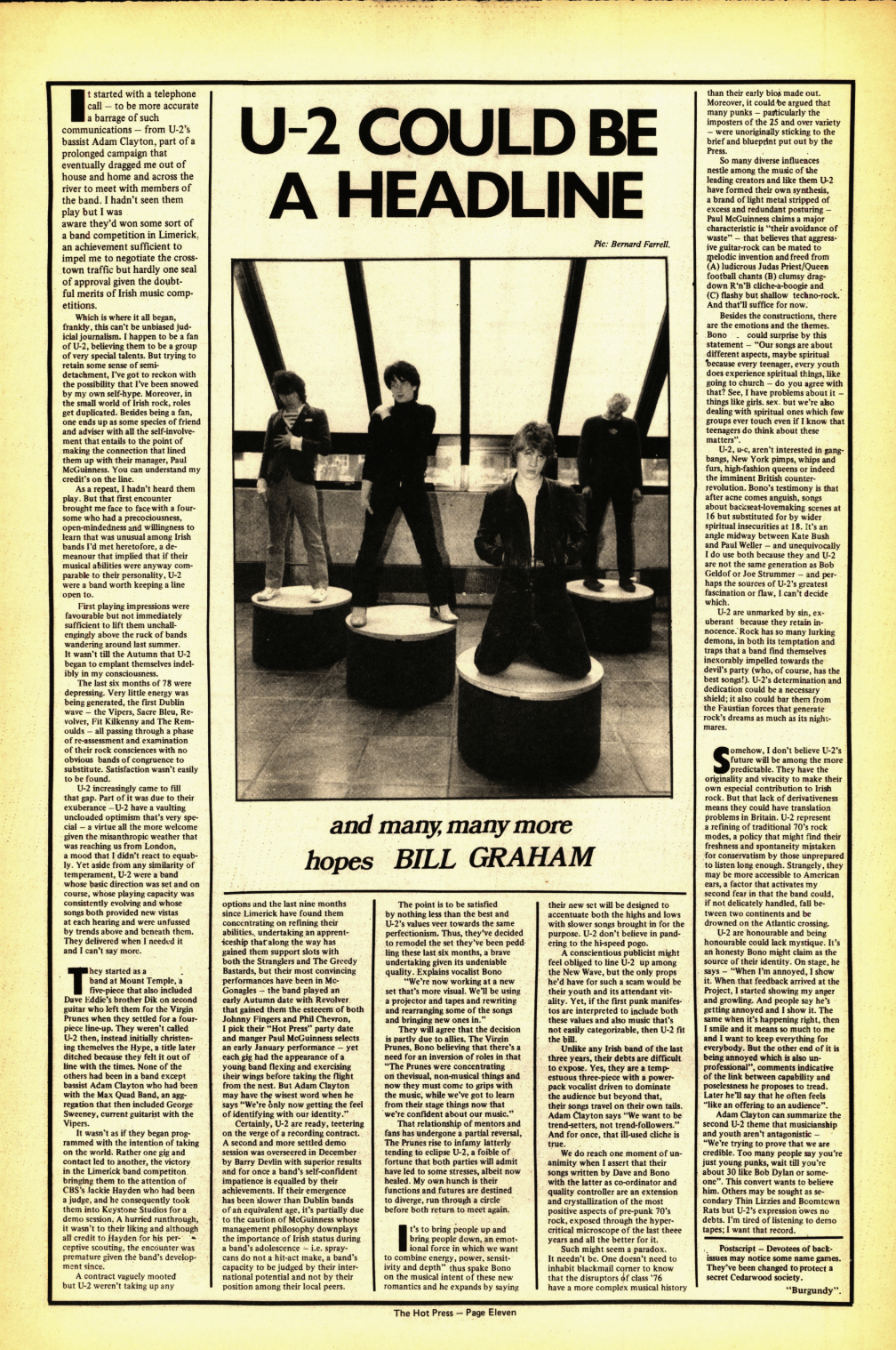 U2's first major interview in Hot Press.
They will agree that the decision is partly due to interaction with their allies, The Virgin Prunes, Bono believing that there’s a need for an inversion of roles in that “the Prunes were concentrating on the visual, non-musical things and now they must come to grips with the music, while we’ve got to learn from their stage things, now that we’re confident about our music.”
That relationship of mentors and fans has undergone a partial reversal, The Prunes’ rise to infamy latterly tending to eclipse U2, a foible of fortune that both parties will admit has led to some stresses, albeit now healed. My own hunch is their functions and futures are destined to diverge, run through a circle before both return to meet again.
"It’s to being people up and bring people down, an emotional force in which we want to combine energy, power, sensitivity and depth” – thus spake Bono on the musical intent of these new romantics, and he expands by saying their new set will be designed to accentuate both the highs and lows, with slower songs brought in for the purpose. U2 don’t believe in pandering to the hi-speed pogo.
A conscientious publicist might feel obliged to line U2 up among the New Wave, but the only props he’d have for such a scam would be their youth and its attendant vitality. Yet, if the first punk manifestos are interpreted to include both these values, and also music that’s not easily categorisable, then U2 fit the bill.
Unlike any Irish band of the last three years, their dents are difficult to expose. Yes, they are a tempestuous three-piece with a power-pack, vocalist driven to dominate the audience – but beyond that, their songs travel on there own tails. Adam Clayton says, “We want to be trend- setters, not trend-followers”. And for once, that ill-used cliché is true.
ORIGINALITY AND VIVACITY
We reach one moment of unanimity when I assert that their songs, written by Dave and Bono, with the latter as coordinator and quality controller, are an extension and crystallisation of the most positive aspects of pre-punk 70’s rock, exposed through the hypercritical microscope of the last three years, and all the better for it.
Such might seem a paradox. It needn’t be. One doesn’t need to inhabit blackmail corner to know that the disruptors of class ’76 have a more complex musical history than their early bios made out. Moreover, it could be argued that many punks – particularly the imposters of the 25 and over variety – were originally sticking to the brief and blueprint put out by the music press.
So many diverse influences nestle among the music of the leading creators – and like them U2 have formed their own synthesis, a brand of light metal stripped of excess and redundant posturing – Paul McGuinness claims a major characteristic is “their avoidance of waste” – that believes that aggressive guitar-rock can be mated to melodic invention and freed from (a) ludicrous Judas Priest/Queen football chants; (b) clumsy drag-down R n’ B cliché-a-boogie; and (c) flashy but shallow techno-rock. And that’ll suffice for now.
Besides the constructions, there are the emotions and the themes. “Our songs are about different aspects, maybe spiritual,” Bono says, “because every teenager, every youth does experience spiritual things, like going to church – do you agree with that? See, I have problems about it – things like girls, sex. But we’re also dealing with spiritual questions, ones which few groups ever touch, even if I know that teenagers do think about these matters.”
U2 aren’t interested in gang-bangs, New York pimps, whips and furs, high-fashions queens or indeed the imminent British counter-revolution. Bono's testimony is that after acne comes anguish, songs about backseat-lovemaking scenes at 16, which are substituted for by wider spiritual insecurities at 18. It’s an angle midway between Kate Bush and Paul Weller – and unequivocally I refer to both, because they and U2 are not the same generation as Bob Geldof or Joe Strummer – and perhaps the source of U2’s greatest fascination or flaw, I can’t decide which.
U2 are umarked by sin, exuberant because they retain innocence. Rock has so many lurking demons, in both its temptations and its traps, that a band find themselves inexorably impelled towards the devils party (who, of course, has the best songs!). U2’s determination and dedication could be a necessary shield; it also could bar them from the Faustian forces that generate rock’s drams as much as its nightmares.
Somehow, I don’t believe U2’s future will be among the more predictable. They have the originality and vivacity to make their own especial contribution to Irish rock. But that lack of derivativeness means they could have translation problems in Britain. U2 represent a refining of traditional 70’s rock modes, a policy that might find their freshness and spontaneity mistaken for conservatism by those unprepared to listen long enough. Strangely, they may be more accessible to American ears, a factor that activates my second fear in that the band could, if not delicately handled, fall between two continents and be drowned on the Atlantic crossing.
U2 are honourable and being honourable could lack mystique. It’s an honesty Bono might claim as the source of their identity. On their live performances, he says, “When I’m annoyed, I show it. When that feedback arrived at the Project, I started showing my anger and growling. And people say he is getting annoyed and I show it. The same when it’s happening right, then I smile and it means so much to me and I want to keep everything for everybody. But the other hand of it is being annoyed which is also unprofessional” – comments which are indicative of the link between capability and poselessness he proposes to tread. Later he’ll say that he often feels “like an offering to an audience.”
Adam Clayton can summarise the second U2 theme – that musicianship and U2 aren’t antagonistic – “We’re trying to prove that we are credible. Too many people say you’re just young punks, wait till you’re about 30 like Bob Dylan or someone.” This convert wants to believe him. Others may be sought as secondary Thin Lizzies and Boomtown Rats, but U2's expression owes no debts. I’m tired of listening to demo tapes. I want that record.
– Bill Graham
- Becoming U2, by Brian O’Connell, tells the extraordinary story of the night that the four-piece from the Northside of Dublin played their first ever official gig as U2, in a band competition – and won! – thereby changing the course not just of Irish music but of popular music across the world. Becoming U2 is published by Hot Press Books. The hardback is available exclusively from the shop on hotpress.com.
RELATED


- Music
- 13 Aug 26
Hot Press Announces Publication of Becoming U2

- Music
- 07 Jul 26
New album on the way, as U2 return with 'Street Of Dreams'
RELATED


- Film And TV
- 24 Feb 26
Ukranian filmmaker shares short film inspired by U2's new EP

- Music
- 18 Feb 26
U2 surprise-release new EP Days Of Ash

- Music
- 20 Oct 25