
- Music
- 14 Apr 26
Moya Brennan: Revisit a classic 1986 interview, from the set of the 'In A Lifetime' video in Gweedore








As tributes continue to pour in for Moya Brennan – following the sad news of her death yesterday, aged 73 – we're revisiting a classic Hot Press interview, penned by the late great Bill Graham.
Originally published in Hot Press in 1986:
In the magical, wind-swept landscape of Ireland's remote north-west the cameras roll as U2's Bono and Máire of Clannad make the video for their collaborative single 'In A Lifetime'. Bill Graham joins the entourage at work and at play and talks to the main protagonists.
I have had my share of strange experiences, but few as incongruous as driving in convoy with an empty hearse through Northern Ireland on the same day as Peter Barry and Tom King are meeting at Stormont for the first session of the Anglo-Irish Conference. I have seen some strange musical alliances, but few as odd as an acoustic guitar, an accordion and, for god’s sake, bagpipes being filmed by a video crew in a bar in Gweedore.
Even if Bono is on board for this most bizarre of occasions, the location should immediately identify those really responsible. Gweedore, of course, is Clannad’s home. With them, surreal combinations are commonplace. After all, this is a group whose apprenticeship was spent singing versions of The Beach Boys and Joni Mitchell, translated by their grandfather for local Gaelic pantomimes!
In the nicest possible way, I’ve learnt my lesson: Clannad are impossible to interview. There’s always one more anecdote left, one further twist to their tale. You talk to Máire Ní Bhraonáin for two hours, share other informal sessions with her and the rest of the band and think you’ve tracked down their true trivia secrets when she admits to having had the same juvenile music teacher as Dana and Feargal Sharkey and sharing ballet lessons with the aforementioned Eurovision winner!
Then the tape tucked away, in the sweetest, most endearingly frustration way possible, she throws you another morsel from her memories.
"Ah yes, she'll say, "Then there was the time when I was 11 and in my green Irish dancer’s dress, playing with my father’s band in Glasgow on St Patrick’s Day singing ‘The Hucklebuck’ and ‘My Boy Lollipop’. "
Quite, quite impossible to interview! The Clannad musical family tree extend backwards and sideways through parents, grandfathers, aunts and uncles in a maze that would probably befuddle even the most resourceful of researchers, Pete Frame. With their background, I think it’s highly probable that they family mutt’s got his own equally lengthy story of how he’s related to Nipper, the original HMV gramophone dog.
In other words, any journalist who travels to Gweedore seeking facts about Clannad’s music is likely to end up more confused than ever. But if he or she goes there seeking the feel, enlightenment is certain.
The group, the video crew and most of their camp-followers were spending these December days in Gweedore for another reason, shooting the screentrack for 'In A Lifetime', their collaboration with Bono.
For Clannad, it's a whole other sort of homecoming, their first opportunity to feature the scenery and community of their native parish in a video, an expedition ion that sends almost 50 of us, cast, crew and camp-followers from the media and their record company scrambling up and down the windswept mountains of Donegal in dank, raw weather. So many have been called to the colours that Ostan Na Gweedore, the local luxury hotel, normally closed through the off-season, had been specially opened for the video invaders.
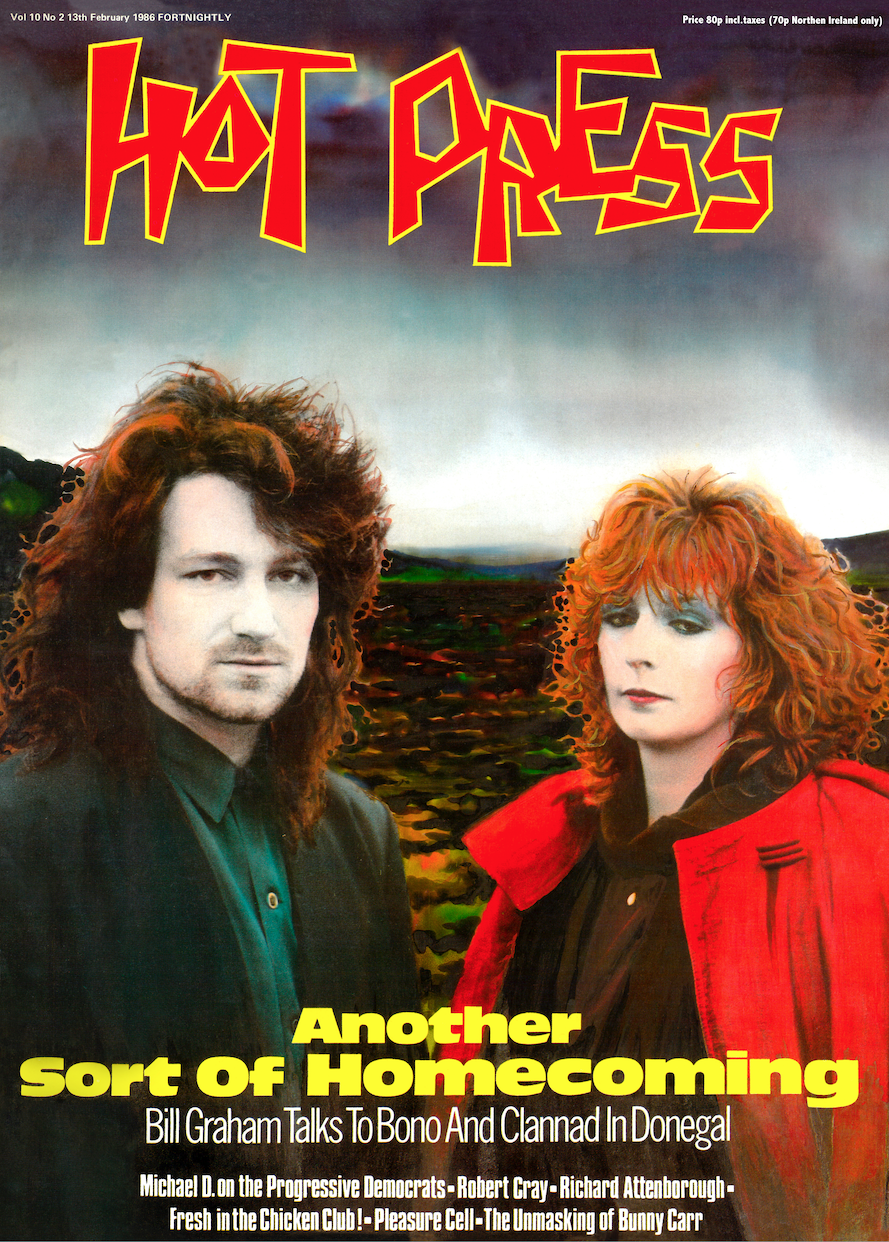
This is an expensive video, costing at least £80,000, its budget increased by the group's determination to film in Gweedore, remote from both the media centres of Dublin and London. As Máire accepts, the full budget is more than it cost to record their six pre-RCA albums but that's how the cookie must be crumbled in the video age. Ideally Bono's participation should give Clannad the passport to markets and video outlets that have previously ignored them. Nobody wants that crucial opportunity to be missed through underinvestment.
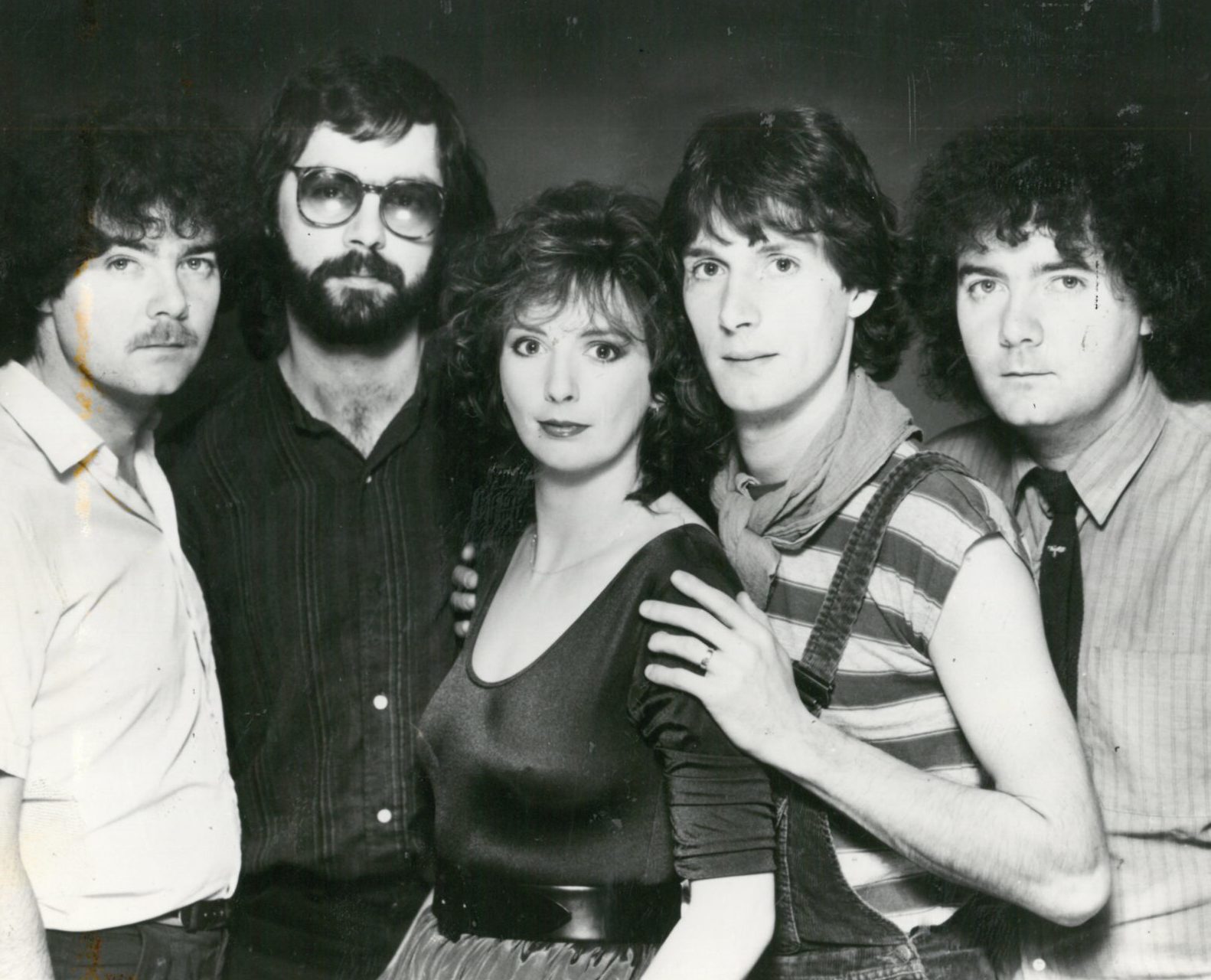
It arrives at a pivotal point in their career. Clannad view the Macalla LP as the true follow-up to Magical Ring, with this new album intended as proof of their skill as Celtic pop innovators, blending their heritage of harmony and melody with the design science of the hi-tech studio.
But all has not run smoothly since the album's release. Because of the delicate state of Máire's vocal chords, a tie-in tour has been cancelled and in the UK, the album's second single 'Almost Seems (Too Late To Turn)"'- for me, the album's highlight by virtue of Máire's measuredly heartfelt reading and the poignant balance of the arrangement was the victim of unsympathetic airplay policies.
The 45 had been released as a fund-raiser for the BBC's Children In Need charity, but Beeb's left hand must not have known what its right was doing for their own Radio 1 denied it airplay, deeming it inappropriate for its format and thus dooming 'Almost Seems...' to chart failure – a definite setback.
More positively, RCA America are finally showing real enthusiasm about breaking Clannad, a group whom the company had previously considered out of sync with the US tastes, though as the experienced Máire will comment guardedly, "Seeing is believing." Whatever, breaking Clannad to the wider world audience they deserve may now turn on the 'In A Lifetime' single, its video and Bono's attendant and influential endorsement.
Which is why this convoy of two mini-buses and the hearse – actually intended as a prop for a funeral scene – leaves Windmill Lane Studios one December Wednesday noon on a definite mission. Seven hours later after blithely driving through the North and bouncing over the mountain roads of Donegal, we finally enter the parish of Gweedore...
Passing a crossroads, Clannad's bassist, Ciarán Ó Braonáin, forever in shades, explains the finer points of the local geography.. "On the map this is the centre of Gweedore but the truth is, there's no real centre to it. It's only on the map because this is where the old railway station was."
He's right. Gweedore is nowhere and everywhere, a sprawling collection of cottages, houses and shops patterned for over six miles along the main road without any definable village centre. Ciaran continues, laughing about confused German tourists who arrive at the station crossroads to find no conventional town square.
But then Gweedore has its own law, lore and very special logic. As Donegal's Gaeltacht, it's proudly retained its own identity, a community that's held onto its long-defined tradition without ever denying the late 20th century. Never under-estimate these people. Ireland's most forgotten Western county may be remote but it is the reverse of primitive. At best, as in Gweedore, its people have self-reliance, an individuality, both a sense of community and an outgoing curiosity, and a lack of cant that makes them among the most fascinating on this island.
Okay, holidaying as a child on Aranmore Island means that I've long had reasons to be in love with the county, but watching Bono and Adam Clayton, a self-confessed ligger for the week, blending into the landscape, I could see they've both become equally smitten.
But Gweedore is even more unique in many ways. Besides having its own magical folklore, Donegal Gaelic is distinct from the rest of Ireland, a dialect with its own idiosyncratic accents and words which some claim is closer to Scots Gaelic. Yet the Gaeltacht tourist trade means this society can be equally at home with Beef Wellington as Wellington Boots and down the road, in the industrial estate, the girls whose grandmothers were weavers now work in a computer firm. The simple secret is that this is one community that has never lost its belief in the power of education. The same combination of dedication and open-mindedness impels Clannad.
In the exposed outdoors, the video shoot is an endurance test. Partially sheltered in woodland, we're spared the worst of the biting weather but the wind is forever upsetting the accuracy of the smoke-machines and blowing fumes into our eyes. For a whole afternoon director Meiert Avis and cameraman Tommy Forsberg - an Ingmar Bergman graduate who also shot U2's 'New Year's Day' video - forever fastidiously figure out their angles as the main actors Máire arid Bono continuously pace back and forth through their scene, aloft the wild and wondrous Poison Glen.
Everyone implicitly admits, however, that the real star is the scenery and spirit of Donegal. Later in the hotel, Pól Ó Braonáin - who's been dubbed "Fellini" for his efforts - oversees the casting of locals as extras for Friday's shooting, which will take place at a crossroads on a bare mountainside.
That's where the hearse features. Driven by Charlie Whisker, an artist friend of Bono who's stimulated the singer's growing interest in the blues, it's part of a funeral procession that's intended to symbolise the evolution from life to death. As Máire later comments: "Remember that myself and Bono never look at each other. This is not a 'love' song - it's a ‘life' song."
Fortunately there are other more convivial settings. Friday evening, Leo Ó Braonáin's pub is featured. Beneath the arc lights, the bar's regulars must never have seen the like. Fiddlers saw away, a group of local children give a Christmas mumming routine and that's when Leo on Cordovox accordion, the bagpiper and Noel Ó Dúgáin on guitar play their magnificently bizarre set.
Leo is a most alert and hospitable presiding spirit, always ready to pull out his accordion for a song. In his presence, you understand both the closeness of the Clannad extended family and how music is among the necessities of life for them.
Close to the bar, Bono soaks it all in. In the last year, he allowed his conviviality overcome any remaining puritanical streak, albeit he still paces himself, preferring to slowly sip glasses rather than pints of Guinness. But he can't completely escape the duties of stardom, for by nights end he must have, signed almost a dozen autographs for everyone present.
When the camera and lights are packed away, it all gets quietly mad. The autograph seekers are even propositioning the video crew, Clannad manager Dave Kavanagh and, of all people, myself, the NME's Adrian Thrills and Smash Hits' Peter Martin. Behind the bar, Bono and Máire are pulling the pints.
Truly a family affair. Later Pól gives the best summary for the expedition: "It's something I'll remember for a long, time. To me, there's a whole circular thing about going back arid rising people who, when I was 12, were directing me in my forays on the stage."
Bono will admit that recording 'In A Lifetime' with Clannad was part of his musical higher education. Like many of his generation, he'll confess to having wrongly believed there was no life before '76, other than the obvious landmarks from Marc Bolan back beyond to Elvis Presley.
The same exploration through the past links both 'In A Lifetime' and his impromptu recording with Keith Richards and Ron Wood, 'Silver and Gold', on the Sun City album. Recently Bono's been taking his musical history lessons and as we talk, the theme's just as likely to slide off towards English folk music, gospel or Richard Thompson.
He believes the process began he saw Ridley Scott's futuristic flick, Blade Runner.
"It seemed to be set some place where Los Angeles meets Tokyo in the '90s or towards the turn of the century," he reflects, "Well, somehow I felt that the Vangelis soundtrack didn't click, somehow I could imagine an ethnic soundtrack as being more suitable. And then I was talking with Chris Blackwell and he thought people wouldn't want pure electronic music in the '90s because it would remind them of whatever loss of humanity they might be suffering. He thought they'd be looking for musics that would encompass ethnic sound, cajun, reggae, Irish, blues or hybrids that would be a merger between the available technology and ethnic sounds."
That theme led him to German producer, Conny Plank, who'd briefly worked with Clannad in their pre-RCA career and who's long been intrigued by the possibility of a marriage between Irish and electronic music. But that was theory; for Bono, Clannad's magnificent 'Harry's Game' was proof.
The first time he heard the group's groundbreaking single, the effect was devastating.
"I almost crashed my car," he recalls. "There were bass synths and vocal banks, people keying vocals. Through keyboards. There it was under my feet, more developed than anything else."
Simultaneously Bono had been talking with violinist Steve Wickham about ways of modernising Irish music.
"I was beginning to see the future of something, it might be, something that could avoid the trappings of rock'n'roll places like the Marquee or the Ritz in New York, and go straight to Carnegie Hall. They're not the same as modern classical composers like Philip Glass or Steve Reich but Clannad deserve to be categorised in some place near them."
If he has one worry, it's that Clannad can "be more interested in pop music. It's their experimental side I prefer."
One thing was destined to lead to another. 'Harry's Game' became the atmospheric theme that closed U2 concerts. Previously strangers, U2 and Clannad gradually began to huddle together. Máire takes up the story.
"There's total musical respect between the two bands which is lovely to have, especially because when two bands meet, there's often so much bickering. RCA had been edging in for some time, suggesting I should do a duet. And there were a couple of big names there but it didn't turn me on. If it didn't mean anything to Clannad, it didn't mean anything to me."
Bono and Máire first met in the wake of 'Harry's Game'.
"They started to play it, and we were introduced in Windmill one day and he said they were on an American tour and in some of the university interviews they were being asked about this song, so please tell me more so I can talk about it... but some of the band didn't know him or the rest of U2 before the recording. We were gradually meeting up because of using the same studios, because both managers are close friends... I think the first band-to-band meeting came because of going to Croke Park. But it was a gradual thing. We didn't meet like our five members and their four members - like, I've only just recently met The Edge."
Máire first suggested the alliance but all agreed "if it wasn't great, it wasn't going on the record, no matter how much time was spent on it."
Bono truly disrupted the proceedings.
"This was our ninth album and you could lose a little bit in terms of different ways of performing. It broke our routine... So myself, Ciarán, Pól and the producer, Steve Nye, went into the studios and played him the instrumental track without a guide vocal once and he immediately learnt it and turned around to the engineer and said 'Kevin you know the way I like it, give me a mike.' He'd never heard it before and he immediately started singing with it.
"We all just sat there with our mouths open. The way he works, it's sometimes a spontaneous thing where what you do right away can work."
Bono has similar memories of the session though he thinks the second take was the good one.
"I was copping out from being a 'musician'. Pól was giving me timings but I just said 'play the track and give me the microphone.'"
With, as Bono says, "Radio 1 DJs playing it twice in a row", a video was inevitable. Bono co-directed it though he left most of the location direction to Meiert Avis while he and The Edge came up with the basic scenario.
"We don't believe in videos with storylines," he explains, "we're imagistic. We don't think you should explain a song. You should add other images that you didn't know were there in the song."
But relationships now extend beyond the studio. Donegal is close to his heart. After the pressure of American tours, Bono says he and his wife Ali often retire there or to Scotland because, he jokes, "we're sure it will rain there."
Gweedore and the extended Clannad family also loom large in his affections. "You can see the love they have for each other. They're very physical in their affections. And then there's their father, a tee-totaller, running the noisiest pub in Ulster...
"I prefer the experimental side of Clannad to their pop side. 1 think there's a huge hole in Irish music ready to be filled, to which they can contribute."
For Clannad, U2 and whoever else may enter, the race is on.
Revisit the video for 'In A Lifetime' below:


RELATED

- Music
- 05 Sep 19
Album Review: Frank Turner, No Man's Land

- Music
- 16 Oct 26
Nominees for RTÉ Radio 1 Folk Awards announced


- Music
- 16 Oct 26
Chris de Burgh announces Ireland tour this spring

- Competitions
- 16 Oct 26
