
- Music
- 20 Aug 26
Loah: "Irish people are so much more than their stereotypes"








Following the release of her long-awaited debut album, Materia Medica, Loah discusses medieval time travellers, the “big, bold energy” of the Irish scene, collaborating with the late Eoin French of Talos, and writing about the legacy of mother and baby homes.
On the surface, music and pharmacy don’t, Loah admits, have much in common. But like the patchwork of distinct sounds, ideas and eras that make up her debut album, she is aware that we all contain multitudes – and her experiences as a qualified pharmacist are as intrinsically intertwined into her being as her creative work, as a renowned musician and actor.
The title of her new project, Materia Medica, dips into both those worlds, taking its name from an ancient pharmacology textbook about healing plants.
“In ancient days, when things were a lot more mystical, and they didn’t have as much science, healers were these kind of poetic, musical people,” she tells me, from her home in West Cork. “They were like, ‘When you hear this song, maybe you’ll feel better…’ Thankfully, we are not there anymore!
“But music is really, genuinely, healing for the soul,” she adds. “Life without medicine would be short-lived, but life without music would be joyless. For me, music is the ephemeral thing that your soul craves – that nothing of Earth can give you.”
Music is a world Loah has been immersed in, on a professional level, for over a decade – releasing three EPs, and carving out her own unique, genre-splicing sound she describes as “ArtSoul”. Materia Medica, her long-awaited debut album, was created over the course of five years – with the Irish-Sierra Leonean singer-songwriter, also known as Sallay Garnett, describing the release this summer as “a huge weight off the shoulders.”
“There’s times when you feel the pressure – and you’re like, ‘What if everyone hates it, and I suck?!’” she laughs. “Creativity is a rollercoaster, emotionally. But what’s important to me is that I’ve made it, and I think it’s class. Even if it’s just a couple of my friends, who are super nerdy, who I know will like it – that’s totally fine!”
Co-produced with Brian Dillon of Meltybrains? and Daniel Forde, the album features contributions from representatives of every corner of Irish music – including her sister Fehdah, harpist Alannah Thornburgh, Soda Blonde’s Dylan Lynch, Crash Ensemble, Congolese-born guitarist Niwel Tsumbu, and Grammy Award winner Francesco Turrisi. Another notable contributor was Eoin French of Talos, who passed away after a short illness in August 2024.
“Frenchie and I were friends,” Loah says. “I’m like a secret Talos backing vocalist – I’m actually on several of his albums, just singing BVs. He knew I was making my album and I was like, ‘Would you be up for working on something?’ We’d been meaning to do it anyway. So we just spent a day together. I’d started the song already, and I knew it would be a good one for him to help me finish. And it was brilliant. It became ‘Intimacy’ and I’m so proud of it.
“It was just a really special moment between pals. We didn’t even take a picture on the day – because it was just so normal to be doing stuff together. And I regret that sometimes – like, ‘I wish we took a selfie…’ There’s those little moments of sadness after. But I’m mostly just grateful that we had that experience.”
Collaboration has always been an important part of Loah’s artistry – from co-writing Hozier’s ‘Someone New’ over a decade ago, to dueting with Rhiannon Giddens on PBS last year.
“Every collaboration is really different,” she tells me. “There’s the energy of the other person or people involved, and then there’s the uniqueness of what you create – that you could only do with them. That’s the most interesting part.
“If I’m singing with Lisa [Hannigan], I sing in a very particular way that really matches her, but it still sounds like me. But I made a song [2017’s ‘Shadow’] with The Scratch years and years ago – and they can’t believe that we made that, because it’s them, but it’s also like nothing else of theirs. And with Frenchie – ‘Intimacy’ was one thing before, and it became another thing with him. The process is always really special, because you go into it like, ‘Neither of us can totally predict what this is going to be like.’”
Even outside of her close collaborators, the “big, bold energy” of her fellow Irish creatives has been a major source of inspiration for Loah – with the singer giving specific shout-outs to recent CMAT and Kneecap gigs she attended.
“They’re not trying to fit into something that’s not them, for the sake of success,” she resumes. “Even Jazzy. I met her years ago, for a TV thing. It never got made, but it was really sweet to meet her then, because she wasn’t doing what she’s doing now. She told me she was into music and she’d played the violin, and we chatted about violin stuff.
“And her thing now is to make these dance bangers, because that’s what she likes to listen to and that’s what she loves to make – and she’s really good at it. We’ve moved through different times in Irish music where people felt they had to slot into a sound. I maybe even felt that sometimes myself. But I feel emboldened by how much people are being resolutely themselves now.”
Loah tells me that she considered emigrating “so many times” in the past – “and came really close.”
“I was actually going to do it, but then Covid hit, and I was like, ‘Ah, fuck this – I’m not leaving. I’m sick of trying to leave!’” she recalls. “And I’m really glad that I stayed – because I think the richness [of the current scene] comes from the fact that people are here, together. Everyone rubs shoulders with each other, because it’s so tiny. You’re making your own little world, while brushing up against all these other ones, that are really different. And everyone knows each other. I don’t think you can get that in any other place.”
When she was approaching Materia Medica, Loah knew she wanted the album to reflect how our understanding of concepts like Irishness were expanding.
“It’s a funny moment,” she says. “There’s all this external fascination – people are looking for a very specific stereotype. But Irish people are so much more than their stereotypes. I think it’s really important to be exactly who you are in Ireland. To be like, ‘Ireland is also this, and it’s this…’
"We want to hold onto our traditions as best we can, because they’re really important, and they feed us in our soul. But we are also a nation that has always gone outward. And by joining the EU and being part of that modern movement, we have movement inward as well. There’s much more of a flux and a flow, and that’s obviously going to change you as a country. You can’t expect it not to.
“So [this record is] not redefining anything – it’s just expressing exactly where you are, in a moment in time. It’s part of the historical record!” she laughs.
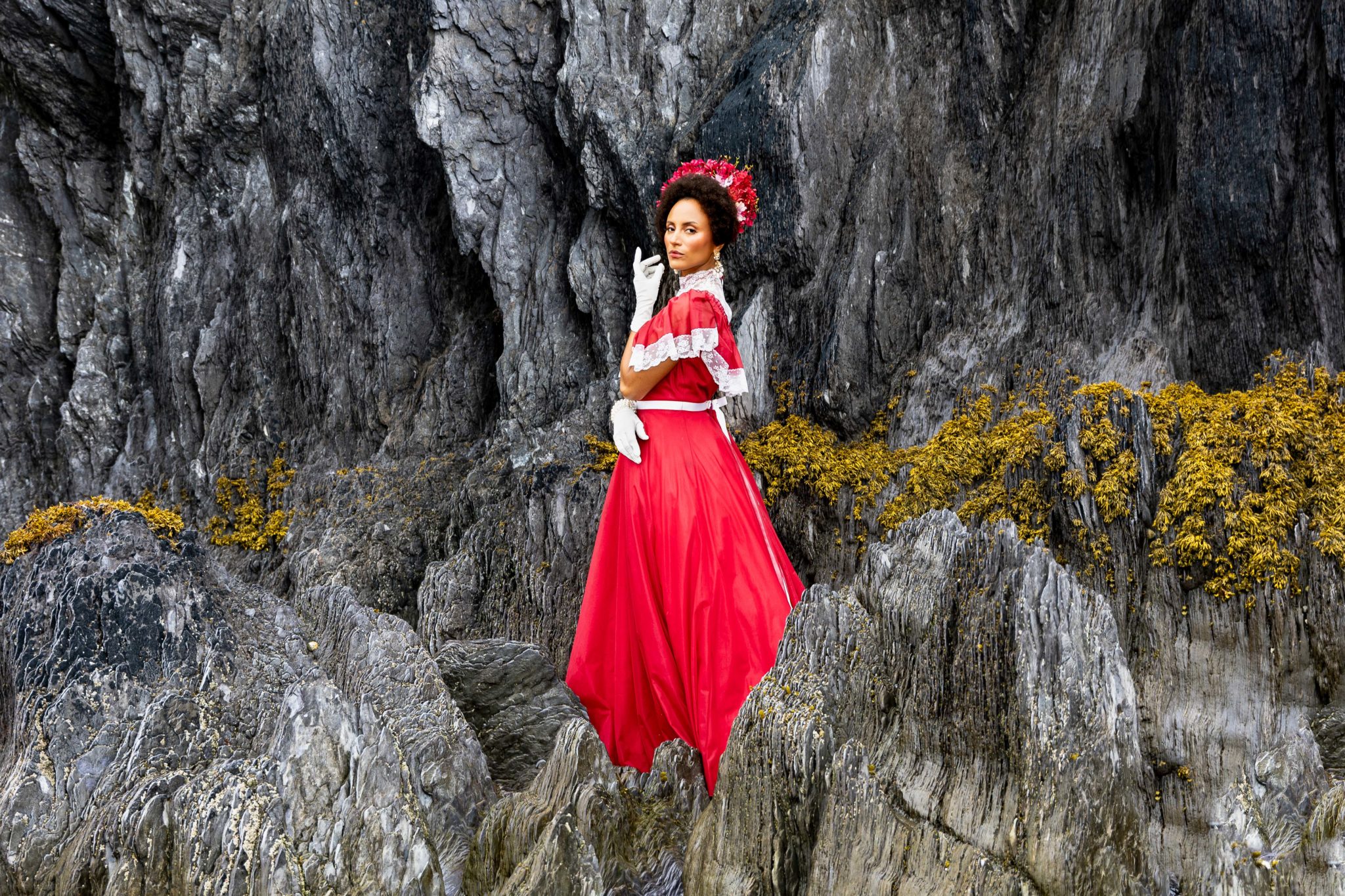
There’s also an element of fantasy that extends throughout the album – centred around the adventures of Isobel, a “medieval time traveller.”
“I’m such a fantasy nerd,” Loah smiles. “I love super geeky, concept-y things. It’s quite visual and cinematic – she’s popping up in different eras and times, with different jobs and different skills. Maybe I should write a novel about her story...
“When I wrote ‘Isobel’s Lament’ years ago, it was a medieval lute piece that I put words to,” she elaborates. “And I was like, ‘Wow, that would be so cool if you were this character from the medieval period who found herself in 20-whatever – trying to make sense of AI and modern music and computers…’”
Credit: Susannah Appleby
At the same time, Loah’s own experiences have also informed the album – with her songwriting swaying at times between the “super direct” and the “really abstract.”
“I’m challenging myself more to be more direct, but it’s very vulnerable – so I like to have the option to go either way,” she explains. “Especially if you’re performing something all the time. You need to be comfortable with revisiting an emotion over and over again.”
The track ‘Our Tree’ delves into the legacy of mother and baby homes – a chapter of Irish history that has directly impacted Loah’s own family.
“My mum was born in a mother and baby home,” she tells me. “So it’s very personal – it’s in my family. She was an orphan, and was adopted. That was another one where I knew I could go in different ways with it. I could write something very direct, telling the story of what happened. But that didn’t feel natural or organic, so I went the other way, with a more abstract, poetic metaphor about it – about the scattered seeds of these children, and the tree of life.”
Goddesses and spiritual figures – including Yoruban deity Yemonja and Ireland’s Brigid – also feature in the song, with Loah revealing she was “reading a lot of mythology and scripture” at the time.
“I realised all of these female goddess characters had a really terrible time,” she notes. “Their origin stories are horrendous – something awful always happened to them. It’s mad that we’ve baked the suffering of women into mythology, as well as everything else. And of course, Mary too – her son was crucified! So when you wrap it all in, and zoom out, you’re like, ‘God, we’re recreating these terrible, tragic origin stories, in the way that we’ve treated women – can we stop? Can we not do that?!’”
Loah took on the role of another religious figure, Mary Magdalene, for the Barbican’s production of Jesus Christ Superstar in 2019.
“That was around the time I started reading all this literature around Jesus – because I didn’t know anything,” she recalls. “My friend’s dad was like, ‘You should probably read the Bible.’ And I was like, ‘Oh yeah, I guess if I’m playing Mary Magdalene…’
“Me and my friend Jack O’Rourke, the singer-songwriter, had also gotten into this conversation about how one of the biggest influences on literature and arts throughout history is actually the Bible, because it’s just a really old book. And once you do read it, you realise how many people – modern, secular artists – quote it.”
Having appeared in the National Theatre’s production of The Playboy Of The Western World, Spilt Milk, Kin, and Conversations With Friends over the past few years, Loah feels her work as an actor continues to feed a different side of her creative brain than her work as a solo artist.
“Because it’s someone else’s vision, and you’re fitting into it,” she says of acting. “Fundamentally, it’s a group thing, and it’s serving something that’s not all about you. And that’s lovely. If you’re a solo artist like me – not a band – it can be a lot of self-generating, and time alone, thinking and reflecting on what you’re doing. It’s so nice to get into a company and just sort of disappear – and be one cog in a machine.”
As for her next musical move, Loah reveals that she’s already thinking about her next record.
“I think it’s a normal way for things to swing – when you’ve done an album that’s a big collage group effort, with tons of people in different countries, you just want to do a solo one, where it’s just you in the corner of a room for a week,” she reflects. “So I feel like I’m swinging towards something much simpler for next time. But we’ll see. You never know…”
• Materia Medica is out now. Loah features as part of the line-up of SIRENS at the National Concert Hall, Dublin (September 26) and Cork Opera House (27).


RELATED

- Music
- 26 Aug 26
Kate Nash announces intimate Irish shows this autumn


- Music
- 12 Aug 26
Huartan announce Free State Tour 2026

- Culture
- 11 Aug 26
Emma Langford, Sean Ronayne and Ben MacCaoilte to tour new show Crónán

- Music
- 07 Aug 26
Babyshambles announce new live album ahead of Irish dates

- Music
- 05 Aug 26