
- Music
- 01 Oct 26
Gurriers: "We’re not politicians – we’re just musicians shouting and roaring about the trials and tribulations of the world"








As Dublin post-punk maestros Gurriers unveil their brilliant new opus Nobody’s Coming To Save You, they discuss the album’s fascinating array of musical and literary influences, political upheaval, the apocalyptic tenor of the times and more with a rapt Will Russell.
Dinnseanchas, or place-lore, occupies a central place in Irish culture, transforming the physical geography of the Celtic landscape into a dense web of story, memory and meaning. My first listen to Gurriers’ rather excellent sophomore effort, Nobody’s Coming To Save You, is driving through the summer rain on the winding road from Baile Breac to Dunquin on the Dingle Peninsula.
Big, bruised clouds rumble over Mount Eagle; sudden shafts of light turning the sea from slate to green. It is not a road that encourages speed, though Gurriers’ sonics do their best to suggest otherwise.
Listening to Gurriers on Slea Head, it is hard not to hear the music striving towards an older, almost Yeatsian idea of Ireland – not because that world is present in the sound itself, but because the songs seem haunted by its absence. Their Ireland is fractured, wired and contemporary; possessing a longing for something more rooted and numinous.
There is also a feral spaciousness to Gurriers. The music can feel enormous without ever becoming clogged. At their best, they sound like a band prowling around inside the song, restless and half-wild, testing its boundaries and always threatening to tear through them.
That sense of abandon is deceptive. Recorded between Attica Studios in Donegal and Holy Mountain in London, with Idles’ Mark Bowen and Loren Humphrey at the controls, the album is meticulously engineered beneath the hood – its rhythms, textures and spaces pulled apart and rebuilt, until all that feral energy feels less accidental than carefully unleashed.
INTELLECTUAL INFLUENCE
“Mark got involved in a funny way,” Gurriers frontman Dan Hoff explains, “because he invited us to see Idles two years ago in the Olympia. We became quite friendly, and then when we were looking at making the second album, I asked Bowen what he thought of a certain producer, and he was like, ‘Man, just let me do it. I want to make it.’”
“He’s just such a good dude,” drummer Pierce Callaghan adds. “He was so enthusiastic about the whole thing and his knowledge of gear and understanding of music is incredible.”
Nobody’s Coming To Save You is an album with an impressive didactic streak, the kind that sends you away searching for the books of Kurt Vonnegut, Rebecca Solnit, Samuel Beckett and Mark Fisher – seeking the intellectual influence behind the record.
“I think for me lyrically,” Dan says, “‘Nobody’s Coming To Save You’ came from – it’s going to sound funny – anger towards a review we got once. Someone gave us quite a low score in an album review, because we had a lot to say, but no answers about the political zeitgeist. I just don’t feel that’s a fair review, because we’re not politicians.
“We’re just musicians shouting and roaring about the trials and tribulations of the world. But that’s what I wrote down – 'Don’t even know you / Cards on the table / Whip up an answer / If you are able'. Then I use two quotes from two people, who are very important in my life. There’s Kurt Vonnegut: 'If this isn’t nice / Then I don’t know what is'. And one from Rebeca Solnit: 'Hope ain’t a whisper / It’s an axe you break down doors with'. I’m explaining – I don’t have the answers, but these two people do.”
“It is very much how the world feels,” Dan continues. “Irvine Welsh’s new book is Can Nothing Save Us? Even Fontaines’ new album is about catastrophe and less hope. There is this kind of anhedonia with people at the moment, it just seems quite grim, and I think the best thing we can try and do, is find through art and poetry, the answers that we can use to try and understand why this is happening.”
It’s more about turning people on to look at the political system for themselves, right?
“Yeah,” Dan agrees. “I think it’s to put a mirror up to the political system, isn’t it? I don’t have the answers, I didn’t go to college or have generational wealth.”
So, is ‘Waiting For Fisher’ about Mark Fisher?
“Yeah,” Dan confirms. “Mark Fisher and a play on Waiting For Godot as well. Last year I read a lot of Mark Fisher, he spoke to me in a non-fiction way that I could get behind. I find it hard where some non-fiction books feel like actual essays that people write in college. But I keep going back to Fisher’s last book, Postcapitalist Desire: The Final Lectures – how he references movies and books with reality. It’s kind of what you do as a musician, as an artist.”
And ‘Party Lines’ references an enduring influence on Fisher – Žižek coupled with the geopolitical situation in Sudan.
“There was so much bloodshed in Sudan,” Dan explains, “that you could see the blood from satellite images. Alarm bells should be going off in a lot of people’s heads. Also, the hypocrisy of governments in trying to send aid to Gaza and Sudan, but then also funding and allowing the weapons to go to Israel or Sudan. It just feels insane. Nothing really surprises you anymore, which is even more depressing.”
POLITICAL AWARENESS
Do you get the sense that the people coming to your shows are politically astute – that there’s a kind of shared political awareness or energy in the room?
“There’s a bit of that, definitely,” Pierce replies. “I think our audience has developed over time. When you start out in guitar music, the first early adopters, bar your mates or whatever, are primarily the middle-aged, BBC Radio 6 stereotype, and within that sphere, there’s a lot more political awareness and consciousness.
“I think now that we have a much bigger cohort in our audience of younger people, that they are just into the music and maybe aren’t aware of the depth and the weight of what is being said here. But I don’t want to tar everyone with the same brush.”
For all its political weight, this is a great dance-punk record and there’s psychedelia, there’s thrash, there’s huge physical energy. You don’t come away feeling glum; if anything, all that anger gets turned into exhilaration.
“People who listen to the music are very political,” Dan reckons. “You can’t not be these days, being online with TikTok and Instagram. But when people go to gigs, it’s a release, and they go out there and just enjoy themselves. And even them enjoying themselves is against the system.”
“Escapism is a huge part of what we do,” Pierce expands.
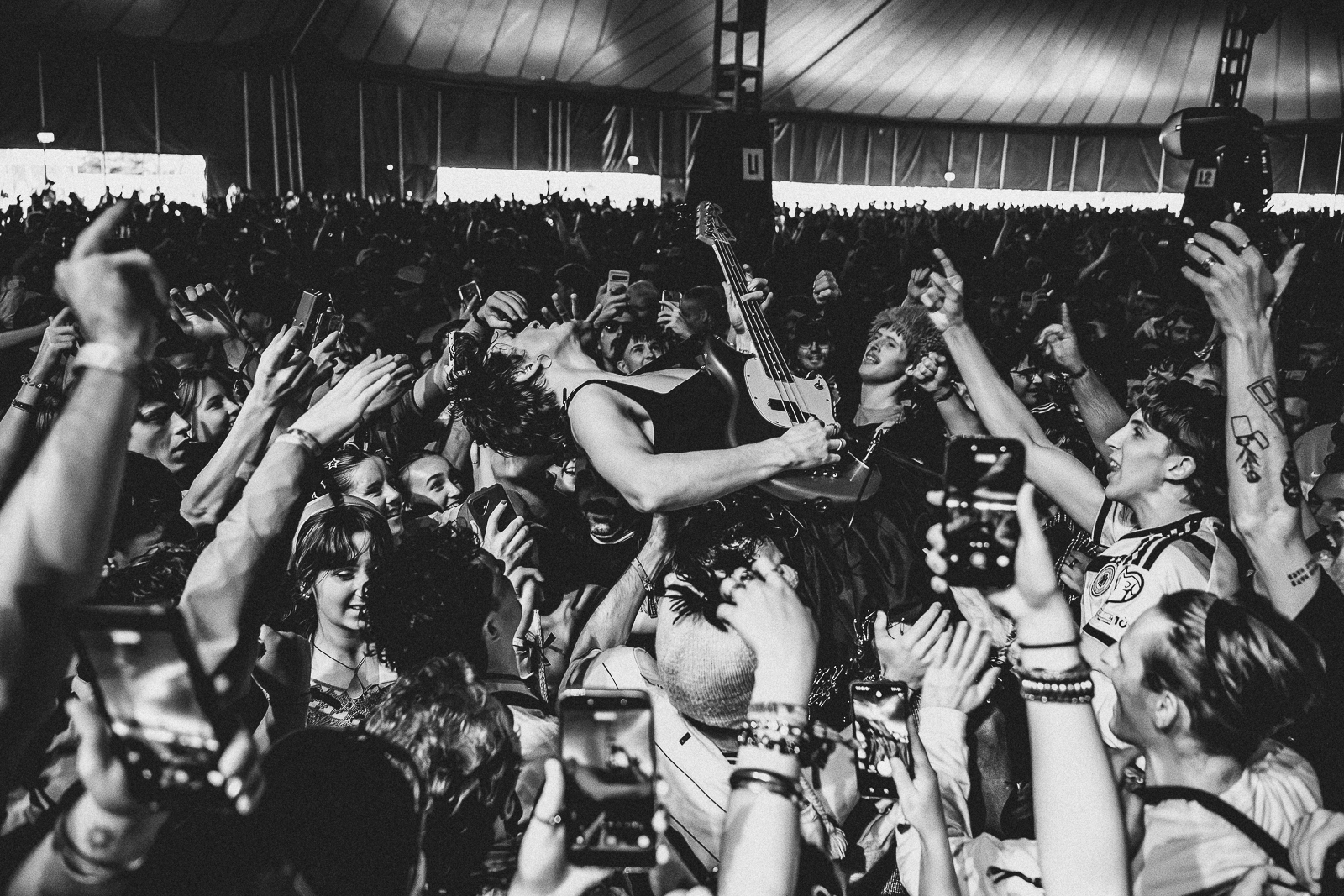
Gurriers at Electric Picnic on August 28, 2026. Copyright Jason Doherty/hotpress.com
‘Nothing Happens Twice’ takes in Dead Internet Theory, the LA fires and Gaza, yet still lands as a banger, driven by the kind of taut, funk-metal propulsion associated with Rage Against The Machine. Elsewhere, ‘Shades’ veers into hardcore, while ‘Pins’ splices grunge with the murkier textures of trip-hop. Across the record, I kept hearing Californian reference points – not necessarily influences, but a certain sensibility: the feral sprawl of Jane’s Addiction; Rage’s conversion of anger into movement; the abrasion of West Coast thrash and East LA punk; and the elastic, body-conscious energy of dance-punk.
“Mark Bowen will be very happy to hear that,” Pierce laughs. “Mark is always banging the drum that we pull in influences from American bands way more than British or Irish bands or whatever, and about trying to wear that a little bit more. We went out to the States for the first time this year, and it’s a funny thing, because we’re at decent level now at home in the UK and across Europe.
“But then to go to the States for the first time, you feel as if you’re starting over again. But Mark is very steadfast, that we draw from a lot more American influences, so we need to own that a little more and keep going back to America to build it over there.”
Beneath all that feral energy, there is an extraordinary amount of craft in the record’s undercarriage – songs built, dismantled and rebuilt. Take ‘Drones’ as Exhibit A – what sounds instinctive and physical on the surface is, underneath, the product of meticulous studio construction.
“The drums on ‘Drones’ were done in such an unconventional way,” Pierce reveals. “Loren Humphrey, who co-produced the record with Bowen, is obviously an amazing drummer. He’s played with The Last Shadow Puppets and Florence + The Machine. So, when the drums were recorded, it was written in a way that it did have that kind of boom-bappy, ’90s hip-hop influence.
“So, we recorded the drums, and then Loren went and borrowed an old drum-machine sampler from James Ford. And so, we literally programmed the drums into the sampler, and he just came up with an entirely new drum beat out of samples that are essentially me playing. Using that technique, it definitely gives you that kind of trip-hop quality as well – really bouncy.
“Whenever he was saying it to me initially, I’m not lying, I was kind of apprehensive with the whole thing. I was like, ‘I think I’ve written a good part here. I think it’s cool, you know? I don’t want to get rid of it.’ But then the final product is incredible and the process of putting it together, it’s amazing.”
The band hit the road this autumn and winter for a mammoth run of dates across Ireland, the UK and Europe. Enola Gay – joining them for some of those shows – are a band who’ve played an important role in Gurriers’ early days and helped open a few doors when they were starting out.
Dan explains that they were there before Gurriers even had a name or an Instagram account – “I sent Joe, their guitarist, a message saying, ‘You guys are great. I’m in a band. I think you’re one of the best bands I’ve heard at the moment.’”
The connection quickly became more than admiration. Enola Gay brought Gurriers onto a Belfast bill, then helped get them over to the UK, where they met the management team they have now been working with for four years. “They gave us definitely the biggest opportunity we could ever have very early on,” Hoff says, “to play with them is always an amazing thing to do.”
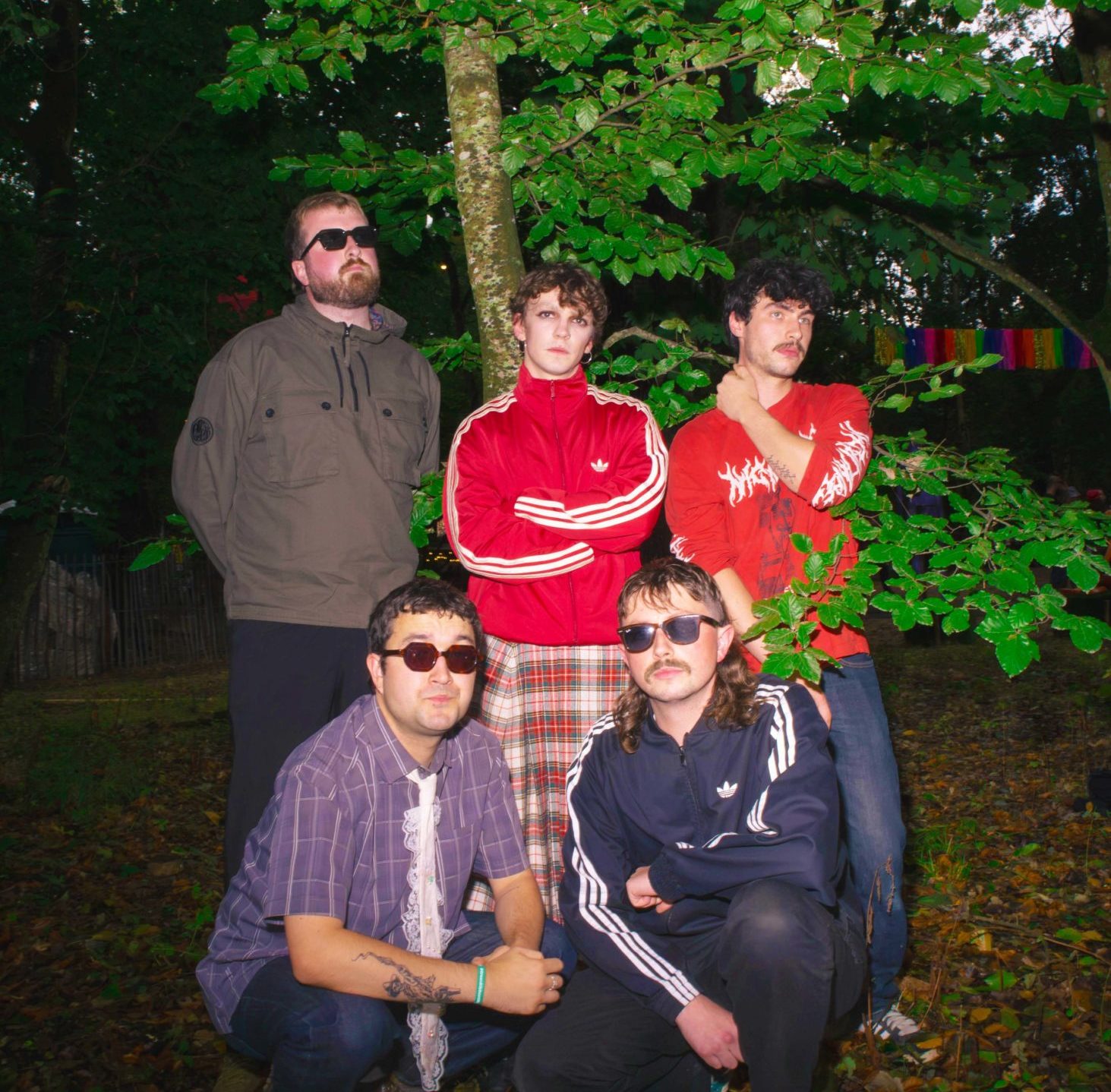
Credit: Saoirse McAllorum
That sense of loyalty has stayed with Gurriers. On the coming run they are also bringing along Rotterdam’s Tramhaus, another group who offered them opportunities early on in the Netherlands.
There is, inevitably, one occupational hazard to spending months on the road with close friends. “A couple of months might not be amazing for some people’s livers,” Dan laughs, “but it’ll be great.”
Indeed, ‘I Wish I Was’ turns to the vicissitudes of life on the road – the distance, dislocation and strain that come with being perpetually in transit.
“I do like the road,” Dan clarifies. “I actually feel a real sense of routine when I’m on tour, which is interesting because I’m the complete opposite at home – unorganised, erratic, paranoid. On tour, I think I need that regimented structure.
MISSING HOME
“But the song is really about the bits you don’t hear about in the books or documentaries,” he continues. “Missing home, missing your partner, missing your family. I was having these dreams where I’d wake up at home, or I’d have spent a whole day with my family or my partner, and then I’d wake up and I’d be in California. I’m not complaining – it’s just how my brain wants to sabotage me in that moment.”
Before they go, I ask about one of those moments that seems to confer a different kind of legitimacy on a young band – appearing on Later… with Jools Holland. Gurriers found themselves sharing the programme with JADE, Blossoms, Laura Marling, Nubya Garcia and Queen’s Roger Taylor.
“It was amazing,” Pierce says. “It kind of justifies an awful lot of what you do. People that aren’t necessarily huge music fans are still cognisant and aware of what Jools is. Suddenly people are like, ‘Oh, they’re a serious band now.’ It kind of justified your whole existence and the journey up to that point.”
What made it particularly special was being able to share the moment. Girlfriends came along; Pierce’s mother travelled over with a friend. For a band whose lives are increasingly spent moving between venues with managers, crew and each other, bringing family into that world mattered.
“A big part of the existence of being in a band is other people making sacrifices to allow you to do what you do,” Pierce says. “Sometimes that can get overlooked a little bit and taken for granted.”
By the time Gurriers disappear back onto the road, what lingers is the optimism beneath the noise. Nobody’s Coming To Save You may invoke Beckett, Žižek, Solnit and Vonnegut, but its real subject is agency – what happens when you stop waiting for somebody else to provide the answer.
Later, I think again of that drive along Slea Head – rain moving across the road, the Blaskets coming and going behind the cloud, Nobody’s Coming To Save You loud in the car. The phrase no longer seems quite as stark.
• Nobody’s Coming To Save You is out on September 25. Gurriers play Ulster Hall, Belfast (October 28); Vicar St., Dublin (October 29); and 3Olympia Theatre, Dublin (November 1). See their full list of tour dates here.


RELATED

- Music
- 16 May 23
Gurriers share riotous second single 'Sign Of The Times'


- Music
- 30 Sep 26
Foinse announced as Classic Hits Radio's New Local Heroes

- Music
- 30 Sep 26
KETTAMA scores two spots on UK's Official Trending Chart

- Music
- 30 Sep 26
F3miii scores 20th week on US Billboard Hot 100 with 'Noble'

- Music
- 30 Sep 26