
- Music
- 24 Oct 26
Andy Irvine: "When I took on Woody, I took it all on"


As he releases Devoted, his magnificent tribute album to Woody Guthrie, Andy Irvine talks about his ’60s correspondence with the man himself, becoming pals with Ramblin’ Jack Elliott, the bouzouki in Irish music, and the enduring contradiction of Sweeney’s Men.
In the mid-1950s, Andy Irvine discovered Woody Guthrie through Lonnie Donegan recordings and thus began a lifelong dedication to the Dust Bowl troubadour – both his music and his life philosophy.
Indeed, Andy’s eighth solo LP Devoted is a tribute album, reimagining selections from the Guthrie songbook through a distinctly Irish lens. It’s a fascinating record by one of the defining figures of modern Irish folk, central to the short-lived but hugely influential Sweeney’s Men, and also to one of the most important groups in the history of Irish traditional music – the mighty Planxty.
Woody Guthrie transformed American music by making folk songs speak directly to the lives of ordinary, contemporary people by turning themes of migration, labour, injustice and protest into the foundation of the modern singer-songwriter tradition. In so doing, he laid the groundwork for the cultural titans of Dylan and Springsteen.
His student, Irvine, broke ground too. Between them, Sweeney’s Men and Planxty reinvented Irish folk and traditional, opening the sound to new instruments, arrangements and international influences, while creating a template that a generation of Irish musicians would follow.
And somewhere alongside Andy Irvine through all his decades of musical adventure, Guthrie has remained a constant travelling companion and perhaps a guiding light.
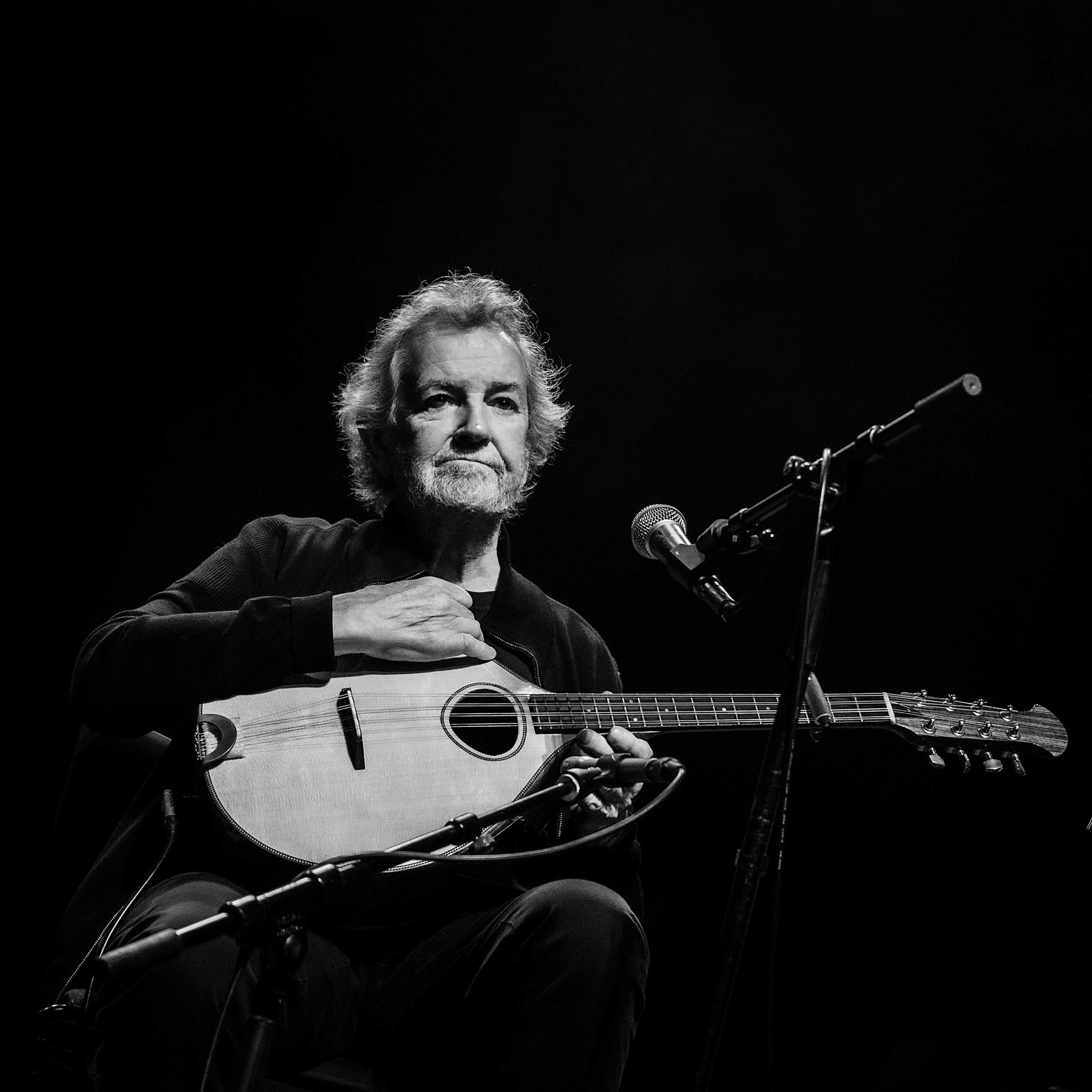
“I was looking for music which would lift my spirits,” Andy recalls. “I discovered skiffle in about 1957. I bought two Lonnie Donegan EPs, and on one of them, on the back of it, was a song that Lonnie was singing, which it said was written by Woody Guthrie. I thought, ‘Wow, Woody Guthrie, that’s a great name.’
“I could find out nothing about him, because in those days, there was no way of finding out. So, I wrote a letter to ‘Woody Guthrie, USA’. I had no idea how famous he was. I mean, if you wrote a letter to ‘Bruce Springsteen, USA’, it’d probably get there. But it came back about six weeks later, and that was the end of that.”
Fortunately, it wasn’t. By 1959, Andy was frequenting Ewan MacColl’s Ballads and Blues Club in London, where Guthrie’s world suddenly became flesh and blood. There he befriended Guthrie intimates Ramblin’ Jack Elliott, Derroll Adams and Cisco Houston, with Elliott even teaching the young Irvine to play harmonica in Woody’s style.
“I was talking to Jack,” Andy laughs, “and he said, ‘You know, Woody used to play it upside down?’ I said, ‘Oh, why did he do that?’ And Jack said, ‘Well, I don’t know, but I believe southern blues players used to do that as well.’ So, I have no idea why he did, but I learned to play the harmonica the wrong way around, with the bass notes on the right.”
Remarkably, the opportunity to write to Woody Guthrie presented itself once again through Sid Gleason, a New Jersey folk-scene figure and friend of Guthrie. With her husband Bob Gleason, Sid became part of the small circle caring for Woody during his years at Greystone Park Psychiatric Hospital.
“I met Pete Seeger,” Andy relates, “and he told me that Woody was in the psychiatric hospital in New Jersey. So I wrote to Woody, and it was answered by Sid Gleason, and then I wrote to Woody and Sid and they both became my friends. All the letters I wrote to Woody were discovered when they knocked down the psychiatric hospital a few years ago.
“They’re now in the Woody Guthrie archive in Tulsa, Oklahoma. I went there and asked, ‘Can I photograph these?’ They said, ‘Yes, they are yours after all.’ So, I have copies of them. They make interesting reading, because I was about 17, and I’m like a different person.”
Alongside the letters, Andy went one step further, sending Woody an audio tape of himself singing and playing with Ramblin’ Jack Elliott.
“We sang a Woody song on one of them,” Andy details. “It was the first time I’d actually sung, because I was shy about singing, and I sang as much like Woody as I could. At the end, Jack turned to me and said, ‘Geez, Andy, you sound more like Woody than I do.’ And Woody had said about Jack, ‘Jack sounds more like me than I do.’ I thought, ‘Wow! I’m more like two Woodys!’”

Woody Guthrie
Around that time, Andy almost moved to America.
“I had been to the US Embassy in London,” he explains. “I got a sponsor. All the things that were necessary at that time, and I was going to go. In fact, Jack sent me a letter – he was in France, I think – saying that he was booked on a passage to New York in December, and he’d really be very happy if I was there with him.
“But in the meantime, I got this job with the BBC Repertory Company. I was only 18, and still kind of under my parents’ thumb, as it were. So, I thought, ‘I better do this job.’ So, it was two years on the BBC Rep, and when I come off that, I was a bit of a changed man. So I never did go.”
Guthrie however, has remained an enduring influence throughout Andy’s life, both musically and philosophically.
“Everything,” Andy agrees. “When I took on Woody, I took it all on. I’m never quite sure whether my love of travel is from Woody, or whether it was endemic in me, but we both shared that same love of the road.”
Post-Sweeney’s Men, Andy travelled extensively around Eastern Europe.
“I spent about 18 months on the road hitchhiking around the Balkans and loved the music,” Andy describes.“It took me a long time to understand it, and when I did, I couldn’t stop playing it. Lots of people in Dublin, when I came back, would cross the road to avoid me because I would say, ‘Hey, you have to play this rhythm!’ Except, Dónal Lunny, who was into it immediately.”
Johnny Moynihan introduced the Greek bouzouki into Irish folk music with Sweeney’s Men in the 1960s by experimenting with tunings that suited Irish accompaniment. Andy expanded its musical vocabulary, drawing on Balkan influences to give it a more melodic character.
Dónal Lunny, particularly with Planxty, developed its rhythmic and harmonic possibilities, helping establish the powerful accompaniment style that became central to modern Irish traditional music.
“I was in the south of Bulgaria,” Andy explains, “and I thought I’d like to go down to Greece and get a bouzouki. But I didn’t want to encourage the fascist government by leaving any money. I went down and sold my blood outside the hospital, which was the thing that people on the road did in those days.
“I’m a bit ashamed of it now, because I think the people who needed the blood probably had to pay the hospital to get it. But I made enough money to buy the bouzouki and hightailed it back to Bulgaria without spending a penny in Greece.”
Andy had already paid tribute to Guthrie in 1991 with ‘Never Tire Of The Road’, written for his solo album Rude Awakening, and inspired by Woody’s restless life. More than three decades later, Devoted feels like the fulfilment of that same impulse – not a single tribute song this time, but an entire album given over to the man who first set him on the road.
“I had a couple of songs that that were just about in my setlist,” Andy relates. “‘Buffalo Skinners’, ‘Rangers Command’ and ‘Tom Joad’. I always did that, and then I had been to the Woody Guthrie archive in Tulsa, and found a few songs that weren’t that well known. I just started recording with Leon O’Neill, who was really brilliant recording me and so it went.”
If Bob Dylan transformed Guthrie’s influence into a new American songwriting language, Andy Irvine carried a slice of it into Irish traditional music. I wonder about the elements of American folk in Sweeney’s Men.
“Johnny Moynihan and me would sing songs from anywhere if we liked the songs,” Andy replies. “We both liked old time-y American music. I’m not sure how much we put on record. When Terry Woods joined the band, he sang a couple of American songs on the first album.
“The thing about Sweeney’s Men and its influence is always quite interesting, because Sweeney’s Men was never that popular in its day. People in the audience in those days used to shout up, ‘Sing something we all know!’ That’s exactly what we didn’t do and wouldn’t do. So, at the time, we were never that big – we’re far more popular now.”
• Devoted is out now. Andy Irvine tours Ireland with Quilty in November. See the full list of dates here.


