
- Music
- 06 Sep 26
Absolute Lilt: "Lilting was popularised during oppression, so it’s another weapon in the arsenal of Irish resistance"








As they release their debut EP Criostal, trad duo Absolute Lilt talk about keeping traditions alive, their 11-piece band BIIRD and their unbreakable bond.
“I remember looking at you and thinking, ‘Who is this mad one?’ You were just walking around, shoulders high, and I was like, ‘Who is this ginger one here now?’”
Niamh Hinchy, one half of Absolute Lilt, fondly remembers the first time she met her bandmate and best friend Lisa Canny in 2014, at a house party in her native Limerick after a Hermitage Green gig.
“Lisa started singing ‘Songbird’ by Eva Cassidy and I started harmonising along with her, and she just stopped and was like, ‘Who are you? You need to be in my band!’”
Mayo native and multi-hyphenate Lisa Canny (a seven-time All-Ireland Fleadh Ceoil champion on both the harp and tenor banjo) was at that time working on a solo project with her band. A few weeks after that fateful singsong, Lisa asked Niamh to come to Dolan’s where she was filming her music video.
“I’d usually say ‘no’ to those types of things, just out of anxiousness. I didn’t know her, but this one time, I thought, ‘I like this girl, I’m gonna say ‘yeah’,’” Niamh recalls. “That’s how I segued into the trad world. I wasn’t in it whatsoever before that. I met a few of the musicians playing with Lisa, and they were all tradies, so that’s how I got into it.
"Now I’m in a trad band," she laughs. "It’s funny how life works. The butterfly effect.”
While Niamh tells me she’s had “zero training whatsoever”, she learned how to hone her beautiful voice by harmonising to Westlife in her bedroom when she was a kid.
“My dad’s in music and my mom sings in a choir, so she’d always be singing harmonies with the radio,” says Niamh. “My granny used to sing harmonies with her brothers and sisters, so it’s in the blood a bit.”
In terms of early influences, both Lisa and Niamh loved pop in their early years. Artists as diverse as Paul Brady, Nelly Furtado, Steely Dan, Destiny’s Child, The Staves and, of course, the Spice Girls were part of the tapestry of their musical education. Fast forward to 2023, and while touring with the Lisa Canny band in Germany, Lisa taught Niamh how to lilt.
“You taught it to me,” Niamh recalls. “Then we did it in harmony, and we were like, ‘That sounds cool’. So we just videoed it and put it up on Lisa’s page. It wasn’t contrived in any way, there was no, ‘Let’s set up a page and see how this goes.’ We threw it up and then it went a bit viral.”
Three years on from posting that lilting clip, Lisa and Niamh could not have predicted their whirlwind rise. With over 600k followers and 100 million views online, Absolute Lilt signed to Heavenly Recordings early this year.
“It’s completely bonkers, and nonsense in nature, and nonsense in every other aspect,” Lisa adds.
In case you’re wondering what lilting actually is, it’s a form of traditional singing that uses nonsensical syllables rather than real words. Singers use repetitive, percussive sounds like “dum”, “dee”, “diddle” and “day” – not quite the type of thing you would expect London’s Heavenly Recordings to fully appreciate.
“It came about quite organically, because I met one of the Heavenly Recordings team through doing that BBC Live Lounge session with Kneecap, where I was playing harp with them,” Lisa explains. “Then we met Toddla T through the Kneecap lads. We clicked immediately, and he was like, ‘What are you doing? What do you want to do?’ I told him, ‘I’ve got this lilting thing, actually. It’s kind of funny, and it’s with Niamh.’
“He’d met Niamh already through Naoise, so I said, ‘Will we get a couple of days in the studio with you?’ He was like, ‘Absolutely!’ We did four days, and made this and another album, which you haven’t heard yet. It’s like a drum and bass, EDM, lilt collab album – which is as bonkers as it sounds!”
Lisa sent the album to her contact at Heavenly Recordings and things moved pretty quickly from there.
“That was on a Thursday, and I was in their offices on the Monday morning,” she says.
Their debut seven-track EP, Criostal, is an extraordinary introduction to Absolute Lilt and the art of lilting itself. Their triumphant lead single ‘P Stands For Paddy’ blends trad with R&B. It features ethereal, lush vocals from Canny and Hinchy; Robbie Walsh on bodhrán; Kait Cullen-Verhauz on cello; and Alan Doherty on whistle duties – the result is a gorgeous, hypnotic ride. Think Clannad meets TLC.
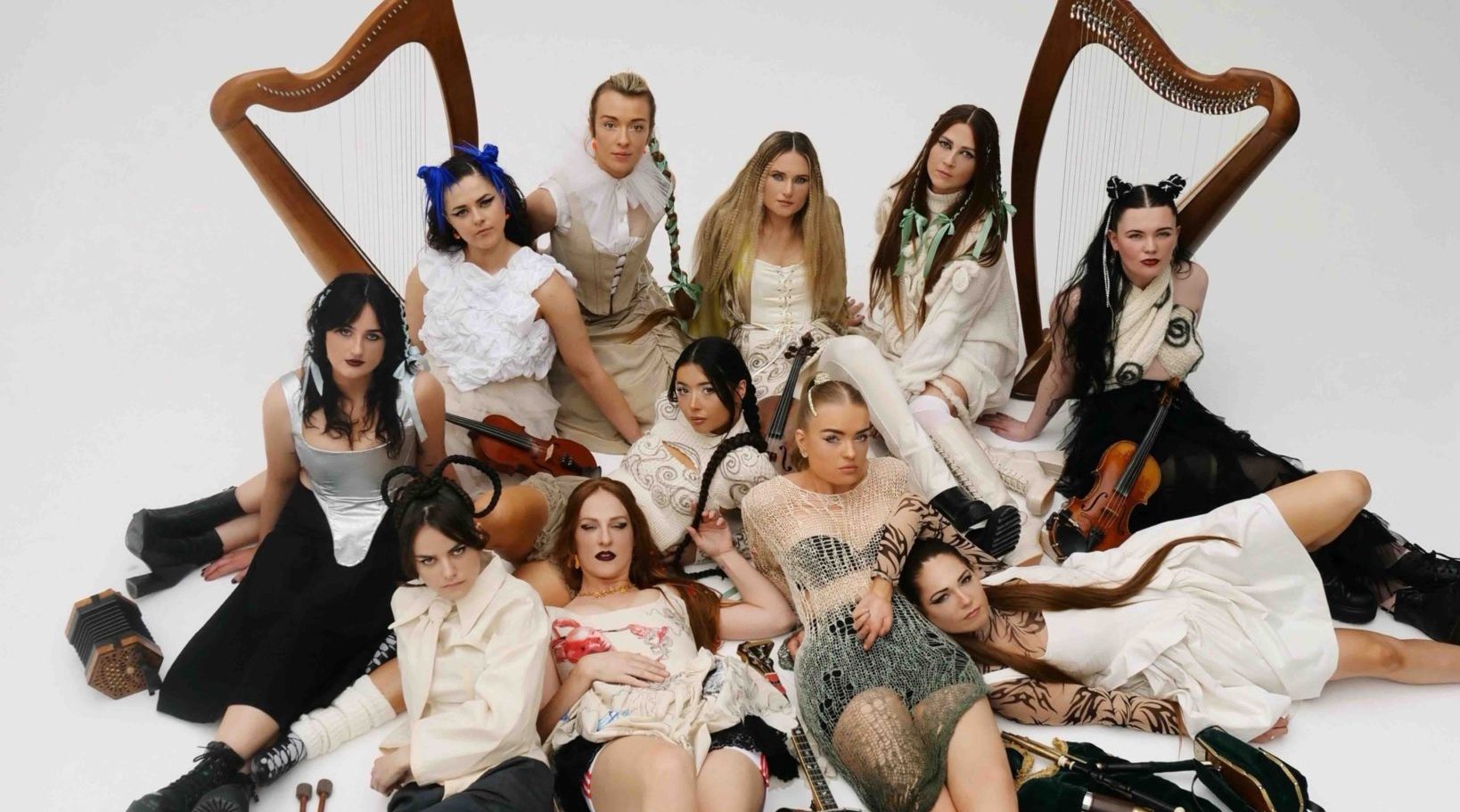
Along with Absolute Lilt, Lisa and Niamh are part of another trad act, a spectacular 11-piece, all-female group called BIIRD.
“Having made friends with Toddla, I got to sit down with his wife Annie Mac,” Lisa says.
As fate would have it, it was Annie Mac who would go on to book BIIRD for their first ever gig at a literary night at the London Irish Centre.
“I’d been trying to put BIIRD together for 12, 13 years,” Lisa continues. “I needed that kind of push, so they were both quite instrumental in getting both of these projects up and running in the end.”
Calling by Zoom from Lisa’s home in London, it’s easy to see how Lisa and Niamh harmonise and perform so beautifully together. Throughout the call, the pair finish each other’s sentences and bounce off each other the way only best friends do. With such a hectic touring schedule and everything that goes with it, even the oldest of friends can fall out, but that doesn’t seem to be an issue for Lisa and Niamh.
“We share a room every time,” Niamh tells me. “You know when you can just be completely silent with someone? It’s like being there with your sister. It’s a safe space.”
When forming BIIRD, Lisa didn’t leave anything to chance when it came to who joined the band.
“I very carefully selected everyone, not just off their musicianship, but also on how well we would get on,” she explains. “There was a lot of trust and love needed between us to find our feet, and make sure that everyone was feeling comfortable in BIIRD. It’s an ongoing process. There’s constant negotiations and conversations that have to be had, but I think that’s the beauty of a girl band. We can be like, ‘What the fuck is wrong with you?’ and then sit down and have that conversation out.
“I’ve been in bands with boys before, and had to kind of suppress that more emotional side of me. I’m a highly emotional, highly sensitive person, and I feel everybody else’s emotions as well, so I need to know what’s wrong. ‘How do we fix it? How do we move on from here?’”
Working in music throughout their adult lives, do they think things are a bit better now for women in the music industry?
“I don’t think I had any awful experiences of misogyny in my younger years, or at least I didn’t see it as such at the time,” Lisa considers. “Now I can reflect back on some experiences and wish I was more equipped to understand what it was at the time, but maybe ignorance is bliss?”
Having recently spent time writing songs with Eleanor McEvoy, the contrast in realities for both generations is stark.
“She needed to have a male manager when she started,” says Lisa. “Because people wouldn’t deal with her directly, and wouldn’t deal with a female manager. She said, ‘We just never questioned that. It was just, we need a man for the money talks.’ I can see it now and again, little elements of people underestimating us, or us exposing a fragile male ego. That’s what happens when you get alpha females together.”
What do Lisa and Niamh make of the recent explosion in Irish music abroad, particularly the fetishisation of Irish music and Irishness in England?
“When I moved over to London first, coming into sessions with my harp and banjo, people were like no, no, no,” Lisa recalls. “There was complete resistance to the harp and the banjo, and now, sure everyone’s like, ‘Oh my god, banjo! That’s the coolest thing ever!’ Kneecap were instrumental in it with the Irish language. Lankum, with what they did with folk. There’s been little stepping stones to this moment.”
“I love it. The more love we can get, the better. Bring it on,” Niamh enthuses. “We’ve always loved where we’re from, and it’s great now that other people are recognising it. Look at the size of our country on the map. We’re so tiny, and the talent coming out of us with musicians, sports people, entrepreneurs. I’m glad it’s being seen around the world.”
“Trad has always been this poppin’ among its practitioners and in the community,” Lisa says. “The fleadhs are getting bigger every year. The standard of musicians in the competitions is getting better every year. Meitheal and all the other schools that have teenagers playing trad are getting bigger and bigger every year.
“Trad has always been that poppin’ and that buzzin’, but what’s happening now is that the industry is catching up. It isn’t just the industry, because I’m not going to give them all that credit, it’s being audience-led. People are looking towards more authentic things and towards home again. I don’t think it’s any surprise it’s happening in parallel with what’s going on politically around the world.”
As Planxty did in the ‘70s, how do Absolute Lilt and their contemporaries feel about transforming trad music for the next generation?
“Trad and folk and all of these things have revivals,” says Lisa. “It’s a circular thing. It happened in the ‘60s and ‘70s, it’s happening now and it’ll happen again in 40 years. At the crux of it all is, we’re the best songwriters, we’re the best storytellers and we’re probably the best musicians in the world. We’re up there with the gospel musicians. I’ll give ourselves and the gospel musicians that trophy.”
On a cultural level, it must feel good to be revitalising the ancient tradition of lilting?
“I try not to think about it too much,” Lisa admits. “With traditional music, there’s always a real onus and a responsibility, and there’s a lot of fundamentalists that wouldn’t agree with what we’re doing. But I think we’re getting an extra licence with lilting, because it’s really missing in the public space.
“It’s an honour to be able to bring it to a wider audience. It’s also a great responsibility that we do it in a tasteful way, and that’s always a negotiation with how much we experiment with it and how we present it. No doubt there’ll be some backlash agaist us modernising it, but that’s what traditions do, and that’s how they live and breathe.
“So we just have to do what feels good to us, and hopefully we’ll go down in history as an act that revitalised lilt.”
The ripple effect of Absolute Lilt can already be seen amongst the younger generations.
“I was at Westport Scoil Cheoil last week and three little girls put down their instruments and started lilting as I walked past,” Lisa enthuses. “The tears were welling up in my eyes. If that’s our effect, if that’s all it has, that’s amazing. Allegedly, lilting came from the time of penal laws.
“Anything Irish music-related was stamped out, so people started lilting to dance to, and to teach their kids. Lilting was popularised during oppression, so it’s another weapon in the arsenal of Irish resistance. It’s great that we’re not losing it. I’m always very careful to tell that story when I’m teaching it. It’s important, because those stories start to get lost if you don’t keep telling them.”
Brimming with talent and passion as they set out on their North American tour with Ed Sheeran later this month, you can only think the sky’s the limit for BIIRD and Absolute Lilt.
“You might want to come back and ask that question about how we stay friends, because a little sprinter van for six-and-a-half weeks is going to be a challenge!” Lisa teases. “The rise and fall of Absolute Lilt and BIIRD!”
• Criostal is out now.


RELATED

- Music
- 03 Jul 26
New Irish Songs To Hear This Week

- Music
- 22 May 26
New Irish Songs to Hear This Week


- Music
- 22 Oct 26
Talking Heads announce jointly authored book New Feeling

- Competitions
- 22 Oct 26
WIN: Tickets to A New Local Hero 2026 live finale at The Academy

- Music
- 22 Oct 26