
- Film And TV
- 25 Mar 26
Danielle Galligan: “We have a sense memory as Irish people of what it’s like to be colonised"








Danielle Galligan on Spilt Milk, the need for collective politics, and why Irish stories still matter.
When Danielle Galligan talks about her career, she tends to frame it less as a dramatic ascent and more as a balancing act. “Life is never one genre,” she says. “It’s always magical and beautiful and stressful and overwhelming, everything all at the same time.”
It’s a fitting description for an actor whose recent work has ranged from international productions like House Of Guinness through intimate Irish storytelling like the film Lakelands, to popular series like Kin and The Walsh Sisters.
Galligan now stars in Spilt Milk, Cara Loftus’s moving drama set in 1980s Dublin during the heroin crisis. Galligan plays Maura, a mother confronting both personal crisis and the larger social reality of a community abandoned by institutions and forced to act for itself.
For Galligan, the emotional centre lies with the women who organised grassroots resistance.
“To me the real heroes are the women who started the Concerned Parents Against Drugs movement,” she says. “These parts of Dublin had been neglected since the founding of the State really, and they were up against an unknown enemy. No one knew what heroin was at the time.”
Maura initially believes the problems in her family are her fault – the kind of internalised blame many parents feel. But through solidarity with other women, she begins to see the wider context.
“She sees the problem as localised to her own home,” Galligan says. “She’s blaming herself. And then through sharing her experience with the other women, she sees there’s a greater societal fault – it’s the failing of a government, Gardaí and institutions.”
The film ultimately becomes a story about collective power rather than individual heroism.
“There’s a real culture of individualism happening,” Galligan says. “This film really shows the triumph of community over individualism. We can only have individual heroes because of the support of a community around them.”
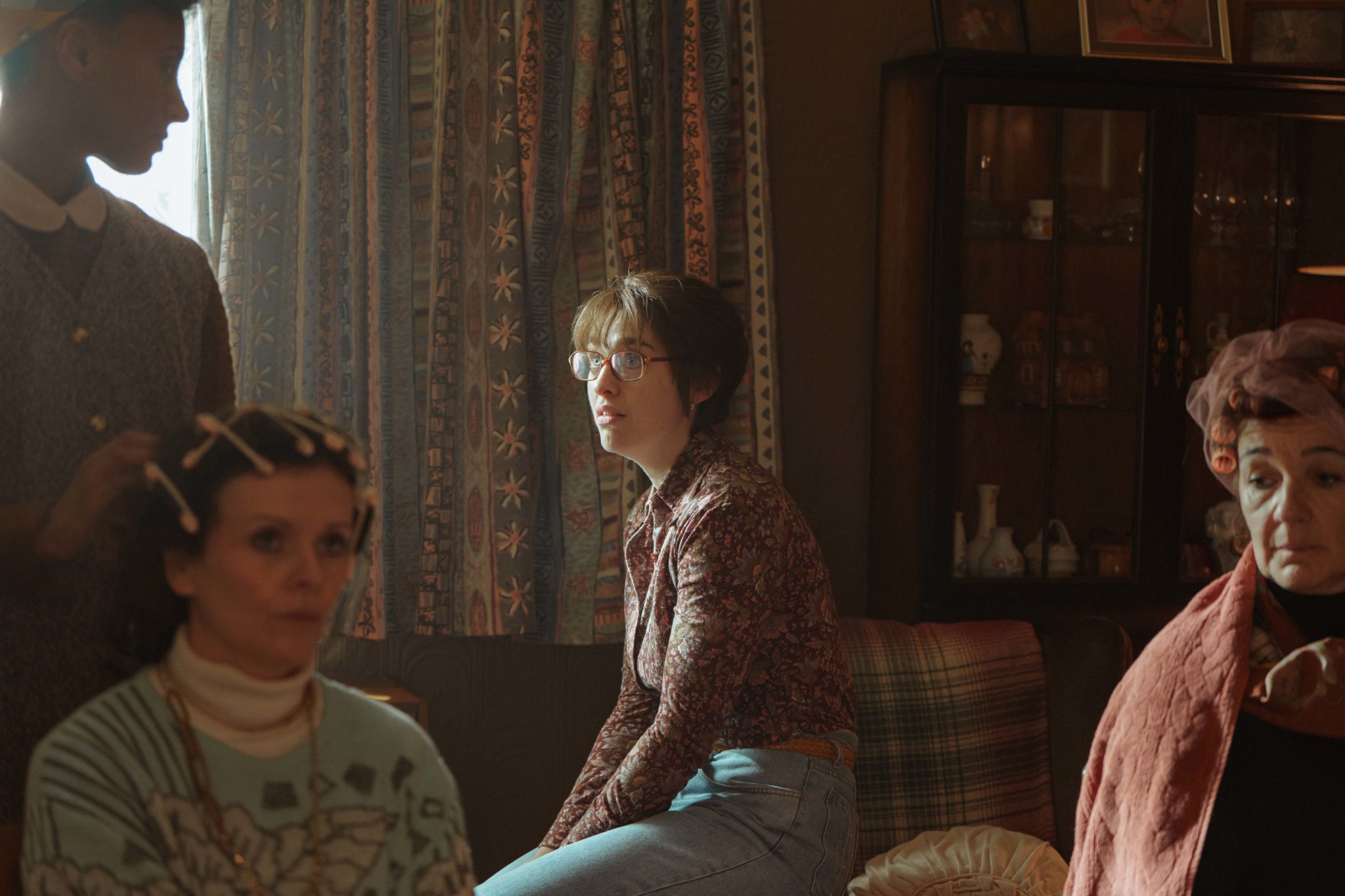 Spilt Milk.
THE ROLE OF ART
Those themes – collective action, political responsibility, and the power of storytelling – were also part of Galligan’s recent experience at the Berlin International Film Festival, where she was selected as one of the European Shooting Stars. Amidst conversations about filmmaking, identity and politics, Galligan found herself reflecting on the position of Irish cinema within that broader landscape.
“I found myself feeling really proud of our industry,” she says. “Talking about Screen Ireland, about the support we have for artists, even the basic income for the arts, it made me realise how much infrastructure there is behind the moment Irish talent is having internationally.”
Across the festival, artists were grappling with the question of whether art should be political – a debate that felt particularly urgent in the current European climate.
“There was a lot of discussion about the rise of fascism across Europe,” Galligan says. “Every country had something to say about that.”
While she describes herself as someone who often listens more than she speaks in explicitly political discussions, the debate pushed her to think more deeply about the role of art.
“I’ve always instinctively thought that art is political,” she says, arguing that film carries particular power because of its ability to reach wide audiences. “Our job is to hold a mirror up to society.”
For her personally, identity and embodiment themselves are also political.
“You can only create from your own perspective,” she says, “and my perspective is that of an Irish woman. Sometimes just moving through the world in a female body can feel political.”
EVERY CHANGE MATTERS
Ireland’s own history also informs her belief in the importance of storytelling.
“We have a sense memory as Irish people of what it’s like to be colonised, of what it’s like to be erased, of what it’s like to have your culture and language taken from you,” she says. “And the only way to keep the people alive is to continue to tell their stories.”
That sense of responsibility is also what makes films like Spilt Milk resonate beyond the past. Though set in the 1980s, the issues it explores – housing inequality, addiction, community neglect – remain painfully familiar. Yet Galligan ultimately returns to something more hopeful: the idea that ordinary people, through small actions, can still change things. In Ireland, she points out, recent history has already proven that point.
“I became a voter around the time of the marriage referendum and Repeal,” she says. “Those were grassroots movements. People handing out flyers thinking it might not make a difference – and then suddenly you have constitutional change.”
The lesson, she suggests, is simple.
“Every bit of change matters,” she says. “Every life saved matters. And stories can remind us of that power.”
• Spilt Milk is in cinemas now.
RELATED

- Film And TV
- 18 Aug 26
Mrs Brown's Boys' Brendan O'Carroll cancels Christmas specials


- Film And TV
- 23 Feb 26
Jessie Buckley crowned Best Actress at 2026 BAFTAs
RELATED

- Film And TV
- 17 Feb 26
Tributes paid to Godfather actor Robert Duvall: "The greatest storyteller of all time"


- Film And TV
- 04 Feb 26
Ashton Kutcher on The Beauty: "Every so-called villain can rationalise their behaviour"

- Film And TV
- 12 Jan 26
Jessie Buckley wins Best Actress at Golden Globes

- Film And TV
- 01 Jan 26
