
- Opinion
- 09 Feb 26
Read an extract from Gerry McGovern's 99th Day: A Warning About Technology – "The people of Bento Rodrigues were externalities. Invisible"








In his acclaimed new book 99th Day: A Warning About Technology, Gerry McGovern uncovers the appalling dangers that are being visited on people and communities by mining companies – and the inestimable cost, in terms of the damage to nature and the environment, of a business that is built on greed. Here, he visits the site, in Brazil, of one of the largest mining-dump collapses in history and describes its shocking aftermath. It is set to become one of the biggest issues of the coming year in Ireland…
A half-starved brown horse and a half-starved white horse stood sullen sentry on the road that led to the ruins of old Bento Rodrigues. Founded in 1697, it was named after Cape Benedict Rodrigues, one more greedy gold digger from Portugal. Their heads bowed, their manes were dirty and uncared for, their bodies gaunt from the scant grass that lay around. They hardly moved, even as our driver, Juscelino, blew his horn as he edged forward. Like the land, they had seen enough suffering to be oblivious.
In 2013, Samarco produced a local history brochure of Bento Rodrigues. Samarco, a partnership between Vale and BHP Billiton, an Anglo-Australian company, had mines up in the surrounding mountains, representing one of the largest iron processing operations in Brazil, producing low-grade iron pellets. As with so many modern operations, much of the work was done by subcontractors on cheap, short-term contracts.
The region had great cultural value, and had been inhabited by many Indigenous peoples before the Portuguese arrived, the brochure stated. The text between the lines was heavy. For those with a conscious eye, it told of sickening genocide and enslavement of Indigenous people, and the “forced arrival” (aka enslavement) of Africans to be worked to death in the mines of Bento Rodrigues, the gold digger. Skipping over such inconvenient details, the brochure instead focused on the “flowering and flourishing” of the Catholic religion.
In 1831, Bento Rodrigues had 454 inhabitants, only 146 fewer than it would have on one fateful day in 2015. Of those, 318 were free people and 136 were enslaved. The British Empire would abolish slavery three years later, in 1834. Not in Bento Rodriques. Perhaps more than any other country in Western civilization, Brazil was built on slavery, dragging at least four million enslaved Africans across the Atlantic Ocean — ten times more than in North America. In 1888, it would be the last country in the Western world to outlaw slavery. Slaving runs deep in the psyche of the Brazilian elite.
In some ways, Samarco had published a fitting local history. There was mention that the village water needed improving in quality and quantity, though there was no explanation as to why. Over 100 villagers were listed as being interviewed for the history, yet there was not a single local quoted, not a single name of a local villager mentioned in the text. No life stories, no anecdotes about the local barber, mine worker, farmer or shopkeeper. Nothing. Ordinary people were invisible. Instead, we got several pages of demographics and statistics based on a survey. We learned about gender profiles, age profiles (it’s “quite a young” population), work status. There were a couple of photos of local people at a distance, though no close-ups. The history described the strong religious faith of the community and used a stock image of hands joined in prayer to illustrate this. It is a history commissioned by a mining company and written by a PR company, who did their best to produce something clean, something nice; who did not come to Bento Rodrigues with any ill intent. They simply did not see the local people or meet the people or talk to the people or listen to the people or tell the stories of the people. These people could have been in any village or town in Brazil, in South America, in the world of the poor. Like the environment, like the giant mining industry that surrounded Bento Rodrigues (and would soon suffocate it), the people of Bento Rodrigues were externalities. Invisible.
Juscelino, our driver, was kind, generous, fair, diligent and friendly. He was in his sixties and clearly had enjoyed his life. He worked for 24 years in the surrounding mines, mainly as a driver of large trucks. After retiring, he took up taxi driving. He was a proud and reasonable man, giving us good advice and always charging us a fair price. He informed us that it would take about an hour to travel the 25 kilometers from Mariana to Bento Rodrigues. The first 15 minutes were like a normal trip, and feeling that we were getting close, I wondered how the rest of the drive would need another 45 minutes. Then we came around a bend and before us there was a convoy of stalled heavy trucks. The road snarled upwards into a beaten hillside. There was an even bigger truck coming down, carrying construction equipment, taking up both lanes as it moved slowly. A man and a woman directed traffic, communicating over walkie talkies. They didn’t have masks on, even though the air was thick with dust.
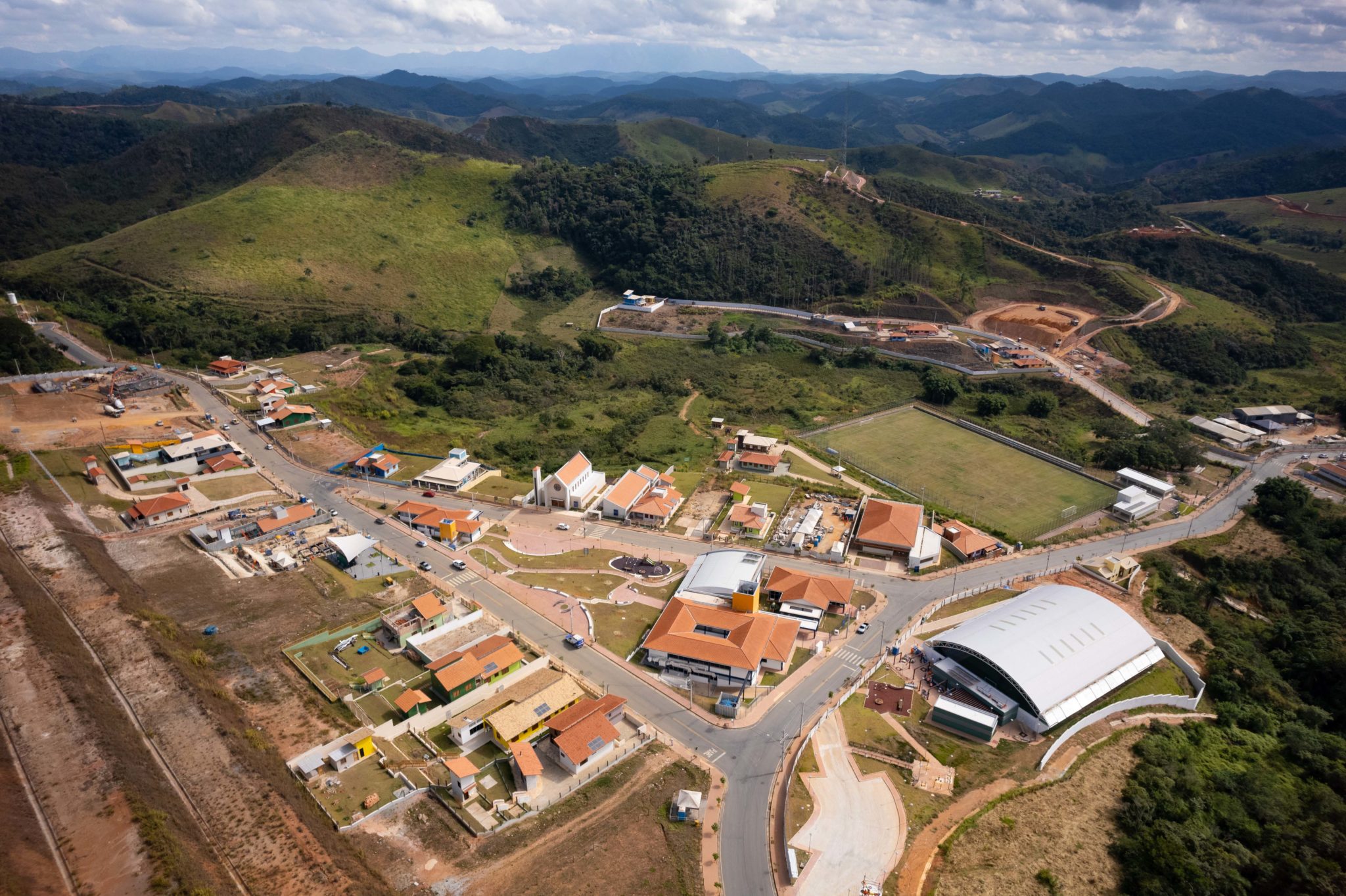
We waited as small dramas unfolded. After about ten minutes, they let us move. We drove slowly upwards and over and through the dust. It felt like we were passing into another world. Then before us was modernity. A new village. Novo Bento Rodrigues. Not shiny. Covered in dust. New roads, schools, shops, houses, a community center. When I looked up Novo Bento Rodrigues on Google Maps it had 163 reviews and an average rating of 4.3 out of 5. Why so many positively glowing reviews for a village that hadn’t even been fully built yet? The old Bento Rodrigues has no reviews. In fact, neither Mariana nor Ouro Preto, much larger towns, has any reviews either. Belo Horizonte, the state capital, the sixth-largest city in Brazil, with a population of 2.7 million people, had no reviews on Google Maps, yet Novo Bento Rodrigues had 163. Why would a village that wasn’t even inhabited, that had no time for memories to form, be so glowingly reviewed? It’s Google’s world, a world riddled with fake news and content. A world of AI lies and manipulation. Manufactured reality. At Google, they make it, and they fake it, in collaboration, of course, with marketers and branders and scammers and propagandists. When I scanned down the reviews I saw phrases like: “Getting perfect. First world thing;” “It will be wonderful to live here;” “Awesome place;” “Extremely beautiful, pleasant and very well-planned place.” Only very occasionally did I read a reference as to why Novo Bento Rodrigues was being built.
When we were planning the trip to Bento Rodrigues, people told us that we would not be allowed enter either the new or the old village. We were told we must contact the mining company for permission. We did and heard nothing back. Then we met a friendly tour guide, and she said she knew a driver would take us there without any problem. Although there was some security, and Juscelino’s driving license was checked, there were no major interrogations. It was all friendly. We drove through the new village still being born out of concrete, stopping once to ask for directions to the old village, because even though Juscelino had spent his life driving in this countryside, he had not driven these roads because they were new.
Bento Rodrigues
A little outside Novo Bento and the familiarity came back. Juscelino knew this road well, though it was now redder and more silent and deeply potholed. And then, a few kilometers further, it changed again into something new, some new direction being gouged out of the land. The hillsides now menaced above us with loose clay and stones. This place was not ready. We kept going anyway, not sure what to expect next. It must have been five more kilometers until we came around another tight bend and saw the two gaunt horses. Up ahead was another checkpoint. Juscelino had to beep the horn to get attention. The young, bored security guard was friendly and indifferent and gave us the directions that he said would lead us to what remained of the village. We drove along a new stone and gravel road and saw some more horses to our right and then a family of capivara (capybara), a large rodent, whose main habitat is rivers, lakes and swamps. It reminded me of a visit Rosilda, her family, and myself had made to the Capivara National Park in the Piauí state in the north-east of Brazil, where some of Rosilda’s relatives came from. Because of the drying climate, capivaras had gone extinct there, though the park still kept their name.
As we drove slowly over the gravel and stones, Juscelino pointed up to the mountains. There was a mining dump and a water dam up there, he told us. On November 5, 2015, the Fundão mining dump from the Germano mine collapsed and a mud avalanche thundered into the dam water underneath with tremendous force, liquefying and becoming a tidal wave of sludge. Forty-four million tons or almost 18,000 Olympic-size swimming pools of toxic sludge swept through Bento Rodrigues and then hit a choke point in the land, resulting in a huge backsplash that suffocated and submerged much of the village. As we listened to Juscelino, we drove past where the village used to be and where there now was a lake. We went a little further until we came to the raging red Gualaxo do Norte river.
It was one of the largest recorded dump collapses in modern history. Killing the river as it went, the iron oxide mud flooded down the Gualaxo do Norte and then into the larger Doce river, and then for another 700 km all the way to the Atlantic Ocean. It traveled twice as far as the previous record for mining mudflows in South America. An estimated 1.6 million people were affected and incalculable amounts of wildlife. “The social structure of this region has been turned upside down,” said Joca Thomé, a resident of Regência, a coastal village. The families that lived off fishing could no longer fish because nobody wanted to buy the fish from a diseased river. The tourism industry collapsed, except for a few disaster tourists who came to gawk.
With the still-raging red Gualaxo do Norte blocking us, there was no way to get to what remained of the old village by this route. Juscelino turned the car, and we drove back towards the checkpoint. Mining gave him everything and he was proud of the life he had lived. He told us of a friend of his who was from Bento. A small farmer with animals and gardens who lost everything. We drove past the checkpoint without seeing the bored young security guard and found our own way to a bridge that brought us across the water and to the part of the village that remained unsubmerged. Almost like a normal place. You could expect to see children coming out of the still colorful community and sports center, or to see a door open and someone leave the barbershop. Normal, except there were signs of red mud everywhere. Up high on the walls of the remaining houses, the tidal wave of mining mud had done its paint job. It started to rain and Juscelino’s mood changed. He wanted to leave, saying that it “wasn’t good” to be around there any longer.
99th Day: A Warning About Technology is also available to order from the Hot Press shop now:


