
- Music
- 25 Sep 26
U2: The first Hot Press cover interview








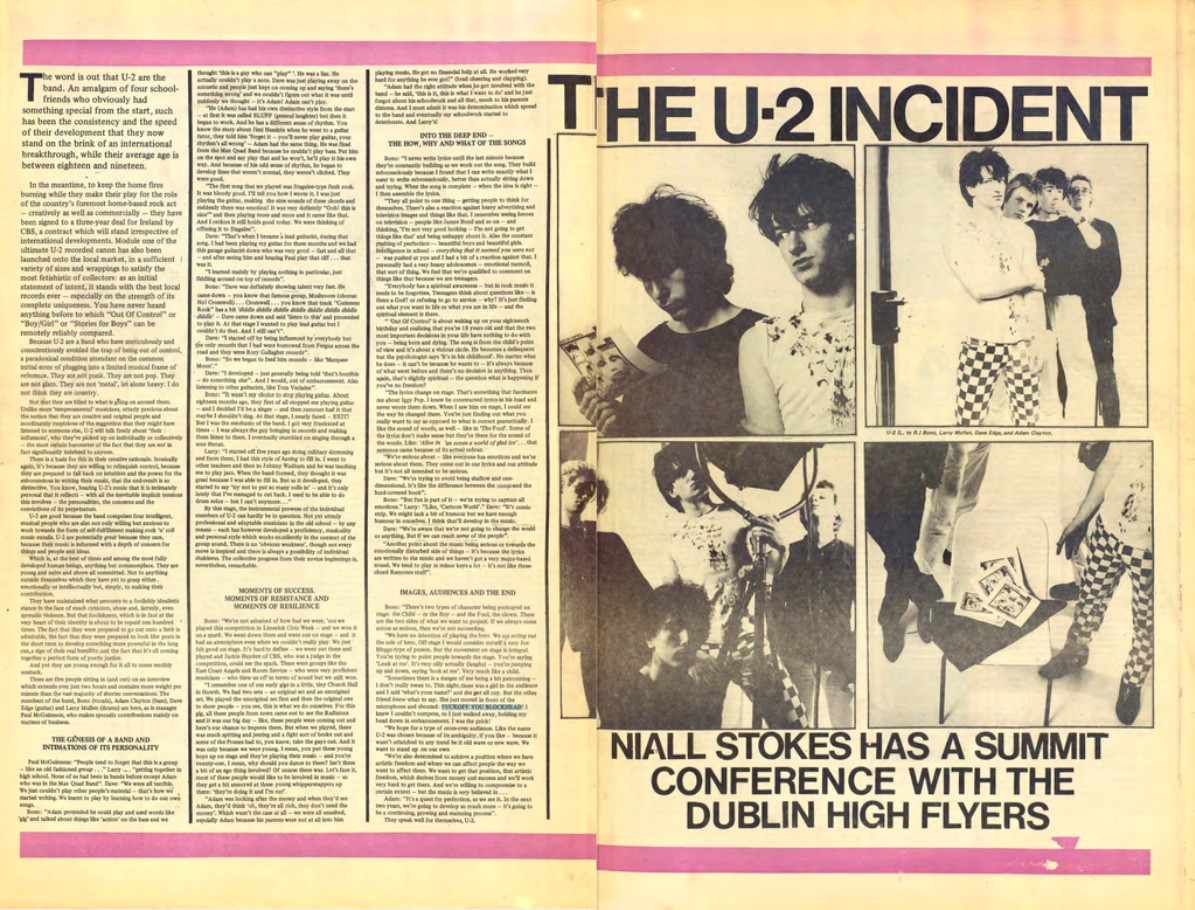
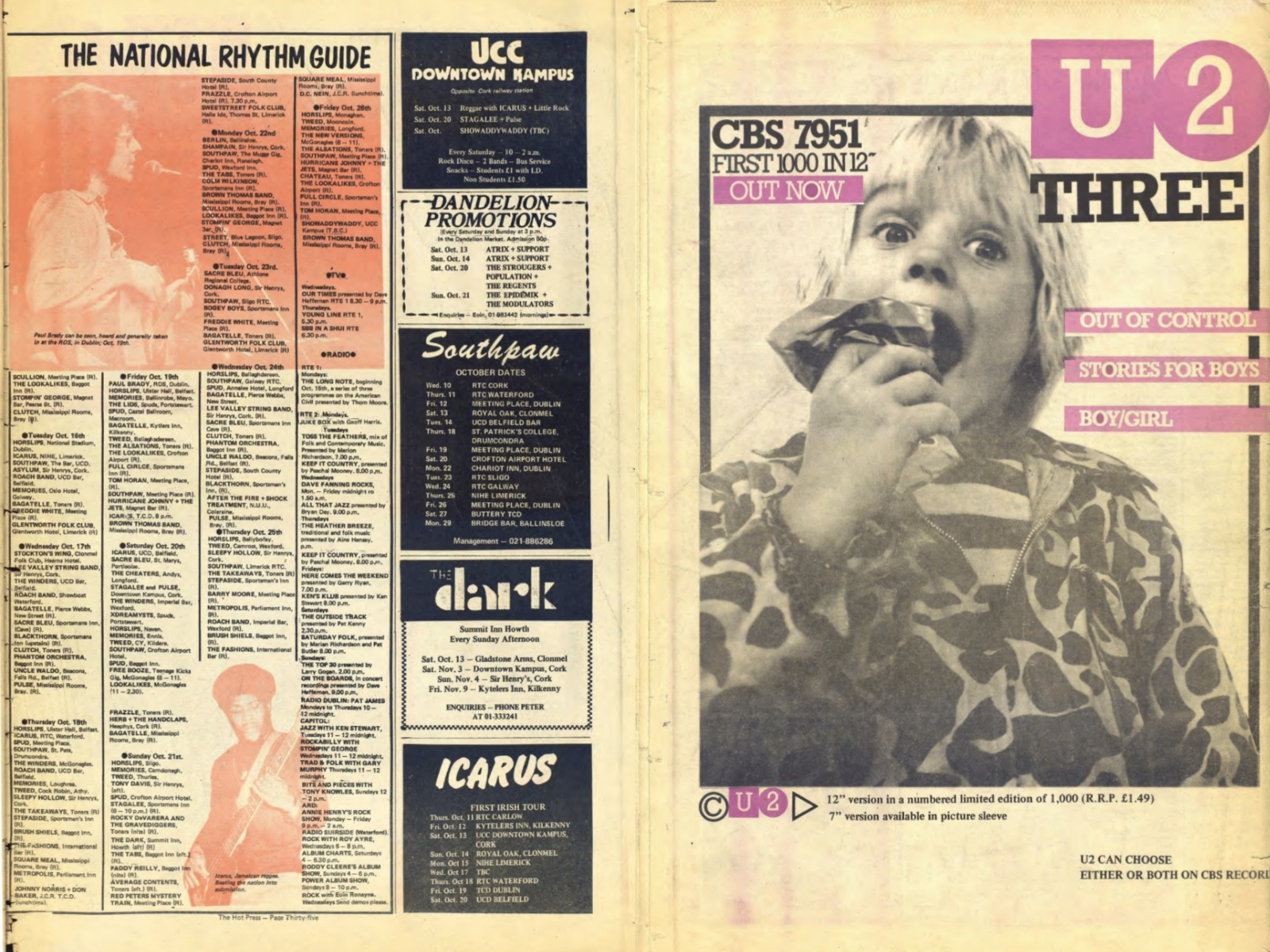
The interview was timed to coincide with the release of U2 Three, the band's first EP release. At the time, the subheadline was succinct. Niall Stokes, we explained, has a summit conference with the Dublin high-flyers. There was a strong sense that this was the beginning of something big. And look how it turned out!
The word is out that U2 are the band. An amalgam of four school friends who obviously had something special from the start, such has been the consistency and the speed of their development that they now stand on the brink of an international breakthrough, at an average age of less than nineteen.
In the meantime, to keep the home fires burning while they make their play for the role of the country's foremost rock act - creatively as well as commercially - they have been signed to a three-year deal for Ireland by CBS, a contract which will stand irrespective of international developments.
Module one of the ultimate U2 recorded canon has also been launched onto the local market, in a sufficient variety of sizes and wrappings to satisfy the most fetishistic of collectors: as an initial statement of intent, it stands with the best local records ever. Its crucial strength is its startling uniqueness: you have never heard anything before to which 'Out Of Control' or 'Boy/Girl' or 'Stories for Boys' can be remotely reliably compared.
Because U2 are a band who have meticulously and conscientiously avoided the trap of being out of control, a paradoxical condition attendant on the common initial error of plugging into a limited musical frame of reference. They are not punk. They are not pop. They are not glam. They are not "metal", let alone heavy. They are hardly country!
Not that they are blind to what is going on around them. Unlike more "Temperamental" musicians, utterly precious about the notion that they are creative and original people and inordinately suspicious of the suggestion that they might have listened to someone else, U2 will talk freely about their influences, who they've picked up on individually or collectively - the most certain barometer of the fact that they are not significantly indebted to anyone.
There is a basis for this in their creative rationale. Ironically again, it's because they are willing to relinquish control. After all, they are prepared to fall back on intuition and the power of the subconscious in writing their music and their lyrics, so that the end-result is so distinctive. You know hearing U2's music that it is intimately personal, that it reflects - with all the inevitable implicit tensions this involves - the personalities, the concerns and the convictions of its perpetrators.
U2 are good because the band comprises four intelligent, musical people who are not only willing but anxious to work towards the form of self-fulfilment that making rock ‘n’ roll music entails. U2 are potentially great because they care, because their music is informed with a depth of concern for things and people and ideas. Which is, even at the best of times, anything but commonplace.
They are young and naïve and above all committed. Not to anything outside themselves which they have yet to grasp either emotionally or intellectually but, simply, to making their contribution. They have maintained what amounts to a foolishly idealistic stance in the face of much cynicism, abuse and, latterly, even sporadic violence. But that foolishness, which is in fact at the very heart of their identity, is about to be repaid one hundred times.
The fact that they were prepared to go out onto a limb is admirable; the fact that they were prepared to look ‘silly’ in the short term to develop something more powerful in the long run, a sign of their real humility; and the fact that it’s all coming together is a perfect form of poetic justice. And yet they are young enough for it all to come terribly unstuck.
There are five people sitting in (and out) on an interview, which extends for over two hours and contains more weight per minute than the vast majority of shorter conversations. The four members of the band, Bono (vocals), Adam Clayton (bass), Dave Edge (guitar) and Larry Mullen (drums) are here, as is manager Paul McGuinness, who makes sporadic contributions, mainly on matters of business.
THE GENESIS OF A BAND AND ITS PERSONALITY
Larry: “Getting together in high school, none of us had been in bands before except Adam, who was in the Max Quad Band.”
Dave: “We were all terrible. We just couldn’t play other people’s material – that’s how we started writing. We learnt to play by learning how to do our own songs.”
Bono: “Adam pretended he could play and used words like ‘gig’ and talked about things like ‘action’ on the bass, and we thought this is a guy who can play! He was a liar. He actually couldn’t play a note. Dave was just playing away on acoustic, and people kept on coming up and saying, ‘there’s something wrong’, and we couldn’t figure out what it was until suddenly we thought – it’s Adam! Adam can’t play.
“He (Adam) has had his own distinctive style from the start – at first it was called BLUFF (general laughter), but then it began to work. And he has a different sense of rhythm. You know the story about Jimi Hendrix when he went to a guitar tutor, they told him, ‘forget it – you’ll never play guitar, your rhythm’s all wrong’ – Adam had the same thing. He was fired from the Max Quad Band because he couldn’t play bass. Put him on the spot and say play that and he won’t, he’ll play it his own way. And because of his odd sense of rhythm, he began to develop lines that weren’t normal, they weren’t clichéd. They were good. The first song that we played was Stagalee-type funk rock. It was bloody good. I’ll tell you how I wrote it. I was just playing the guitar, making the nice sounds of these chords, and suddenly there was emotion! It was very definitely, ‘Ooh! this is nice’ and then playing more and more and it came like that. And I reckon it still holds good today. We were thinking of offering it to Stagalee.”
Dave: “That’s when I became a lead guitarist, during that song. I had been playing my guitar for three months, and we had this garage guitarist down who was very good – fast and all that – and after seeing him and hearing Paul (Bono) play that riff... that was it. I learned mainly by playing nothing in particular, just fiddling around on top of records.”
Bono: “Dave was definitely showing talent very fast. He came down – you know that famous group Mushroom (chorus: No! Cromwell) ... Cromwell ... you know that track ‘Guinness Rock’ has a bit – diddle diddle diddle diddle diddle diddle diddle diddle – Dave came down and said, ‘listen to this’ and proceeded to play it. At that stage I wanted to play lead guitar, but I couldn’t do that. And I still can’t. “
Dave: “I started by being influenced by everybody, but the only records that I had were borrowed from Fergus across the road, and they were Rory Gallagher records.”
Bono: “So we began to feed him records – like Marquee Moon.”
Dave: “I developed – just generally being told, ‘that’s horrible – do something else’. And I would, out of embarrassment. Also listening to other guitarists, like Tom Verlaine.”
Bono: “It wasn’t my choice to stop playing guitar. About eighteen months ago, they first of all stopped me playing guitar – and I decided I’d be a singer – and then rumours had it that maybe I shouldn’t sing. At that stage, I nearly faced – EXIT! But I was the mechanic of the band. I got very frustrated at times – I was always the guy bringing in records and making them listen to them. I eventually stumbled on singing, through a sore throat.”
Larry: “I started five years ago doing military drumming and from there, I had this style of having to fill in. I went to other teachers and then to Johnny Wadham, and he was teaching me to play jazz. When the band formed, they thought I was great because I was able to fill in. But as it developed, they started to say, ‘try not to put so many rolls in’ – and it’s only lately that I’ve managed to cut back. I used to be able to do drum solos – but I can’t anymore...”
By this stage, the instrumental prowess of the individual members of U2 can hardly be in question. Not yet utterly professional and adaptable musicians in the old school – by any means – each has however, developed a proficiency, musicality and personal style which works excellently in the context of the group sound. There is no obvious weakness, though not every move is inspired and there is always a possibility of individual shakiness. The collective progress from their novice beginnings is, nevertheless, remarkable.
MOMENTS OF SUCCESS, MOMENTS OF RESISTANCE & MOMENTS OF RESILIENCE
Bono: “We’re not ashamed of how bad we were, ‘cos we played this competition in Limerick Civic Week – and we won it on a spark. We went down there, and we went out on stage – and it had an atmosphere even when we couldn’t really play. We just felt good on stage.
“It’s hard to define – we went out there and played – and Jackie Hayden of CBS, who was a judge in the competition, could see the spark. There were groups like the East Coast Angels and Room Service – who were very proficient musicians – and blew us off in terms of sound, but we still won.
“I remember one of our early gigs in a little, tiny Church Hall in Howth. We had two sets – an original set and an unoriginal set. We played the unoriginal set first and then the original one to show people – you see, this is what we do ourselves. For this gig, all these people from town came out to see the Radiators, and it was our big day – like, these people were coming out and here’s our chance to impress them. But when we played, there was much spitting and jeering, and a fight sort of broke out, and some of the Prunes had to, you know, take the guys out.
“And it was only because we were young. I mean, you put these young boys up on stage, and they’re playing their music – and you’re twenty-one. I mean, why should you dance to them? Isn’t there a bit of an ego thing involved? Of course there was. Let’s face it, most of these people would like to be involved in music – so they get a bit annoyed at these young whippersnappers up there: ‘they’re doing it, and I’m not’.
“Adam was looking after the money, and when they’d see Adam, they’d think, ‘Oh, they’re all rich, they don’t need the money’. Which wasn’t the case at all – we were all smashed, especially Adam because his parents were not at all into him playing music. He got no financial help at all. He worked very hard for anything he ever got! (loud cheering and clapping).
“Adam had the right attitude when he got involved with the band – he said, ‘This is it, this is what I want to do,’ and he just forgot about his schoolwork and all that, much to his parents’ distress. And I must admit it was his determination which spread to the band and eventually my schoolwork started to deteriorate. And Larry’s!”
INTO THE DEEP END THE HOW, WHY AND WHAT OF THE SONGS
Bono: “I never write lyrics until the last minute because they’re constantly building as we work out the song. They build subconsciously because I found that I can write exactly what I want to write subconsciously, better than anything sitting down and trying. When the song is complete – when the idea is right – I then assemble the lyrics.
“They all point to one thing – getting people to think for themselves. There’s also a reaction against heavy advertising and television images and things like that. I remember seeing heroes on television – people like James Bond and so on – and thinking, ‘I’m not very good looking – I’m not going to get things like that’ and being unhappy about it. Also the constant pushing of perfection – beautiful boys and beautiful girls. Intelligence in school – everything that it seemed you were not – was pushed at you, and I had a bit of a reaction against that. I personally had a very heavy adolescence – emotional turmoil, that sort of thing. We feel that we’re qualified to comment on things like that because we are teenagers.
“Everybody has a spiritual awareness – but in rock music it tends to be forgotten. Teenagers think about questions like – is there a God? Or refusing to go to service – why? It’s just finding out what you want in life or what you are in life – and the spiritual element is there.
“‘Out of Control’ is about waking up on your eighteenth birthday and realising that you’re 18 years old and that the two most important decisions in your life have nothing to do with you – being born and dying. The song is from the child’s point of view, and it’s about a vicious circle. He becomes a delinquent, but the psychologist says, ‘it’s in his childhood’. No matter what he does – it can’t be because he wants to; it’s always because of what went before, and there’s no decision in anything. Then again, that’s slightly spiritual – the question ‘What is happening, if you’ve no freedom?’
“The lyrics change on stage. That’s something that fascinates me about Iggy Pop. I knew he constructed lyrics in his head and never wrote them down. When I saw him on stage, I could see the way he changed them. You’re just finding out what you really want to say as opposed to what is grammatically correct. I like the sound of words, as well – like in ‘The Fool’ some of the lyrics don’t make sense but they’re there for the sound of the words. Like: ‘Alive in an ocean a world of glad ice’... that sentence came because of its actual colour.
“We’re serious about... like, everyone has emotions and we’re serious about them. They come out in our lyrics and our attitude but it’s not at all intended to be serious.”
Dave: “We’re trying to avoid being shallow and one-dimensional. It’s like the difference between the comic and the hard-covered book.”
Bono: “But fun is part of it – we’re trying to capture all emotions.”
Larry: “Like ‘Cartoon World’.”
Dave: “It’s a comic strip. We might lack a bit of humour, but we have enough humour in ourselves. I think that’ll develop in the music. We’re aware that we’re not going to change the world or anything. But if we can reach some of the people...”
IMAGES, AUDIENCE & THE END
Bono: “There’s two types of character being portrayed on stage: the Child – or the Boy – and the Fool, the Clown. These are the two sides of what we want to project. If we always come across as serious, then we’re not succeeding.
“We have no intention of playing the hero. We are acting out the role of hero. Off-stage, I would consider myself a very Joe Bloggs-type of person. But the movement on stage is integral. You’re trying to point people towards the stage. You’re saying ‘Look at me’. It’s very silly (laughs) – you’re jumping up and down, saying ‘Look at me’. Very much like a child.
“Sometimes there is a danger of me being a bit patronising – I don’t really mean to. This night there was a girl in the audience and I said, ‘What’s your name?’ and she got all coy. But the other friend knew what to say. She just moved in front of the microphone and shouted: ‘FUCK OFF YOU BLOCKHEAD!’ I knew I couldn’t compete, so I just walked away, holding my head down in embarrassment. I was the prick!
“We hope for a type of cross-over audience. Like the name U2 was chosen because of its ambiguity, if you like – because it wasn’t attached to any trend, be it old wave or new wave. We want to stand up on our own.
“We’re also determined to achieve a position where we have artistic freedom and where we can affect people the way we want to affect them. We want to get that position, that artistic freedom, which derives from money and success and we’ll work very hard to get there. And we’re willing to compromise to a certain extent – but the music is very believed in…
Adam: “It’s a quest for perfection, as we see it. In the next two years, we’re going to develop so much more – it’s going to be a continuing, growing and maturing process.”
They speak well for themselves, U2.
- Becoming U2, by Brian O’Connell, tells the extraordinary story of the night that the four-piece from the Northside of Dublin played their first ever official gig as U2, in a band competition – and won! – thereby changing the course not just of Irish music but of popular music across the world. Becoming U2 is published by Hot Press Books. The hardback is available exclusively from the shop on hotpress.com.
RELATED

- Music
- 23 Sep 26
U2 announce title of next album and new single

- Music
- 22 Sep 26
U2: The First Article in Hot Press, 1978

RELATED

- Music
- 13 Aug 26
Hot Press Announces Publication of Becoming U2

- Music
- 25 Sep 26
Album Review: Nothing But Thieves, Stray Dogs

- Music
- 25 Sep 26
Dolly Parton to posthumously feature on U2 song 'Torn'


- Competitions
- 25 Sep 26
WIN: Tickets to OLD TOWN - The Songs of Phil Lynott at the National Concert Hall

- Competitions
- 25 Sep 26