
- Music
- 04 May 26
Rónán Ó Snodaigh & Myles O’Reilly on Mise Tusa: "Songs open gates into whole worlds"








As they release their brilliant third album, Mise Tusa, Rónán Ó Snodaigh & Myles O’Reilly take Will Russell through their creative process.
In 1919, Eoin MacNeill pushed back against the idea of Ireland as something broken or interrupted. In Phases Of Irish History, he reframes our story as a continuum rather than a sequence of ruptures. Christianity and later Anglo-Norman influence are seen as layers absorbed into an existing system.
Even the Vikings – so often reduced to agents of destruction – are reconsidered as participants in the shaping of early urban and economic life. In MacNeill’s view, nothing is simply preserved, and nothing is wholly lost; each new layer alters the structure even as it is absorbed by it.
That same sense of accumulation – of forms being folded, re-voiced, and made to live again from within – runs through Mise Tusa, the third album from Rónán Ó Snodaigh and Myles O’Reilly.
Mise Tusa suggest continuity. As if it might have emerged a century ago – or might indeed be heard a century from now. There’s something ancestral in it, certainly, but also something searching, unsettled. The record doesn’t reconstruct a tradition; it inhabits one, and in doing so, carries it forward.
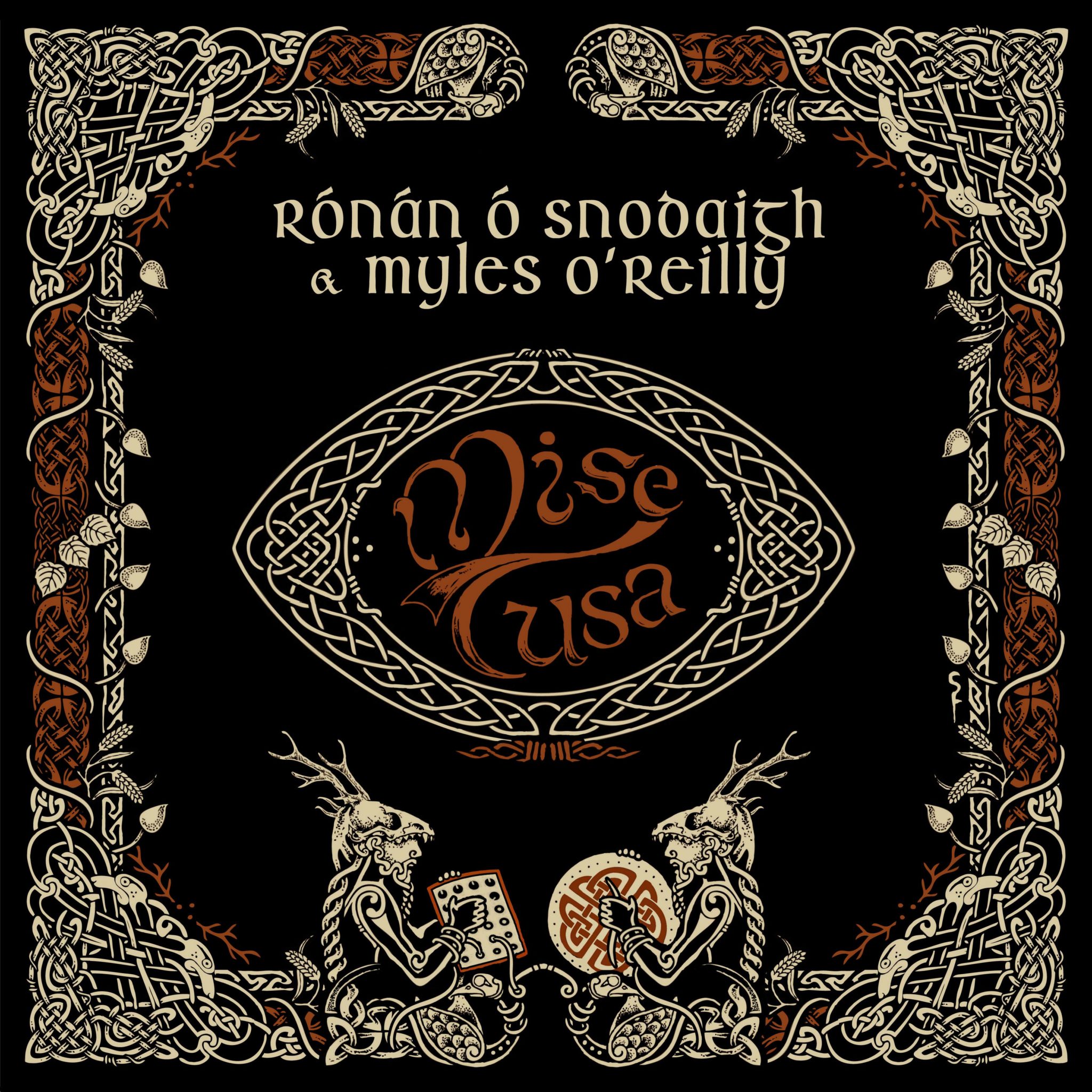
One only needs to consider the title track. A psychedelic reel to lose yourself in.
“Deadly,” Myles succinctly replies.
“Oh, you like that?” Rónán queries.
And we’re off into wonderful detail about the creation of this exquisite album.
“I thought I’d overcooked it,” Rónán continues, “because conceptually I put in such a shift on what we were at. I was really upset when the Israelis started bombing the Gazans. The lack of mercy really got to me. With that track, ‘Mise Tusa’, I was so offended by what I was witnessing, I perceived it as something like the weird psycho films in the future where people haven’t got feelings.
“So, I was trying to imagine, what if that was me? I was trying to imagine, if I was an Israeli, how would I feel about this being done in my name? I spent ages ripping myself apart trying to imagine it. I made myself sick, is what I was doing.”
EXPLORATORY TEXTURE
Elsewhere, the exploratory texture on opening track ‘Cúl and Tigh’ is opulent. On Seán Mac Fhearais’ ‘Anseo I Lár an Ghleanna’, meanwhile, you’re drawn into the chase – the thunder of hooves, the breathless flight – as Myles opens a rather wonderful box of restless, evocative sounds, conjuring a dash across the glen with redcoats close behind in the penal years.
“I nerd out,” Myles explains. “I flake off for hours with those sounds. Essentially Rónán had something started on the bodhrán, on the guitar, and from there we build the sonics. Sometimes we go too far and reel it back a little bit. It’s always a very enthusiastic process from both of us; we don’t ever come across any hurdles.”
“It’s what something suggests,” Rónán expands, “and then after you go to that suggestion, you’re at a different point of view, then you’re on to another suggestion. So it’s hard to map out exactly how you get from A to B.”
“A marker, for me,” Myles explains further, “is, if Rónán starts a track on the guitar, and at some point we’ve layered enough interesting sounds that get along with each other, that we can actually pull out the guitar from the mix and it doesn’t affect the song – that’s a great success.”
The idea of a composition shaped by absence at its core is fascinating. Can you dig deeper into that?
“Well, our spirit is very much like when we met,” Myles conveys. “We used to sit around kitchen tables with our buddy Bernie in Kerry, and we watched YouTube videos of deadly tracks, and that’s very much what our process feels like. It feels like a bit of a session around in Rónán’s gaff and we’ll always leave with a tune.”
What sort of stuff were you listening to?
“Personally,” Myles says, “I’m into the sonics of generative and minimal ambient music, most notably Jon Hopkins, or A Winged Victory For The Sullen and Kyle Bobby Dunn. I’m really into those sonic things where one note can express a lot of texture. That’s the kind of stuff that I have on in the background that affects my mood.”
“That’s a good idea,” Rónán agrees. “It gradually affects everyone around his mood, which is more settled. There’s things I listen to, not that I try to mimic them, but they’re parts of my mental landscape. Like in this album, there’s a lot of songs I did that are not my songs; I wanted to map out something.”
Tell me more about that – for example, the version of Jinx Lennon’s ‘We Don’t See Anything’ is artfully different to the original.
“I’m glad you noticed that,” Rónán replies. “Songs open gates for me and my memory bank, they open into worlds that I know and have spent time in. We did ‘Réir Dé’, which comes from Ó Riada, and that’s another gateway into a whole world.”
The supplication of the Seán Ó Riada track settles gently, unfolding as a quiet, enduring blessing.
SOMETHING SACRED
“That’s exactly how I’m treating it,” Rónán agrees. “It’s a prayer. But most of these songs I’ve had in my head, or I’ve been singing to myself for the last 20-plus years. I know that one from when I was a young fella. I rang Peadar Ó Riada to get permission, I hope he likes my version of it. There’s a tiny little poly rhythm going on between me feet, the bodhrán and the song, the three of them kind of triangulate. I don’t know what the word is, but you get a little bit crosseyed.”
At Shane MacGowan’s funeral, when Peadar Ó’Riada’s choir Cór Cúil Aodha rose in song, it was something sacred and utterly unforgettable.
“I feel what Ó Riada is at,” Rónán replies, “is probably the closest to what I believe is pure gold, in the whole country. Beyond all the other brilliant songwriters and singers, what he’s doing – if I close my eyes, I see blackthorns, hawthorns, wiggly hills. I get really full. He’s got it bang on at what he’s at down there.”
This record is suffused with an ancient sense of Irishness, but also feels modern.
“We’re in the middle of it,” Rónán simply states. “We are it. That’s the thing – by doing it, you re-establish your contact, or by listening to Ó Riada or the ambient stuff that Myles was talking about. It shifts your vibration. For me, I don’t see the benefit of straying away from the supporting root system of what we have, even though I’m a futurist, and I want to see into the future."
On Mise Tusa, every second is delivered with careful artistry, down to the pollinating bee and creaking gate at the end of Ger Wolfe’s ‘The Crackling Radio’.
“I’m really glad you listened to it so carefully. Those bees are Manchán Magan’s bees,” Rónán relates.
Myles adds, “Rónán recorded them for Manchán and sent them to him in his last days.”
• Mise Tusa is out on May 1. Rónán Ó Snodaigh & Myles O’Reilly play Vicar Street, Dublin on November 5.
RELATED

- Music
- 01 May 26
Album Review: Rónán Ó Snodaigh & Myles O'Reilly, Mise Tusa

- Pics & Vids
- 22 Jul 24
Joy In The Park Festival 2024

- Lifestyle & Sports
- 14 Jul 22
Joy In The Park to be held in Cork's Fitzgerald's Park this weekend
RELATED


- Culture
- 21 Sep 21
John Francis Flynn to play the Feakle Folk Club this Friday


- Music
- 30 Aug 21
Track of the Day: Martin Leahy - 'Brian'

- Music
- 26 Apr 21
Martin Leahy's new single ‘The Wolves In The Valley’ out now

- Music
- 28 Sep 26