
- Music
- 18 Nov 26
Queens Of The Stone Age: “Josh does have a strong vision coming into things, he has ideas. They don’t always stick, and they morph and change as ideas do”


As Queens Of The Stone Age return with the brilliant Perfecth, bassist Mikey Shuman discusses co-producing the album, massive stadium shows with Foo Fighters, the band’s kinship with Nine Inch Nails, the influence of Iggy Pop and more.
Queens Of The Stone Age are back with their first studio album in three years, Perfecth, another brilliant mix of the band’s trademark electrifying rock with mellower acoustic moments, as exemplified by the wonderful lead single ‘Easy’. When I catch up with QOTSA bassist Mikey Shuman, the group are in Edmonton in Canada, where they’re currently in the midst of one of the most exciting tours of the year – a stadium excursion with their good friends Foo Fighters.
Mikey is slightly late for our interview, and in a satisfyingly rock star-like explanation, it turns out he was taking a sauna. Suitably relaxed and settled in for the chat, he opens by reflecting on the Foos tour.
“It’s been great, it’s nice to play with friends,” he enthuses in his Californian baritone.
“Supporting bands is weird, we don’t do it very often. But it’s also really fun and a challenge to try and win people over, especially at that magnitude – you’re playing a stadium and trying to bring tens of thousands onboard. Of course, there’s a crossover with our bands, but it’s a humbling experience too.”
STRONG OPINIONS
Notably, Shuman is credited as co-producer of Perfecth along with frontman Josh Homme. How did he find the experience?
“Well, it’s not like we walked into it being like, ‘Okay, me and Josh are gonna produce this thing’,” he considers. “The last four records, we’ve all really produced. It’s just five guys with strong opinions and a lot of ideas, who know how to make their way in the studio. With producing, it’s also about how to deal with people. On this particular record, it just became a lot of Josh and I exploring themes, especially lyrically.”
At this point, Shuman takes a brief pause to further ruminate on the subject, then resumes.
“I don’t know, it’s just funny with producing,” he continues. “It’s funny this is the first record where I get my name on it, we’ve all been doing the role. There are so many versions of producing too. In modern music, it’s different to how it was back in the ’50s and ’60s. The producer would choose the studio, get all the musicians together, and basically make the best supporting cast for the artist. Whereas now, it can be, ‘I made a kick and snare beat, and I’m a producer on a hip hop record.’
“It’s all just different. But anyway, it feels good to be recognised for so much fucking work! (laughs) I slave over this thing, I think about it all day for a year. But it’s just because me and Josh work so closely together every day.”
In terms of the lyrical themes on Perfecth, although it feels beaten down at times, there is also the kind of lust for life Queens have traditionally exuded.
DEVASTATING AND BRUTAL
“Our last record, Times New Roman, was much more devastating and brutal,” suggests Shuman. “It had a somewhat pessimistic outlook on life – this one is more optimistic about the future. Josh has written a lot about love, but maybe it’s been masked in different ways. On this record, it was just about love, family, friendship and acceptance. And getting past fear to live a more authentic and freeing life. The main thing was stripping away any kind of mask and metaphor that might be used.
“Just say the words as they are and how you truly feel, and how you would say them maybe to me. It was a big struggle, and there were a lot of exercises to do that, because it felt weird for him to do so. I had to push him to be like, ‘It’s okay to do that. If that’s what you really wanna say, and that’s what’s most authentic to you, just fucking do it.’ And I explained that this will connect with people more so than ever before.”
One of the highlights is ‘Sunday’, a song that had previously featured on Iggy Pop’s 2016 album, Post Pop Depression, which Homme produced.
“Iggy wrote the lyrics, but Josh had the music, which he originally was gonna hold back because it’s so good,” Shuman explains. “It was my favourite song on that album too, so it was the two of them, and Dean [Fertita] put his stuff on that record as well.”
In the way it captures how empty the titular day can feel, ‘Sunday’ has a notable bleakness, albeit undercut with a kind of flinty defiance. In both its QOTSA and Iggy iterations, it’s one of the best things either artist has ever done.
“I don’t know Iggy very well,” Shuman reflects. “I’ve been out with him sometimes, but not personally like the other dudes, touring and making a record with him. But as a fan, just like the way Josh has done on our record, he took a similar approach on the chorus – it’s pretty fucking straight up, he’s not hiding anything. He’s talking about Sunday and what it means to him, and being able to be free and letting go.
“It’s a little bleak, but it’s uplifting too in other regards, in the dichotomy between the verse and the chorus. I think Iggy did the same – maybe as he grew older, he was willing to say things he might not say in the past either.”
TERRIFIC SLEEVE
Perfecth boasts another terrific sleeve, with a blurred image of the band members surrounding Homme, who’s been through the ringer in recent years through various health and personal issues. Indeed, the imagery of QOTSA has always been one of their major strengths, with the band delivering a series of classic album covers and gig posters over the years, often with a certain horror aesthetic. Is it an aspect Homme always has strong views on, or do all of the band contribute?
“We all chip in,” explains Mikey. “Josh does have a strong vision coming into things, he has ideas. They don’t always stick, and they morph and change as ideas do, and that’s okay. He gets very excited about something and he’ll go on tangents about them to me for hours. But then they evolve, it’s like making a film. You have a script and you think it’s going to be one thing, and it grows in so many different ways, based on the collaborators you bring into the fold.
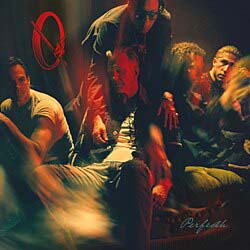
“The cinematographer has a vision, the director has a vision, and then you have the production designer and the actors themselves. There’s also how the editor puts it all together. I see it like that, but Josh does come in with the idea and vision. As far as art, on the last three records, we let [Liverpool artist] Boneface take the reins. He came into the studio with us. We flew him out to LA, and he sat with us while we were making the record.
“Then we gave him free reign to make his art. So in that regard, it’s influenced and inspired by us, but we love other art and we want to collaborate with people in that way. On this one, there was a discussion about specifically having us on the cover, which we’ve never done.”
The sleeve has a notably dreamy, washed out quality. How does Mikey interpret it?
“The main idea was, on this record, we wanted to get across being as human as possible – to communicate this is the most authentic record we’ve made,” he says. “Not in, like, fighting against technology, but maybe in a slight response to it. Just seeing how it is, and being like, ‘Okay, let’s do what we do best, what we love to do.’ Which I think makes us different than some other bands in our space, and some of our peers. It was just time – it was time for us to make this record and finally be on the cover.”
RIFF-DRIVEN MASTERPIECES
Now 30 years on the go, Queens Of The Stone Age made their bones with pulverising, riff-driven masterpieces like Rated R and Songs For The Deaf. Perfecth shows another side to the band, leaning more into their acoustic side at times. Mikey sees it as all being an essential part of the QOTSA package.”
“Well, it’s funny, going back, I’ve never been into metal,” he says. “I guess metal can be defined in different ways, but I’ve never been a metal person, and all of us really come from punk rock. So even when I became a Queens fan when I was 16, I saw it as not metal – I saw it as this different version of heavy that’d I’d never heard before. I always saw the multiple personalities and different sides of the band.
“Songs For The Deaf was the first record I got, and just those three different voices – I couldn’t figure out what the fuck was going on between Mark, Nick and Josh. That was showing there were many different sides of this band. Then you go back to the earlier stuff like Rated R – that’s the second record and there are many mellow songs. All of the records have them, I just think they’ve been overlooked by the songs people focus on or identify us with.
“They might have looked over that other side of the group, but it’s always been there. The other thing I always think about is Led Zeppelin III – there are rockers on it, but there are a bunch of fuckin’ acoustic songs. And no one gives them shit!”
I ask Shuman – who joined the band in 2007 – about the influences on hard rocking, early QOTSA tunes like ‘Mexicola’, and if Black Sabbath would have been a primary inspiration. I’m ready for a deep dive, filled with technical detail and anecdotal digression, but the bassist is more concise in his analysis.
“Shit man, I don’t know,” he shrugs. “You’d need to talk to Josh – that song was written in, like, fuckin’ 1999.”
There goes my 33 1/3 tome on the subject. Chuckling heartily, Shuman resumes his thoughts.
“Who knows?” he says. “When I was young, I was in a hardcore band, and now I can’t really imagine playing that music personally, even though I might listen to it, enjoy it and be nostalgic for it. It’s just a different time in your life. Talking about ‘Mexicola’, it’s 27 years later and I’m not really sure where that came from. We all love heavy music, but I don’t have the answer for that.”
HOT STREAK
Shuman joined the group around the release of Era Vulgaris, which followed hot on the heels of their Rated R / Songs For The Deaf / Lullabies To Paralyze hot streak.
Era Vulgaris was based around more berserk, skewed guitar riffs, allied to jerky new wave rhythms with hints of Devo. Some fans were puzzled by the departure, but personally, I’ve always seen it as an absolute classic. What’s Shuman’s take?
“I joined when they were finishing it,” the bassist recalls. “So I only recorded b-sides and so on. But I remember hearing it, because they played it for me when I joined. I was like, ‘This is a fuckin’ wild record.’ And it was so different. I remember hearing ‘Turnin’ On The Screw’ first and being like, ‘Who’s singing?’ Especially because on the other records before that, there were three vocalists, and I figured maybe there was somebody else singing.
“I didn’t even realise it was Josh, honestly, which is funny looking back now. But I think that was such a record that was hated on when it came out, and when I joined, I could see people just didn’t connect with it. But what we’ve found out with all our records is, when we put it out, it takes people a year or two to come around. Now when we meet fans, a lot of them go back to Era Vulgaris and say how much they love it.
“It takes a second to get over your expectation of what the band is and the record you loved previously. Especially, it was such a weird sounding record that people hadn’t figured it out yet. It is one of my favourites too, honestly.”
I previously met Queens in the summer of last year, when they played Imma in Dublin and were also promoting their Alive In The Catacombs album. A trio of Vulgaris tunes were among the highlights, in the shape of ‘Misfit Love’, ‘Battery Acid’ and a super funky ‘Make It Wit Chu’, which prompted a mass singalong.
TIME TO BREATHE
“With ‘Misfit Love’ and ‘Battery Acid’, the dichotomy of those two always really got me,” says Mikey. “It’s just such a fuckin’ brutal-but-dance-y moment on that record. And yeah, ‘Make It Wit Chu’ is a moment in our set where we can bring it down for a second. Cos if I go see any band, I don’t want two hours of the same brutality the whole time.
“You need to have some ups and downs, and we think a lot about the trajectory of our setlists. That song in particular is a moment to, not go fully mellow, but to take some time to breathe. It allows everyone to come together instead of being so focused on what the band is doing.
“It’s a moment for everyone to sing along, and it’s nice for us as well, to lift up our heads from what we’ve been doing for the last hour. We can enjoy what’s going on and watch people come together for one moment – that’s what we love about our audiences. It’s great for the crowd as well as for us.”
Era Vulgaris also featured backing vocals from Trent Reznor of Nine Inch Nails, with whom QOTSA have toured in the past – a double whammy as awesome as the Queens/Foos shows. It feels likes Queens Of The Stone Age and Nine Inch Nails are both kindred spirits in terms of their intensity and attention to detail.
“I do agree,” nods Shuman. “The first time I met Josh, Troy (Van Leeuwen, QOTSA guitarist) and Joey (Castillo, ex-Queens drummer), my friend was playing in Nine Inch Nails at the time. So I went to that tour in San Francisco and saw Queens opening up for Nails, and I guess that’s when my name was floated around. I met those guys on tour and I was a huge fan of both bands. Trent sang on the song ‘Era Vulgaris’, which was a b-side, and he collaborated on ‘Kalopsia’ from Like Clockwork. He did some programming and sang on that tune.
“And yes, I do see a lot of similarities. It doesn’t matter what the final musical product is, there is an ethos, kind of like a fuckin’ murder-board, where you can pull the string and tie these people together. It is this punk rock deep within, and that ethos coming out in whatever the music ends up being. There is attention to detail, we’re workaholics, and a little bit of light coming out to some darkness that we share. And how those two can work together simultaneously.
“Josh and I went to the Nails show recently and were just fuckin’ blown away. We were really inspired by the show he put together and how much thought went into that. It pushes you as well – we like to tour with artists who do that. That’s why we toured with Viagra Boys opening up for us, because we knew they would give something where we’d be like, ‘Okay, now we gotta give even more.’ So we like being aligned with those bands and we definitely see the connection you’re talking about.”
It’s remarkable that when so many rock bands essentially burn out creatively after their imperial phase, QOTSA and NIN have shown incredible consistency throughout their careers.
“Well, I wouldn’t point out people,” says Shuman. “But unfortunately, I think a lot of artists get content with how they grew their fanbase and got their success. I don’t know if that’s about age or not, I don’t know what the reason is. But they fall into this trap of doing the same thing and giving the people what they want – which we want to do as well to an extent. But with both us and NIN, our main interest is growing, evolving and constantly challenging yourself.
“I think that’s probably what you see when you watch us live, or you listen to the records. We wanna push people’s buttons, push boundaries, and especially push ourselves. Otherwise we wouldn’t do it, honestly. We’re grateful for the fanbase and the success we have, but I’m telling you – we would not do this if it didn’t feel fresh, dangerous, and like we were taking risks.”
• Perfecth is out now.
RELATED


RELATED

- Music
- 16 Mar 26
Ms Banks: "Having music has helped me through life"


- Opinion
- 21 Dec 24