
- Culture
- 11 Nov 26
300 Years of Gulliver’s Travels


Dublin City In The Rare Ould Times.
Gulliver’s Travels is one of the world’s great enduring works of art. But there is much to be learned too from remembering the lie of the land in the capital city during era in which it was written – and how transformative great projects were at the time. We set sail from Bristol, May 4, 1699, and our voyage was at first very prosperous.
And so, Jonathan Swift’s Lemuel Gulliver embarks on his travels. His tale was first published three hundred years ago, in October 1726. It caused a sensation and within three years had been translated into Dutch, French, German and Italian. By the end of the 18th century it was also available in Danish, Swedish, Russian and Portuguese. And it has endured. Writers and philosophers battled over it and for a long time it was thought too misanthropic and cynical. But the global bloodbaths of the 20th and 21st centuries have restored its reputation as a modern classic.
Indeed, the darker his vision, the more it resonated with how the world was unfolding. Just look at 2026. Gulliver’s Travels is a satire, but it’s not meant to be funny. Swift addresses the fantasy of “progress” as well as racism, colonialism, slavery and the suppression of human rights. He certainly captures untrustworthiness, schemers, greed, amorality and hubris. It could also be argued that the ‘language Engine’ developed by a professor in the Academy of Lagado (in Part III of the book) pretty much described a proto-Large Language Model almost three hundred years in advance. It’s uncanny.
And, of course, there are the various unforgettable groups and individuals he meets, like the Houyhnhnms, the chilled equine beings encountered in Part IV. They have a settled, calm and rational society. They have no word for a lie but call it “to say something that is not.” But they also reveal the dark side of rationalism, with their emotionless behaviours and their treatment of the ugly, rambunctious Yahoos.
Gulliver describes a grand assembly on their island, during which the Houyhnhnms describe the Yahoos as filthy animals and consider exterminating them all. There are portents here of eugenics and genocide. As for the Yahoos, they haven’t gone away, you know. Savage, irrational, hairy, “brutes in human form”, they scrabble after shiny stones. They represent the worst of humanity, so much so that “Yahoo” is considered unparliamentary language in Dáil Eireann.
DOWN WITH YAHOOS
Gulliver’s Travels is a great work of world literature and we should all be digging out unexpurgated versions to take us into the appropriately dark weeks that lie ahead. Readers will realise, with a sinking stomach, that for all the hope engendered by social, scientific and technological developments, people haven’t changed very much in 300 years. The achievement is all the greater when you remember that it was written with quill and ink and typeset by skilled workers, with none of the assistances or fripperies that attend modern scripting, and certainly nothing like AI’s instant results or AI slop.
When Swift was appointed Dean of Christchurch in 1713, wider streets and new housing areas had begun to shape what we now know as the Georgian areas north and south of the river. But silt in Dublin Bay was a major impediment to cargo ships.The Dean would have witnessed the first attempt to free a channel in 1715, when the first piles were driven into one of the Bay’s sandbanks for the Great South Wall. It was finished in 1730, after Gulliver’s Travels was published, but didn’t last.
A second project began in 1761, this time with huge cut granite stones from a quarry in Dalkey, starting at Poolbeg lighthouse and building towards the city. Happily, it’s still there, but it didn’t solve the silting problem so another wall was initiated on the north side of Dublin Bay. This was the Bull Wall. It was started in 1820 and completed in 1825 at a cost of £95,000 (which, allowing for inflation, is around £12m, or €14m, today). Well, you wouldn’t get it built for that today! Not on your nanny!!
Up here on Hog Hill we reckon a major infrastructural development like that would cost a hundred times more when planned, and a whole lot more again before being finished. And it would take far longer than five years to complete if the NCH or the Metrolink, or any of a dozen major construction projects, are anything to go by.
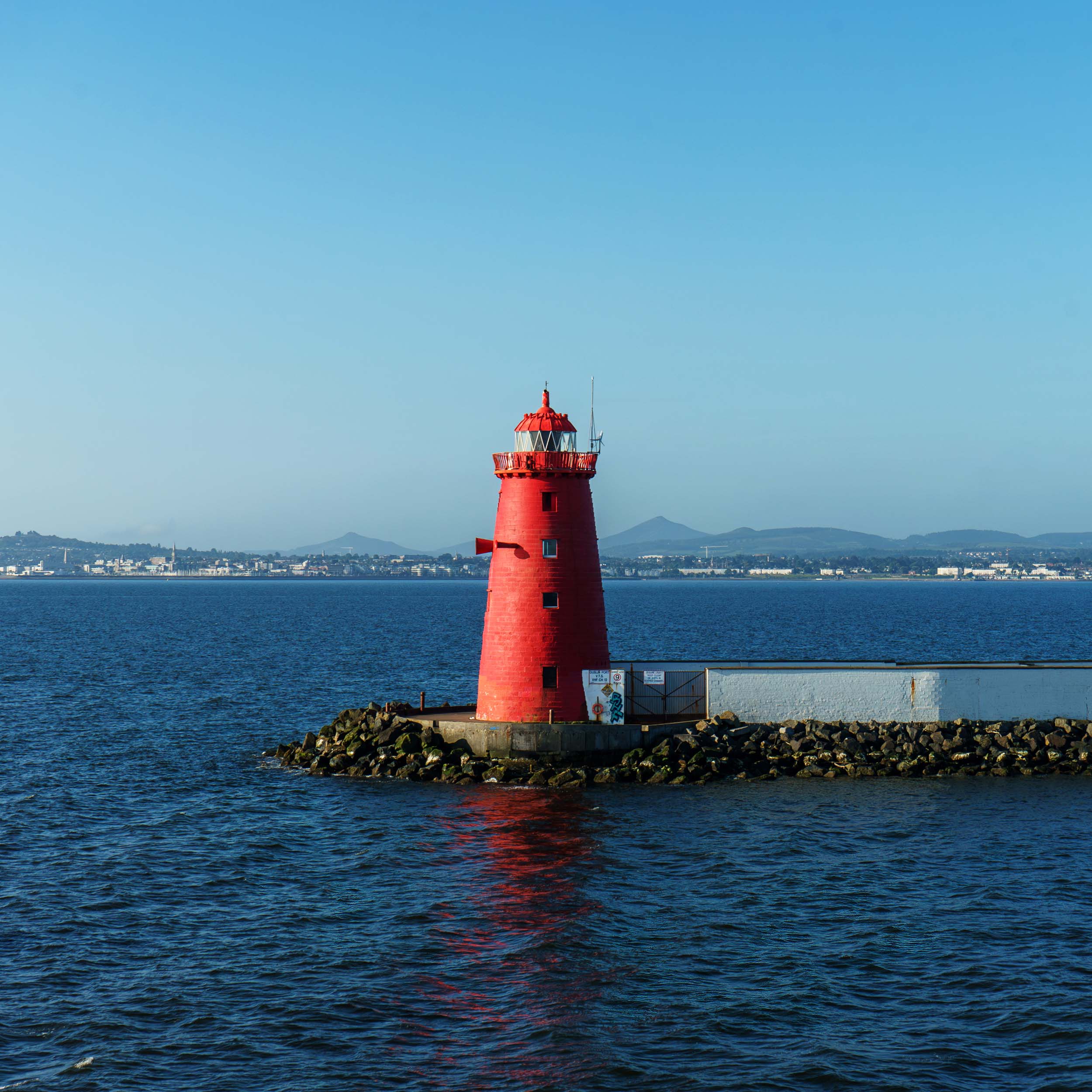
In fact, major infrastructural project or not, it almost certainly wouldn’t be built at all today, nor would the South Wall. The planning and permission processes would last for ages and every sentence would be parsed and analysed to death, not a creature living in the swamp that the bay then was would be spared a role, legal eagles would make their fortunes, and no greater boast could be made than “we held it up for 25 years.” And the Houyhnhnms would be every bit as bad as the Yahoos, if not worse. Swift would have had a field day.
BULL ISLAND
But look at what the city and people of Dublin gained from the Great South Wall and the Bull Wall. For a start, they got a port. The walls created natural tidal effects that deepened the entry to the Liffey from 1.8 m to 4.8 m. And they got the Bull Island itself, as the silt now scoured from the river course was deposited on the North Bull sandbank.
It’s a huge asset. It has more designations than any other site in the country, as a National Bird Sanctuary, a biosphere reserve, a National Nature Reserve, a Special Protection Area under the EU Birds Directive, and a Special Area of Conservation under the EU Habitats Directive, while also being the subject of a Special Amenity Area Order. And there’s kite-surfing and paragliding, walking, sunbathing and swimming on Dollymount Strand. Oh, and golf in both Royal Dublin and St. Annes golf courses.
Yeah, it’s true that on a very hot summer day you’ll encounter Yahoos and Yahooettes and Tattoos and Tattooettes as well, plus more than a handful of Houyhnhnms, noses high. But that’s life. Meanwhile, the South Wall is one of Dublin’s great walks, taking you out to the middle of the bay with views to Bray and Wicklow to the south, Howth to the north, and the Bay waters all around.
In addition, the land reclamation process begun in Dean Swift’s time moved the city’s centre of gravity eastwards, with stable land created for the port, sports amenities and parkland, the Poolbeg power stations, and now the new housing blocks around Poolbeg. Don’t we need more of this kind of thing, rather than less? Factoring such benevolent downstream impacts into planning for major developments might help relieve the burden of fatalism, bureaucracy and nimbyism/populism. But for now we’re going to crack open Gulliver’s Travels and play “spot the people you know”.
Shouldn’t be too hard.
RELATED

- Film And TV
- 10 Nov 26
David Walliams named as UK celebrity behind sex claims court injunction

- Culture
- 10 Nov 26
New book celebrates life of Belfast music legend Bap Kennedy

- Culture
- 10 Nov 26
Meet the Arts Officers: We want to change the perception of Longford
RELATED

- Culture
- 10 Nov 26
Sci-fi author M. John Harrison becomes oldest winner of Booker Prize

- Culture
- 09 Nov 26


