
- Music
- 14 Mar 26
Foy Vance: "Our limitations are the thing that makes us unique. AI seeks to be perfect, and we seek perfection"








Foy Vance’s powerful new record, The Wake, completes an epic 26-year, seven-album odyssey. The Emmy-winning songwriter discusses the genesis of his crusade, recording with the legendary Ethan Johns, and the abiding inspiration provided by his brilliant father.
“Tell me about your father.”
I’m sat in O’Regan’s on South George’s Street on a quiet Friday morning with Foy Vance and that’s how I choose to open the interview.
“Tell me about your father.”
A quizzical, Luke Skywalkerish opening gambit, I grant you. But Foy’s hot-off-the press album, The Wake, marks the completion of a 26-year personal odyssey, across seven albums. His father, Hugh Bailie Vance, is the paramount artistic – indeed, philosophical – muse spanning that mammoth creative arc.
Hugh was a pastor, who moved his family from Northern Ireland to the US, where he preached all over the Deep South for six years, before returning and settling in Bangor, County Down.
“He was a scene,” Foy tells me, “anywhere he went, he was most assuredly there. He was born in Belfast in 1945, right at the end of the war and out he popped. He was a wild man in a lot of ways. Because he was a preacher, everything was sort of dressed up as a story or fable, or a philosophy. Preachers have a certain way of talking, almost like songwriters. They’re always trying to find a way of coining a phrase.
“So, talking to him was poetic and abstract. When he was alive, I kind of dug it. But I was also like, ‘Enough, Da, enough. I don’t know what all this means.’ There was always a little tale to be told about any situation that’s coming up. As soon as he passed, man, that’s the first thing I missed. Hence turning to my guitar, I found any time I picked it up, he was right there, real close. Just by sitting still with the guitar, all the that he said would resonate and fall out.”
Were you very close?
“Yes,” Foy relates, “we were. He was a very loving father, very positive, very supportive. I mean, he was over the top. Sometimes, if I’m honest, it was embarrassing. I’d be leaving the house with a load of friends and he’d be saying, ‘I love you son’, and give me a kiss and a hug. And they’d be like, ‘Did someone die?’”
From a man of his generation, unusual.
“For a man of his generation, indeed,” Foy agrees. “But he had a tough upbringing, which I shan’t go into, but it was hard. You find that oftentimes, he was like, ‘Okay, I know how to transform this into something different’.”
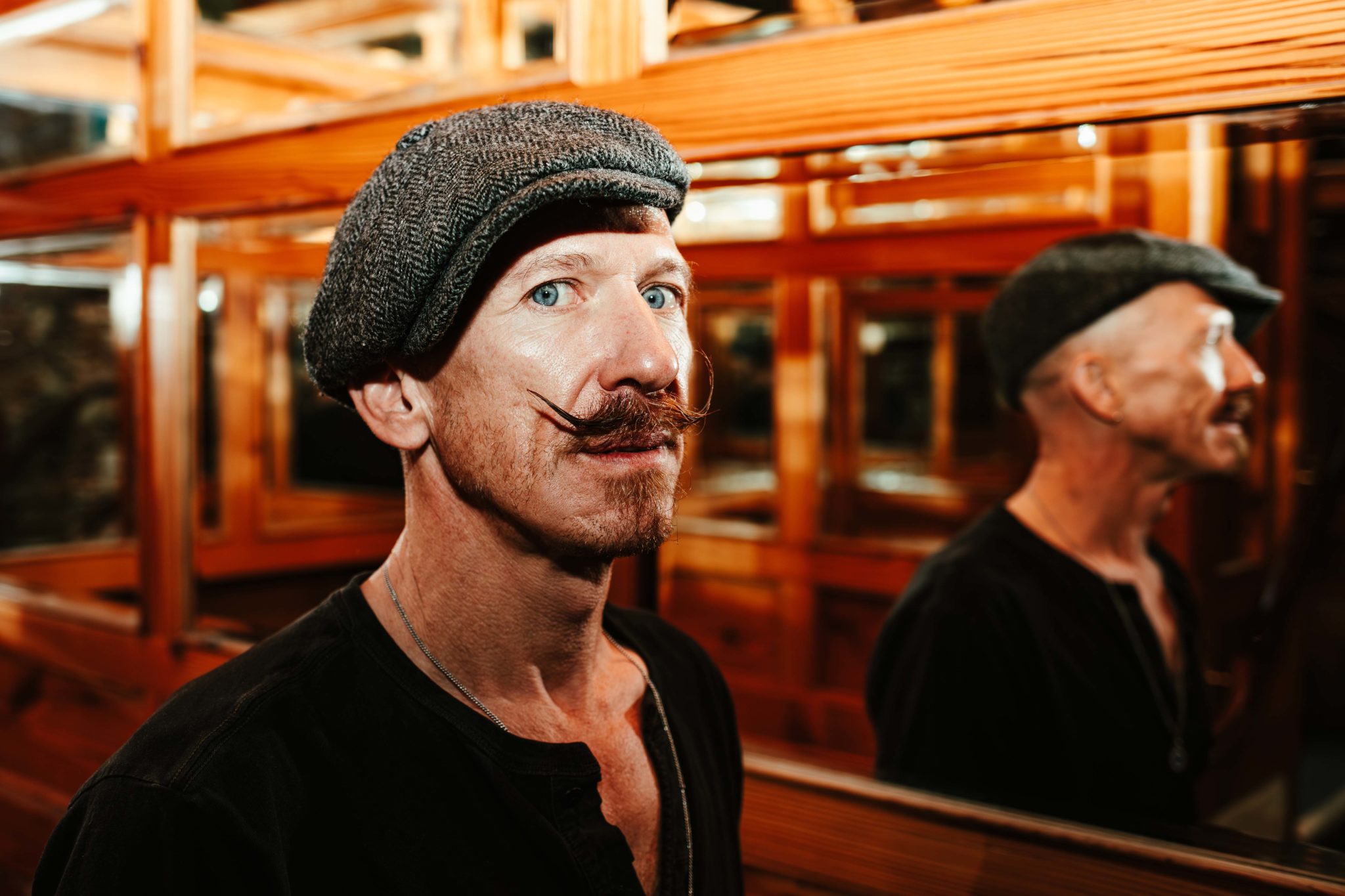
Foy Vance. Copyright Abigail Ring/ hotpress.com
Grand it is, to be chilling in Regans, sipping Guinness Zero, watching Dublin mosey into its weekend, listening to Foy Vance reflecting on his crackerjack new record. The man is sound as a pound, a brilliant artist indeed. But one who’s light with it – deep yes, but quick to laugh and have the banter.
Later, when I fudge a question, rather than bullshit me, he gently requests for clarification. And in mid-confab, when an enthusiastic fan politely interrupts and asks for a selfie, Foy chats warmly.
Researching the interview, I read that Foy once stated that the first genuine song he wrote, ‘Cryin’ In The Night’, followed the passing of his father in 1999.
“That’s correct,” he clarifies. “Truth is often stranger than fiction, right? I was in Lanzarote, because I’d had this idea that I needed to get away from my comfort zone. I needed to get away from familiarity and formula, and just go out and try and find something. So, I moved to the Canaries. My idea was, ‘I’ll play in the evenings, and during the days, I’ll write.’
“The writing wasn’t coming easy at all, but every day I was trying. January 30, 1999, at 1.30 in the morning, I was doing this riff. I would try and play songs on stage and see if I could make it up and get away with it, see if anyone would notice. So, I was doing that, and I just kept singing these lyrics about a thief coming in the night, Jesus coming in, imagery that would have been my dad’s language as a preacher,”
He dives deeper into the memory.
“I went home that night,” he continues. “Did you ever play Tetris? Do you remember when you’d play it for like, three, four hours, and then switch it off? You try and go to sleep, and Tetris is happening. It was like an audible version of that. It was almost like tinnitus, I couldn’t get rid of it – it just kept going round and round. It was annoying actually, and upsetting. I didn’t know what was going on, I was just feeling out of sorts.
PASSING GIFT
“I woke up the next morning and found my phone, which I still lose to this day, and there was 14 missed calls from home. So, I called home, and my Mam told me that at 1.30 in the morning, as I was doing that song, closing up my show, my Da was dying on the other side of the world. So I hung up the phone, walked out the back of the house, sat down, and for the first time the entire song poured out.”
A passing gift from the threshold.
“Exactly,” Foy nods, “which is a hard thing to reconcile at first. It took me a long time to reconcile with it – that the greatest kick in the balls was also the greatest gift he ever gave me. It’s the greatest blessing and curse simultaneously. Strange as it might sound, I’m grateful for his passing in a weird way. The fact that the loss of him was also the gain of direct lines for what I wanted to say, to help me articulate or reflect my experience down here. I’d give all this back for one minute to hear one more story. But these things happen, and worse things happen to better people.”
When I wonder if he resolved in 1999 to embark on this seven-album odyssey, without hesitation, Foy replies, “on that day.” He tells me that a favoured aphorism of his father’s was, “Give me the boy at the age of seven, and I’ll give you the man’. Thus, the number 7 became something of a mandala.
Remarkably, Foy finished The Wake, the seventh and final album in the cycle, on 30 January, 2025, 26 years to the day from that long Lanzarote night. A short documentary on the album’s genesis and creative process, titled Sketches Of The Wake, illustrates his work in the studio with producer Ethan Johns, who appears to be a rather beautiful soul.
“He’s so full of love,” Foy confirms. “He is a beautiful guy. And a beautiful guy aside, he’s in the company of one. You know, his dad, right? Glyn Johns.”
Indeed, I do. One of the architects of classic rock’s golden era – among others, he shaped the sound of The Rolling Stones, Led Zeppelin and The Who. So good, they named a minimalist way of recording drum kits as the Glyn Johns Technique.
“So,” Foy continues, “not only was Ethan a young, talented, eager and interested kid, his dad is Glyn Johns. He was mic-ing up amps for Keith Richards. His first gig was playing drums on Labi Siffre’s ‘(Something Inside) So Strong’. The things that man saw as a kid and has experienced throughout his life… It was beautiful to watch this shorthand between what was happening in the room, and how he was capturing it. It was so effortless.”
GLUT OF HIGHLIGHTS
The Wake contains a glut of highlights, a standout being the magnificent ‘Call Me Anytime’. “I would happily listen to that forever,” Johns tells Vance, and watching them work it out in the studio is marvellous. Sticking with the Odyssey theme, I reckon ‘Call Me Anytime’ to be Ithaca, the ultimate destination of Odysseus’ 10-year, post-Trojan War journey. Is it about fatherhood?
“Of course,” Vance confirms, “and falling short of the call. This is just my take on it, but it feels close to solipsism to bring kids into the world. It’s like, ‘Let there be children, and then there were children’. So, I brought these little beings into the world. I guess that song’s acknowledging in myself the times I fell short of my duties as a father, quite frankly, because of alcohol. I was always engaged with my kids.
“But there was a veil between me and them, because I was always kind of drinking – not blind drunk, lying on the floor at nine in the morning – but always drinking. That song came out of, I guess, manning up, owning up to my responsibilities as a father, and getting clean, being ready to be there for them.”
Opening track ‘A.I.’, contains the ambivalent refrain, “No use getting ready for the fight”. Ambivalent, because what follows is a remarkable folk/ blues/electronica cornucopia, complete with a full Jon Plunkett poem thrown in for good measure. All of which AI, in its current incarnation, simply could not create.
LISTENING AND ENGAGING
“That song is more like a celebration of human limitations,” Foy clarifies. “Our limitations are the thing that makes us unique. AI seeks to be perfect, and we seek perfection. In our pursuit of it, we feel miserable all the time. But as the great Beckett said, ‘Try Again. Fail Again. Fail Better’. That’s where it’s at. There’s the journey, there’s the learning.
“I mean, it’s not even stop seeking perfection. It’s realising that it’s not something that is achievable. The real beauty of these things is in our inability to reach it. There’s something beautiful, poetic, real and human in that.”
There’s folk now shuffling into the front bar for their mid-afternoon tipple. Foy and I continue chewing the fat, across his marvellously manic homemade videos for ‘A.I’ and ‘I Think I Preferred The Question’; his Da teaching him to play guitar; and family gatherings at his Grandma’s where everyone was encouraged, indeed press-ganged, into performing a piece – the young Vance would sing ‘The Bonnie Banks Of Loch Lomond’, ‘The Skye Boat Song’ and ‘Wild Mountain Thyme’.
Later, I ask him does he ever rue setting such a lofty goal as seven albums.
“I don’t regret setting the goal,” he replies. “Because up until that moment, quite honestly, I was never a very committed person. Jobs-wise, I worked on a building site, I delivered lemonade, I delivered milk for a while. I also delivered newspapers and brochures in a van. I worked in storage and in a chemist, and I worked in a post office for a day – employed at nine, deployed at five.
“I went to jujitsu for six months, I went to boxing for six months – same with gymnastics and diving. Music is the one thing that I started out and stuck to. I realised this is the only thing I have that can redeem this quality in myself – I need to figure out how to stick to something and see it through.
“I didn’t think it was going to take 26 years to the day. But I think even if I had gone back to my 24-year-old self and said, ‘This is going to take you 26 years to finish’, even then he would have said, ‘Alright, yeah.’ Because this is not about forcing something – this is about being present, listening and engaging. Truth of the matter is, man, that if no one listened to the songs, I would still write them.”
INTIMATE SHOWS
It’s time to wrap up and let Dublin get on with its weekend. To celebrate the release of The Wake, Foy will play five intimate release shows in New York, LA, Nashville, London and Belfast in March, the latter at the Duke Of York. Later this year, Foy will play a special hometown show – A Celebration Of Life With Foy Vance – at Custom House Square in Belfast. The show will also feature Joshua Burnside, Vittorio Angelone, Bonnie Bishop and Jon Plunkett.
“I played a lot in the Duke Of York,” Foy recalls. “Not with my original stuff, that was before I had even started really writing. I was in a soul covers band. We used to play in Dublin a lot – do you remember Break For The Border? We used to have a residency there. But I’ve always had a soft spot for the Duke Of York. So the tour starts with a big night in Belfast – I’m setting out for the next eight months from there, like the Titanic!”
• The Wake is out now. A Celebration Of Life with Foy Vance is at Custom House Square, Belfast on August 15. See full details of his upcoming shows here.


