
- Culture
- 22 Nov 26
Declan Lynch: "So many interviews took place in pubs... Now the whole PR industry is terrified of losing control, but the world we lived in was characterised by the opposite of that"


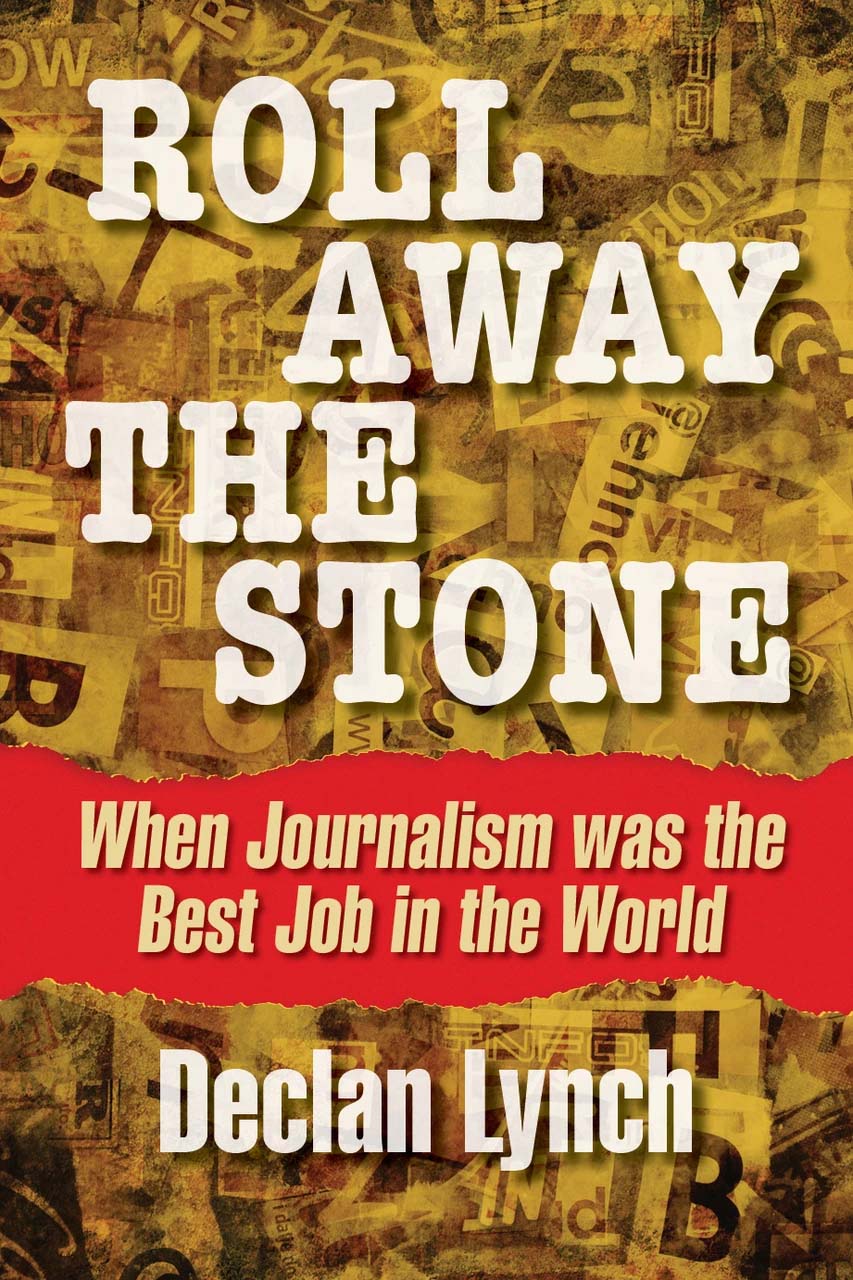
In Roll Away The Stone, Declan Lynch revisits the riotous early years of Hot Press, brings Bill Graham and Con Houlihan vividly to life, and asks what it will take to reclaim journalism’s rebellious spirit.
“It’s just a shame you missed out on rock ’n’ roll. It’s over… you got here just in time for the death rattle.”
So says Lester Bangs, played by Philip Seymour Hoffman, to the young William Miller, Cameron Crowe’s fictionalised younger self, in Almost Famous. I thought of that scene when I saw the subtitle of Declan Lynch’s new book, Roll Away The Stone: When Journalism Was The Best Job In The World.
For Miller, of course, the golden age is still ahead. Bangs is remembering his youth; Miller is having his. Around the same age, Declan Lynch was finding his way into Hot Press, and his account of the magazine’s Upper Mount Street and Wicklow Street years is full of mad stories.
What immediately strikes you is the access – the people you could get to, the time you could spend with them, the places you might find yourself. For anyone conducting interviews against the clock today, with a publicist hovering just beyond the screen, it’s the stuff of dreams.
“The one that always haunts me,” Declan laughs, “was with Paul Weller. I spent a day with Paul Weller in Townhouse studios in Shepherd’s Bush, and he was recording ‘That’s Entertainment’. He would keep going into the studio doing another version and I’m thinking, ‘God, how much more am I going to have to listen to this?’ You know, it never crossed my mind to stick on the tape recorder and get a personal memento of one of the seminal moments in English pop music.”
One particularly enviable assignment found Hot Press editor Niall Stokes interviewing Bob Marley, which ended with Marley singing a song just for him. Niall was Lynch’s editor then and is mine now, and what strikes me is the matter-of-factness of it all – an encounter we now regard as rock history was, at the time, part of getting the next issue out.
“We didn’t idolise people,” says Declan. “We had a sense that it was us and these artists against the darkness outside. But we weren’t reverential. We knew these guys’ music. We knew what they were doing. So, there was a basic acceptance, on the part both of us and of the person we were interviewing, that you were going to give it a good shot, and you were going to try and put out something about them that maybe hadn’t been done before, and they were up for that.
“So many interviews took place in pubs; people were aware that this could end up in the article, everyone accepted that. Now, the whole PR industry is terrified of losing control, but the world we lived in was characterised by the opposite of that. There was a real sense that you never knew what was going to happen next, or what people were going to say next, and the articles were better as a result, and everybody could see that.”
The International Bar, The White Horse and Mulligan’s are all equally alive on the page, peopled by figures such as Hot Press legend Bill Graham and the incomparable Con Houlihan.
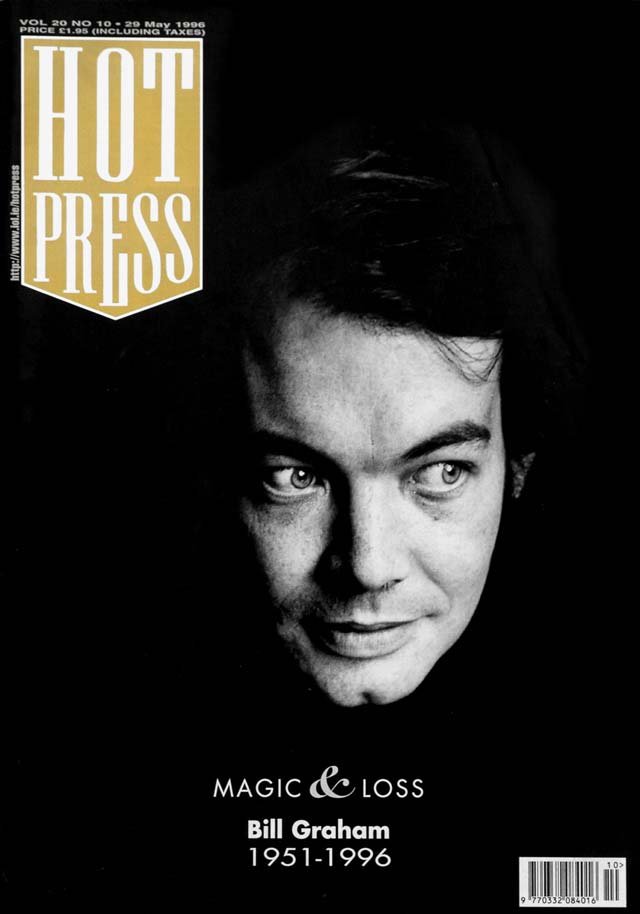
“Anyone around Hot Press at the time, was extremely lucky that Bill was a mentor, without ever being conscious of that,” says Declan. “To have Bill’s brilliance around you was just amazing. I mean, I am still astonished at it. There’s two people I regard as geniuses that I’ve encountered. One is Arthur Matthews, and one is Bill.
“He was such a presence and such an unusual person, and it fits into this theme that I was trying to explore in the book – the kind of people basically who were attracted to journalism in that era. I don’t know where they are now, but they’re not in journalism. There was a thing about journalism that seemed to suit a certain type of person; you might call them now, roughly speaking, eccentric. It attracted people who were highly intelligent, but not amenable to the bourgeois lifestyle.”
One glorious episode finds a young Lynch dispatched to interview Con Houlihan in a packed, positively feral Mulligans. Proceedings eventually relocate to Houlihan’s house, where a smorgasbord of spirits is served and the interview is suspended when its subject falls asleep. Lynch keeps vigil, waiting for the great man of letters to wake so he can finish asking his questions.
PAINSTAKING WORK
At times, the book strays into Hunter S. Thompson’s Rum Diary territory, as when an Irish Press staff member appears in the office wielding a petrol bomb. Elsewhere, the laughter gives way to something more sombre – the great Ned Murphy dying at his desk at the Independent. Amid the uproar, Lynch never loses sight of the people themselves, or of how much of their lives they gave to the job.
“The legendary George D. Hodnett, who wrote about jazz in The Irish Times, supposedly used to sleep in the office,” Declan relates, “It doesn’t matter whether that’s true. What matters is that people thought it could be true. You can’t imagine an Irish Times columnist bedding down there now. There was that eccentricity. There was also just drinking. Once vast amounts of alcohol are sloshing around, occasionally you’ll find somebody standing on a table with a petrol bomb. It’s just a law of nature.”
Also, the practicalities contained in the book are a revelation in themselves. To interview Keith Richards, Hot Press scribe Liam Fay rang the Caribbean from a payphone in his Rathmines bedsit – a conversation spanning the distance between a young journalist’s rented lodgings and the life of a Rolling Stone. Or so the story goes!
And getting the resulting magazine to the printers demanded its own ingenuity. Every fortnight, the painstaking work of assembling Hot Press was followed by the task of getting the finished pages to The Kerryman in Tralee, sometimes via a dash across Dublin to catch someone heading for Kerry.
“The funny thing was, as far as we were concerned, we were cutting edge,” Declan laughs. “We were setting a course for the future of Irish life. And yet, looking back, it’s like medieval practices. My particular area was proofreading and corrections – with a scalpel. The galley would come up with the article on it.
“I’d mark the spelling errors, write the corrections on a sheet of foolscap and take it downstairs. The typesetter would type up the corrections. I’d bring them back up, cut them out with a scalpel, put some Cow Gum on the back and stick them onto the page. Then we were ready to do it all over again.
“It seems impossibly laborious, yet we thought nothing of it – the magazine looked well, the layout was great, the pictures were great. There was a real sense of design. Niall was always very keen that it had to look well. We were a rock ’n’ roll magazine.”
Declan’s entry into this wild and wonderful world came through a review of jazz guitarist Louis Stewart on UCD’s Belfield campus, which he submitted to Hot Press while studying law. His lodgings were in the wonderfully named Mrs. Hitchcock’s boarding house. Between the law lectures – the jazz and an address with its own hint of suspense – the makings of a rather different career were already falling into place.
“I’d been radicalised by the Sex Pistols, by reading great magazines like NME,” Declan explains. “Music was the meaning of life for me. There was something transcendent about it, and I absolutely wanted to be part of it. But I was from Athlone. It seemed like something happening on the other side of the moon.
“Whatever struck me the night I wrote that piece about Louis Stewart, I thought, ‘Well, it’s not that far away. I can send this in’. I’d written for school magazines, so I had some facility for writing, I suppose. The Louis Stewart thing struck me in a funny way.
“There was the drummer smoking a pipe, all these mellow jazzers – and I was into Dr Feelgood and the Sex Pistols, this incredible energy coming out of punk. I suppose I welded the two together in what was meant to be a funny article. And, Mother of God, it got printed.”
SHARPER EDGE
In 1991, in his Irish Press TV column, Lynch expressed the hope that, should Madonna have a son, he would prove less troublesome than the “precocious Nazarene”. Bishop Brendan Comiskey denounced it as blasphemy and urged readers to consider withholding their custom and their advertising from the Irish Press. The paper published an apology to offended readers.
A joke in a television column had become a demonstration of who could bring a national newspaper to heel. That struggle gives the book’s account of journalism’s freedoms a sharper edge – they were fought for, rather than bestowed. Now, facing what Lynch calls Silicon Valley’s “nerd Reich”, the profession is perhaps surrendering ground again, but there’s still optimism in the book, particularly when it discusses Julie K. Brown’s reporting on Jeffrey Epstein for the Miami Herald. Does work like hers give Lynch hope that journalism can reclaim its power?
“You will always have great people in journalism,” Declan replies. “What I’m worried about more is that the institutions are fraught. Ages ago, the great newspaper groups and the media institutions of the world should have come together to address this issue that we now live in a post-truth age. “The mainstream media is still carrying on like it’s 1995 and the other fuckers are way ahead of them. So, we’re in trouble, but when I started out, that was a feeling I had as well. We were up against terrible forces, but it did change. I guess it’s not completely hopeless.”
• Roll Away The Stone: When Journalism Was The Best Job In The World is out now.
RELATED

- Opinion
- 20 Feb 21
Former Hot Press Writer Molly McAnailly Burke Has Died


- Opinion
- 20 Feb 81
FROM THE ARCHIVE: The Stardust Tragedy In The Cold Light Of Day
RELATED

- Culture
- 19 Nov 26
Romesh Ranganathan adds extra show to 3Olympia run


- Culture
- 19 Nov 26
€4.5 million allocated for cross-border Arts and Culture projects


- Culture
- 17 Nov 26