
- Lifestyle & Sports
- 21 Jul 26
Ríon Hannora: "Clothes are made to be worn, and felt, and witnessed"








Ríon Hannora – one of the country’s most buzzed-about and thought-provoking fashion designers – talks corsets, bridal wear, funding, Dublin Independent Fashion Week, and styling the likes of Kate Nash and BIIRD.
There were signs, from an early age, that conformity and practicality were never going to factor too heavily in Ríon Hannora’s worldview. In fact, you could trace the defiance and irreverence that has gone on to shape the fashion designer’s boundary-pushing work all the way back to a visit to Paul O’Connor Shoes, a children’s shoe shop in Cork City, when she was just four years old.
“My dad would take me there whenever I needed to get new shoes,” she tells me. “And I remember being so distraught, because I was surrounded by all these pink sparkly shoes – and that’s all I wanted. But my parents are very practical people, and they always wanted to dress me very practically. So it was, ‘Not a chance. You need to be wearing boots because it’s winter, and it’s cold.’ I didn’t want boots!
“I also had this dress called my party dress, when I was maybe six or seven,” she adds. “It was a pink velvet dress, and it had a little frill at the end. I wanted to wear it all the time, but they were like, ‘No, you have to keep it for special occasions.’ So every time a kid in my class was having a birthday, I’d be like, ‘Yes! I get to wear my party dress!’”
Ríon has subsequently built a career out of that penchant for dressing up – styling some of the biggest names in Irish music and beyond, and challenging societal norms across a series of acclaimed collections, including her latest, Chapter 7: Sex Before Marriage, made up of unisex bridal wear.
But she also feels that, in many respects, she’s continuing a tradition already laid down by the women in her family.
“My granny is an amazing dressmaker and knitter,” she says. “When I was small, she used to make me and my teddies matching jumpers – which was so cute. And she used to make a lot of my mom and her siblings’ clothes.
“And her mom before her was also an amazing dressmaker. I think both of them were tortured artists in a way, because they were so passionate about this thing – but were forced to get married and have kids instead. So sometimes it’s nice to go to fashion shows, and be like, ‘They would have loved to be here…’”
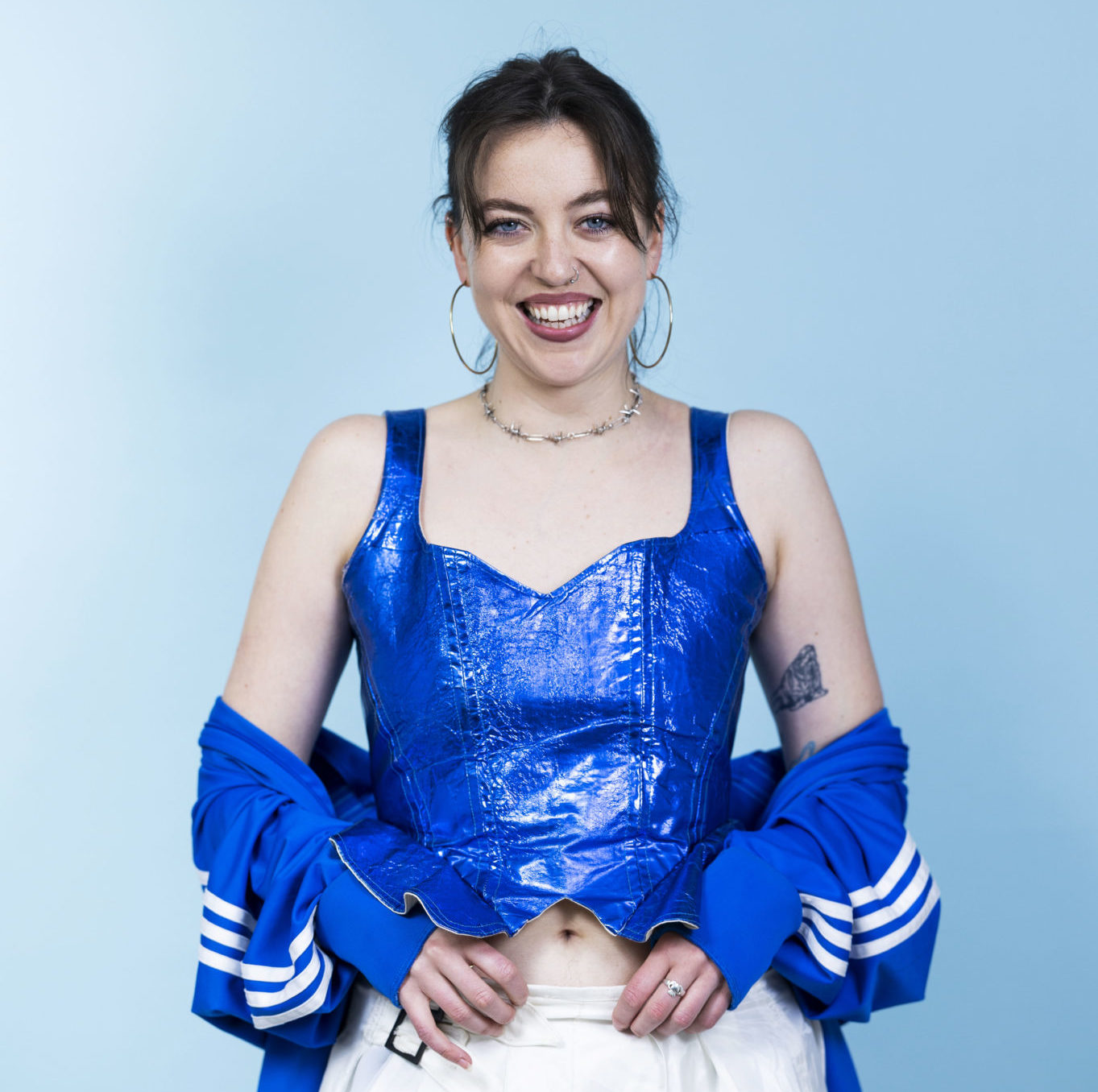
Credit: Cat Gundry-Beck
Ríon’s own journey in fashion design kicked off as a teenager, when she received a sewing machine for her birthday.
“I was really excited, but I didn’t know about patterns or anything like that,” she recalls. “I would just go to Hickeys, and fabric shops in Cork, and go to the bargain bucket, for random scraps. I’d just be cutting into things, and sewing things together – like, ‘Hmm, I think this is how a t-shirt is made…’ They would obviously be really wonky, but I loved them! My mom would have to hide the scissors from me as a teenager quite a lot, because I’d just be cutting into clothes.”
She sharpened her skills at the Limerick School of Art and Design, before a graduate visa took her to Oakland, California.
“I worked for this sustainable denim fashion house there,” she elaborates. “They introduced me to using deadstock fabrics, and reusing fabrics. They’d go to these massive deadstock warehouses for denim jeans and jackets, and they showed me how to take things apart – and then they’d patchwork things into these amazing garments.”
Covid, however, cut that adventure short, and brought her home to Cork. But it was during her time back in the city that she received her “first bit of monetary encouragement” for her own work, when she was awarded an Individual Artist Bursary from Cork City Council.
“They gave me that award for a collection, before I even realised I was making a collection,” she explains. “It was Covid, so a lot of things were closed, and I had a lot of time on my hands. I was just going around, adding to this folder I had on my phone, of all the funny graffiti all over Cork.
“I love graffiti,” she adds. “Not murals, but graffiti that’s just like mark-making – or when people drew a penis or something. I just think it’s so funny.
“So, I told them in my application that I was making corsets that were very inspired by the Baroque era and this very luxurious lifestyle – and then I would spray paint bits of graffiti that I saw around Cork onto them. I couldn’t believe people were going to give me money to do it! But that first bit of encouragement is a major factor in why I kept going.”
From there, “it just snowballed,” Ríon reflects, with seven collections, which she calls ‘chapters’, now under her belt. She relocated to Dublin in 2022 – though she’s been enjoying a change of scenery in Paris for the past few months, before she heads away to New York, to study at The New School on a prestigious Fulbright Scholarship.
Through it all, her fascination with corsetry has remained a key feature of her work.
“I’m obsessed with them – and I don’t think it’s going away,” she laughs. “I did a portfolio course at the Crawford in Cork, and that whole portfolio was based around crinoline skirts – those cage skirts that women used to wear under their amazing gowns. I was obsessed with the whole ‘underwear as outerwear’ thing.”
She was also interested in the history, and the politics, of the corset – a garment often associated with women’s oppression in patriarchal societies, before being reclaimed by a new generation.
“Women’s bodies have always been scrutinised, and political,” she points out. “It’s a really interesting sign of the times, what people are making women’s bodies do. At the moment, there’s this surge of super skinny bodies, and this pressure for celebrities to be wafer-thin.”
Societal pressures were certainly upended at her first solo runway show last year, at Bewley’s Grafton Street, where she unveiled her Sex Before Marriage bridal collection – with Ríon Hannora-branded condoms tossed like flower petals, as models showcased looks celebrating ‘everything good about marriage… while discarding outdated baggage.’
“It was nice to be able to showcase my work in front of people,” she tells me. “A lot of the time, things just live online now. You make collections, and put in all this work, to just post a picture of it on the internet. It can feel really anticlimactic. Clothes are made to be worn, and felt, and witnessed.
“Someone said it felt like an actual wedding,” she laughs. “My whole family came, there were drinks and food, people were crying…”
View this post on Instagram
With PJ Kirby Galang of the I’m Grand Mam podcast among those who’ve worn her custom outfits on their big day, Ríon has noticed a growing demand for a range of wedding options beyond the traditional tuxedo and “big white dress.”
“There’s various alternative ways of getting married,” she resumes. “The idea of the big white dress is great for some people , I’m sure – but having something a bit more relaxed, but still special, is where I probably am in the Venn diagram of it all!
“Making clothes that people feel good in, is always what I want,” she adds. “So, to make someone’s wedding dress that they hopefully have an amazing day in – that’s job done.”
Ríon has remained a strong advocate for slow fashion and sustainability throughout her career, while also using her growing platform to speak out about the lack of funding opportunities for fashion in Ireland. Fashion is not listed as an artform in the Arts Act 2003 – and due to it being seen as a ‘commercial’ rather than ‘artistic’ pursuit, funding opportunities in the field are typically limited to the Design & Crafts Council Ireland, and not the Arts Council.
“It’s very disheartening to have the Arts Council not see what you do as a form of art,” she tells me. “I also applied for the Basic Income for the Arts when the pilot came in, and they emailed me back saying I wasn’t eligible to get it, because I wasn’t an artist.
“It’s also interesting to see the categories of art that the Arts Council do support,” she continues. “And I’m not trying to take away from them. I absolutely believe that circus, for example, is a form of art. But there’s things like architecture that get funding from the Arts Council and the Design & Crafts Council. If it’s commercial, the Arts Council won’t fund it, but if it’s artistic architecture, they will. So if you can put that clause in for architecture, why could you not put that in for fashion? There’s commercial sides to all of these things.”
Does she see that lack of recognition changing anytime soon?
“People are definitely talking about it more,” she reckons. “Deirdre McQuillan, who is the fashion editor of The Irish Times, is an amazing advocate for it, and has been banging down the door for a while.
“It’s frustrating, because Ireland is really known for its fashion as well,” she adds. “Like its knitwear. But a lot of the time, it was women working from home who were doing the dressmaking and the knitting – so I feel it's quite disrespectful to them. It’s like they’re not taken seriously, because they were working from home. I do think there’s a bit of built-in misogyny in that.”
View this post on Instagram
Ríon's work also involves close collaboration with a range of top musicians – as the stylist behind the 11-piece trad supergroup BIIRD, as well as the mastermind behind some unforgettable looks for the likes of Kate Nash and CMAT.
“It’s one of my favourite parts of the job,” she says. “I really like getting to know someone, and really knowing what they like to wear, and what they don’t like to wear – and what makes them feel good. Especially if people are performing onstage, and need to feel a certain way. Being able to enrich that experience for them is really fun.”
Getting to attend events like Glastonbury is another perk of the job.
“I went with Kate Nash last year,” she tells me. “What I’d normally do with Kate is have a fitting beforehand, maybe in her house, and figure out a few outfits for festivals. She’ll want a stage outfit, and then one that’s within the same world, but a little bit more relaxed, for interviews and press afterwards.”
For Kate Nash last summer, that meant being prepared for three Glastonbury performances: a headline slot on the Left Field stage, a surprise performance for BBC Introducing, and a special guest appearance during SPRINTS’ set, for their cover of ‘Foundations’.
“I’d gone to the NCAD Degree Show last year, a few weeks before Glastonbury, and I’d picked up a few business cards that I really liked,” Ríon recalls. “And someone from the Degree Show's look that I saw ended up on Kate, onstage with SPRINTS. It was Greta Giardini, who’s amazing. She’s an aerial artist, so she makes a lot of these beautiful costumes that would be comfortable for aerial – so you can imagine they would be comfortable onstage as well.”
How did her collaboration with BIIRD come about?
“Lisa Canny just messaged me on Instagram,” she reveals. “She was still putting the group together – that was maybe three years ago now. She explained it all to me, and I was like, ‘Girl, yeah. 100%. Sign me up.’”
Ríon is also kept busy as a co-founder and board member of Dublin Independent Fashion Week – a community-driven event championing ‘a more inclusive, accessible, and representative future for Irish fashion.’
“It’s something that grew from frustration, and not having a platform,” she reflects. “And rather than waiting around for, I don’t know, the adults to do it, we decided to just do it ourselves.
“You can see, from how much traction it’s been getting, that people feel the need for it as well,” she adds. “To see how much it’s grown is amazing. And hopefully this year will be bigger – there’s talks of collaborations…”
She counts her “comrades at Dublin Independent Fashion Week” – including Aisling Duffy, Seeking Judy (Megan McGuigan), Mihai Mar, and The Zero Waster (Sarah O’Neill) – among her favourite Irish fashion designers right now, in addition to Sinéad O’Dwyer, who’s been making international waves in recent years.
“She’s been an amazing advocate for making clothes for lots of different body types,” Ríon says of Sinéad. “She makes a lot of clothes for women who are size 20 and above, as well as your size 6s. She actually created a new mannequin, to promote body positivity, that was part of the Met Gala this year.”
What about some stand-out Irish shops that platform homegrown designers?
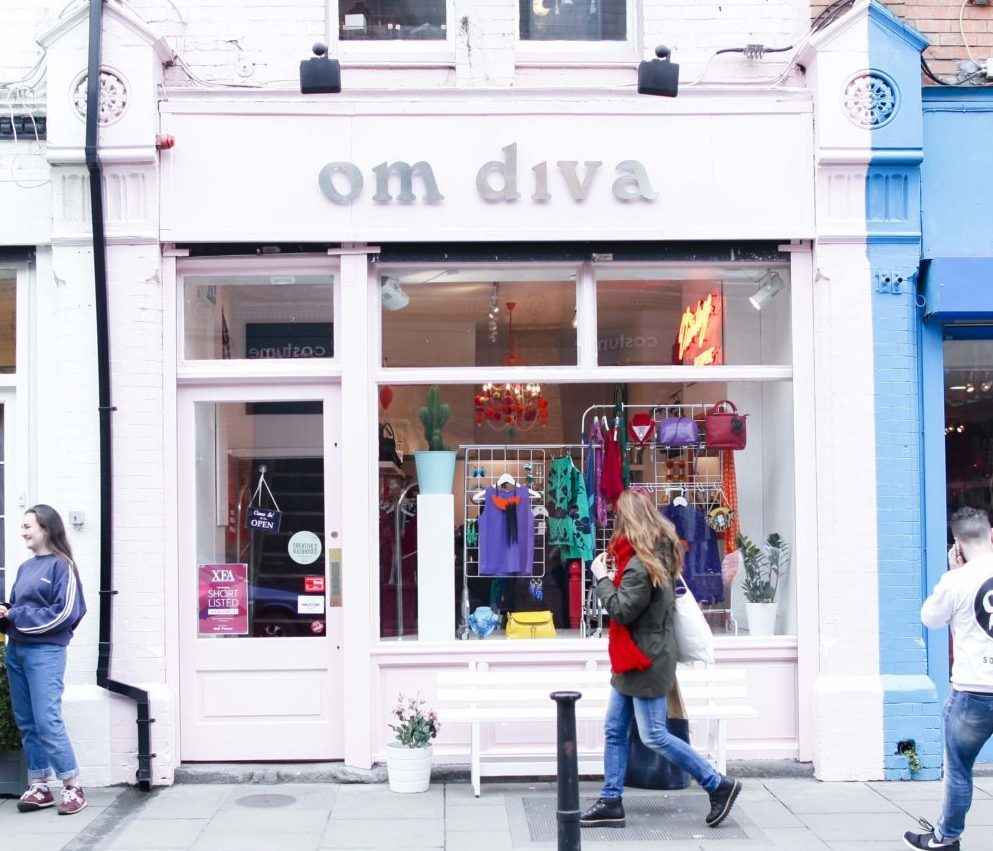
“Om Diva is amazing,” she remarks. “My studio was above there for three years. There’s also a shop in Rathmines called Beautiful South, run by Gráinne Wynne, who’s great. And there’s a new one down in Dingle, The Slow Concept. It’s run by a couple [Frances Fogarty and Feargal O’Cinnéide], and they have loads of amazing independent designers there, like Mihai Mar [of Mar Knitwear].”
There’s also Indigo & Cloth, an independent menswear and lifestyle store, along with a specialty café, in Temple Bar. Ríon, among many other people, was sad to hear that the business recently received notice to vacate – though reports have since emerged that the shop will be moving to Clarendon Street in mid-August, while it continues its search for a more long-term home in the city.
“Andy has lots of Irish design in there, and there’s also a studio space above it,” she notes. “I don’t understand what this city is going to look like in 10 years, if they keep doing this to small businesses – there’s not going to be any culture left.”
That’s one of the reasons she makes an effort to support Irish businesses when sourcing materials and fabrics.
“I did a collection a few years ago, made of all Irish linen, from Emblem Weavers,” she tells me. “It’s a family-run business – three generations now – and you can go and literally see them weaving things, in Wexford. It’s like being with the garment for its whole life – seeing them weave this beautiful linen, and then bringing it home.
“There’s also an amazing shop on Capel Street, WM Trimmings It’s a family-run business too. I go in and Kumar knows my name – it’s just a nice community to be in. There’s not that many fabric shops left in Ireland because the craft of people making their own clothes is dying. So, it’s nice to actually go into shops, and support smaller physical businesses, rather than just online stores.”
• Dublin Independent Fashion Week returns from September 10–16. Follow Ríon Hannora’s work at @rionhannora on Instagram and rionhannora.com
RELATED


- Lifestyle & Sports
- 17 Jul 26
Blasta Books: Recipes to add to your regular kitchen repertoire
RELATED

- Lifestyle & Sports
- 16 Jul 26
10 years at Mother Macs Public House: "A pub where people feel at home"

- Lifestyle & Sports
- 16 Jul 26
Limerick: Genuine history, rich culture, and an energy just waiting to be discovered

- Lifestyle & Sports
- 15 Jul 26
McNeill's: "You have to make sure you preserve it the best you can"

- Lifestyle & Sports
- 15 Jul 26
This Is Cavan: A Top Staycation Destination


- Lifestyle & Sports
- 14 Jul 26