
- Music
- 31 Oct 26
Rhiannon Giddens: "The banjo led me to the idea that history is not divorceable from the music we make"


North Carolina singer-songwriter Rhiannon Giddens discusses her stellar new album, Hope Is The Thing With Feathers.
Although she’s been performing for decades, folk music pioneer Rhiannon Giddens isn’t slowing down. Having previously trained at Oberlin Conservatory in Ohio as an opera singer, in 2005, she pivoted to old-time, string-band music with the Carolina Chocolate Drops.
She’s covered a whole lot of ground since then, with seven solo albums and collaborations with Francesco Turrisi, T Bone Burnett, Silkroad Ensemble, and fellow Chocolate Drop Justin Robinson. Last year, meanwhile, Giddens played banjo on Beyoncé’s global smash ‘Texas Hold ‘Em’. Named by NPR as one of the most influential women musicians of this century, Giddens is also a MacArthur Genius grant recipient, children’s book author and composer.
Rounding out a spectacular CV, she also has two Grammys and a Pulitzer Prize for the opera Omar. At the heart of Giddens’ work, no matter the medium, is history. Her latest album, Hope Is The Thing With Feathers, takes its name from an Emily Dickinson poem. Reading it with fresh eyes, Giddens saw the poem in a new light and thought, “This is so right now”.
“I’m almost 50 and I’ve been doing this for 20 years,” Giddens tells me. “I’ve been thinking and taking stock of all I’ve been fortunate enough to do. So it feels like a record of stopping for a second and just going, ‘Okay, this is amazing’. But then it’s also a record for right now, because I’m really leaning into the earlier art of recording music. Music has been around for millenia, but recorded music is about a hundred years old and it’s eating itself right now.
“The industry is in freefall and streaming has upended the whole thing. For the album, we did all of the sessions straight off the tour. I really wanted it to be fresh off the stage, keeping the energy of us playing together, without isolation. You can hear the breath, you can see the instruments and you can feel the room.”
These days, simply sitting around and making music with people may be a kind of protest. With a career as entwined with activism as music, Giddens offers a pointed critique of the impending (and in some ways, already prevalent) encroachment of AI onto the arts, but not before taking a deep, cleansing breath.
“It dovetails into this idea that the product is the thing,” Giddens explains. “We’ve commodified art to such a degree that people forget the process is the thing. The song is less important than the life it took to make that song. The experience of making it, the people you work with, the folks you learn from – that’s the important part.
“If you plug it into a thing and out pops another thing, then what’s the point? It’s just a product you didn’t actually have any hand in. I’m not interested in a conversation of comparisons, whether it’s good or bad. My conversation is more of what we’re losing as human beings by relying on generative AI in every artistic endeavour. We need labels and rules, specifically with music. I don’t want to use it, but if somebody else wants to use it, it’s a free world.”
Giddens warms to her theme.
“We need to stop pretending we can use these powerful things in ways that are not controlled,” she continues. “We do that with everything else. You can’t just get in a car and go 200 miles an hour, right? You have to follow rules, you have to wear a seatbelt for your own safety. It’s the same with this technology, but nobody really seems interested in that conversation. It’s more of a ‘yes’ or ‘no’ discussion. Well, we don’t deal well with ‘yes’ or ‘no’ as humans.
“But, can we have some laws? Can the Recording Academy acknowledge this is very messy? We’re not getting what we need. And in the process, the people who sit for six months learning that one guitar lick are the ones losing. We’ve outsourced art completely, it’s been taken out of our schools and communities. Of course, there are pockets of people keeping music alive, the Fleadh Cheoil for one. But overall, it’s pretty bleak.”
Born of cultural dissection and frank introspection, Giddens’ own music sounds better than ever. Hope Is The Thing With Feathers is the outcome of the singer’s hard look in the mirror, gazing at her present, but also her personal history.
“Even though I don’t live there anymore, North Carolina has shaped who I am,” the Greensboro native affirms. “As a biracial person who’s constantly questioned as to that, I choose which label I pick. Sometimes I say I’m biracial. Sometimes I say I’m Black because that’s how America sees me, because of our one-drop rule in an effort to keep a permanent underclass. But these labels don’t actually matter to me.
“The label that matters most to me is being from North Carolina, where both sides of my family come from. So much of who I am is there and if it’s not North Carolina, it’s Virginia, or South Carolina, or Georgia – the southern Piedmont. My roots are very deep in that soil.
“I come from the rural people of North Carolina, so that’s the music I champion. Everybody doesn’t have to be everything. I’ll continue going back to that well, because it’s really deep and it’s who I am. I don’t need to play fiddle music from Arkansas, other people can do that. This is what I do and I’m happy to stay in it.”
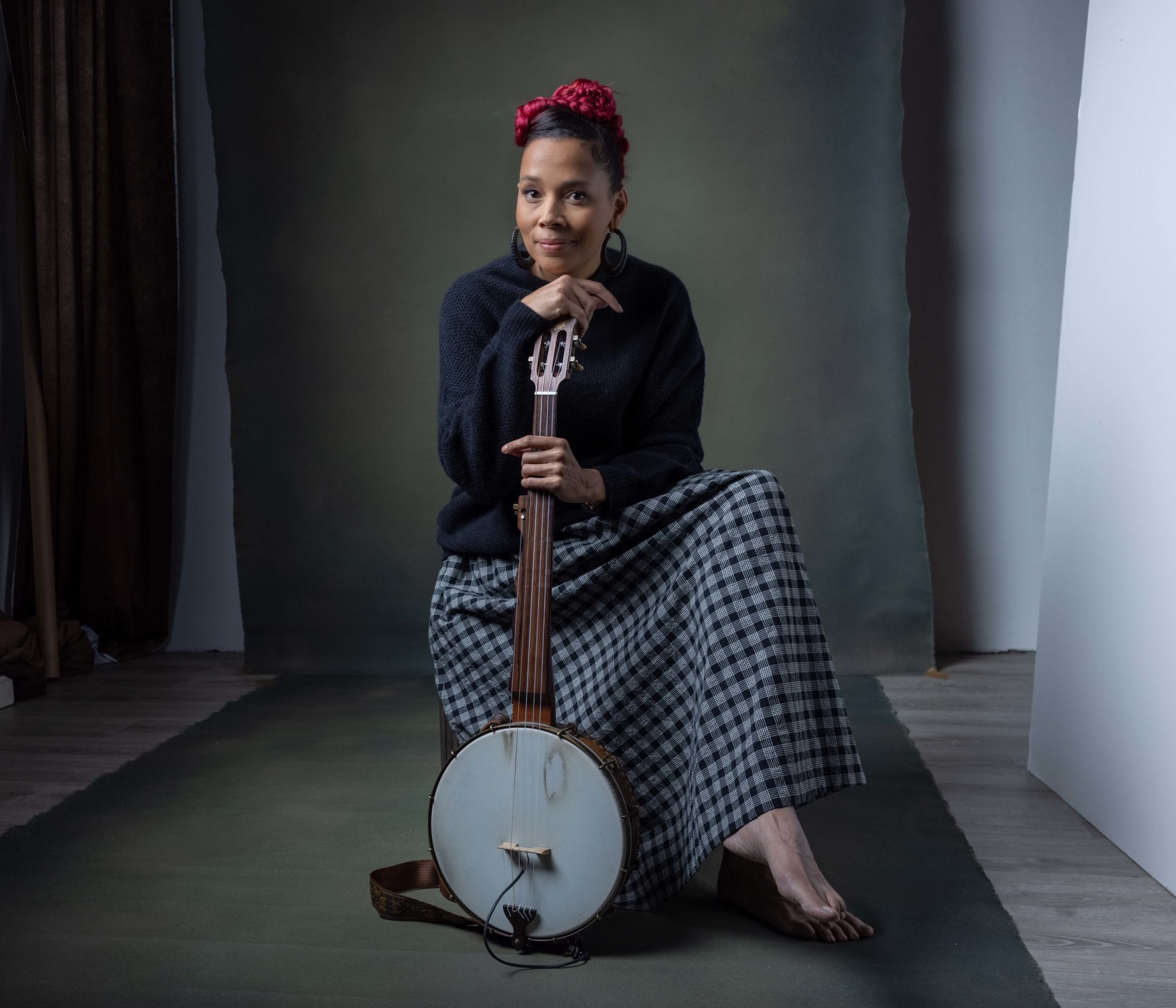
Credit: Karen Cox
Lately, Giddens has been slowly immersing herself in the Irish music scene. She moved here many years ago after she had two kids with her then-husband Michael Laffin, a music producer from Limerick. Wanting her family to have an “Irish experience”, she enrolled her children in Gaelscoil. Now as a mother to teenagers, her capacity for musical exploration is widening.
“I didn’t really get into the music scene in Ireland because I was cooking, cleaning and taking my kids to lessons,” she says. “But now that my kids are old enough, I can start diving in more. I’m not a big fan of just learning stuff, I need to have a personal connection with it. So now I’m starting to acquaint myself with more Irish musicians. I just went to Cormac Begley’s place in Kerry and that was amazing.”
“I’ve actually picked up the concertina,” she beams, showing me her prized Baritone. “I was playing just before this! I’m obsessed. I play it every day now, and it’s kind of my entryway into the Irish tradition. I’ve been connecting it to my own, and that’s always the next point. If you become a guest in somebody else’s tradition, you have to ask if you’re generating something positive rather than extractive.”
The album features a range of touchstones, with original songs sitting beside tracks from artists who’ve inspired Giddens. Standouts include the contemplative ‘Carolina’, fellow Carolinian Libba Cotten’s ‘Freight Train’ and civil rights anthem ‘Walk With Me’. Though these songs represent the past, they have just as much weight today. For many of us, it shines a light on history we may not know, but certainly should. But for Giddens, it’s personal.
Indeed, when I ask if she can sum up her life’s mission, she smiles knowingly, a sage ready to bestow wisdom.
“My mission goes back to the idea that we don’t have to do everything,” she reflects. “Sometimes, life leads you to the thing that you do. The banjo led me to the idea that history is not divorceable from the music we make. The banjo is not divorceable from the fact that it does not exist without the transatlantic slave trade.
“I take all of that and try to sit in that history, so that I can notate the same hardships for people today. It’s the larger systems we’re up against. That’s what we’re fighting, not individuals. Individuals obviously have a huge effect, but they are in service to a system that needs to be dismantled.
“That’s what music is for: to challenge and uplift. Billy Bragg once said that music can’t change the world, but music can change the people that change the world. I think he’s dead right. We cannot expect music itself to do anything, but we have to try to get it to the people, to the lawmakers who can do something that will make people’s lives better.”
• Hope Is The Thing With Feathers is out now.
RELATED


- Music
- 16 Oct 26
Album Review: Francis and Gareth, Eyes Bright And Low

- Music
- 09 Oct 26
Album Review: Sheryl Crow, Pick You Up
RELATED

- Music
- 25 Sep 26
Album Review: Julia Jacklin, The Gem

- Music
- 10 Jul 26
Album Review: Finn Wolfhard, Fire From The Hip

- Music
- 03 Jul 26
Album Review: Sienna Spiro, Visitor

- Music
- 05 Jun 26
Album Review: Wallis Bird, I Can See Your House From Here


- Music
- 17 Apr 26